
The heartland rocker on the origins of Farm Aid, standing up to record execs, and “Funny How Time Slips Away.”
By John Spong
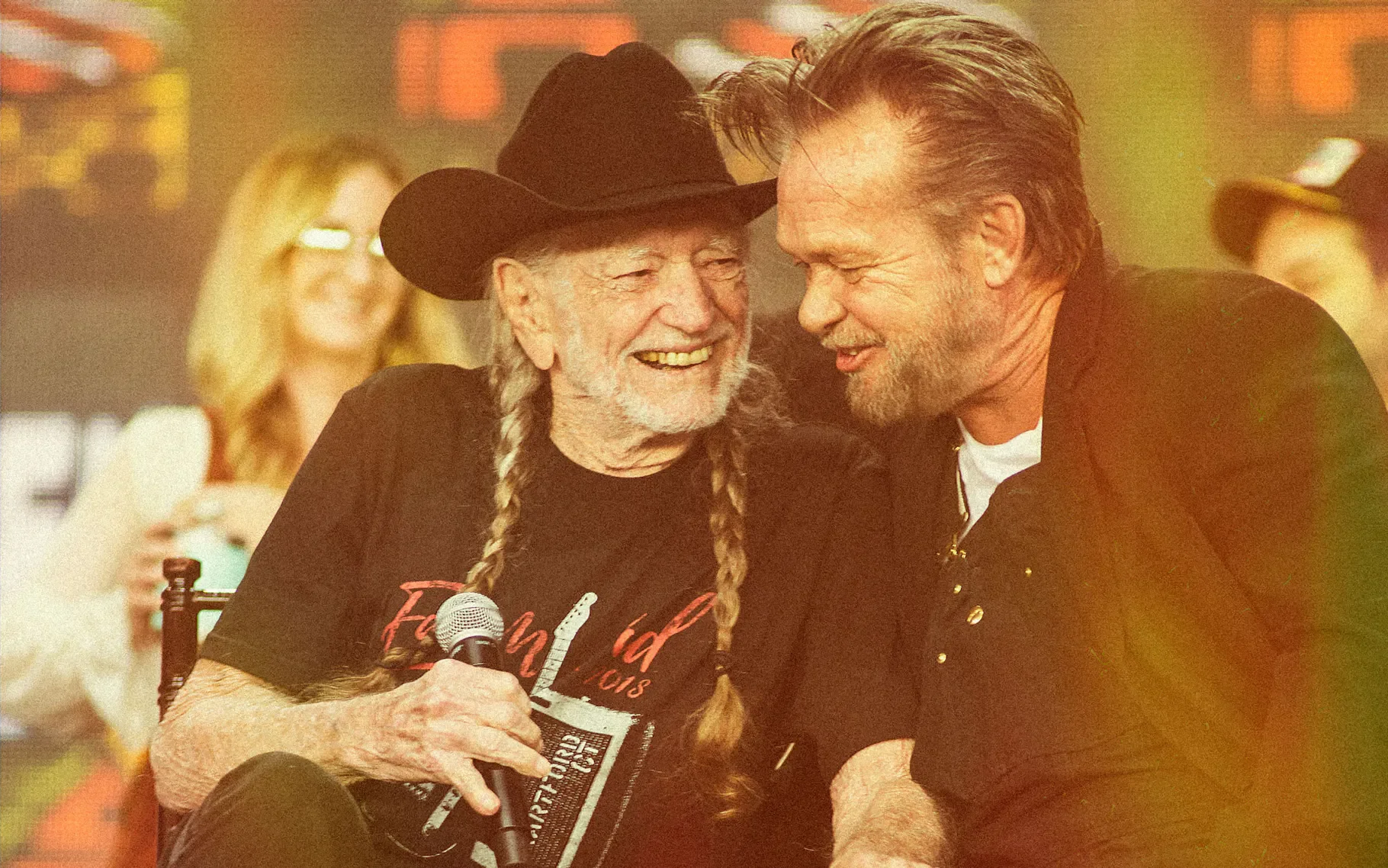
Willie Nelson and John Mellencamp speaking at a Farm Aid press conference on September 22, 2018. (Photo by Ebet Roberts / Getty Images.)
The first time John Mellencamp ever talked to Willie Nelson was in mid-August of 1985, when Willie called Mellencamp’s Bloomington, Indiana, home after finishing a round of golf at a nearby course. One of the guys Willie’d just played with had turned him on to Mellencamp’s then-two-week old album, Scarecrow, and its angry, anthemic title track protesting the ongoing American farm crisis, “Rain on the Scarecrow.” Willie was thinking about putting on a show to raise money for farmers and was looking for a cohost. Mellencamp was the first artist he called.
Despite the new record and his small-town Midwestern roots, Mellencamp was not a likely candidate. All-star benefits were becoming something of a trend, and Mellencamp, the iconoclast, had passed on all such invites. What’s more, Willie was talking about a fast turnaround; he wanted to schedule the concert the following month. Still, the cause was worthy, and the ask came from Willie. Mellencamp signed on, he was joined quickly by Neil Young, and the three opened up their Rolodexes to flesh out the bill. Five weeks later, on September 22, flanked by fellow legends like Johnny Cash, Bob Dylan, B. B. King, Tom Petty, and Bonnie Raitt, they played the first-ever Farm Aid, in Champaign, Illinois, raising more than $9 million.
Forty years on, Farm Aid and its three cofounders are still at it. But while fans may think of the nonprofit as an annual concert, it means a great deal more to the families it serves. Farm Aid has become a massive—and massively effective—community organizer, connecting farmers and farmworkers with legal and lobbying aid, educating on new legislation and agricultural methods, protesting industrialized farming, and providing a host of other services. All told, it has raised more than $80 million for those efforts, and Willie has famously signed every check.
Mellencamp details all that on this week’s One by Willie, but not before discussing the first Willie song he fell for as a kid, “Funny How Time Slips Away,” off Willie’s 1962 debut album, . . . and then I wrote. The song was one of Willie’s first contributions to the American Songbook and was a reliable hit for other artists for nearly fifteen years before Willie became a star, and it gets Mellencamp musing on the parallels between early Willie and early Dylan—and the way Mellencamp himself later followed Willie’s example in his own bitter battles with record-industry overlords.
One by Willie is produced by John Spong and PRX, in partnership with Texas Monthly. The PRX production team is Jocelyn Gonzales, Patrick Grant, Pedro Rafael Rosado, and project manager Edwin Ochoa. The Texas Monthly team is engineer Brian Standefer, producer Patrick Michels, and executive producer Megan Creydt, with graphic design by Emily Kimbro and Victoria Millner. And Dominic Welhouse provides invaluable research and editing help.
Transcript
John Spong (voice-over): Hey there, I’m John Spong, and this is One by Willie, a podcast in which I talk each week to one notable Willie Nelson fan, about one Willie song that they really love.
This week, we talk to Willie’s fellow Rock and Roll Hall of Fame member and Farm Aid cofounder John Mellencamp about one of the first Willie songs Mellencamp fell for as a kid growing up in Seymour, Indiana, “Funny How Time Slips Away.”
The song was, of course, one of Willie’s first contributions to the American Songbook, a reliable hit for other artists for nearly fifteen years before Willie finally became a star himself. And that gets Mellencamp thinking about the parallels between early Willie and early Bob Dylan . . . which in turn gets us into the parallels between Willie and Mellencamp himself—especially when it came to dealing with bad ideas from record executives, which in turn gets us into the unlikely origin story and ongoing significance of the nonprofit they started together in 1985, Farm Aid.
Now, if you’re one of those people like I used to be, who always thought Farm Aid was just a cool, once-a-year, all-star concert, you’re about to hear about the hugely important work they do for farmers all over the country—all year long—and why Mellencamp thinks Willie’s efforts for the American farmer deserve a Nobel Peace Prize. He makes a pretty good argument.
So let’s do it.
[Willie Nelson performs “Funny How Time Slips Away”]
John Spong: Well then, the place to start is what’s so cool about “Funny How Time Slips Away”?
John Mellencamp: What I’ve always admired about Nelson is his determination and his ability to keep moving forward, and keep not being deterred by naysayers, or “You can’t do that, you can’t do this.” But I’m sure you know this as well as anybody, but when Nelson first started out, nobody really wanted to sign him because of his voice, and that’s why he became primarily a songwriter. And this was one of his first hit records recorded by somebody else. And I was, first time I heard it, I was, I don’t know, maybe ten—ten or eleven?
John Spong: Huh? Was that Willie’s version or was it like that Joe Hinton R&B hit?
John Mellencamp: I don’t know. I just remember the song. I don’t remember who was doing it.
John Spong: Right, right. Well, so Hinton had the hit—if it was an R&B track, then that was Hinton. I don’t need to play that whole song for you but could I start it?
John Mellencamp: Sure.
[Joe Hinton performs “Funny How Time Slips Away”]
John Spong: Does that come through?
John Mellencamp: Yeah. That’s not the song I heard.
John Spong: Okay. Well then I’ll take you to Willie’s early version.
[Willie Nelson performs “Funny How Time Slips Away”]
John Mellencamp: That’s the song I heard.
John Spong: That’s it?
John Mellencamp: Yeah. I think it was on Liberty Records.
John Spong: Wow.
John Mellencamp: Yeah. That’s the version I remember. Yeah.
John Spong: What’s that do to you? When you hear it now?
John Mellencamp: It makes me realize what a wonderful, simple songwriter Nelson is.
John Spong: Yeah?
John Mellencamp: Yeah, yeah. And that he, you know, kind of overcame great odds to even be able to put his own voice on records, because he was the guy who was behind the scenes in the beginning, writing songs, because Nashville didn’t think his voice fit their sound, or whatever you want to call it. But in [a] Willie Nelson way, he proved them wrong. And that’s what I admire about Nelson.
John Spong: It was interesting that he spent a lot of years kind of doing what they said, trying to make it work, but then ultimately realized I got to do my thing. He was writing all those songs. Other people were having hits on him. He was making money. But yeah, you’re right. His recording career—
John Mellencamp: He didn’t have one.
John Spong: Nobody was buying those records.
John Mellencamp: Well, the reason they weren’t buying those records was because nobody was promoting them. They just viewed him as a songwriter. And his voice—almost like Dylan, his voice was so outside of the box for country music at the time, the same way that Dylan’s voice was outside the box for early pop-rock music. I mean, that’s the reason they formed Peter, Paul and Mary—was to sing Bob Dylan songs.
John Spong: Right.
John Mellencamp: Peter, Paul and Mary were really three folk singers in New York that Dylan’s manager put together to sing Bob’s songs. And so they both kind of found themselves, in a different time period, but early on in the sixties, of people saying, “Well, your voice can’t make it, but we sure like your songs!”
John Spong: “We’d like to make money off of them, so let’s find somebody palatable.”
John Mellencamp: Yeah. “Let’s find somebody that fits in the box that can sing these songs.”
John Spong: In the lyrics, one of the things that I love about that song, it’s so simple—it’s a conversation. It’s one side of a conversation, which I remember the first time I heard this, I thought that was kind of a unique way to present what was happening in a song. It’s just the one speaker’s thought. It’s “Well, hello there.” And then in the first verse, you don’t really know. It just seems like it’s two people catching up, but it’s a little presaging of something.
John Mellencamp: Well, he had a lot of songs that were very conversational, which is the word I think you’re looking for. The songs are very, his earlier songs are very conversational, like “Hello Walls.”
John Spong: For sure.
John Mellencamp: “Crazy.” All of those songs are very conversational, and I think that’s why people responded so well to ’em. Because they were conversations that everyone had had, could relate to, and to this day are still having.
John Spong: Right. In the second verse, you figure out that it’s an old love, and he’s heartbroken. But then I’ve got a question about the third verse. When he says, “I guess I’ll see you around. Don’t know when, never know when you’ll be back in town. But remember when I tell you, in time you’re going to pay—and it’s surprising how time slips away.” What’s going on there?
John Mellencamp: Well, I think that he is, again, talking very simply about people’s emotions and how people feel about a breakup. And he says it very simply, very easily, very understandably and very—the most important—he’s saying it in a very relatable way for anybody, which is anybody that’s had a relationship, which is everybody.
John Spong: An editor once asked me to write something about this song, and he kinda got on me. He was like, “But wait, you didn’t mention the threat of physical violence at the end of the song.” And I said, “What?” And he said, “No,” he says, “‘Remember when I tell you, in time you’re going to pay?’” And I was like, “You’re not from here at all.” I mean . . .
John Mellencamp: Yeah, I never even, something like that never even crossed my mind.
John Spong: Exactly.
John Mellencamp: Meaning, “You’re going to pay.” You’re going to find somebody that’s going to do you the way you did me.
John Spong: Exactly.
John Mellencamp: So I would say the guy that said that was, like, way out of bounds. Is this guy in jail now?
John Spong: Yeah. I spent enough of my youth, well, lovelorn to realize that, yeah, sometimes the only hope you have is that she’ll end up hurting eventually, too. And that doesn’t even happen that often. But yeah, I don’t think that was a threat.
Is there a sense of why this song, maybe musically, would have lent itself so well to R&B covers? Because Al Green is the way a lot of people come to it first, that Joe Hinton that I mentioned a second ago.
[Blank performs Blank]
John Spong: That was a hit in the sixties, they all hit before Willie. How does this song, why does it go so well into that R&B soul setting that I know you grew up on?
John Mellencamp: I think that any song that is a good song can be played in any fashion. It doesn’t have to be R&B. I mean, you could do this song punk, and it would still be good. Because the song is good. If the song is good, the f—ing song is good, and I don’t care what fashion you play it in, what style it is. I mean, there’s been hundreds of songs. I mean, if you think back on Sinatra covering Beatles songs, it would be like, “What?” [Singing] “Yesterday . . .” you know? Frank Sinatra singing “Yesterday,” it’s not the same. But he didn’t try to do it in a rock fashion. He tried to do it as a traditional ballad. So a good song’s a good song.
[Willie Nelson performs “Funny How Time Slips Away”]
John Spong: When you’re growing up in Seymour, so you hear that when you’re eleven, rock and roll and R&B are something you get into, from what I’ve read, as you are coming into your teen years, was Willie somebody that kids listened to in Seymour? Was there an awareness of him then? I guess his career hadn’t really taken off yet, so maybe not.
John Mellencamp: My parents are only twenty years older than me, and they were kids when they had me. And so I was inundated with all kinds of music. They kind of tuned out with music, my parents did, when the Rolling Stones and all that kind of stuff started happening from England. But up until then, I grew up listening to Woody Guthrie, to Hank Williams, to Johnny Mathis. All kind of stuff was playing in my house. And like I said, my parents were kids, so there was a lot of music.
John Spong: Yeah. I’ve read that Odetta mattered a lot in your household.
John Mellencamp: Yeah.
John Spong: Yeah. Do you have favorite Willie albums? How did your evolution as a fan of his go before you ended up getting to know him?
John Mellencamp: I think he made a record in 1970-something, that I can’t remember the name of, but it was a double album. I remember that. And I think it had “Angel Flying Too Close to the Ground.”
John Spong: Oh, yeah.
John Mellencamp: It might’ve been early eighties or something, and I had that album. And my best friend who was, he was a school teacher of mine. He’s about six years older than me. He loved Willie. And so really, he’s the guy that turned me on to Willie Nelson.
John Spong: I think that album is Greatest Hits (and Some That Will Be), and so it’s stuff from the past, but it’s also some new stuff he was introducing, including “Angel.”
John Mellencamp: Yeah, maybe. I don’t know. I’d have to get in my album collection to remember the name of it.
John Spong: It’s one of the things that I had thought about, and you were touching on it a second ago. ‘Cause that is, that’s once Willie, the world has caught up to Willie. That he’s even got a greatest hits album is something that was unthinkable just seven or eight years before.
John Mellencamp: Oh yeah, yeah, yeah. Nobody in Nashville believed in anything except his songwriting. They believed that he was a good songwriter, but, this guy’s voice is so obtuse compared to what everybody else sounds like.
And that’s the problem with music and always has been, is that people are very narrow-minded about musicians and songwriters. If they don’t really fit in with the time or the day, what’s happening now, it’s very easy. What’s the easiest thing in the world? What answer are you going to get when you ask anybody anything? Generally the answer’s going to be no.
John Spong: Right.
John Mellencamp: Because it’s simple that way. If you say no, then you have no responsibility,
John Spong: No risk, no responsibility.
John Mellencamp: That’s right. So if you say yes, then all of a sudden, “Well, you’re the one that signed Willie Nelson, and he’s not happening.” And all of a sudden you’re on the hook. So nobody wants to, none of these business people want to ever, even to this day, want to be responsible for any artist at all. Because they’re taking care of themselves.
John Spong: You mentioned that first Liberty album, that’s just great. So when Red Headed Stranger hits in ’75, and Willie is becoming one of the biggest artists and the biggest-selling artist in country, Liberty took his first album and two songs off his second album, repackaged it as a “best of” and got it out in the market, because it’s time to finally make some money on this music we didn’t understand yet.
John Mellencamp: Oh, yeah. I mean, that doesn’t surprise me one bit. I mean, I’ve seen record companies and the music business, yeah. I mean, that’s why they call it the business. It’s business.
John Spong: And it made me wonder if there’s a parallel of sorts in his career and yours, because like I said, he spent a decade kind of doing what the label told him, and it didn’t work. You had a lot of ideas foisted upon you when you were coming up. I think you got better, quicker, at telling them to piss off. But when I think about—
John Mellencamp: Well, you know why? Because I had people to look at, like him and like other people, to say, “Hey, f— you. I’m doing it this way.” When I made my first record, I didn’t even know that they had changed my name.
John Spong: Oh?!
John Mellencamp: I walked in, I walked in and saw the album cover, and there was that name on there, and I thought, “I don’t want that name.” They said, “Well, you gotta take that name, or you can go back to Indiana.” So, it’s pretty easy for somebody who’s been in the music business to pull the wool over a 21-year-old guy’s eyes. Pretty easy.
John Spong: When I think of Red Headed Stranger, when Willie hits, and I think of Lonesome Jubilee, which is the first record that “Cougar” doesn’t appear on, that word—they’re like declarations of independence to me. You also bring in the accordion and the fiddle. I remember being a college kid, hearing that record for the first time and thinking, “What in the world is this? In rock and roll?” And then listening again and again and again, and never stopping. Those two records are declarations of independence.
[Blank performs “Blank”]
John Mellencamp: Well, I was trying to make my steps—baby steps. So it was Johnny Cougar, John Cougar, John Cougar Mellencamp. So, trying to make baby steps. Because my ambitions were not very high when I started out. I just wanted to make a record. I figured if I made a record, I thought I, I was done. I’ll make a record. And then I had the opportunity to make two records, so I did make my second record. And now I’ve made something like 36 albums.
So, I could have never imagined, nor could I have dreamed or even thought about being 72 years old and still doing this. It just wasn’t in my consciousness. And I don’t think anybody my age, or anybody that starts out at 22, could even envision doing this as long as I have, or as long as Willie has, or a lot of guys. A lot of guys. But most people that I started out with, they’re all gone now. They’re gone. It’s just a few of us left, in my generation.
[Willie Nelson performs “Funny How Time Slips Away”]
John Spong: Let’s go to Farm Aid. I mean, one of the reasons, maybe the primary reason, that people associate you two closely is because you founded Farm Aid together, you’re still doing it together. Can you talk about that origin story?
John Mellencamp: You mean how did this happen?
John Spong: Yeah.
John Mellencamp: Well, as you know, Willie has had a lot of ups and downs in his career. And he was here in Bloomington, where I live, and was playing golf with a couple guys that I knew, and he just casually said to them, “You know, Bob Dylan mentioned that we should do something for the farmers, and I think it’s a good idea.” And one of the guys had heard my new record, which was a record called Scarecrow, and he said, “Well, you know who John Mellencamp is?” He goes, “Yeah, not really. But kinda, I guess.” And my friend said that I had just made a record about the small family farm, which was kind of true, but kind of not true. But it did have a song called “Rain on the Scarecrow,” that was about the farm crisis.
So Willie, being the way he is, he immediately…they got done playing golf, and he got me on the phone and he said, “Hey, this is Willie Nelson. Would you like to help me put together Farm Aid?” Now, you have to remember [that] at the time, there were all kinds of charity things going on. I remember saying “No” to Coca-Cola for Save the Statue of Liberty. And I thought, “F— you. I’m not doing that. You’re just promoting your product, and the Statue of Liberty’s not going any place.”
So I got quite a few calls back then. And I said “No” to quite a few things that were very popular. ‘Cause I just never did like to fall in line with what everybody else was doing. But Nelson came with a kind of an original idea. But I can tell you that Willie, me, nor Neil had any idea that forty years later we would still be doing this. We were naive enough—and Nelson was about fifty, I guess—we were all naive enough to think that, “Well, we’ll do this concert and there’ll be a lot of people, and the people who make the laws will see that this needed to be changed.” And we were going to change the world with one concert.
John Spong: Right.
John Mellencamp: But it didn’t work that way. I remember going to speak to a Senate subcommittee, and it was Nelson and I, and we sat there in the chamber in front of the Senate committee, and there were a few people there. And so they asked us a couple questions, and Willie answered a couple, and I answered a couple.
And then one of these guys, one of these senators goes, “Where’s your guys’ guitars?” Yeah! And either I said, or Willie said, I can’t remember, but somebody said, “We’re not here about guitars.” And he goes, “You’re not going to play?” We both shook our heads, “No, we’re not playing.” He got up and left. And I looked at Nelson, and I went, “You know what? We should get the f— out of here.” And so, shortly thereafter, we left.
And it was at a senate subcommittee. I don’t know if Willie would remember it—I’m sure he would. I sure did, ’cause I made a special trip to Washington D.C. to have some guy insult me about what Farm Aid was about—”Where’s your guys’ guitars?” What? We’re not playing.
John Spong: A little context for folks who weren’t around and maybe don’t remember the history, the farm crisis in the mid-eighties was an absolute tragedy. And so, a few weeks ago, I taped one of these with Paul Begala. You know Begala, by chance? He’s a political consultant. Nowadays, he’s on TV at CNN, but he also consults, but he and James Carville were kind of the architects of Bill Clinton’s two presidential runs.
John Spong: And so Begala wanted to talk about the song “Heartland,” which Dylan and Willie wrote together, which is about the plight of the farmer. It’s from ’93, but it’s going back to this stuff. And I asked Begala, I said, “Wait, you were around in the eighties. You were doing political work. You remember the farm crisis. You know what this song’s about.” And Begala said that in ‘88, around this time, around this time that this senator is taking things so lightly with you guys, Begala was working on Dick Gephardt’s presidential campaign. He visited every county in Iowa. Begala said that when they were in Iowa, farmers whose loans were getting called in, were going into bank lobbies and killing themselves.
John Mellencamp: Yes.
John Spong: Begala had to pause and compose himself at that memory. And so that’s Iowa. In “Rain on the Scarecrow,” the 97 crosses, if I read right, “the 97 crosses in the courthouse yard,” that’s in Iowa. “Rain on the Scarecrow,” which you kind of humbly didn’t go into too far just now, is a true story.
John Mellencamp: Yeah, it is.
John Spong: Those were awful times. That’s what you guys were trying to address.
John Mellencamp: Yeah, it was. But like I said, we were so naive that we thought, “Hey, look, this is f—ed up, and you guys need to fix it, and I’m sure you’ll do what’s right.” And we were idealistic and young, but it just didn’t work out that way. And to this day, they’re still using the American farmer as a pinball machine against other nations and trades and embargoes and all kinds of stuff.
[John Mellencamp performs “Rain on the Scarecrow”]
John Spong: To get to that first Farm Aid, the timeframe, which is another pretty amazing achievement, Live Aid was the thirteenth of July, [and] Dylan made that comment about “Maybe we could help the farmer out some too.” Scarecrow came out two weeks later. Willie called two weeks after that, and you had five weeks to put together this massive, what, twelve-hour, fourteen-hour concert benefit, there in Champaign, Illinois?
John Mellencamp: It seemed, we had no problem getting artists. We had artists lined up that wanted to do it. I mean, we had everybody from Van Halen to you name it, wanted to play at Farm Aid.
John Spong: John Fogerty made his first appearance since Creedence broke up.
John Mellencamp: I know. He stayed at my house.
John Spong: Of course he did.
John Mellencamp: He stayed at my house, and he played with my band.
John Spong: Wow.
John Mellencamp: Yeah.
John Spong: Wow. When you talked about the Coca-Cola Statue of Liberty benefit, there was an element—that was just something that happened in the eighties. There were all these all-star benefits. It starts with Live Aid, and then there was a Canadian heavy-metal band benefit, a couple of rap ones. The Sun City one was pretty cool, but to be, I don’t want to like a jerk, but there was an element of fashion. And as you said, self-promotion to a lot of that and corporate promotion to a lot of that.
John Mellencamp: Well, that’s why I said no to a lot of those things, because my manager at the time was also managing another successful band of the moment, and they were playing there, and I saw fighting about who was going to be on TV and who wasn’t. I was just like, “I’m out. I’m out of this.” I never, even, when Willie and I and Neil put together Farm Aid, I don’t ever remember having a conversation with anybody about TV or TV time or what time—none of that existed.
John Spong: Also though, all those other benefits were one-offs. Farm Aid persists. Farm Aid is about to happen in September. The problem persists. The problem has evolved, it’s a different problem now. But Farm Aid has made a tremendous difference for over forty years now, or almost forty years. Can you talk about some of those—and you’re on the board. Can you talk about some of those achievements, some of what it’s done?
John Mellencamp: Well, I don’t really want to get into bragging about, or saying that, here’s what I’ll say.
John Spong: Okay.
John Mellencamp: I’ll say that Willie deserves a Nobel Peace Prize for Farm Aid. It is the longest running charity of its kind in the world, in the f—ing world. And yes, there has been a lot of changes, a lot of reinventing what Farm Aid’s about, but it all stems from Willie. Neil and I just carry water. We just carry water.
John Spong: If you’re a fan of you guys and of the music, like I am—so I’ve been to the Farm Aid website a few times in the past, and I go there to see when the date is and what the lineup’s gonna be. I went yesterday, looking to get a sense of what Farm Aid means to people—it is so much more than that concert. If you go to the website—and you can see it there in front of you, I’ve pulled it up: Under “Our Work,” it says, “Are you a farmer?”
You click on that to see the resources they provide. There’s a hotline if you need help. And that hotline is the same 1-800-FARM-AID number y’all set up for donations during that first concert. I watched that on TV; I remember it. Then you go down: “Farmer’s Aid Resource Guides: Connect with an organization.” This floored me. You go here, scroll down, there’s these filters to help you find the kind of help you need. This is community organization on a massive scale for people. “What best describes you? Farmer? Farmworker? What state? What kind of farm: vegetable, livestock, you know, type of results.” It’s amazing.
John Mellencamp: And most of that credit needs to go to a woman named Carolyn Mugar.
John Spong: Yeah.
John Mellencamp: Who has run Farm Aid for—since the beginning. And all of this hard work, and this detailed work, is basically okayed by the board, and then Carolyn would do it. So I’d like to go, “Yeah, that was me.” No, it was Carolyn.
John Spong: Carolyn’s the one with her sleeves up, and thank goodness. Thank goodness you’re getting attention to it. But, I mean, if somebody’s trying to figure out how to leave their farm to their kids, there’s legal assistance that they can find here at the touch of a finger.
John Mellencamp: Find out, yeah, that’s right.
John Spong: If they’re thinking about switching to organic or regenerative farming, that’s a touch of a finger here. If there—there’s a special thing, if you’re a war-veteran farmer, there’s special organizations set up to help those people, you guys are connecting them.
John Mellencamp: If you’re a Black farmer in the South.
John Spong: Yeah.
John Mellencamp: There’s all kinds of help, ways, if you get online to find out what Farm Aid can do for you, and what you can do for Farm Aid.
John Spong: Yeah. When y’all appeared in front of the Senate subcommittee, that bill didn’t pass. But not too long afterwards, there was a Farm Credit Bill that did, I think, in ’88.
John Mellencamp: Mm-hmm.
John Spong: And it was to help farmers whose loans were insured by the Farm Housing Administration Department, or whatever; I don’t know that stuff as well, but when that was passed, Farm Aid sent out a letter to 90,000 borrowers, under Willie’s signature, explaining to them how they had just been helped, how their loans could be protected, the steps they had to take to follow through on that. That’s real.
John Mellencamp: That’s big.
John Spong: That’s big. That’s big.
John Mellencamp: That’s what I said. I said, that’s why Willie needs, he needs to get that award.
John Spong: But then the thing with it is there’s great music at it. It’s also saying “thanks” to farmers, a lot of the concerts have been in smaller towns, not the big stadiums or whatever, and you’re taking it to where the farmers are, so they can go. They’re proud folks. You’re not giving ’em a charity. You’re throwing ’em a party.
John Mellencamp: Yeah, that’s right. That’s a good way of putting it.
[Willie Nelson performs “On the Road Again” at Farm Aid]
John Spong: What’s Willie Nelson like at a board meeting?
John Mellencamp: Funny. He always says funny stuff.
John Mellencamp: You know, the thing about Willie, he knows when to talk and when not to. He’s a pretty smart guy. He knows that you can learn more by listening than you can by talking.
John Spong: You’ve also talked about how after the first press conference ever for Farm Aid, y’all went back to the bus together?
John Mellencamp: No. I went back to the bus, and he didn’t show up. And I had to wait for him for about an hour.
John Spong: What was he doing?
John Mellencamp: Well, he walked back in, and I go, I go, “G—damnit, where the hell you been?” He goes, “Doing what you need to do.” And I go, “What’s that?” And he goes, “Pay more attention to your fans.” ’Cause I got offstage and just went back to the bus and people wanted autographs and stuff, and I don’t go in much for that kind of stuff, so I just went back to my—went back and waited for him. I thought he’d sign a couple autographs and come on, but hell, he spent an hour out there signing people’s autograph and talking to them.
He’s a good guy. Deep down inside him, underneath that laughter and that smile, there’s a thinking individual that’s a good guy. And he can also be a rough guy. And that’s what I admire about him. He’s hardheaded and softhearted. That’s Willie Nelson.
John Spong: I love it.
John Mellencamp: Hardheaded—hardheaded and softhearted. That’s him.
John Spong: That’s a good line.
John Mellencamp: Hmm. I have to use it in a song, I guess.
John Spong: Back to work.
John Mellencamp: Yep.
[Willie Nelson performs “Funny How Time Slips Away”]
John Spong (voice-over): All right, Willie fans. That was John Mellencamp, talking about “Funny How Time Slips Away.” A huge thanks to him for coming on the show, and a big thanks to you for tuning in. If you dig the show, please subscribe, maybe tell a couple friends, and visit our page wherever you get your podcasts, and give us some stars or type in some comments. Every little bit of that helps the show more than you know.
Please follow us on Instagram at @onebywillie—all one word—find us on Bluesky, and join our ever-expanding Willie conversation at the One by Willie group on Facebook.
I’m your host, John Spong. Thanks for listening.