
Martie Maguire and Emily Strayer on the High-Energy, Happy Picking in Willie Nelson’s “Bloody Mary Morning”
The founding members of The Chicks recall blasting his songs in the family station wagon as kids, plus one fan’s very weird Willie tattoo.
By John Spong
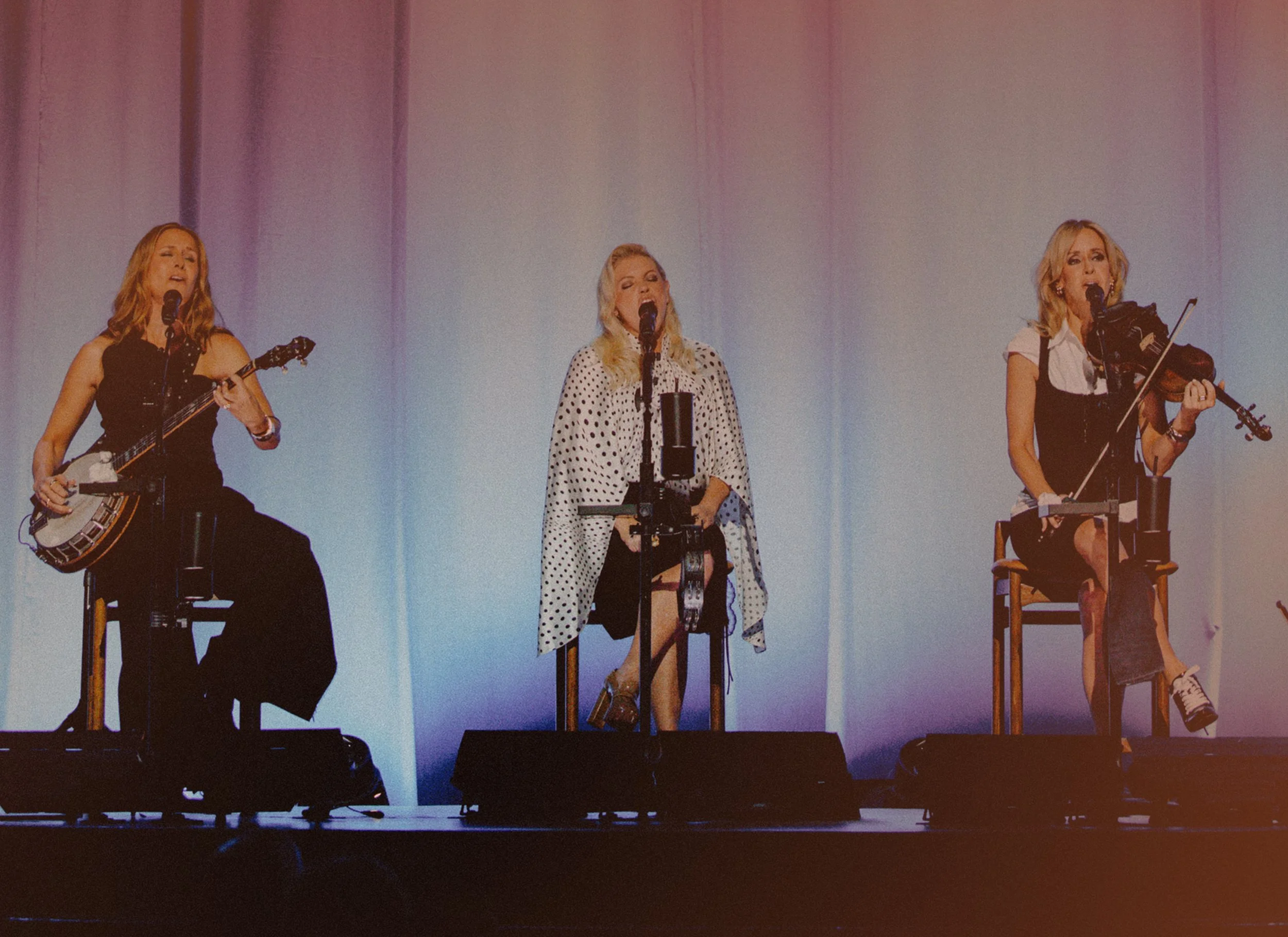
The Chicks at Fox Theatre in Detroit, September 30, 2026. (Photo by Thomas Falcone / Courtesy of The Chicks.)
Martie Maguire and Emily Strayer, the hot-picking fiddle and banjo players in American musical-and-cultural icons The Chicks, can’t recall the first time they ever heard Willie Nelson, but they remember clearly those early moments when his music made a permanent impression. Their maternal grandparents, known to the sisters as Baba and Gaggy, raised their mom on a farm in Pennsylvania, and Martie and Emily used to watch them slow dance to Willie records whenever the family visited. “I feel like Willie was central to their love affair for each other,” says Martie.
Fast-forward to the mid-70s, when the sisters’ dad, an English teacher from Stamford, Connecticut, took a job in Texas and moved his young family to Addison, just north of Dallas. “He wanted to be a cowboy more than anything in the whole world,” says Emily. “And so, this kid from Stamford, who loved music…we’d be in the backseat of the old station wagons with the paneling on the side, and it was just Willie blasting all the time. To me, it was the soundtrack to what Texas was.”
This week on One by Willie, Martie and Emily talk about one of the tracks their dad played on repeat, which would grow to become the Willie song they most love to pick together now that they are rock stars themselves, “Bloody Mary Morning.”
The song was, of course, a key track on Willie’s revolutionary 1973 LP Phases and Stages, a concept album depicting the breakup of a marriage from the wife’s point of view, on Side 1, and the husband’s, on Side 2, and we walk together through some of Phases’s songs, paying particular attention to Willie’s telling of the woman’s side of the story and just how true it rings. But they also talk about how much fun they have playing “Bloody Mary Morning,” before recounting memories of time on Willie’s bus when they toured together back in 2000; giving a reverent look at one of Willie’s oldest friends and most frequent collaborators, who happens also to be one of Martie’s earliest heroes, legendary fiddle player Johnny Gimble; and describing the surreal scene backstage at Willie’s star-studded 90th birthday show at the Hollywood Bowl in 2003—where they played, of course, “Bloody Mary Morning.”
One by Willie is produced by John Spong and PRX, in partnership with Texas Monthly. The PRX production team is Jocelyn Gonzales, Patrick Grant, Pedro Rafael Rosado, and project manager Edwin Ochoa, with graphic design by Joanna Holden and Modular, ink. The Texas Monthly team is engineer Brian Standefer, and executive producers Megan Creydt and Melissa Reese. And Dominic Welhouse provides invaluable research and editing help.
John Spong: (voiceover):
Hey there, I’m John Spong. And this is One by Willie, a podcast in which I talk each week to one notable Willie Nelson fan about one Willie song that they really love.
This week, we close out Season 7 with Martie Maguire and Emily Strayer, founding members of 13-time Grammy-winners and American musical-and-cultural icons The Chicks, who are going to let loose on their very favorite Willie song to get together and play, “Bloody Mary Morning.” It’s a song that their dad played constantly, in the house and the station wagon, when they first moved to Texas in the early 70s, and it shaped their earliest understanding of this place where they grew up.
But it’s also, of course, a key track on Willie’s revolutionary 1973 album Phases and Stages, a concept album examining the end of a marriage from the point of view of a wife, on Side 1, and a husband, on Side 2. And so we walk through the album together, paying particular attention to Willie’s depiction of the woman’s side of the story and just how true it rings.
And then they’ll also get into what a joy “Bloody Mary Morning” is to play live, before taking a look at one of Willie’s closest friends and most important collaborators, who happens also to be one of Martie’s childhood idols, fiddle player Johnny Gimble; and the surreal, star-studded scene backstage at Willie’s 90th birthday shows at the Hollywood Bowl back in 2023.
So let’s do it.
[Willie Nelson performs “Bloody Mary Morning”]
John Spong: Where we always start is, and it's always a stupid question…and it's a stupid question again this time. Martie and Emily, what's so cool about “Bloody Mary Morning?”
Emily Strayer: It has banjo on it. That's what's so cool about it.
John Spong: I knew that was the answer!
Emily Strayer: Every time we play with Willie, on whatever we're doing, we always pick that song. And it just lends itself to our instrumentation, and it's fun, and it's accurate to the life of a musician; you got to get up and have your Bloody Mary in the morning sometimes.
Martie Maguire: Hair of the dog.
Emily Strayer: Hair of the dog, a little bit. And so, you know, it's just a fun song.
John Spong: Yeah. Yeah. And it's cool because there's not a lot of banjo in Willie. I think that's probably the first record that had any.
Emily Strayer: Yeah.
John Spong: And it's got some fiddle. I can't hear the fiddle on that version.
Martie Maguire: It's way too turned-down in the mix.
John Spong: Way too turned down.
Emily Strayer: If you do say so yourself.
John Spong: I agree completely. I agree completely. Well, if it's cool then, will you listen to it with me?
Martie Maguire: Yeah.
John Spong: All right. Dynamite.
[Willie Nelson performs “Bloody Mary Morning”]
John Spong:
Can you hear it?
Emily Strayer: Yeah.
Emily Strayer: It's the best.
John Spong: Isn't that the best?
Emily Strayer: It's the best. And here we are in LA.
Martie Maguire: It's such a fun track. I could just feel the spontaneous energy in the studio that must have been happening. There's not a space that isn't filled. As instrumentalists, like Emily and I are, we're always wanting to fill every space when the singer isn't singing. It's, like, “OK, I think he stopped singing, I'm going to do a little something.” And this song is so quintessential…
Emily Strayer: Yeah, picking.
Martie Maguire: …filling the space with happy picking. I love it.
John Spong: It's relentless. It's relentless. It's like under three minutes and there's, like, three guitar solos. And they're short, and they're interacting, and they're just pounding each other. It's wonderful.
Emily Strayer: Yeah, but it's so effortless at the same time. It's just so relaxed in its approach to…just as Willie is. But yeah, just that being from Texas, and either having to go to Nashville or go to LA to work all the time, or New York or whatever, it's like getting back to Texas is always great. It's a priority. I feel like we mimic that in our career, as well. Willie has been a beacon for that. Of like, you can stay in Texas and still work the circuit.
John Spong: Yeah. Yeah. Which is the thing, ‘cause when he did this, that was the thought. Nashville hadn't worked, and so he split and came home, and it's like, “Maybe something’ll happen, but if it doesn't, I'll play Texas, Oklahoma, New Mexico from now until doomsday and everything’ll go great.”
Emily Strayer: Yeah.
Martie Maguire: This song, I mean, this recording sounds like [a] Texas recording, if you can differentiate. It's not slick. It's like a jam. You know what I mean?
John Spong: Yeah.
Martie Maguire: It's like musicians jamming, but it's still perfection. There aren’t any mistakes or out-of-tune notes, but it feels like Texas recording. But where was it recorded?
John Spong: It was in Muscle Shoals. And it's cool, it was the second record for Atlantic. The first one was Shotgun Willie, and so that's when he leaves Nashville and RCA. And they record in New York, and he gets to record with his own band, which was the height of creative control as of '72 or whatever, right? And so then it's time for his next record with Atlantic–and he changes everything for country music with Shotgun Willie; it's so funky, and it's so laid-back, and all that–so the next album, they're like, "Oh, well now we'll go to Muscle Shoals and play with session guys. How do you feel about that?" Willie's like, "I trust you. Let's do it." And so this is the Swampers. It's David Hood on bass, and Barry Beckett on piano.
Emily Strayer: Oh, wow.
John Spong: They bring Johnny Gimble in from Texas to play the fiddle, although he's not on this song. It was a different fiddle player. But it was like, let's get together with some like-minded, free spirits who are really good at what they do and see what comes out of it.
Emily Strayer: That's cool. That's cool. Well, our dad, who was pretty much our biggest influence of why we listened to country music, and why we listened to Willie, he is from Stamford, Connecticut, and my mom is from Hanover, Pennsylvania. And so we came to Texas because my dad got a teaching job there. But my dad was always playing Willie Nelson. He was always listening to the Grand Ole Opry. He wanted to be a cowboy more than anything in the whole world. And so this kid from Stamford who loved music, we'd be in the backseat of the old station wagons with the paneling on the side, and it was just Willie blasting all the time. So when, I guess, Martie, you were five and I was three? When we moved to Texas? And to me, it was the soundtrack of what Texas was. As a kid, we're going to this new place, and we're moving across the country to become Texans, and it was just Willie all the time. It was Willie and Dolly.
Martie Maguire: Jerry Jeff Walker.
Emily Strayer: And Jerry Jeff Walker.
Martie Maguire: Yeah. And Texas Playboys. We've got all their records. I got the record collection. Emily's mad. He gave me the entire record collection. I mean, that's where I first heard fiddle, was the Texas Playboys.
John Spong: Oh, wow.
Martie Maguire: He would morph into, right Emmy? I mean, he would don this persona of a Texan, well before he had the right to be having an accent and wearing overalls to the bluegrass festival.
Emily Strayer: Yeah, he was, again, doesn't have a country accent, but he would pull the RV into these bluegrass festivals and [drawls] “all of a sudden he starts talking like this.” And I was like, "Who are you?" The first house he bought was near, what's the ranch on Dallas?
John Spong: Oh, Southfork.
Emily Strayer: Southfork. We literally lived like two blocks away from Southfork. That was his idea.
Martie Maguire: Looked nothing like Southfork Ranch.
Emily Strayer: No, no. It was a little ranchette. It was super ugly, but he wanted that lifestyle. And so it's just funny that Willie was so ingrained in us from the time we were so little.
[Willie Nelson performs “Bloody Mary Morning”]
John Spong: When we were talking about what y'all were going to discuss, Emily, you had said that Phases and Stages, the album itself, is probably your very favorite Willie album. Do you remember when you became familiar with the album?
Emily Strayer: It's blurry as far as when I was introduced to Phases and Stages, but I do know Charlie would play it constantly, as well. So, I was just like…it was always around at that part of my life too. I was like, "Oh yeah, yeah, yeah. I remember this. I remember that." But I don't know. I just feel like as a concept record, I just thought that was so cool, that it was a full-encapsulation storyline. And to return to that “Phases and Stages” song and…
John Spong: “The Theme,” yeah.
Emily Strayer: …yeah, the theme song. I just felt like it was so brilliant, and so different, and opened up how you can make albums. And not just being singles and separate songs.
John Spong: Well, it's interesting because your fans will know, but that's Charlie Robison, who was your first husband. And that's how we know each other, because he was a buddy of mine way back when. And Charlie's brother Bruce is the one that let me know, like, I had been listening to songs off Phases and Stages, and I didn't know it was a concept album, and Bruce was one that said, "My dude, you know, [listen] a little more closely.”
[Willie Nelson performs “Phases and Stages (Theme)”]
John Spong: But for folks who maybe aren't aware of that, what's the story on Phases and Stages? What's the catch there?
Emily Strayer: To me, it's just about love lost, and falling out of love, and a woman walking away. I mean, for us having gone through, how many divorces collectively have we had, Martie? It just hits home. But the lines like “ironing and crying, crying and ironing” and things like that are...and almost like, he's like, "Wait, you're unhappy? She used to love to iron my shirts." It's like, "Dude."
John Spong: Yeah.
Emily Strayer: No, it's a little bit of a, I don't know, an epiphany for women being able to walk away.
John Spong: Yeah.
Emily Strayer: That's what I take out of it, at least.
John Spong: And that's the thing, because the first side is the woman's side, and it's a divorce and a marriage dissolving from her point of view, and then side two is the dude's point of view. And I've always wanted to ask a non-dude, but when you said “washing and ironing,” that's the first song on the record. That's her realizing it's not working anymore. Does Willie get the voice and the experience of a woman right?
[Willie Nelson performs “Washing the Dishes”]
Emily Strayer: I think so for that time period, just the fact that he is understanding that that's a problem.
John Spong: Yeah.
Emily Strayer: These days, everyone's a little bit more cognizant of women and their plight. But for that time period, I think it's very observant of a woman's place in the home and in a relationship and everything.
John Spong: Well, and I love too that, because it starts with “Washing and Ironing,” and that's the song about the realization. But then it's “Walkin',” and I'm walking away…
[Willie Nelson performs “Walkin’”]
John Spong: …"Crawling ain't no good at all." And she's got this integrity, and she's leaving on her own. You get to a song like “Pretend I Never Happened”...
[Willie Nelson performs “Pretend I Never Happened”]
John Spong: …I remember that was the first song I thought, this sounds more like a woman's point of view, in part because it sounds like something you would say sarcastically to some asshole husband who had been criticizing you, and that's throwing it back in his face a little bit. I don't know. It's one of the things that kills me about the record, and there's such a depth to her side of the record that I feel like there kinda isn't on the dude's side.
Emily Strayer: Probably, probably. But I would think it'd be very difficult to be married to Willie Nelson. As lovely and wonderful as he is, and as much as you'd want to be with him, it's like his life on the road and all the things that go along with that. And so I'm sure he understands, or has had the women in his life have to tell him what's what.
John Spong: Yeah. I wondered if there wasn't a little bit of reporting on his part in describing what she's going through.
Emily Strayer: Right.
John Spong: But it's funny too, because on the other side, there's just a lot of denial. And there's a line...Oh shoot, what is it? "It's not supposed to be that way…
[Willie Nelson performs “It’s Not Supposed to Be that Way”]
John Spong: …“You're supposed to know I love you." Nice try.
Emily Strayer: Right.
John Spong: Yeah. And I guess you got to it. The album's kinda what a divorce feels like.
Emily Strayer: Mm-hmm. Yeah. So, it's beautiful, but it's heart-wrenching at the same time. And the sounds of the album go with the angst of it. It's just like those pure sonic sounds. Sometimes when things, they don't match up sonically to what the story is, but to me it's the perfect match.
John Spong: Yeah. Well, and he leaves a lot of room there, and so you get to...except for “Bloody Mary Morning,” because that's the rave-up on the thing. But you get to ruminate as he walks you through this thing. You can look around and key on certain things. What are the sounds in there? Or is that too in the weeds?
Emily Strayer: I don't know. I don't know if I’d describe it correctly. It's more of a feeling and it's an emptiness. It's leaving room to just think on it. But of course, his guitar is signature. Nobody sounds like Willie on the guitar.
[Willie Nelson performs “I Still Can’t Believe that You’re Gone”]
John Spong: You were talking a second ago about the bluegrass festivals and the role Willie played in your introduction to Texas, but I guess also, I mean, y'all figured out pretty early that music's important and special.
Emily Strayer: Yeah, but it was our escape too. It was like when Martie started on fiddle…we played classical in school. My mom was the classical player. She wanted us to play Suzuki violin. All three of us had to figure out how to do that. Martie obviously excelled, and I had to look for something else. So by that time she was taking fiddle lessons that my dad gave her for Christmas, and she had...well, why don't you tell it, Martie?
Martie Maguire: Yeah. I feel like we were forced into music by our mother, who was very strict and wouldn't let us watch much TV. She wanted, she started her kids on Suzuki violin and piano, and we were a little forced into it. And I remember putting on the headphones, and sitting down behind the couch where the record player was, and just putting on records and going, "Can I do that with my instrument?" And I think that is the magic moment where kids go, "Ooh, I can actually play music I like on my instrument," and that's what keeps them going. Because there's no way in hell I was going to go join an orchestra somewhere and make that my career.
And I get why, as a mom–you know, we're all moms–I get why you want to give them a traditional music background or whatever. But it was really, at 12, learning to play the music that I loved. I was obsessed with that record collection and bluegrass music. I mean, as a family, that's what we did on the weekends. That's how we bonded. We didn't have enough money to have a Holiday Rambler RV, but that's where our parents put the money. I don't know if mom was 100% on board.
Emily Strayer: No, my dad would just show up with stuff we couldn't afford.
Martie Maguire: Yeah, and that was his crazy personality that I really…I loved the juxtaposition between the English teaching mom and the crazy dad. But then Emily, since I wouldn't allow her to play, and I would beat her up if she tried. She was playing “Cotton-Eyed Joe” in her room one time and I went in there and-
Emily Strayer: She hit me over the head.
Martie Maguire: Because I didn't have a lot of things. I wasn't a great student. I didn't have a lot of things that I felt like...I had soccer and I had the fiddle, don't mess with me. So she heard the banjo at these festivals, and what was it, Emily, about the banjo that lured you in?
Emily Strayer: It was all the hot guys playing it, actually .
Martie Maguire: There were some. Béla Fleck? You had a mad crush on Béla Fleck.
Emily Strayer: To me, it partly was what are the girls not doing? And I liked the fact that it was something that I didn't see a lot of girls doing. And I was kinda sporty and, I don't know, kinduva tomboy, and I was like, "Ooh, I could do that." And then it was just off to the races. I loved it. And then I got a spot in our kids' band because the banjo player left, so there was a lot of, maybe...I don't know if it was a conscious decision that way, but it was fun.
John Spong: And I'm guessing at that point, was Willie something more that you hear in the Rambler RV, or do y'all actually incorporate, are his songs in your...do they get played at bluegrass festivals?
Emily Strayer: No, we were almost…it was our introduction into bluegrass from when Martie started playing. I don't know how we met the other kids that we played in the kids' band with, but we would go...oh, it was probably your fiddle teacher who told you about these other kids that were in the…Texas’s youngest bluegrass band. So we were actually learning more about bluegrass at that time, but listening to country at home. But we weren't incorporating country songs into the bluegrass. We were basically just pretty purist bluegrass stuff. But I would say we listened to more country at home. And in the Rambler, Holiday Rambler.
John Spong: As you get more adept–I mean, you're essentially child prodigies–as you get more adept at playing and picking, do you remember when you started to realize, "Oh, I've got all this country music playing in the house…Willie's actually something special. There's maybe a different kind of depth or a different kind of talent at work here." Or was that a realization you had?
Martie Maguire: Well, Emily, I don't know if you remember, but my mom grew up on a farm in Pennsylvania, and I remember–we called them Baba and Gaggy, our grandparents; I think our older sister named them–but I remember Gaggy putting on-
Emily Strayer: He loved Willie Nelson.
Martie Maguire: And he would grab our grandma, and they would dance, and they had an amazing relationship, and I feel like Willie was central to their love affair for each other. But I don’t…and they're not around to ask, but I just remember them slow dancing to “Crazy” and all those records. So that was my first memory of Willie, was being at that farm and our grandparents slow dancing.
Emily Strayer: Yeah.
John Spong: That gets me.
Emily Strayer: And again, back to the Texas culture, my dad, it was just around us all the time. And watching Austin City Limits, Willie on Austin City Limits, to me, those are impressions that I remember, and just that Texas troubadour type of songwriting and everything. And then when Natalie was out in Lubbock, getting the Lubbock country tutelage through her dad, Lloyd, I just feel like we came to it with this stuff that was just in our cellular makeup by that time. It wasn't like we were playing those songs. It wasn't like we were playing in either the kids' band or the early Chicks, but it was just in there.
[Willie Nelson performs “Bloody Mary Morning”]
John Spong: So can you describe his artistry? What do y'all hear? What is special? Maybe start with his singing. How would you describe what he does?
Martie Maguire: I love singers that don't sound like anybody else. You hear it, and you're like, "This is authentically them." And it's not about vocal acrobatics. I feel like the more pristine and perfect and, I don't know, technical a voice can be, I tend to not gravitate toward that as much. Willie, it's so iconic, and truly him, and different, and soulful. I love that he doesn't...like, I don't like perfect. And I think even when we go in the studio, it's like, "No, kinda dirty it up a little bit." And the fact that he has his own cadence, I think that's soulful. It's like blues players play a little behind the beat, fiddle players who hit a little scratchy note. Or they, what do we say? They kinda swing it. Blues, I hear the blues in Willie, even in his guitar playing, how he bends his notes and he doesn't quite get up to the note. That's soulful.
Emily Strayer: Yep. That guitar playing and his cadence. I was going to say his rhythmic, or lack thereof, singing to me is just so signature to him.
Martie Maguire: More emotion.
Emily Strayer: Yeah, and it does evoke emotion.
John Spong: And it's a great conversation, and it came up when I was talking with I'm With Her a few weeks ago. Willie's singing, often it's smooth. It's often whispered. There's kind of a glide to it. It just flows smoothly. And then here comes the guitar part and answer. He's always making space for Trigger to do something, and it's just very percussive. And there's this wonderful, almost inherent tension that you're not picking up on as tension, but it makes it automatically interesting.
And I kinda feel like y'all do that in a way, because Natalie's singing has got so much energy and attitude, and there's this defiance in it a lot of the time. Y'all have blood-harmony, beautiful voices, and so she's coming across that bed that y'all make, and they just fit, they just…there's an inherent tension. Not that anybody would notice that, but it just makes it automatically interesting.
[The Chicks perform “Wide Open Spaces”]
Emily Strayer: You know, I think Martie and I, the sister harmonies, definitely, I won't say it takes that edge off, but it just is something different than the lead singer. So I think if we all had these balls-to-the-wall, powerful voices like she did, I think it would be too much. I think it is the mixture of the two, I guess I'd say.
Martie Maguire: The longer we do this, the more I've come to appreciate, like, he plays in a repetitive way that gets in your…that you can't get out of your head. And I think a lot of times musicians are trying to play more notes or play...like, the simplicity of his picking, I think is...you know…
Emily Strayer: He plays guitar like a vocal line, versus [sings] “Ticka-ticka-ticka-ticka-ticka-ticka-ticka,” which is very bluegrass, and we're used to that.
Martie Maguire: He’s not trying to show off.
Martie Maguire: Yeah. Yeah. It's just like it's tasteful and repetitive. I know that sounds like a negative word, but there's something about that that I think as humans, we like that repetition. That's why pop music is so liked by the masses. It's like that simple thing, and his songwriting can be like that too. It can be very complex, like a lot of those songs on Phases and Stages, but I don't know.
John Spong: When you say repetitive, this has come up before. He really seems like he's tickling himself sometimes with the guitar and the notes that he picks. Because it's like Thelonious Monk. It'll be [sings] “Dun-dun duh; dun-dun duh, dun-dun duh.” It'll be almost an off thing, and you can tell he just did that for himself. He plays this song every night. “I'm going to have fun in a way that I may be only one that gets,” and it's just a wonderful thing to get to view, to be part of.
Emily Strayer: Yeah. Well, we've been lucky enough to play with him a few times, and it is hard to sing with him sometimes, because he sits back. Or he changes it all the time, I guess is my point. Soundcheck will…the show will not go the same way as soundcheck did, just say that.
John Spong: Well, talk about that because y'all have played with him a number of times and we were talking about this before we got on the air actually, he did. He went on tour with you guys on the Fly tour in, I think it was October of 2000.
Emily Strayer: Yeah.
John Spong: What?
Emily Strayer: I know, crazy. So on that tour, it was our first major headlining tour, and we're like, "Instead of bringing up the new person on our label to open up for us, why don't we pay homage to the people that really have influenced us?" So we picked Willie and Ricky Skaggs, and who else did we have?
John Spong: Patty Griffin was in there.
Emily Strayer: Oh yeah, that's right.
Martie Maguire: I feel like it was a conscious effort to introduce our fans to people that maybe weren't on their radar.
Emily Strayer: I mean, I'm sure Willie was on their radar.
Martie Maguire: They're all huge stars, but not necessarily our young fans’ top…they're not the top.
John Spong: Or that mattered to you, people that were really important to you. “You guys need to…heads up, children.”
Emily Strayer: My favorite time of his run with us on that tour was, well, there's two things. Martie's husband at the time was Irish, and he was not as familiar with Willie. And so he’s…how long had you been married? Not very long. But he basically moved over here from Ireland, and Martie decides to tell him, like, pull his leg and tell him that his nickname is “The Red Headed Strangler.” And so Gareth keeps referring to him as The Red Headed Strangler.
Martie Maguire: And in the catering line, he asks Willie, how did he get his nickname, The Red Headed Strangler? And I said, "What did Willie say?" And he goes, "He just looked at me with the funniest look." Yeah, he's not forgiven me for that. I said, "I didn't think you were going to say it to Willie."
Emily Strayer: And my second favorite story of that time was, we went on Willie's bus, which was like, [sings] "Aaaaah." Just want to make it on Willie's bus and see what it's all about. And he took out this picture. He's so funny. I mean, we all know how funny he is, but he took out this picture, and he was showing us this picture, and I'm just like, okay, someone's done a-
Martie Maguire: It was a tattoo. It was a tattoo.
Emily Strayer: It was a tattoo. And we're just like, "Oh, okay." But it's a tattoo of him. And we're like, "Oh, that's interesting." And then he just starts giggling. And I'm like, "What is so funny?" And then I look down and the beard, his beard…is this woman's crotch. And I was like, "HR!" No, I'm kidding. I was like, "Oh my God, I love that he was down to share that with three young women." And I was like, "Oh my God, he thinks we're cool enough to get it. And cool enough to hang with him." And that made me really, really happy. I'm assuming you've seen that picture too.
John Spong: I had not thought about it in a great many years, and I'm proud to offer that. But yeah, that made the rounds some 25, 26 years ago.
Martie Maguire: We're in the inner circle.
Emily Strayer: It's been a minute. I know. We got invited into the circle, and I was really happy about that.
Martie Maguire: Because he's so quiet. He's so kind. He’s so…you know, when Dolly died, I was really thinking so much about Willie. Not because I think he's going to die, but because I'm just like, there are so few people we meet and we meet a lot of people doing what we do. You do too. And they usually do disappoint. And you're like, they're not very grounded, or they're so insecure that they just can't be real. And he's one of those rare, rare people that are such superstars and such icons, but I really think he's a genuinely kind human being that doesn't have a bad thing to say. And it's really hard. And we know how to walk that political line and he's-
Emily Strayer: Do we? I don't think we do.
Martie Maguire: Well, we don't. We choose not to. I mean, it's a choice.
John Spong: You know where it is. Yeah.
Martie Maguire: It's a choice. And we've decided not to. And he decided…and it might be a generational thing too, for he and Dolly. Because I remember our mom saying, "You don't talk about religion or politics." And I'm like, "Well, that's old school." I kinda feel like a responsibility to talk about it. And stakes have always been high. I think my kids think that the stakes are really high right now, more so than they ever have been. But I have to remind them of all the times in history, [when] yeah, we thought, “Wow, we're having an existential crisis.” And it's true if you really think back on it…maybe not with the environment; I mean, that's the worst it's ever been. But no, I really respect that he's probably, I don't know, but it seems like he's probably kind to everybody, and doesn't want to hurt anybody's feelings, and that’s awesome.
[Willie Nelson performs “Bloody Mary Morning”]
John Spong: Well, so then to blend all that together with the music, and this will seem a little left field, and it will seem left field, Johnny Gimble was such a huge figure in Willie's life and in his career. We've not had a fiddle player on the show before, so I've not been able to ask anybody about Johnny Gimble.
Martie Maguire: Yeah.
John Spong: And you were talking about your western swing, your Playboys records earlier. Martie, who was Johnny Gimble?
Martie Maguire: Oh gosh, he was my idol for a really, really long time. I mean, he still is. I listened to that fiddle on records, and I would just say to my teacher, Johnny Thorn, out in Grapevine, "I want to play like this."
John Spong: Oh, wow.
Martie Maguire: And we did a recording back when the, what's the radio show, Emmy? Prairie Home Companion.
John Spong: Oh, wow! Ah, shit.
Martie Maguire: When Prairie Home Companion, the original one, we got to be on the live show, and Johnny Gimble was on, and I don't think I've ever been more freaked out. And we got to fiddle together and I got his autograph and got a picture with him. I mean, that was just probably my first big starstruck moment.
John Spong: Oh, wow.
Emily Strayer: I'd forgotten about that.
Martie Maguire: Yeah.
John Spong: Wow. In the legend, according to legend, of course, he was a Playboy, but the thought is that in the late '50s, it was either Johnny Gimble or Freddie Powers or Paul Buskirk that first introduced Willie to Django Reinhardt. So even if he had never played all that great stuff, that's a very important contribution to music.
Emily Strayer: Oh, absolutely.
John Spong: Johnny also, wonderfully, when rock and roll happened and it looked like western swing wasn't going to be a way to make a living anymore in the '60s, he went to barber school. And so did always cut Paul English's hair, supposedly, from then on. But Willie, you know, he didn't have a fiddle player in the band. He got Mickey to replace the steel and the fiddle, but he would get with Johnny every chance he got. And if I can play one other little thing for you, it's less than a couple minutes, but Willie and Johnny just got together and picked every chance they had. They would do, like, that record Somewhere Over the Rainbow. It's just a picking record. It's just Willie and Johnny and Freddie Powers and Buskirk. And Dean Reynolds. But check this out.
[Johnny Gimble and Willie Nelson performs “Twinkle Twinkle Little Star”]
John Spong: Can you hear it?
Martie Maguire: Yeah.
Emily Strayer: Is that “Wheel Hoss,” Martie? Sounds like “Wheel Hoss.”
Emily Strayer: That's great. Oh my gosh.
John Spong: Isn't that great?
Emily Strayer: That is so great.
Martie Maguire: Yes.
Emily Strayer: Where did that come from?
John Spong: It was something called Willie Nelson: Down Home, and it's just them sitting under a tree in Luck. And it's like an hour-long thing, from '97 or so. There's some stuff off of Spirit on there.
Emily Strayer: That's really cool.
Martie Maguire: You forget how well Willie picked. I mean, he's soloing like crazy.
Emily Strayer: Yeah.
John Spong: There's something in the happiness that they take from each other's presence. Like when they're done, Johnny Gimble says, "I beat you." There's just such joy in what they're doing, in that friendship. It's cool. Is it hard to sing along with yourself while you're playing a fiddle solo?
Martie Maguire: Oh my God. To scat while you're playing? Because a fiddle is…they're no frets obviously. And yeah, you have to be listening for pitch with your ear, but if you're thinking about pitch when you're singing…yeah, I've tried to do that, it's really hard. Really hard.
Emily Strayer: I can't imagine you doing that.
Martie Maguire: But I mean in our music though, sometimes the fiddle's going, and I'm supposed to be singing–like the record–and I've tried…even just to hold a note, I mean, it's hard.
John Spong: Yeah. I think Glenn Gould, Thelonious Monk, and George Benson and Johnny Gimble, is what I think of with that skill. And not very many others. Tell me about Willie's 90th birthday show at the Hollywood Bowl.
Emily Strayer: Oh, that was fun. That was fun, but we didn't get to see him that night. I don't think he was feeling super great. Well, I think they were just protecting his energy, so we didn't really get to see him, but we were honored to be there. And it was super fun. And once again, we played “Bloody Mary Morning,” because that's our favorite.
Martie Maguire: And the Hollywood Bowl is always a great place to play. I love that venue.
Emily Strayer: Yeah.
Martie Maguire: It was star-studded. Oh my gosh. We were just...stars everywhere, actors, musicians, producers. It's crazy.
John Spong: Did you gurm anybody?
Martie Maguire: Yes. I gurmed Ethan Hawke. And we had some wine at the time. We had Gaslighter Wine, and I went and knocked on his dressing room.
Emily Strayer: Martie is a flirt, if you didn't know that already.
Martie Maguire: I gurmed Tom Jones. And I had him sign an autograph for my daughter who...I have an old-school daughter who’s only, she was only what, 16 at the time? And she loves Tom Jones, and he was the kindest. And Ethan was the kindest. But yeah, I'm sure I was red in the face and stuttering and crazy.
Oh, and then Jennifer Garner, who I always thought Emily looked like, she was so sweet. And I remember Natalie realized that they both lived near each other in LA, and they were like, she was like, "Oh, I love my gynecologist. You need a gynecologist here? Take her number." And they were swapping phone numbers so they could share gynecologists. It was…sorry, that's TMI, but she is the coolest person.
John Spong: It's really wonderful how, through the five years we've been doing this show, I mean, gynecology just comes up all the time.
Emily Strayer: Never. Never.
John Spong: It's phrasing, Trigger, and gynecology.
Martie Maguire: You always need a good gynecologist.
Emily Strayer: Leave it to Martie.
Martie Maguire: Wherever you can find it.
John Spong: It's the second reference, after the tattoo comment earlier, to be frank.
Martie Maguire: That's what we took from Willie's 90th. A great contact for...
Emily Strayer: But the band, it was so fun to play with…some of the guys in the band we've played with before. Like, Audley Freed was there.
Martie Maguire: Plays with Sheryl [Crow].
John Spong: Oh, yeah.
Martie Maguire: Who else was in the band, Em? Who was…
Emily Strayer: Well, Don Was was directing it, which was great. It's always an honor to be there with him.
John Spong: Yeah, he's amazing.
Emily Strayer: He's so cool.
[The Chicks perform “Bloody Mary Morning”]
John Spong: Well, so to wrap it up, usually I'll ask people, is there one great lesson from Willie's life, from his art, from his example, whatever? But I want to do it different. I want to ask, what do you hope your kids take from Willie? When they listen to his records, see him with y'all, just know what he does? What's the lesson for them? What do you hope they take from it?
Martie Maguire: Pay your taxes. No.
Emily Strayer: Martie!
Martie Maguire: No, I'm kidding.
Emily Strayer: Well, my kids go out to Willie's picnic a lot, and they're already huge fans, my older kids. And so they probably know more about him than I do at this point. They love him so much. But I think if they were wanting to be musicians, which that's not really their path right now, but I just think it's like when you're approaching whatever you do in life, it's just, he was a blueprint for just doing it your own way and not... you know, he went to Nashville, of course he had songwriting success, but he didn't fit that mold. And then he came back and he did it his way. And I think that is a life lesson for anyone, even not in music. It's just-
Martie Maguire: Don't give up.
John Spong: Don't give up. Yeah.
Emily Strayer: Don't be like everybody else. Just do your own thing. And to me, that would be the life lesson I want my kids to take away, is just be an original.
Martie Maguire: Yeah. And be kind.
John Spong: And be kind. That's beautiful.
CONCLUSION - CLIP FROM END OF FOCUS SONG
John Spong: (voiceover):
All right, Willie fans. That was Martie Maguire and Emily Strayer of The Chicks, talking about “Bloody Mary Morning.” A huge thanks to him for coming on the show, and a big thanks to you for tuning in. If you dig the show, please subscribe, and stop by our website at onebywillie.com. Oh, and please visit our page wherever you get your podcasts and give us some stars or type in some comments. Or maybe just tell one friend to check out the show. Every little bit of that helps more than you know.
Oh and as I mentioned at the top of the show, this is indeed the last episode of Season 7, but we are already booking more great Willie fans for Season 8, and should be back with more One by Willie before you know it.
One by Willie is a production of John Spong and PRX, in partnership with Texas Monthly. Our PRX production team is Jocelyn Gonzales, Patrick Grant, and Pedro Rafael Rosado, with project manager Edwin Ochoa. Our Texas Monthly team is producer / engineer Brian Standefer, and executive producers Megan Creydt and Melissa Reese, our art and web design come from Joanna Holden and Modular, ink., and we get invaluable research and editing help from the great Dominic Welhouse.
Please follow us on Instagram at onebywillie–all one word–find us on bluesky, and join our ever-expanding Willie conversation at the One by Willie group on Facebook.
I’m your host, John Spong…thanks for listening.