
The Story Behind Sinéad O’Connor’s Duet with Willie Nelson
It was October 1992 and the Irish singer, who died earlier this week, was being excoriated in the press following her appearance on Saturday Night Live.
By John Spong
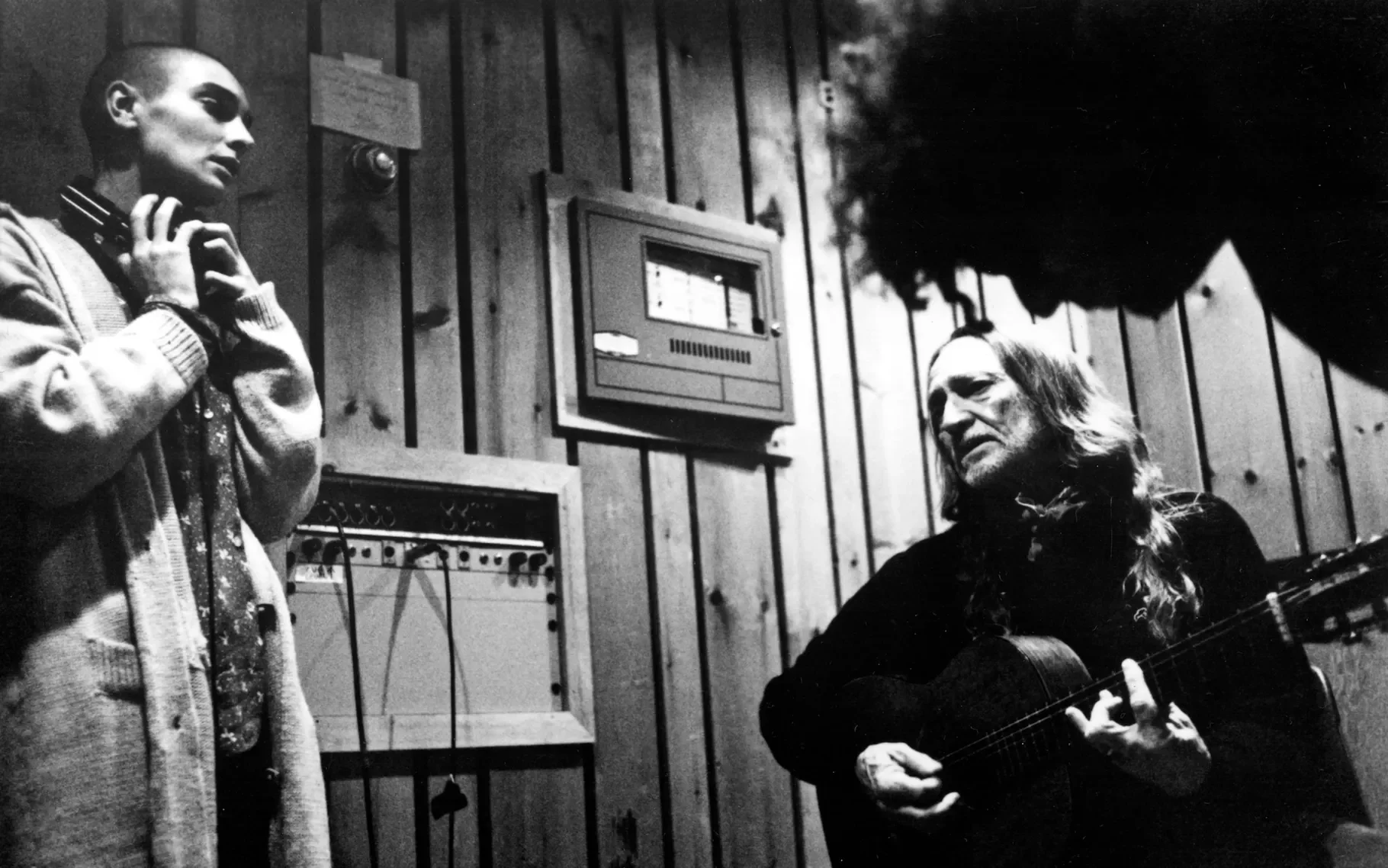
Sinéad O'Connor and Willie Nelson in 1992.
Melodie Gimpel/Everett
When Irish singer-songwriter Sinéad O’Connor died in London earlier this week, fans of her 25-year-plus recording career mourned the silencing of a singularly evocative and steadfast voice. For more casual listeners, the memories were simpler and likely confined to two long-ago moments when she’d dominated pop culture worldwide.
In 1990, her cover of Prince’s “Nothing Compares 2 U” made her a global phenomenon, topping the charts in 22 countries. Then, in October 1992, after middling chart success in the meantime, she became ubiquitous again when she ripped up a photo of Pope John Paul II during an appearance on Saturday Night Live. She was protesting the sexual abuse of children by Catholic priests, but the world was decades away from acknowledging that tragedy. The backlash to O’Connor was intense and, for a while, inescapable. Two weeks later, at an all-star tribute to Bob Dylan at Madison Square Garden in New York, she was viciously booed off the stage.
Willie Nelson was also on the bill that night, and seeing the way O’Connor was treated, invited her to join him in the studio the next day. The song they recorded, released on his 1993 album, Across the Borderline, was a cover of Peter Gabriel’s “Don’t Give Up.” Gabriel’s original 1986 version was inspired by the Dust Bowl–era photography of Dorothea Lange, but written and sung from the point of view of a contemporary English miner left behind by the Margaret Thatcher economy. His narrator’s despair is palpable, but he finds the resolve to carry on in a chorus sung by his wife—in Gabriel’s case, duet partner Kate Bush—who reassures him, “Don’t give up, you’re not beaten yet . . . you still have us.”
Willie and O’Connor play the parts of Gabriel and Bush in their version, respectively, in terms of the lyrics. But tonally, emotionally, and spiritually, their roles are reversed. Willie sounds somber yet steady; when O’Connor first appears, she sounds impossibly fragile, as if her heart has just been broken. But as the song winds on, she finds her balance. The power, even defiance, returns to her voice. When she joins Willie for the bridge, you hear them realize that neither is alone, and together they’ll endure.
In this excerpt of a One by Willie episode from February 2021, Borderline producer Don Was describes the impetus for that recording session, explaining why he chose the song for Willie and why Willie wanted to sing it with O’Connor. His story will change the way you hear the song forever.
Listen now:
Watch the full video of “Don’t Give Up,” featuring Sinéad O’Connor.
(Read a transcript of this episode below.)
He holds up Willie’s 1975 classic, Red Headed Stranger, as an inarguable example of why that works so well, citing it as one of his own biggest influences. On this week’s episode, Cobb discusses “Time of the Preacher,” the overture/aria that frames the Old West, revenge-and-redemption concept album, describing how it invites listeners into the record—and what a nervy departure it was from the country music of the time. From there he gets into Pink Floyd, Dolly Parton, the true definition of “outlaw,” and the most important instrument an artist can take into the studio: a belief in themself.
We’ve created an Apple Music playlist for this series that we’ll add to with each episode we publish. And if you like the show, please subscribe and drop us a rating on Apple Podcasts or wherever you get your podcasts.
One by Willie is produced and engineered by Brian Standefer, with audio editing by Jackie Ibarra and production by Patrick Michels. Our executive producer is Megan Creydt. Graphic design is by Emily Kimbro and Victoria Millner.