
The Black Pumas guitarist, producer, and songwriter examines the Latin and Tex-Mex elements in Willie’s music, how they got there—and why that makes Willie “the most American thing we have.”
By John Spong
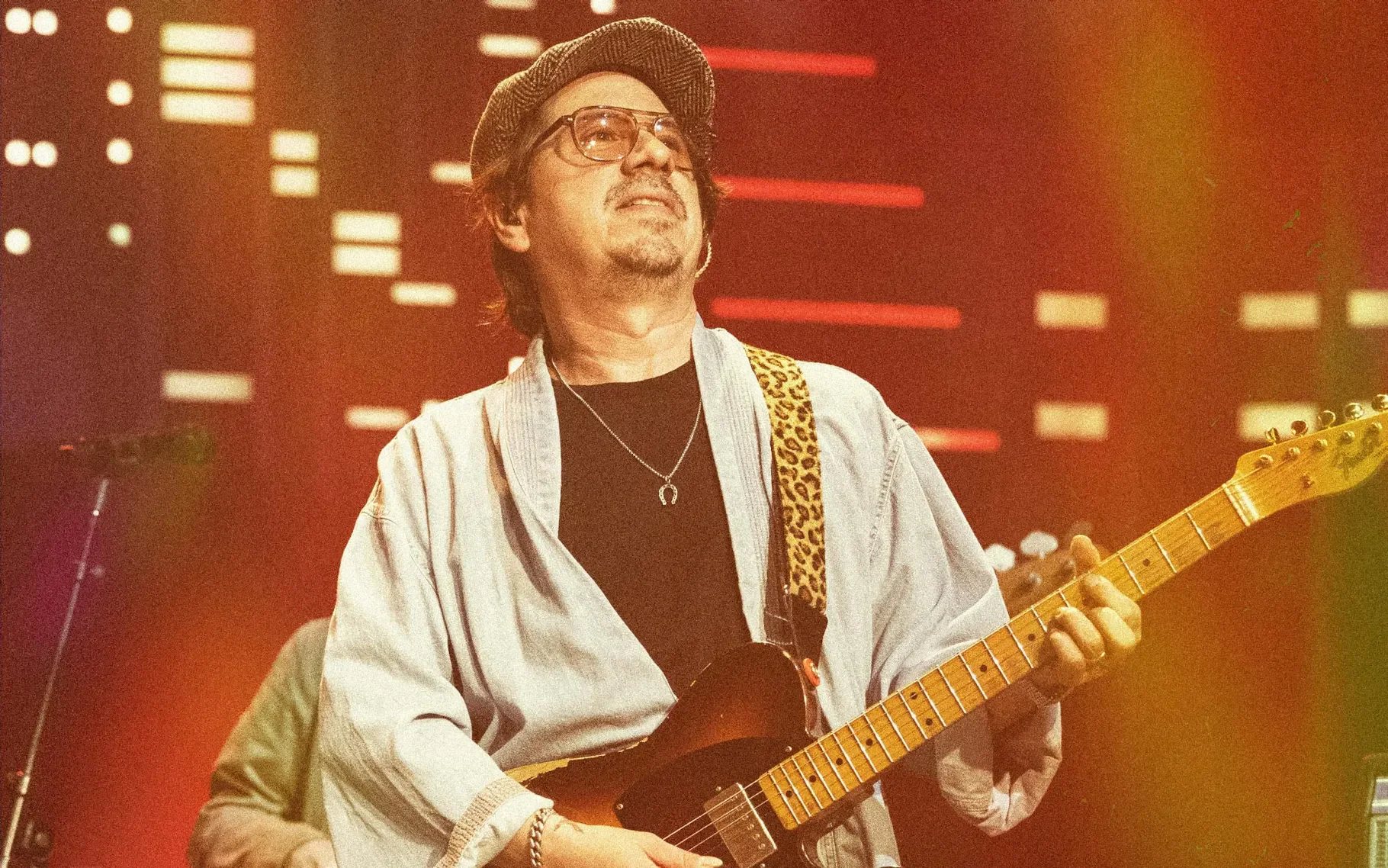
Adrian Quesada performs on Austin City Limits, February 20, 2024. (Photo by Rick Kern / Getty Images.)
Adrian Quesada is one of those people who doesn’t much like to sit still, at least not artistically. When he encounters something he digs, be it a song or a musical style, he likes to take it apart, to find out how its pieces fit, to learn about its influences and antecedents. When he was growing up in Laredo, traditional Mexican music was everywhere, and when he started playing guitar in his early teens, he initially studied flamenco. But his main love was hip-hop, and curious about the samples that provided hooks for so many songs he loved, he schooled himself on the original jazz and funk cuts being repurposed. After moving to Austin in 1995, he and some other Laredo expats who missed the cumbias back home formed the Latin funk orchestra Grupo Fantasma. But he was also studying music at U.T., immersing himself in Afro-Caribbean rhythms and West African artists like Fela Kuti and King Sunny Adé. When you listen to his music now, be it with Black Pumas or one of his many side projects, you hear little bits of all of that.
(Read a transcript of this episode below.)
Last summer, he encountered Willie’s 1998 album Teatro. That album, produced in a small movie house by Daniel Lanois as a showcase for Willie’s guitar-picking over a bouncing bedrock of Afro-Cuban rhythms, is considered a masterpiece by Willie World insiders. But it’s also a distinct outlier in the catalog, a record many longtime Willie fans were slow to warm to.
Not Quesada, who was intrigued by the concept and impressed with the execution. But it was his deep dive into the album’s centerpiece, “I Never Cared for You,” that floored him. It’s a song Willie wrote and first recorded in the early sixties, and when Quesada found older versions of it, he realized that for Teatro, Lanois hadn’t put anything into the song that hadn’t always been there. On this week’s One by Willie, Quesada examines not just “I Never Cared for You,” but the whole of Teatro, marveling at the surreal world Lanois created for the recording and at his own surprised discovery of the Latin elements in Willie’s music.
One by Willie is produced by John Spong and PRX, in partnership with Texas Monthly. The PRX production team is Jocelyn Gonzales, Patrick Grant, Pedro Rafael Rosado, and project manager Edwin Ochoa. The Texas Monthly team is engineer Brian Standefer, producer Patrick Michels, and executive producer Megan Creydt, with graphic design by Emily Kimbro and Victoria Millner. And Dominic Welhouse provides invaluable research and editing help.
Transcript
John Spong (voice-over): Hey there, I’m John Spong and this is One by Willie, a podcast in which I talk each week to one notable Willie Nelson fan about one Willie song that they really love.
This week, Adrian Quesada, the guitarist, producer, and cofounder of Black Pumas, talks about “I Never Cared for You,” off Willie’s 1998 Daniel Lanois–produced album,Teatro. Now, to my ear, Teatro’s long been something of a Rosetta stone among Willie albums, the record that most clearly displays the Latin influence on his guitar playing. But the thing about a Rosetta stone is that it’s going to make a lot more sense if you’ve got somebody to translate, right? And probably give you some history.
Well Adrian—who grew up studying flamenco guitar in Laredo and then founded the Latin funk orchestra Grupo Fantasma in Austin before creating wonderful one-offs, like his 2018 collection of brown Texas soul music, Look at My Soul, and 2022’s sublime Boleros Psicodélicos—is going to play both those roles as we listen to Teatro. He’s gonna explain the flamenco, conjunto, and other Latin elements that he hears in Willie’s music . . . give a sense how they got there . . . and conclude that it’s this blend of experiences that makes Willie, quote, “the most American thing we have.”
Then he’ll put on his producer’s hat to marvel at the surreal world Lanois created to record Teatro, before shifting finally to pure fan mode to describe a night last October, when he saw Willie play a big outdoor show at downtown Austin’s Lady Bird Lake.
Oh but two other quick things: Diehard Willie and Teatro lovers will notice that the tracks we listen to are different from the ones on the album proper. That’s because we were actually watching the Teatro performance doc that Wim Wenders made in the days after the album was recorded. And note that videos of the individual tracks are up on YouTube, and you should check those all the way out.
And then lastly: We recorded the interview at Adrian’s Austin studio, Electro Deluxe, just a few weeks before his song “Like a Bird,” from the movie Sing Sing, was nominated for an Oscar. And how cool is that?
So let’s do it.
John Spong: Where we’ll start then is where we always start. What’s so cool about the Willie song “I Never Cared for You”?
Adrian Quesada: The song “I Never Cared for You”: so you, to go back to earlier this year, had suggested checking out the Teatro album. And you sent me the film, which I got to watch on the road. I was traveling most of this year. Loved the concept. It’s one of those concepts and ideas that, before you even listen to the music, or to watch the film, or anything, my mind was already made up. Like, this is going to be the coolest thing I didn’t know about. Definitely, obviously a Willie fan, a Daniel Lanois fan, I just missed this when this came out. Who knows what I was listening to at the time. So I started there. And I watched . . . the film is incredible. [It] sucked me in.
The idea of making it dance music and of this album as a whole and in particular, infusing kind of Cuban rhythms, Afro-Cuban rhythms with this, and how seamless it felt—nothing felt forced at all, it actually felt like this is how the music was supposed to be in the first place—was what made me do kind of the deep dive. And “I Never Cared for You” grabbed me in so many ways. My entry point was through this album. And I went back and listened to the original version and a few other versions. But I grew up, my first guitar lessons for a few years were playing flamenco guitar.
It was very, it was flamenco and classical. It was way too rigid and way too much discipline for me at fourteen, fifteen. And my friends were like, drinking beer in a garage and playing rock and roll, where I was like, “Man, forget all these lessons. And I just want to play with an electric Les Paul and go play with my friends in the garage.” So I studied for about four years, but I was not disciplined enough for that at that time. So I kind of grew up around flamenco, my sister’s a flamenco dancer in Madrid, and so it’s just been around all that. I mean, the other thing was, with “I Never Cared for You” was like, it feels almost like a flamenco song to me, as well. And you definitely hear the influence of Afro-Cuban music. What struck me was that actually, when I thought a lot of this was maybe Lanois kind of forcing the issue on it at first? I was like, “Maybe this was him saying, ‘Let’s give it this, that and the other.’ ” [And] went back and checked out the original, and it almost, you can see how he drew that line from the original to this one., where it almost has that undercurrent to it in the original version, which struck me as like, crazy. And I went back and listened to some live versions and everything, and they all kind of have that. And it’s a different rhythm than you hear in a lot of country music. You just don’t hear that. Not only the rhythm, but the chord progression itself. It actually has that . . . it could be something like a million different styles in Latin music. So yeah, that obviously grabbed me and made me like want to kind of dissect the song, and get into it.
John Spong: I found a host of versions that I wanted to play for you before we listen to the one with Lanois. And so the original version was a single on Monument in ’64 that Fred Foster produced. And I think it’s David Parker is the guitarist who plays this flamenco opening for it. And it’s weird because that’s the only record Willie put out on Monument. He was in between labels. He had had two records with Liberty that didn’t work. And then he does this thing with Monument, and it probably didn’t work because this, as you say, is not country music in 1964 by any stretch. And then he goes to RCA for the rest of the sixties.
But so, one that I have that can be hard to find: Bear Family Records out of Germany, put out a Legends of the Grand Ole Opry CD, which is all of Willie’s appearances on the Grand Ole Opry from the early sixties. And he played this there. And when I listen to it, I just see all those white people in the Ryman Auditorium thinking, “What in the world has this guy . . . what does he think he’s doing here?” Can I play that?
Adrian Quesada: Yeah, absolutely. I’d love to hear it.
[David Parker plays guitar on Willie Nelson’s Grand Ole Opry performance of “I Never Cared For You”]
Adrian Quesada: Jesus.
Willie Nelson: “That’s David Parker. How about a nice hand for David?”
[Willie Nelson performs more of “I Never Cared For You”]
Adrian Quesada: That’s so intense. Even just the idea of playing that, “I never cared for you.” If you don’t get the context of all the lyrics, that it’s almost, like, opposite day or something . . . it’s intense to be playing that for your date that night. “Hey, I got a song called, ‘I Never Cared for You.’”
John Spong: Right. A little of the trademark Willie darkness that people forget about. Well, where to go? Do you want to show me what you learned now? Or should we watch the Teatro version?
Adrian Quesada: We’ll watch the Teatro version, yeah.
John Spong: I love that. And should I start it at that Django interlude, intro?
Adrian Quesada: Yeah, of course. Yeah.
John Spong: God, it’s so cool. And so the movie, because for some reason, nobody knows about it, or very few people, they recorded this record over four days in this incredible recording studio Daniel Lanois had made in a movie theater, in Oxnard, California. And it was almost all first takes over the course of two days, first or second takes. And then on the last day, they brought in Wim Wenders and said, “We’re going to re-create everything we’ve just done, and film it.” So they invite into the crowd, .sitting in the seats in the old theater are Woody Harrelson, and Marianne Faithfull, and Robbie Robertson, and Harry Dean Stanton—
Adrian Quesada: Oh, I didn’t know that.
John Spong: Yeah. It’s just Willie World and Lanois world coming together to watch this thing.
Adrian Quesada: I read a story about, I was reading: one of the engineers on the session, he said that they had to find Willie some weed. And so he went to try to find the best weed they could get. And he brought it back. And I don’t remember if it was like he tried it before he gave it to Willie, or he tried it with Willie, just out of courtesy when he gave him some, and the guy just got blasted. And he had to roll cables, do engineer things, roll up cables or patch cables. And he was like, “I had no idea what was going on for hours,” after trying the hit, to smoke the same stuff that they had gotten Willie.
John Spong: I think, I read a related story that said, yeah, the guy went and they gave him a bag of weed. And then he let slip that it was for Willie Nelson. They’re like, “Oh, do not give this to Willie Nelson. Go upstairs.”
Adrian Quesada: Oh yeah, that’s what it was. Yeah.
John Spong: “And get the better weed.” It was $800 an ounce or something, which I suppose was a lot in 1998. I don’t know. But, laid the dude right out.
Adrian Quesada: Yeah, that’s what it was, that he went . . . Yeah.
John Spong: So yeah, here’s what it does to Willie.
Adrian Quesada: Yeah, that intro is kind of out there, the whole intro to it on this movie version.
[Willie Nelson performs “I Never Cared For You”]
John Spong: When we did one of these with Lanois, he put this on and then just started doing a free-form, Beat poetry over it.
Adrian Quesada: Oh wow.
John Spong: It was like, “Damn.”
Adrian Quesada: For a second there, it sounds like he’s doing the solo in “Hotel California.”
John Spong: Oh, wow.
Adrian Quesada: For, like, two seconds there. It’s like . . . I love this shot going into here.
Adrian Quesada: I thought they added that for this version, but it’s in some earlier versions too. That [guitar playing,] it’s in some earlier versions too. Another thing I love is how it ends. It’s all kind of sad, minor key, but then it ends on a major key, with him saying, “I never cared for you.” He ends on a major, kind of more happy chord. I always find a sense of humor in that, when people do something like that in a song. They’re saying, “I never cared for you,” but suddenly, he ends it on this like, happy ending.
John Spong: Well, it’s funny too, that makes me think, I notice watching this film, at the end of each song, there’s a smile, there’s a little bit of happiness, there’s that kind of Willie, the happy-go-lucky, everything’s-going-to-work-out guy that we think of. When he’s actually playing, his eyes are really cold while he’s looking at that guitar. He is serious. I mean, it’s the eyes of an assassin.
Adrian Quesada: Absolutely. Yeah.
John Spong: He means it. Well, so what did you learn about the song? Where did you go? What did you . . . Explain that to me. What’s so cool about all that?
Adrian Quesada: So much. So I’ll start with the music.: I’m not a singer, so lyrics . . . I usually [am] more attracted to music than lyrics. I really got into the lyrics, too. But I think musically, the first thing that grabbed me was the chord progression, and the kind of feel, and everything, just felt vaguely Latin, in that it could be a few different styles. Definitely felt like . . . when I say flamenco in this instance, it would be, it’s sort of like what they call gypsy rumba, I’m saying the most popular example of something like that would be the Gipsy Kings, in that it’s like flamenco-ish–inspired, but not necessarily a flamenco style. Flamenco styles are very rigid and very particular. So it has the feel of flamenco, feels Spanish with the guitar, with the nylon, which obviously is Willie’s stamp on everything, is that nylon-string guitar.
But it has elements of the rumba, which is an Afro-Cuban, .obviously came from Africa, but an Afro-Cuban rhythm. Rumba just kind of meant “party,” a rumbero is somebody who’s like, partying. But it’s become a strong, identifiable rhythm in Afro-Cuban music and made its way into a lot of different Latin styles from there. But there was a big, there’s kind of a rumba undercurrent to it. And as I was telling you, when I was listening to it and I heard this, this kind of made my brain make the connection to everything, where Willie, his phrasing on guitar, I know there’s a lot on the jazz influence for sure.
And obviously the Django Reinhardt, that gypsy-jazz kind of feel. But all of a sudden, I’m like, “Wow, he’s playing like a Cuban piano player.” And a lot of the Cuban piano players have this really kind of angular way of playing that’s really kind of . . . I’ve always felt like the way a Cuban piano player, not every Cuban piano player, but a lot of them, start their solos is with a really intense, almost exactly like how Willie does, like a [singing] “Duh duh duh duh” . . . and then stop. And it’s almost like, I always felt like they were just like, “Stop! Pay attention.” They’re just banging on the door, and then they stop and they leave a lot of space. And Willie always leaves a lot of space. There’s a lot said about his phrasing, both—
John Spong: Oh, you have to do this on the guitar, you have to show me what you mean. I gotta see this.
Adrian Quesada: I’ll show you. And then what also I loved about it, and a big element of Afro-Cuban music, African music in general, is this concept of making a rhythm. We typically count everything in fours. So it’s like, [singing] “1, 2, 3, 4.” And a lot of Afro-Cuban music, African rhythms, subdivide everything and superimpose three over four, or three over two, or a six over four. Which is, for technical terms, called a hemiola. And I actually hear, I hear, in everything I do, ever, I’m always trying to superimpose six over . . . so the way that you would do that is, if the song is going 1, 2, 3, 4., I’ll snap so you can hear it, they go [singing] “duh-duh-duh, duh-duh-duh” . . . so you’re doing three over four there. So you’re putting three beats instead of two. And he does that sooo naturally. I mean, it’s like you could throw him in a Afro-Cuban all-stars band and he would not sound out of place, which is crazy to think . . .
John Spong: I love that.
Adrian Quesada: …to think that the hero of country music would be just as comfortable sitting around with a bunch of Cuban musicians playing. So that, to me I studied Latin music, I was in a Latin band for, you know, ever. So that also was really attractive to me, where I’m like, “How is he doing that so effortlessly?” And it still sounds like him. It doesn’t sound like anything. But there was something where I’m like, I don’t know that he . . . I know some of the obvious influences in his vocal styling and guitar. But I was like, “I wonder how much, if that just comes natural to him or if he really listened to a lot of Cuban music.” And in particular, it’s a Cuban thing. Because I think when Latin music became salsa, and went to Puerto Rico and Colombia, and everybody got involved, I think the swing changed a little bit. But so yeah, it was heavy. It was heavy. Because I just love how he does that. He’s superimposing this other rhythm over what is typically just a four-four rhythm.
[Willie Nelson performs “I Never Cared For You”]
John Spong: I remember when this record came out, I didn’t get it. I didn’t understand. It sounded like a Daniel Lanois record, and I wanted a Willie record. And so it was twenty years before I spent time with it and was like, Oh, I think I understand a little bit more of why, in Willie World, it’s regarded as one of the most important things he ever did.
Adrian Quesada: It is? Okay, wow.
John Spong: But as I was paying attention, one of the things, it was like a Rosetta stone thing for me almost, in that I’d always heard about a flamenco influence on what Willie did, but I didn’t know what to listen for, and I couldn’t really hear it. It’s like this brought out this thing that’s always in his guitar work in particular, but that you can’t miss it when you’re listening to this.
Adrian Quesada: Yeah, absolutely. And it, all of a sudden, just made sense. Because it’s not only on this album, which, you know, highly likely, maybe Lanois did force the issue on a few songs: He was the producer, he may have said, “This is the rhythm and you guys adapt to this.” But I went back. As we were listening to some earlier versions too; it’s not that much of a stretch on this version. Some of the other songs, maybe . . . So he may have forced . . . I don’t like when people really, really force the issue on combining genres. It always just sounds clunky to me.
John Spong: Yeah, I buy that.
Adrian Quesada: And none of it really does on this one. That was the other thing that grabbed me on this, was it just fit like a glove with everything he was doing. And it also could have been, .obviously they probably chose songs that fit this style and all that. But yeah, there was so much. And then obviously, lyrically, it took me . . . my brain was just exploded with trying to play along to it and dissecting all that. But the lyrics are just dark. And I’m like, “Is it funny? Is it dark? Is it serious?” And then like I said, it ends on like a happy note where I’m like, “This is . . . ” I don’t know, I just always think that somehow there’s a sense of humor to a lot of this. It’s a wink. Wink, wink.
John Spong: So was it hard to play? To teach yourself?
Adrian Quesada: This one actually just felt really natural to me, to play. I hear music like that. I always want to force that kind of African 6/8 thing over traditional timekeeping.
John Spong: And the piano players you’ve mentioned when we’ve been texting about this, are Rubén Gonzalez and Thelonious Monk.
Adrian Quesada: Yeah. Ruben Gonzalez had that . . . every time he started a solo or something, it is very much the way Willie does. It’s like this one, bold, strong statement and then like, space. And I think a lot of Cuban musicians, there was a strong jazz influence for sure. So I can hear some of the influence probably of somebody like Thelonious Monk, which just if . . . I don’t know if “jarring” is the right word, when you hear Monk versus somebody, but it’s not smooth. [music clip…Thelonious Monk playing piano] . . . It’s unique. It’s this really strong voice. And I think the best musicians and the best instrumentalists like that have a strong voice, where you can hear two seconds of them on an instrument, and you know it’s them.
John Spong: Well, with Monk, “jarring” is a fine word. Except that if there’s any connotation there of it being a negative, it’s not. But that’s one of the things that always line Willie and Monk up for me, is that Monk’s playing is funny. It’s almost humorous.
Adrian Quesada: Exactly. There’s a sense of humor in all this. That’s why we keep coming back to that.
John Spong: You can tell he’s just cracking himself up with some of the note selections, especially the combinations. And Willie does that. I think I’ve got . . . This is one of the . . .[music clip…Rubén Gonzalez playing piano]…
John Spong: So that’s Rubén Gonzalez.
Adrian Quesada: I mean, you hear it there. I mean that’s like . . . just quick little phrases there that have that . . . there. Imagine that as a guitar, it almost sounds like Willie soloing.
John Spong: Yeah, I hear it.
Adrian Quesada: So like I said, I’ll even turn on my metronome on my phone, so you hear how it superimposes.
John Spong: Oh, cool.
Adrian Quesada: Let me see if I can . . . so if you’re hearing that and he’s playing . . . he’s going like, [singing] “1-2-3, 1- 2- 3, 1-2-3, 1-2-3, 1-2-3, 1-2-3, 1-2-3, 1-2-3, 1-2-3.”
John Spong: Yeah.
Adrian Quesada: Incredible. That stuff tickles my brain, big time.
John Spong: The other thing I wondered about in listening for those kinds of influences on this, and it’s a different part of the world, but in the nineties, a bunch of buddies and I used to go listen to live conjunto music a lot, on the east side. There was a place called La India Bonita. I don’t know if you were here yet.
Adrian Quesada: I don’t think so.
John Spong: It was great. And a lot of the guys that would go with us, or at least a couple of them, were in country bands. And so they had their take on what we were listening to. And one of the things they always talked about was how the drummers, and I don’t know if it’s unique to conjunto, or if it was unique to these guys that we were seeing, they would always make . . . not make fun of, but they were like, “What are the drummers doing?” Because there would be these weird, double-time fills that seemed to come for no good reason, except that he felt like it. Or a rim shot or something. There were these kind of seemingly random things dropped into the song. And sometimes Willie’s fills, when he’s answering himself, his vocals, or just even in a solo, seemed to have that kind of random quality to it.
Adrian Quesada: Absolutely. Yeah. So there’s something about . . . I think with a lot of conjunto music, they’re so in-the-moment, and so reacting to somebody dancing or something like that. And there definitely is a big random element to some of that for sure. And I would say with Willie too, it just seems like everything., when he’s about to do something on the guitar like that, to answer it, it’s like a reaction to almost something, I don’t know if it’s something that’s coming out of him, something he sees in an audience or just a melody that came to him in the moment. It’s like . . . yeah.
John Spong: Yeah. Well, and that it would maybe merge, you know, when he is a little kid picking cotton in Abbott, Texas. It’s Willie and his sister, and it’s Black kids, and it’s brown kids, and it’s their music, and it’s their music. And I think all that stuff stuck with him.
Adrian Quesada: For sure. And that’s what I love about what he’s done for so-called Americana music, is that, sometimes to me, the idea of Americana, as we, as a lot of people know it, is sometimes, honestly, I don’t feel like it reflects the entire American experience.
John Spong: Yeah, nice name for it; it’s not just Bakersfield.
Adrian Quesada: Exactly. So Americana sometimes, to some people, just means, I’m not trying to be an asshole, but white, country music to a lot of people. And the American experience, I’ve always felt, is way more colorful than that, for that to be called Americana. So I think that knowing all this music, everything, and a lot of Willie’s life story and stuff, I think reflects more of the American experience. I think Willie is the most American thing we have.
[Willie Nelson performs “I Never Cared For You”]
John Spong: As a producer . . .. you said you’re a Lanois fan. Can you talk a little . . . it sounds like you read a little bit about how this was produced, and you’ve watched the movie; I’ve got some pictures, actually, to show you. Because Mark Howard is his engineer for all this stuff, and he put out this book. Those are some pictures of what the studio was like.
Adrian Quesada: It seemed like at the time, Lanois’s thing was always setting up camp somewhere, right? And doing a unique kind of studio for every environment — this is crazy.
John Spong: What’s the crazy part?
Adrian Quesada: Just the pictures, just how it looks, how they set this all up. I wonder how long it took them to set this up.
John Spong: It had to take a while, right? And they took most of the seats out, but it’s Persian rugs and Tiffany lamps, and Chinese hanging paper lanterns. And what did Lanois say, he said, “I told the guys, if you squint, I want you to be able to see Cuba.” So he’s passing Cuban cigars around through the whole recording.
Adrian Quesada: Yeah. So cool. I wonder what Willie’s initial reaction was to this whole concept.
John Spong: Oh, I wonder, yeah. He was on the bus and then he would come in to cut. I know one thing that he really dug, the soundboard was in the middle of the room. And Willie, by my understanding, loved that. It felt more like a performance than a studio thing. And that was one of the things that Lanois made a big deal of. Which I think you do here, too. Insulation, or separating people, blocks intuition. Let’s be together.
Adrian Quesada: I think that was part of Lanois’s thing in general, was no separation between a control room and a live room, and just being all part of the one thing. Which . . .. love the concept?. From the technical side, that has to be a major nightmare to always pull off, for his engineers and himself. That is a, that is a . . . my old studio used to be like that, just out of necessity, just because it was. And I really, really enjoyed it. And I always felt like that same concept of, “Oh, I want to be in the room with people.”
But now my new studio has kind of a hybrid setup where we do have a control room we can utilize, and it is so much easier on your ears and on your schedule, to get sounds and check things quicker. But I do think that that’s a part of . . . it seemed like with this album, a lot of it was just them feeling comfortable and more like they’re just playing a show, versus what can sometimes in a studio feel like serious work, doing multiple takes and fixing things and doing this right. And I think he just wanted everybody to feel loose, which comes across, I think, for sure in the album.
John Spong: They talk a lot about the drummers, and Willie’s manager, Mark Rothbaum, always just calls them “the Cubans.” And so the drummers, Victor Indrizzo and Tony Mangurian . . .
He talked about how somebody would open up a lighter and light a cigarette, or a cigar, or I guess a joint, and they would immediately make a rhythm out of it, and just start. Because they were fully immersed in the whole thing. And as you see in the video, Lanois sets them up on the same drum kit. So he gets one that’s left-handed and one that’s right-handed, to make sure that the cymbals can be on either side. And they really are a huge part of this.
It’s also interesting, there’s hardly any bass guitar on this record. So much of it is Bobbie’s left hand. Which, I wouldn’t, my ears will never pick that up on my own, but I love, it’s really cool to think about.
Adrian Quesada: On the film, you can really hear it a lot more, but on the album, it’s there as well, the Wurlitzer, the electric piano is doing bass on a lot of it, particularly on that song you can hear when it starts, when it goes . . . [guitar playing]
John Spong: Yeah.
Adrian Quesada: You can hear the electric piano doing that, and it’s somewhat in the register of a bass. But I think when people make bold moves like that without the bass, you gottta get it really right to make that work. And it works on that one.
John Spong:Well, it’s cool because that’s not her instrument. She’s a grand piano player. And one of the things Lanois said:, “We want to do this different. We’re going to give Willie a Gibson guitar for some songs, and we want you to try this on the Wurlitzer.”
Adrian Quesada: The Wurlitzer sounds awesome on it.
John Spong: Yeah. And speaking of that Gibson, .one more clip, and it’s one of those rare Willie, electric-guitar moments.
[More Willie guitar playing]
Adrian Quesada: He sounds so good on electric, too. You don’t hear that too often.
John Spong: Oh, yeah. That’s the question: Does his playing change?
Adrian Quesada: Yeah, a little bit. There’s just more sustain on electric guitar, in between the notes, whereas, particularly a nylon-string kinda cuts off notes real quick. Which again, lends itself back to the point I’m, like, hammering here, is that sounding like a piano, that . . . But the electric, it’s just a little bit of a smoother thing, so you can hear more of that… He goes into more of those kind of jazz licks, those gypsy jazz kind of licks and things like that. You get to hear him flexing a little bit there because he was killer. It sounds really good.
John Spong: The only other thing, within Teatro is, the studio was there for like four years and they moved on. They created all this stuff and were like, “What’s next?”
Adrian Quesada: So what’s the deal with that theater now? Do you know?
John Spong: I read that some people are trying to get it turned into a studio again, but I think it just kind of . . . somebody else did it, but they didn’t create, you know, this kind of magic. They didn’t have these kind of resources probably, too, and they didn’t have this kind of Rolodex. Because that was the thing. And it’s a more famous place now. Oxnard was a little farming community at the time. And Bob Dylan and Willie and Iggy Pop would walk down the street between sessions and nobody recognized them.
Adrian Quesada: I read that that was part of the appeal there too.
John Spong: Which is kind of something. But since then, yeah, I’m just floored by what they did and the fact that they would move on.
Adrian Quesada: Yeah. What was the reception of the album like when it actually came out?
John Spong: It was—nerds loved it. I remember John T. Davis, who used to write for the Statesman, I think he was writing for the Statesman, he referred to it in his review as “Willie’s soon-to-be-controversial new album.”
Adrian Quesada: Oh, yeah.
John Spong: And it was. I think the Dallas papers panned it? They just didn’t get it. It was probably the same reaction I had, because I was . . . I guess I was on the verge of adulthood then. It wasn’t what I wanted from Willie, and so I didn’t pay it any attention. And that’s one of the things with Willie, he puts out so many records that when a reggae album comes out, if you’re not inclined to listen to it, there’s another Willie record that you already love to go play.
Adrian Quesada: Yeah, it’s funny, I was thinking about this record when you turned me on to it, and I obviously went down and learned more about it. But I was like, “This was his 45th album.” So, I’m like . . . because part of me was like, “How did I not know about this one?” I’m like, “I think it’s okay if I miss somebody’s 45th album.” And also at the time, I was just more of a snob, listening to all this other stuff. But anyways, that’s his 45th album. That’s absolutely insane.
[Willie Nelson performs “I Never Cared For You”]
John Spong: So when you get to Austin for school, you grew up in Laredo . . .
Adrian Quesada: Laredo, Texas. I moved here in ’95.
John Spong: And so from what I’ve read, growing up, the music of the border is everywhere. And you’re hearing that, but also you’re big into hip-hop, which leads to jazz and funk, when you’re finding the stuff that’s soloed . . . that’s sampled. When you come to Austin for school, is there an awareness of Willie then? Especially as you become a musician and stuff? I don’t know . . .
Adrian Quesada: In Austin, yeah, there definitely was. I mean, I wasn’t . . . when I moved to Austin, my first couple of years of being here, I got really into jazz music and was really into hip-hop. And I was like, forcing the issue on that being my identity. I would hang out, I was into avant-garde jazz and hip-hop, and that’s it. So when I got here, some of the stuff like going to see blues, or to see country, and stuff like that, I wasn’t doing it. I was absolutely aware that . . . and I always loved the history of Austin and I love to learn, and I love that part of the culture we know now of Austin, one of the major, I think, notable chapters in that, was Willie moving here and creating the vibe, the general vibe that is still a part of Austin. It is changing, but was what attracted people here, I mean, you could argue that probably one of the biggest moments to create the culture that we now know, was Willie moving here and the scene that he created, the cosmic cowboy, hippie on acid, that loved coun- . . . .that was wearing boots kind of thing. So I absolutely was aware of it for sure. But nah, at the time, I was so obsessed with what I was into.
John Spong: Well, it’s interesting because there’s always been music in Austin. Willie didn’t introduce Austin to music. But by having the success he did, and basing it out of here, that cosmic cowboy scene would’ve happened whether he got here or not, but he, as the biggest person to come out of it, brings attention to the city. And it makes more musicians want to come here, when he owns the Opry House through the eighties. And every touring band in the world wants to play Willie’s place. That’s a big part of Austin becoming this “live music capital of the world,” as they bill themselves, because it’s a huge touring stop now. I saw a parallel, because when I read people talk about your career, they talk about how, through Grupo Fantasma, and through Ocote . . . just through all these different projects of yours, you’ve kind of put Latin, contemporary Latin music on . . . Austin, on that map. It’s weird. There’s this kind of, you’re like founding fathers of a different generation, is a very goofy way to put it.
But then also, another kind of parallel, is that you don’t ever stop. You are always working on something, and they’re not all in the same vein by any stretch. And that, can’t sit still, need to be creating, and need to be creating music is this other complete tie, in my mind, between the two of you guys.
Adrian Quesada: Oh, thank you. I just can’t even believe to be mentioned in the same sentence like that with him. But a lot of it, I mean, I love to learn about stuff, and I love to learn about music. I mean, a number of things: One is, I always feel like I’m getting better. To hear the last thing I did, I’m like, “Man, I can do better than that. I want to try that again.” But also, I try to have hobbies. I try to ride my bike, and I try to do things, but ultimately . . . so, I’ll be on a bike ride hear something, and be like, “Oh, shit. I need to get to the studio because now I have this idea.” And yeah, can’t even think of anything funner to do than . . . I haven’t found a hobby that comes even close to how fun this is. And like Willie says, “making music with my friends.” I saw him a couple of months ago and was hanging on to every lyric. And I’m just, “making music with my friends,” how much cooler than that?
John Spong: It’s not a goofy line in a song. And you were talking about that when I walked in, that was the Austin City Limits 50th Anniversary concert he did? At the lake?
Adrian Quesada: Mm-hmm. Yeah. And it was a full moon. Beautiful moon. It was surreal. It was really surreal. They had his face on a huge screen, and I haven’t seen him in a long time. And just hanging on to every word now. I’m just listening to everything. I’m like, “Man, everything has so much meaning now with him, as long as he’s been doing this.” Like, “Last Leaf on the Tree,” I was crying. I’m just like, “Wow. Willie’s the last leaf . . . ” Everything he was saying, I was like, “Oh my God. He means this. He means every little word. There’s no wasted words, there’s no wasted notes, there’s no anything. It’s just all . . . ” I don’t know.
John Spong: It’s a lot of wisdom in that voice at this point.
Adrian Quesada: For sure.
[Willie Nelson performs “I Never Cared For You”]
John Spong (voice-over): All right, Willie fans. That was Adrian Quesada, talking about “I Never Cared for You.” A huge thanks to him for coming on the show, and a big thanks to you for tuning in. If you dig the show, please subscribe, maybe tell a couple friends, and visit our page wherever you get your podcasts and give us some stars or type in some comments. Every little bit of that helps more than you know.
Please follow us on Instagram at @onebywillie—all one word—find us on Bluesky, and join our ever-expanding Willie conversation at the One by Willie group on Facebook.