
The pride of Odessa recalls the New York recording sessions that produced Shotgun Willie, The Troublemaker, and “She’s Not for You.”
By John Spong
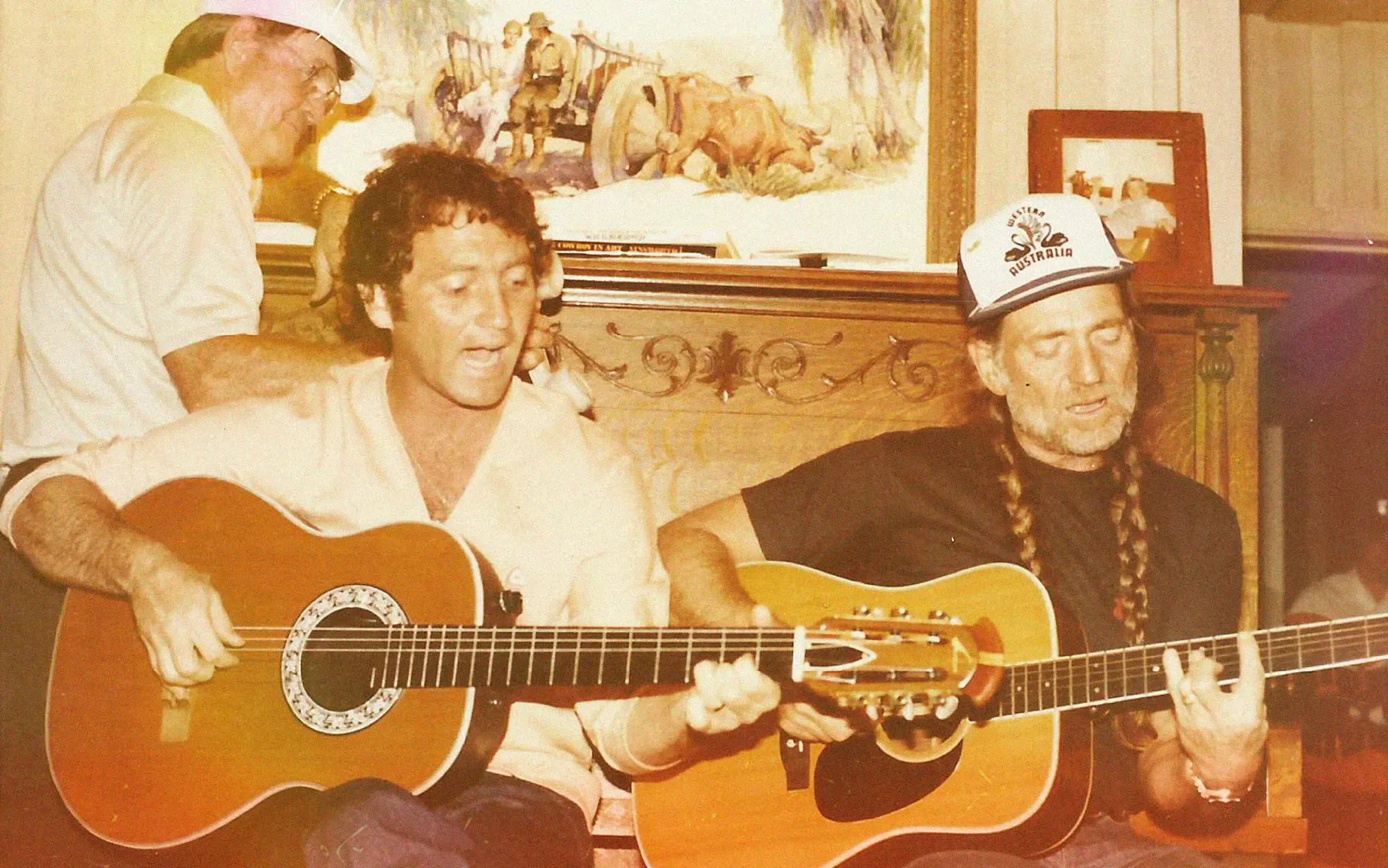
UT Coach Darrell Royal, Larry Gatlin, and Willie Nelson, date unknown. (Photo courtesy of Larry Gatlin.)
When Larry Gatlin first moved to Nashville, in 1971, he was fresh off a job waiting tables at a Steak and Ale outside Houston, a young unknown songwriter thrilled just be in the presence of heroes like Roger Miller, Mickey Newbury, and Willie Nelson. But as big as his dreams were, his clear, rich tenor voice was even bigger. Barely a year and a half later, he found himself in Atlantic Studios, in New York, enlisted to sing backup for Willie in the sessions that produced the game-changing 1973 album Shotgun Willie.
(Read a transcript of this episode below.)
This week on One by Willie, Gatlin, now known for classic hits like “All the Gold in California” and “Broken Lady” and a member of the Nashville Songwriters Hall of Fame, talks about those sessions, focusing on a song he played guitar on, “She’s Not for You.” Well-read Willie lovers will know that at the time, Shotgun Willie was the closest Willie had yet come to having creative control of a project, and Gatlin will describe just how different that was from the Nashville process in which Willie had been struggling. But he’ll also explain a lesser-known key to the magic of those sessions: the gospel songs Willie cut at the start of that week, before even getting to the Shotgun Willie material, which were released three years later, as the album The Troublemaker.
From there, he’ll examine Willie as a role model for how to craft a great song, share memories of the legendary picking parties Willie cohosted with University of Texas football coach Darrell Royal, and discuss the joy of just being around longtime Willie consort Roger Miller.
One by Willie is produced by John Spong and PRX, in partnership with Texas Monthly. The PRX production team is Jocelyn Gonzales, Patrick Grant, Pedro Rafael Rosado, and project manager Edwin Ochoa. The Texas Monthly team is engineer Brian Standefer, producer Patrick Michels, and executive producer Megan Creydt, with graphic design by Emily Kimbro and Victoria Millner. And Dominic Welhouse provides invaluable research and editing help.
Transcript
John Spong (voice-over): Hey there, I’m John Spong, and this is One by Willie, a podcast in which I talk each week to one notable Willie Nelson fan about one Willie song that they really love.
This week, we talk to the pride of Odessa, Texas: Larry Gatlin. He’s a member of the Nashville Songwriters Hall of Fame, the guy who wrote classics like “All the Gold in California” and “Broken Lady,” and he’s going to talk with us about “She’s Not for You,” off the 1973 album that turned Willie’s career around and redefined country music, Shotgun Willie.
Now, most fans know that that album was recorded well outside of Nashville, at Atlantic Studios, in New York. And Larry, who sang backup and played guitar on it, will describe just how different—and how significant—the artistic freedom that Jerry Wexler and Atlantic Records gave to Willie was. But he’ll also get into a lesser-known key to the magic of those sessions: the gospel songs Willie cut at the start of that week, before even getting to Shotgun Willie, which were released three years later as the album The Troublemaker.
From there, Larry will get into Willie as role model for how to craft a great song, the famous picking parties Willie cohosted with UT football coach Darrell Royal, and the joy of just being around longtime Willie consort Roger Miller. With a most unlikely cameo by the singer who gave the world “Looking for Love in All the Wrong Places,” country legend Johnny Lee.
So let’s do it.
[Willie Nelson performing “She’s Not for You”]
John Spong: We’ve had a handful of Songwriters Hall of Fame members on here before, but very few who have actually taught college courses on songwriting, like you have. So, I normally start with, uh—what’s so cool about the song you’ve picked. You’ve picked “She’s Not for You.” I kinda want to say, teach me about “She’s Not for You.” The Willie Nelson song “She’s Not for You.” What’s so cool about that song?
Larry Gatlin: Well, you know, trying to be cool is just really uncool. Just being cool is cool. Well, Willie Hugh Nelson is cool. And I don’t know much about his background, or his education, or anything else, but I know that—as well as people like Kris Kristofferson, John Cash, Roger Miller, Willie, Mickey Newbury . . . Dolly Parton has an incredible song: Go read “Coat of Many Colors,” and just see how . . . it’s not . . . I don’t write lines. And I don’t think Willie writes lines. He may do it subconsciously. He writes syllables. He writes no more than one word at a time, it seems like, because of the way they fall. And just—this old boy who is getting his woman stolen. I mean, he just says that you’re crazy if you believe this woman. “Pay no mind to her. Pay—she only wants to play.” The internal rhyme and alliteration of “Pay no mind to her / She only wants to play,” it’s just—when I did that little songwriter master class you were talking about out there, I asked those 22 young people at the University of Texas at the Permian Basin, I said, “So, y’all want to be songwriters, right?” And they all went, “Yeah, yeah, yeah, yeah.” I said, “You are songwriters already. You’re just not song craftsmen.” And then, I would take their work, make them—or have them, encourage them, to go write. I gave them eight minutes. I said, “That’s how long I wrote ‘All the Gold.’ ” And I came back and took what they wrote. And because of my love for the language and the words, and the fact that I wanted to be their cheerleader, more than their instructor, I said, “Yeah, that’s good. That’s really good. Maybe you twist this a little bit. Put a word . . .” You know.
So, that is the way I go about it. But Willie, he’s just the master craftsman. I mean, holy cow. “Half a Man.” [singing] “If I only had one arm to hold you . . . [or] had none at all.” Oh. That’s just one of my—I mean, I know that’s not the song we’re really talking about, but if you go right on down through, “She just looks for greener pastures now and then / Because she knows Old Faithful will take her back again.” “But it’s your heart. I can’t tell you what to do. But I’m going to anyway. She’s not for you.” It’s my favorite one, not just because he let me—that’s my little; the extent of my guitar expertise is on the intro. That’s me!
John Spong: [Laughs] Yeah, it is.
Larry Gatlin: Willie said, “Just kick it off there, Larry.” And I said, “O-o-okay.” I mean, you got Willie sitting there, and Jimmy Day. I mean, oh! So I played everything I knew in those first two measures.
John Spong: Well, that’s it. Let’s listen to it, then, because it’s great. So, “She’s Not for You.” I know of two versions—the initial two versions. Because I think Willie wrote it in ’62, and Chet Atkins and RCA did a single on it in, was it ’65? Yeah. Went to 43, and that was it, in that Nashville-sound era. But then, in ’72, Willie’s signed to Atlantic. Things are changing. It’s a pivotal moment. And he decides to redo this song. Let me see. I’m going to share my screen and pull up the lyrics. Although I love it—you clearly don’t need me pulling up any lyrics for you to look at.
Larry Gatlin: Oh, I . . .
John Spong: And here we go. Here comes that guitar.
[Willie Nelson performing “She’s Not for You”]
Larry Gatlin: Goodness.
John Spong: I think with that song—because I’ve been listening to it for years, but I listened more closely to get with you. And one of the things that I’ve found with a lot of these great Willie songs is, it’s such a slow reveal. The words do, they carry you along. But, “Pay no mind to her / She only wants to play,” that could be just advice to a buddy. Or your little brother.
Larry Gatlin: True.
Spong: “She said she found heaven in your eyes. . . . Well, sometimes she lies.” Oh. Apparently, the narrator knows her a little better than he’s letting on.
Larry Gatlin: He sure knows a little better than—and you used the word “surprise.” He keeps the anticipation. Well, he does that with his phrasing, too. Look what he did: [singing] “Pay no mind to her”—wait—”She only wants to play.” What is he going to say next? You know. Brilliant cat.
John Spong: Creates such tension.
Larry Gatlin: I don’t like him that much personally, but he’s really—
John Spong: [Laughs] Yeah. And then, there’s just such an overwhelming sense in this song of defeat.
Larry Gatlin: Yeah. The guy is—it’s over. He’s finally just—acceptance. It’s just, “Man. That’s it. This is the fate you’re in for if you trust her.” Of course, you know, Willie—if you recall, the late, great Conway Twitty would never put a woman down in a song. He had 41, I think, number one records. Conway’s deal was, “Hell, man. Women buy most of the records.” So, when it came to Will, that never entered his mind. Conway would not have recorded that song, because it kind of holds the lady in not really the brightest light, as it were. Willie’s just—well, Mr. Faulkner said, “I take the truth and set it on fire.” That’s what Willie does.
John Spong: There you go.
Larry Gatlin: “I just take the truth—I’m trying to take the truth and set it on fire.” The truth is, this old boy is just sitting there, and it’s over, and he is in the dumps, big-time. So, little advice for the next one down the road.
John Spong: Yeah. And so, how does he, like, in the evolution of country songwriting, how does he move the ball forward? And so, I’ll throw some stuff out that’s just what has occurred to me, but you know, and I don’t. Because I think of Willie being in the Harlan Howard and Hank Cochran generation, but kind of the next step. It was a lot of wonderful wordplay. Great melodies, of course, but wonderful wordplay. But then Willie, he’s like the bridge to Kristofferson, almost. And Roger Miller and Mickey Newbury are in there somewhere. But what does Willie—how does Willie move the ball forward in country-songwriting history? Or am I overthinking or making that up?
Larry Gatlin: No, you’re not. Your analogy of it being the next step, I think that’s very spot-on, as the Brits would say. See, those guys that you mentioned, Harlan and Hank and all of them—Roger—they were all hanging around Nashville at the same time, doing guitar pulls and sitting in each other’s trailer house, whatever, before they got rich and famous, and sharing those songs back and forth with each other. They really—and that legacy that came from Hank Williams before that, and Jimmie Rodgers, up through those times, I think that’s a perfect analogy. They took it—Willie took it a little farther. He just refined it a little bit. “Refined” is not the right word, because that kind of sounds like it means they didn’t know what they were doing.
John Spong: Yeah. Suggests it was deficient.
Larry Gatlin: But I talked to a friend of mine one time who’s a great songwriter, Hall of Famer. I said, “What are you reading right now?” He said, “I don’t like to read. It just takes too much time. I don’t like—” I said, “Well, yeah, you do. I said, you memorized every Bob Wills song and Hank Thompson song that ever was in the history of the world. And every Hank Williams song. Yeah, you did—that’s how you did your reading. That’s how you heard words and how they play together.” Well, I think a lot of Will’s—you know, Harlan Howard’s university was the assembly line in Detroit that he worked on.
John Spong: Right.
Larry Gatlin: I think I’ve got that right. And Kris’s came from books. And I think Willie being a great reader, and listening to those other people, and just having a God-given gift to turn a phrase. I mean, sheeww.
John Spong: Yeah. And I know you said that you don’t start with lines. I have a tendency when I’m listening to wonder, especially to the older songs—or just the great songs, really—what line might’ve been first. And I wondered on this one, if Willie wasn’t sitting in a bar with Hank and Harlan and it occurred to him, “Old Faithful will take her back again.” I wondered if that would be the birth, the genesis of this song.
Larry Gatlin: Very well could be. But during those master classes, I said, “If you want to write, read. If you want to write, listen. Especially listen to yourself, to what you say.” I tell them, “Every time you say, ‘Well, I feel like—,’ go write that down. Listen to your heart. Because whatever comes like ‘I feel like,’ that’s the idea for your song.” So Willie, having that mind and that heart, I’m sure—I mean, I can see it right now. Willie and Hank and Harlan sitting at a bar. And Hank, I think, didn’t—I think Roger wrote [singing] “Sorry, Willie. I didn’t know you didn’t know,” okay? Roger evidently had abscondiated with one of Willie’s lady loves or something. That backstory I don’t know all of. But that’s where it comes from. It comes from personal experience. And if he’d sat there with Hank, and they’d been dating his girlfriend, he said, “She’s not for you. Pay no mind to her. She just wants to play.” I mean, you can see that. You can make a whole movie out of that.
[Willie Nelson performing “She’s Not for You”]
John Spong: Larry, I was going to say, the song’s on Shotgun Willie, and you’re in the room. Can you take us back? Set the stage for those recordings. How’d you get the gig?
Larry Gatlin: Okay. This is very interesting. Dottie West invited [my wife] Janis and me to come—she’d heard eight songs on a little tape that I made. I was auditioning for the gospel group the Imperials, with Elvis and Jimmy Dean, out in Vegas. And Dottie was a special guest. Well, I didn’t get the job. Dottie heard, said, “You look enough like Mickey Newbury, you’ve got to be able to write a song. Send me some songs. I’ll try to help you.”
So I went back to Houston, wrote eight songs, sent them to her. She sent us a plane ticket. We got there. That was in June or July of ’71. The first thing we did that night was go to Hank Cochran—when he’s married to Jeannie Seely—get on the boat, go across to Mickey Newbury’s houseboat, where he was. And he got up that morning, came out there, and said, “Boy, you do look like me.” He said, “I want to show you all something I just wrote last night.” And he played us the “American Trilogy” for the first time.
John Spong: Wow.
Larry Gatlin: So, being ushered into that rarefied air—and as soon as she could, she introduced me to Willie, somewhere when he was in town, because he’d moved to Houston, or maybe L.A., back then, and we hit it off. He was just very nice, and friendly, and encouraging. When we got to sing a couple songs, he liked the songs.
So, now comes about that time when he got off of RCA, that time you mentioned, and he got on Atlantic. A bunch of us were going to go for that session. Dottie was going to go. Hank Cochran was going to go. Jeannie was going to go. Jack Greene was going to go. And we were all going to go up there. I got the invitation and the call to come up there and sing background vocals on Willie’s first, the big Atlantic album, that turned out to be Shotgun Willie.
John Spong: Yeah.
Larry Gatlin: Well, we got to the airport, and I was there, and Sammi Smith was there, and Dee Moeller was there. And maybe Jimmy Day. So we flew to New York, got in the hotel, and went to the studio. And of all of that gang that was supposed to come, there were only three or four of us, out of the eight or ten that were going to troop up there. And the deal was, they said, “Hank got bit by a spider on the toe.” The spider that bit Hank was Vat 69 Scotch, I think, or whatever. A little Jack Daniels. Jack Daniels the spider bit Hank on the toe.
So we went up there, and I was—I was a kid. A year and a half earlier than that, I had been a waiter at Steak and Ale restaurant on the Gulf Freeway in Houston. And here I am with Willie, in New York, with Mr. Wexler, and Arif Mardin, and all of those people that were, you know—it was really tall cotton.
John Spong: Was there a sense—so, he’d been at RCA, and it hadn’t been working. And I’ve read some people, some reports at the time suggest that he was just going to retire. But then, you know, Wexler falls in love with his music. And Wexler is a huge western swing fan, and that’s a special bond between Bob Wills nuts. There was an extent, a sense of which he was coming back to Texas almost with his tail between his legs. And so, Atlantic is just trying country music for the first time, and this doesn’t have to work. Was there a sense that there was a lot riding on this? Or is it just the Willie way?
Larry Gatlin: It was the Willie way. I think he finally—you know, Willie plays nice with the other kids in the sandbox. You know, he does. He loves to have that collaboration with people. And they made some great records when he was at RCA. And I don’t know, Mr. Atkins and those people—one of the great, obviously, musicians and producers in the history of music, period.
John Spong: Period.
Larry Gatlin: But you know that old saying, “Life is like a dogsled team. If you ain’t the lead dog, the scenery never changes.” You know, Mr. Atkins was the lead dog, an alpha male—a quiet one. Willie is an alpha male lead dog. Now, they both did it a little gently, and it wasn’t overpowering. But I think, sometimes I think that maybe, maybe the Nashville musicians, the most incredible players in the world, it might’ve been that their way—I mean, it worked because they made some great records. But it wasn’t until Willie broke out and began playing lead guitar on his own records, and became that, really, lead dog, that he could do it by himself.
The first session I did in Nashville, it didn’t sound like me. It didn’t sound like me, because I got in there with those great musicians, and I put my guitar down and let them play. Well, I couldn’t play the way Grady Martin played. No way. But, I had written those songs on my guitar, and the phrasing on that was different, and it just had a different feel. When I didn’t have my guitar in my hand, I went back to strictly the gospel singer that I had been years before, instead of that young songwriter writing his own songs. Willie needs to have Trigger right there, strapped around his shoulder. And that’s what he did with Mr. Wexler.
But when he picked up old Trigger and wrapped that red bandanna around his head and became the Willie Nelson that the world knows? That’s the real one. The guy in the suit and the little string tie, that was Willie becoming Willie later on.
John Spong: And this record’s the pivot. And it’s interesting because, yeah, Grady Martin comes up in this podcast a lot. He was good at what he did. And he liked doing it with Willie. And he ended up recording with Willie lots and lots, once Willie hits.
Larry Gatlin: Sure.
John Spong: But for this record, having your own band in the studio was creative control. And that’s what you didn’t do in Nashville, and that’s what he gets to do with Atlantic. And so, Jimmy Day, who you just mentioned, was instrumental in inventing the pedal steel, with Buddy Emmons. And so, he’s up there. He’s a session dude. He’s been here before. But Bobbie Nelson, on piano, had never been on an airplane before. She’s in New York—so she’s never been in a studio with Willie before. And so, it’s a thing I wanted to ask you about. Because help me, correct me, because I want to learn from you. As I understand it, they didn’t start with the Shotgun Willie stuff. They started with the gospel stuff.
Larry Gatlin: We did.
John Spong: And the record that became Troublemaker.
Larry Gatlin: Yes, we did all of that. We did that whole—I guess we were up there maybe four or five days. Not sure. We went in there and got everything kicked off with the familiar. With those old—“I’ll Fly Away,” and all of that stuff. And then, that whole—maybe it was the Holy Spirit, because we did the gospel songs first—the Holy Spirit and the Willie Hugh spirit that permeated that studio. And it was a strange place for all of us. I hadn’t been in a studio ten or fifteen times in my life. I don’t know that Bobbie had ever played—she’d probably played on some of Will’s concerts, and stuff, but she played in church.
So, I don’t know if . . . of course, Jimmy Day had played on sessions before, but we turned that into our—that studio was our home, for four days. We ate sack lunches in there and drank coffee. We took naps in there at two in the morning, when we needed a good nap. And only went back to the hotel just for four, five, six hours of sleep, then come back—because it was in us.
John Spong: But it comes back to those gospel songs too, because that’s what always struck me, and what I loved hearing from you just now. I won’t walk through all the Willie and Bobbie family history and all of that stuff, but when they were kids, those gospel songs were all they had.
Larry Gatlin: That’s right.
John Spong: Those songs saved their lives. And so, when they’re coming up here, I’m sure in the moment, it felt like, “Well, let’s do this first.” But in point of fact, here they are, finally in a studio together—maybe for the first times in their lives, I think. They need a rock.
Larry Gatlin: Yeah. That was it.
Spong: “Will the Circle Be Unbroken.” And that is “Uncloudy Day.” And that is “In the Garden.” And it’s those songs you did. And those are the songs you and your brothers grew up on, too. And so that’s—that’s magic.
Larry Gatlin: Those songs—it grounded us in that studio. It got us out of the airplane, out of the cab, got us out of the hotel room. It got us out of the Stage Deli, you know, for lunch. It got us into that studio and grounded us right there. And after that, it was just a—oh, it was a glorious time.
[Willie Nelson singing “Will the Circle Be Unbroken”]
John Spong: And so, then comes Shotgun Willie. Then comes that other album you recorded that week.
Larry Gatlin: Oh, that’s right. That’s right. They did the familiar. They got comfortable in there and made it, like I say, made it homey. And Mr. Wexler did that. He heard it. And he gave Will the free rein to do what he wanted to do. And we grounded ourselves, and I cannot believe it’s fifty—what is it? Fifty-three years ago?
John Spong: Yeah. It came out in ’73, and it was recorded in February. Golly! It was recorded this week in 1972 [correction: 1973].
Larry Gatlin: Get out of town.
John Spong: It was February fifth through ninth, were the recording dates.
Larry Gatlin: Get out of town! And take somebody with you. You’re kidding me!
John Spong: Uh-uh!
Larry Gatlin: [Singing Twilight Zone theme] “Do-do-do-do, do-do-do-do, do-do-do-do.”
John Spong: How different was Shotgun Willie, musically, to what country music was in that era?
Larry Gatlin: I had only been on the scene in Nashville, like I say, in a few recording studios. But when I saw the Nashville musicians sit down and hear a song, and write out their Nashville number charts, I knew. I knew this was the real deal. And that these were absolute masters of the craft, and virtuosos. They were incredible. When we went into that one, it was a little different thing. It was not, maybe, as polished. It was raw, you know, but it was raw naturally. A lot of people try to get funky. Again, trying to get funky ain’t funky. You’re just either funky or you ain’t. Or you’re cool or you ain’t. It was Willie being the lead dog and doing that. And like I say, it was organic, up from the ground—and we were about to do “She’s Not for You.” We’d been running it down. And he says, “Take that intro, Larry.” Well, after I cleaned myself up a little bit, I’m, “What?! Okay, Will, I’m going to play all I know.” But, you know, that two little measures I played there, and then Jimmy Day came right over it with that steel, and Willie—it’s up from the dirt.
John Spong: I wanted to play another—just a clip of something. This, in my mind, kind of sums up how different, how revolutionary Shotgun Willie must’ve sounded to somebody who heard it on the radio back in ’72 [correction: ’73]. I think the week before it came out, the number one song, which is a song I love, was this, by Jeannie Pruett.
[Jeanne Pruett performing “Satin Sheets”]
John Spong: Not one thing to criticize about that. I love that.
Larry Gatlin: No. Good Lord, no.
John Spong: But it is not—it is not this.
[Willie Nelson performing “Shotgun Willie”]
Larry Gatlin: [singing] “You can’t play music if you ain’t got nothing to play.” I mean, country music at that—that was kind of, as it evolved into the “countrypolitan” crossover, a little slicker. But I’m not sure even today, anybody but Willie—well, maybe Toby [Keith] could have gotten away with it, God rest his soul. Maybe Waylon [Jennings], maybe John Cash. Very few people could have used the word “underwear” in a country song. Okay? There we go. Willie—can you say, “Shotgun Willie sits around in his boxer shorts”? So, Willie un-slicked it.
John Spong: Yeah. I like—
Larry Gatlin: There’s the magic.
Larry Gatlin: Because I use that sometimes. I’ll tell people, I say—you know that old saying is, “Willie ain’t from around here.” And I mean, Earth. Abbott must’ve been just a little satellite somewhere close to Earth, because he’s otherworldly.
[Willie Nelson performing “She’s Not for You”]
John Spong: Tell me about your friend, and Willie’s friend, Coach Darrell Royal—UT football team.
Larry Gatlin: Red Lane asked me, he said, “Hey, Gatlin. You want to play golf with Darrell Royal?” I said, “Yeah.” So, he set it up. And it was the Four Star Golf Tournament, here in Nashville, for the Boys Club, I think. And played with Darrell, got to play with him, Coach Royal. And a couple of holes—he was so friendly and wonderful. He said, “I really love that ‘Penny Annie’ song that you wrote. That’s my favorite on your album.” You could have busted me—had every dollar I had, if I thought that Darrell Royal had my little old album in his collection and knew the songs.
And it started a friendship. So, we played golf. Darrell’s wife, Edith, and Janis hit it off. We hung out together. They saved my life, Darrell and Edith. She told him, she said, “Darrell, he’s going to kill himself with dope and booze, and you got to go snatch him up. You gotta go get him.” So, he didn’t send me to treatment. He took me to treatment. We palled around, played golf almost every day of the eighteen years, if I was in town. We’d go out, play with Willie when he was in town. One time out there at Willie’s golf course, I said, “Willie, what was par on that last hole?” He said, “Fifteen.” I said, “What’d you make?” He said, “I birdied it.” That’s Will. So Darrell, like I say, I sang at Darrell’s going-away party. You know, his earthly leaving. And with Will, we shared some great guitar pulls. I’ve got a picture of us sitting on the piano stool. Will and I are sitting there together, and Darrell’s standing up—Newbury’s to the right of Willie—having a guitar pull for the ages. One of my priceless possessions.
John Spong: And for folks that aren’t, you know, from where we’re from, Coach Royal was the legendary UT football coach, but he was a huge country music lover, and a huge lyric guy. Because I’ve seen you quoted as saying that before, and that’s one of the reasons he fell for Willie. But when he fell for somebody, like you said, he didn’t push you to recovery. He picked you up and drove you to the center. Like, with Willie, when Willie’s place burns down, right before Christmas in ’70, and he’s living in Bandera in early ’71, he’s not got gigs. His life has been upended. And from what I’ve read, Coach Royal, they were already that close, and he said, “Well, Willie, you need a show. You got to pay your band something. So, we’re going to have a show for you in East Austin, over behind Cisco’s bakery,” at that little place that isn’t there anymore. “And we’ll charge twenty bucks, twenty-five bucks a head, and [it] holds two hundred people. That’d be good money for your band, right?” And Willie said, “I can’t sell two hundred tickets at twenty-five dollars a piece.” And Coach Royal said, “I got this under control.”
Larry Gatlin: Yeah. He said, “I can.” [Laughs]
John Spong: Yeah. And so, the room fills up—with UT football players, of course.
Larry Gatlin: Sure.
John Spong: But I’m sure the governor was there, and a bunch of regents from UT, because, you know, that’s who you’re connected to when you’re the coach of the UT football team. And it’s funny, when Eddie Wilson, who ran the Armadillo—I remember everybody talks about the rednecks and the hippies laying down together at the Armadillo, the lambs and the lions coming together. It was UT football players! That’s who a lot of those rednecks were. It was just a bunch of muscle-bound, not hippie-looking—Darrell Royal, you couldn’t even have sideburns on his team, back in the early seventies.
Larry Gatlin: That’s right. That was the day. But that’s the way Darrell was, and that’s the way Willie is.
John Spong: Yeah. We had Sonny Throckmorton on here, and he talked about those picking parties. Because there ended up being the golf tournament. It was a charity golf tournament, Celebrity [Invitational], and it was Coach Royal, and it was Willie, and Ben Crenshaw hosting it. And then there would be a concert, and they’d get the biggest-deal country stars in the world to come to Austin, or Lakeway, or wherever it was, to play that show. But then afterwards, everybody’s in that hotel room, or wherever. So, there’s picking parties like that. But then Coach Royal would just host them. All the time. And what, they were called “red-light parties”?
Larry Gatlin: Red-light parties. What happened was, after the—the first couple that we did, people knew a little bit about what was going on. And they’d come to the room, the big suite where we’re going to have the guitar pull. And the rules are, “Sit down and shut the blank up.”
John Spong: Right.
Larry Gatlin: “We are listening to this.” Well, as it got bigger and bigger and bigger, the new people coming in, they didn’t know the rules. So what Darrell and Edith did, they brought a little lamp with a red light bulb in it. And Edith would sit there and do it. Darrell didn’t do it. Edith did it. If you were talking during somebody’s song, you got the red light. And if they had to explain it to the new people, Darrell would say, “When that red light goes on, you’re listening to these singers and these songwriters.” So, we had red-light parties forever. And some of the great—I mean, Throckpuddin, as Darrell called him. Sonny Throckpuddin, and Hank, Red Lane, Mickey Newbury, Jeannie Seely, Dottie West, Steven Fromholz, Alex Harvey. You know—
John Spong: Sonny Throckmorton told me that most years, his roommate in his hotel room would be Whitey Shafer.
Larry Gatlin: Oh my lord God, please.
John Spong: I was, like, holy smokes. That’s insane. That’s a lot of hits in one room.
Larry Gatlin: Yeah, it is. And a lot of “Don’t give a rat’s rear.” So, festive spirits, and great writers. Boy, I heard some incredible songs there. And I’ve got to do it: One night at one of the guitar pulls, I was sitting next to Johnny Lee, and he said, “I got a good idea for a song, I think.” I said, “What?” He said, “I don’t have anything against you, I just wish you were someone I love.”
John Spong: Uh-oh.
Larry Gatlin: I said, “Boy, that’s great.” So I wrote it down.
John Spong: You stole it!
Larry Gatlin: I wrote it down on a matchbook, or a piece of paper. Well, we were kind of drunked up that night. And at some future point in time, I put on that jacket that I had, and reached in my pocket, and it was my handwriting. I did not remember the Johnny Lee moment, so I wrote the song. Well, the week it was number one, Johnny called me. I was in Vegas. He said, “Hey, man, how about the song?” I said, “Yeah, it’s doing really good. It’s number one this week.” He said, “Well, I thought you”—he was kidding, kind of joking. He said, “I thought you’d at least give me a call or something, since I gave you the idea.” I said, “What are you talking about?” He said, “We were at the red-light party at The Woodlands, and I told you that, and you wrote it down.” I said, “Johnny, that was two years ago, and when I reached in my pocket and thought—I didn’t remember the red-light party.” I said, “I appreciate the idea. I ain’t going to give you half credit or any of the money. And here’s a song I started this morning that I’ve only got one line for,” and I gave him the line for a song. I said, “We’re even.” He said, “Yeah, we are.” So, just crazy stuff like that. And Johnny Lee, wherever you are, I love you.
[Larry Gatlin & the Gatlin Brothers performing “I Just Wish You Were Someone I Love”]
John Spong: I would like to swap you. I’ve got one good Johnny Lee story, and you’ve got a thousand good Roger Miller stories—can we swap a Johnny Lee story for a Roger Miller story?
Larry Gatlin: Sure.
John Spong: Okay.
Larry Gatlin: Because I’ve got one of the funniest, and it involves Willie. Go ahead.
John Spong: Oh, nice. So, I did a story a long time ago about the movie Urban Cowboy, and I talked to Johnny for it, of course. He told me a lot of history about Sherwood Cryer, who owned Gilley’s. And oh my God, that Pasadena scene was—man, I can’t believe that book hadn’t been written yet. So, he told me all this wonderful stuff about Sherwood and his career, and how he built his empire, and all of that. But then he just, out of nowhere, said, “One other thing about Sherwood, he had a standing bet at Gilley’s: one hundred dollars to any man that could come in and sit on a block of ice and jack off.” I said, “What?” And then it’s Johnny Lee, right? So he said, “John, it can’t be done. It absolutely cannot be done.”
Larry Gatlin: And so?
John Spong: And he left it at that.
Larry Gatlin: So, here’s the deal. Willie and Roger were great friends, as you know. And Willie’s humor was much more subtle. Roger, he’d just get right out in your face. He used to tell me stuff, Roger would tell me stuff—he walked up and he said, “Hey, Gatlin.” I said—no, he called me Lorenzo. He said, “Hey, Lorenzo.” I said, “What?” He said, “Did you ever notice how much weight a chicken can gain, and never show it in the face?” I mean, stuff like that. Willie’s was a lot more subtle. So, here’s what happened. When Roger was in the last days, he had the brain cancer, and it had gone into his lungs, and the whole thing—they knew he didn’t have much time left. So Willie went out to see him. And like I tell you, Willie is a very spiritual cat. I mean, he ain’t going to drag somebody by the collar and get them down on their knees and pray them through to Jesus. I don’t think; he might. But he’s a very spiritual dude, you know?
And so, he was sitting there, and he was trying to comfort his friend Roger. And they’re sitting out on the back balcony of the little apartment, looking out toward Catalina Island over that little twenty-five miles or [singing] “twenty-six miles . . .” And the birds were flying, the sun was beautiful, the waves coming in, the clouds going by. And Willie was trying to comfort his friend. He said, “You know, Roger?” I think he took a big puff. “You know, Roger? Look at this beautiful day. Look at all this God made for us. Beautiful. Catalina Island over there, beautiful birds flying, beautiful blue sea, and the waves and sands. God made all this for us. Isn’t that wonderful?” And Roger said, “Yeah. Just think what God could have done if he’d had any money.” [Laughs] And that’s the kind of stuff I lived. I got to grow up in this business as a songwriter around those two. Oh my goodness.
John Spong: Oh man, that’s marvelous. We got more than we need. Maybe it’ll be a two-part episode. This was a real, real treat. I cannot tell you how much I appreciate your insights, and your memories, and your music.
Larry Gatlin: Well, I’m very grateful to you. I’m humbled by the opportunity. And I’d just like to say, “Hey, Will. Wherever you are, just know that Larry Wayne loves you.”
[Willie Nelson performing “She’s Not for You”]
John Spong (voice-over): All right, Willie fans. That was Larry Gatlin, talking about “She’s Not for You.” A huge thanks to him for coming on the show, and a big thanks to you for tuning in. If you dig the show, please subscribe, maybe tell a couple friends, and visit our page wherever you get your podcasts, and give us some stars or type in some comments. Every little bit of that helps more than you know.
One by Willie is a production of John Spong and PRX, in partnership with Texas Monthly. Our PRX production team is Jocelyn Gonzalez, Patrick Grant, and Pedro Rafael Rosado, with project manager Edwin Ochoa. Our Texas Monthly team is engineer Brian Standefer, producer Patrick Michels, and executive producer Megan Creydt. And we get invaluable research and editing help from Dominic Welhouse.
Please follow us on Instagram at @onebywillie—all one word—find us on Bluesky, and join our ever-expanding Willie conversation at the One by Willie group on Facebook.
I’m your host, John Spong. Thanks for listening.