
Bill Anderson Is Still Kicking Himself for Passing on the Chance to Record Willie Nelson’s “Funny How Time Slips Away” Back in 1961
The Country Music Hall of Famer—almost certainly the only living songwriter who got to Nashville before Willie did—gives a masterclass on songwriting, country music history, and Roger Miller.
By John Spong
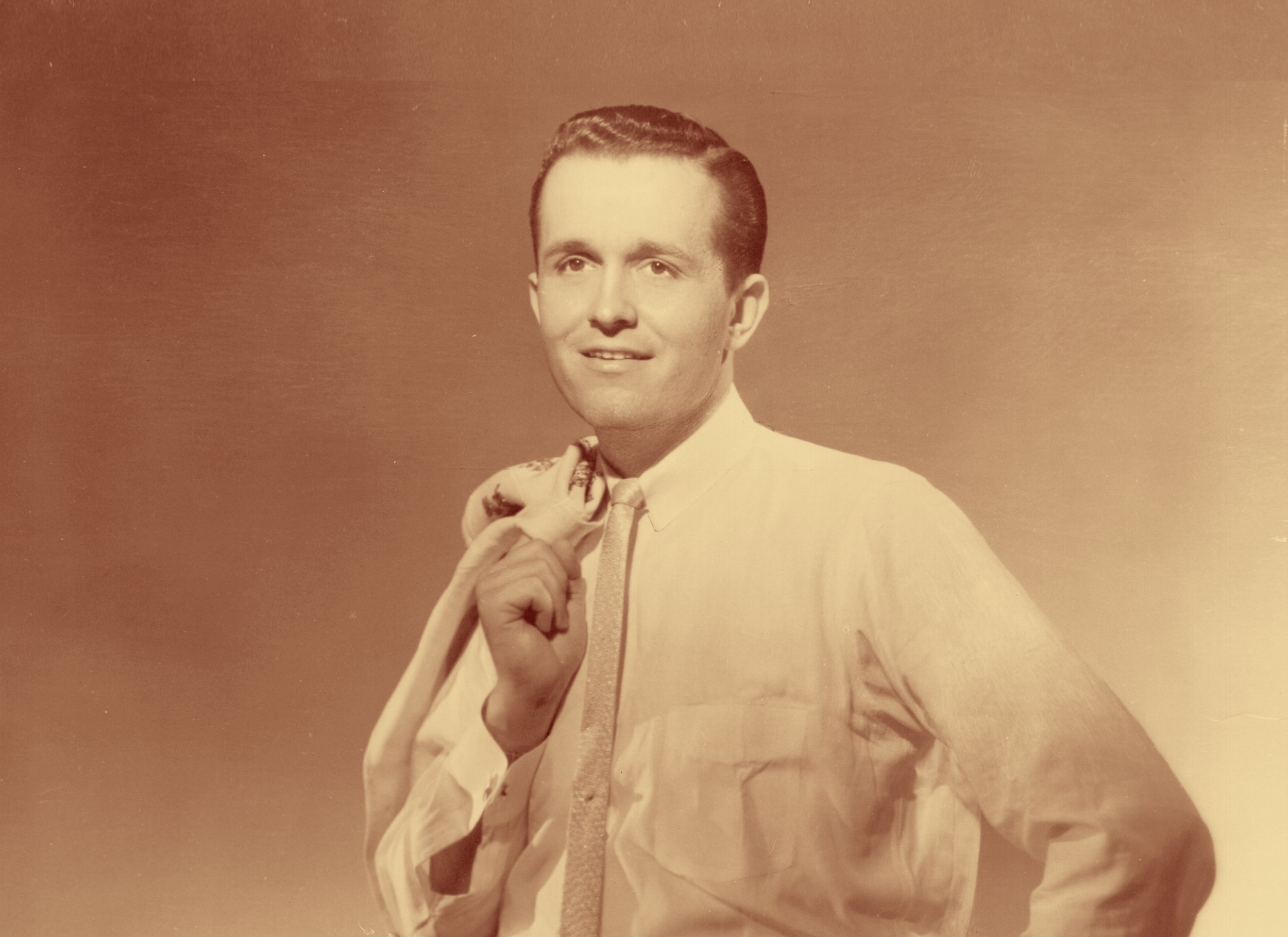
Bill Anderson in a Decca Records publicity still, July 1961. (Photo by Michael Ochs Archives / Getty Images)
Back in early 1961, Bill Anderson and Willie Nelson were both new to Nashville, two young songwriters with dreams of becoming stars as artists, as well. But Bill, who beat Willie to Nashville by a year or so, was further along with his dream. In 1958, Ray Price had spent thirteen weeks at number one with his cover of Bill’s “City Lights,” and by the end of 1960, Bill had scored two top ten hits of his own as a singer. As for Willie, Faron Young’s version of his song “Hello Walls” was climbing its way to number one, but Willie himself had yet to chart as an artist. So, when he stopped by Bill’s office, guitar in hand, he was hoping to get Bill to record another new song he’d just written, “Funny How Time Slips Away.”
“He sat down and started singing, ‘Well, hello there. My, it’s been a long, long…’” recalls Bill now. “And when he got to the end, he just kind of looked at me, like, ‘Well, what do you think?’ And I said, ‘I think it’s too much like “Hello Walls.” I don’t think it’s going to be a hit, and I don’t think I want to record it.’” Whatever disappointment Willie felt in the moment dissipated soon enough. Country singer Billy Walker cut the song and released it that summer, taking it to number twenty-three, which was enough exposure for “Funny How Time Slips Away” to start getting covered by artists from all over, repeatedly hitting on the pop and R&B charts and ultimately earning a spot in the Great American Songbook.
In this week’s One by Willie,Bill dives deeply into that history, describing not only his first meeting with Willie, but also the way the tightly-knit generation of young songwriters who moved to Nashville around the time they did, absolute legends like Harlan Howard, Hank Cochran, Roger Miller, Loretta Lynn, etc., grew the town into Music City U.S.A. Using “Funny How Time Slips Away” as his thesis-statement example, Bill gives a masterclass not just in how to write a great song, but in country music history and Willie’s singular place in it—punctuated with memories of hanging with Willie through the intervening decades, and dogleg digressions on their old friends Harlan, Hank, Roger, and Ray Price.
And then, as Willie and Bill are both very much still active as country songwriters and artists, we take a second to listen to a new composition that Bill had just written and Willie just recorded, “Christmas Love Song.” We taped the interview last October, before the single had been released; our listen to the rough mix was Bill’s first chance to hear it. His pride and appreciation are unmistakable.
One by Willie is produced by John Spong and PRX, in partnership with Texas Monthly. The PRX production team is Jocelyn Gonzales, Patrick Grant, Pedro Rafael Rosado, and project manager Edwin Ochoa, with graphic design by Joanna Holden and Modular, ink. The Texas Monthly team is engineer Brian Standefer, and executive producers Megan Creydt and Melissa Reese. And Dominic Welhouse provides invaluable research and editing help.
John Spong (voiceover):
Hey there, I’m John Spong, and this is One by Willie, a podcast in which I talk each week to one notable Willie Nelson fan about one Willie song that they really love.
This week, Whisperin’ Bill Anderson—who’s a Country Music Hall of Famer; a million-seller many, many, many times over, as both an artist and a writer; a 65-year regular on the Grand Ole Opry; and almost certainly, the only living country songwriter who got to Nashville before Willie did—talks about one of Willie’s earliest entries into the Great American Songbook, “Funny How Time Slips Away.”
Now, as that ridiculously abridged list of achievements indicates, Bill didn’t just witness country music history, he made it. Along with such legends as Harlan Howard, Hank Cochran, Roger Miller, and of course Willie, he was part of the generation of songwriters who moved to Nashville around 1960 or so and turned it into Music City, USA. And that experience and those memories are what he brings to this episode, as he uses Willie’s example to give a masterclass in not just how to write a great song, but also in country music history and Willie’s singular place in it…all punctuated with stories about hanging out with Willie through the decades, and wonderful, dogleg digressions into he and Willie’s old friends Harlan, Hank, Roger, and Ray Price.
Oh and he’ll kick it all off with a little bit about his own, somewhat tortured history with “Funny How Time Slips Away.” I suspect you’ll dig it greatly.
So let’s do it.
[Willie Nelson performs “Funny How Time Slips Away”]
John Spong: Where we start then is with your focus song, and it's "Funny How Time Slips Away.” And normally, I say, "What's so cool about that song?" but it's so familiar to everybody [that] I don't have to start there. And part of the deal is you chose this song for a special reason. And so, can we start there?
Bill Anderson: Yeah, because when I talk about this song, I talk about how smart Bill Anderson was…not! Willie Nelson came up to Tree Publishing Company in the old days, and we're talking, what, early 1960s, I guess? With an old archtarp…tarp–Hello, that's easy for you to say!–archtop guitar. And he said, "I got a song I want to play for you that I just wrote." And he sat down and he's, "Well, hello there. My, it's been a long..." And I'm thinking, "Whoa, okay. That sounds very strikingly familiar to “Hello walls. Hello." And he's pitching me "Funny How Time Slips Away” with an idea that maybe I would want to record it. And he sang it, and it's this beautiful song, ad when he got to the end, he just kind of looked at me like, "Well, what do you think?"
And I said, "I think it's too much like ‘Hello Walls.’" And I said, "I don't think that it's going to be a hit. I don't think I want to record it." But what I didn't realize, and what we've all come to realize since then, is everything Willie Nelson sings has got that Willie Nelson phrasing. And had somebody, had you come in and sung, “Well, hello there, my…” it wouldn't have sounded like “Hello Walls.” But Willie Nelson, it sounded like “Hello Walls,” because he could make the national anthem sound like “Hello Walls” if he wanted to. But I said, "No, I think I'll pass on that song."
And then of course, next thing I knew it was a big country hit by Billy Walker. And then half the world recorded it after that.
John Spong: And yeah, because I thought about that, and it was such a different world back then. Yeah, Billy Walker takes it...Billy Walker was not near the big deal you were in 1961. If my research is right, your last three singles had been top 10, and the three before that were top 20. And Billy Walker hadn't gotten anywhere near that kind of success, but then he had a pretty big hit with this when he did it.
Bill Anderson: Oh yeah!
John Spong: But then all these people started doing it. And every one of them had a pop crossover with it. Before Willie even got it out, there were I think three versions that were all charting on the pop charts, on the pop singles charts.
Bill Anderson: And I'm standing over in the corner saying, "That sounds too much like ‘Hello Walls.’" Which just shows you how smart I wasn't.
John Spong: Well, maybe can I spin it for you? Can we listen to it together? Willie's version?
Bill Anderson: Well, it hurts, but okay.
John Spong: And so, what I'll bring, because Billy Walker did. He put it out in 1961. And Willie put it out for the first time, I think in 1962, on his debut album with Liberty. But then he put it out again in ‘65, with Chet Atkins producing at RCA. And so…
John Spong: So, let me hit play.
[Willie Nelson performs “Funny How Time Slips Away”]
Bill Anderson: Hello walls.
Bill Anderson: Mmmmh.
John Spong: What's that do for you?
Bill Anderson: I was looking at the lyric as I was listening to Willie sing, [and] I had all kinds of thoughts. Number one, if somebody were to write that song today, just an obscure writer, and take it into a publisher, the first thing the publisher would say, or a record executive would say, is, "Where's the chorus?" There's three verses.
John Spong: Right.
Bill Anderson: Just one, two, three verses. The same melody, no chorus. But what a story it tells you. It paints such a vivid picture of this couple just bumping into each other. I thought of Conway's “Hello, Darling” as I was listening. That's a little bit the same type of a song. I thought, "My goodness, Willie's voice sounded so great on there, so clear."
And you could understand every single, little word that he said. And he sang it so great, just the way it needed to be sang. He didn't oversing it. He just kind of let the song come to him, and he brought it to us. And I got mad at myself all over again for turning it down.
John Spong: Well, I love that you brought up the no-chorus thing, because I know from reading you and hearing you talk about songwriting, that one of the things you say is that there's rules, and some of the best songs are songs that break rules. And not having a chorus in there is one. And Willie often didn't. There's no chorus. He does it a lot, in this period, especially. It's just a tagline at the end of each verse that is the title of the song, or the thought of the song, or whatever.
Bill Anderson: I've written a lot of songs like that without a chorus. Not as many today because I co-write a lot today, and you can't hardly talk a co-writer into writing a song without a chorus. The first thing they say is, "We need a chorus." And sometimes I say, "No, we really don't."
John Spong: Well, will you walk through the song with me? Because I love the way he, to me, he builds this tension in the song and then there's a reveal, and then there's...what do you see him doing? How do you see this song unfolding? There was a great quote from you, where you said, "A song can paint a neat little picture, an intriguing story, but it has to also give a reason to care. It has to have a purpose." Where does that come out in here? How does this go from just being a neat picture to being something deeper?
Bill Anderson: Oh, at the end, where he's obviously still got feelings for this person to a degree, but at the end, “Remember what I tell you, in time you're going to pay. And it's surprising how time slips away.” I mean, he kind of sticks that knife in and twists it there at the very end, and it takes on a whole different personality, which is brilliant. He probably had that in his mind from the very beginning when he started the song, he probably knew where that was going to go. And if he didn't, he wrote himself right to that point, and he knew what to do with it.
John Spong: And I love that idea, because it does, it unfolds so organically and kind of at its own pace. Like, he says, "It's been a long, long time. How am I doing? Oh, I guess I'm doing fine." There's no indication there that he is or isn't. But then that first line of the next verse, "How's your new love? I hope he's doing fine." And then it's like, "Oh, this is an old girlfriend he's encountered on the street. And I think he's still pretty tore up about it.” It kinda, it reels you in.
Bill Anderson: And then he takes that title line and makes it mean almost three different things in those three verses. Where he's talking there about a relationship, “It's been so long since I've seen you. It seems like only yesterday…funny how time slips away.” And then the fact that, “That's the same thing you told me, seems like just the other day. Gee, it's funny how time slips away.” And then the fact that, "Oh, baby, you're going to get yours, and you're going to pay–and you'll be surprised how fast time slips away." It's a brilliant song, and it's brilliant in its simplicity.
And I remember, Owen Bradley used to have a saying. The great record producer–he never produced Willie, but he produced a lot of my records–and when we'd try to get a little too fancy with a song, or a little too fancy with an arrangement, Owen had a saying, he'd say, "Boys, Baskin-Robbins has got 31 flavors of ice cream, but vanilla still outsells them all." And that's what Willie did in this song. That's vanilla ice cream. With a cherry on top.
John Spong: Yeah. Done really, really well.
Bill Anderson: Really well, yeah.
John Spong: Well, and if I read, I think I saw that he said that he came up with that tagline first. “It's funny how time slips away” is just something folks say all the time. And he thought, "Huh, there's no song on that. I can build a song around that line." And that's the way you guys did it so often, right? You and Harlan Howard and Hank Cochran and those guys who were all there with Willie in the early '60s, it was a line that would send you somewhere, right?
Bill Anderson: Most of the time, yeah. Some songwriters write from a melody or a feel. Like, they'll get a little guitar riff going or something, and then they'll kind of make a lyric fit the melody, or the tempo, or the feeling of this song. But the way that we wrote them back then, and I still do when I work on songs even today, I like to write from that idea. I like to write from that different lyrical perspective and try to say something in a way that perhaps has never been said on a song before.
And a great saying like "funny how time slips away” or something very close to that is just a pure natural for a song. That recognizing that, pulling that out of thin air as it were and turning it into a song, that's where the genius comes in. That's why you look at Willie Nelson's body of work and know that he was and is something very special as a writer.
[Willie Nelson performs “Funny How Time Slips Away”]
John Spong: Well, that takes us to back when you would've first met him. You got to Nashville in ‘59?
Bill Anderson: I started coming here in the late ‘50s. I didn't move here until January of 1960, but I was coming here some in 1959. And I don't know when Willie actually came to town. I guess he came to town in 1960?
John Spong: I think that's right. I think that's right.
Bill Anderson: And the first time I ever met him, Hank Cochran introduced him to me, out at Pamper Music Publishing. I had gone out there to meet with Hal Smith who ran not only the publishing company, but a talent agency. And Hal and I were talking about the possibility of his representing me as a talent agent, booking my show dates and all that on the road. He was booking Ernest Tubb and later, of course, booked Willie Nelson and a lot of other people. And while I was out there that day, Hank was there and he had this new writer with him. And he introduced him to me, and his name was Willie Nelson. Wonder whatever happened to him.
John Spong: Yeah! Well, and for folks that maybe don’t remember, so Hal Smith and Ray Price had Pamper together. And I think Hank brought Willie in, brought Harlan in, and that was the publishing company. That was these kind of young Turks, for lack of a better term, that were coming in and mixing it up a little bit, and writing some of these great songs.
Bill Anderson: And sitting off the beaten path. There was no Music Row in those days, but most of the music business was downtown, other than Acuff-Rose, which was out south of town. And here's Pamper music in this little old white clapboard house out in Goodlettsville, in the middle of nowhere. And all of a sudden they're turning out more hit songs than all the companies with the big offices downtown.
John Spong: And Willie and Hank in the back, like in a–I've seen pictures, [and] it looked like a really nice tool shed. It was, I guess, the garage behind the house where they would just sit out there and write.
Bill Anderson: That's where I met Willie. Right there.
John Spong: Wow. You've described you guys–and I say “you guys,” because you're right there with them. And “City Lights” was the song of the year in ‘58, that you wrote, that Ray Price had the big hit on–
[Ray Price performs “City Lights”]”
–you've described that period as kind of a changing of the guard, and kind of the end of the Hillbilly era, as Roger Miller is there, Harlan, Hank, Dolly Parton shows up soon, Mel Tillis, Loretta gets there, I think, in ‘61, Tom T. Hall…what was different about what y'all were doing? What had been there befo- …What was country songwriting before? What was country songwriting before you guys got there and what was it afterwards? What did y'all do that was a little different?
Bill Anderson: I don't know that we did anything consciously. I think we just kind of brought our own influences and our own backgrounds and all to what we were doing. You go back into the late '30s, the early '40s, they were singing songs like, “Whiskey and blood run together, and I didn't hear nobody pray at the wreck on the highway”...
[Roy Acuff and His Smoky Mountain Boys perform “Wreck on the Huighway”]
…and we came…I think what we did as much as anything is…Hank Williams kind of opened that door in the early '50s when he was writing “Cold Cold Heart” and “You're Cheating Heart” and “I'm So Lonesome I Could Cry,” and these things…
{Hank WIlliams performs “I’m So Lonesome I could Cry”]
…he was taking country music to a new place. And I think what we did was maybe just extend what he was doing, amplify on it a little bit. I mean, “I Fall to Pieces”
[Patsy Cline performs “I Fall to Pieces”]
…is not a whole lot different from “You Win Again”...
[Hank Williams performs “You Win Again”]
We just kind of expanded on, I think, what Hank Williams had really done to open that particular door. And he began to take country music in a little different direction, and we just kind of expanded on that.
John Spong: And when you mentioned a second ago, there wasn't a Music Row yet, it's easy for people my age and younger to forget that country music wasn't always based out of...Nashville wasn't the home of country music, initially. Or it wasn't the only place. And so, Boudleaux Bryant was, I think, the first full-time songwriter in Nashville, maybe? In the '50s? And so, prior to you guys getting there, songwriting didn't all take place there in Nashville. It wasn't like a community of writers prior to that time.
Bill Anderson: No, it really wasn't. Boudleaux and Felice [Bryant], of course, were here. Vic McAlpine was here. He was writing hit songs. There were writers here in town. I can't just pull up…Cindy Walker, of course, from down in Mexia, Texas, and then a little Jewish guy from New York City named Cy Coben, [were] writing hit country songs, and they were coming off of the West Coast. Not too many of them coming out of the old cowboy black-and-white Western movies, those kinds of things. But occasionally, songs were being written out there. No, there was not that real solid songwriting community here.
I guess we really started that with Hank and Harlan and Willie and the ones that you mentioned, me and Mel and Tom T. Hall and all the ones of us that came here about that time between 1960 and, I'd say, 1964 or 1965.
John Spong: And so, how would it go? How would you get songs in front of each other? I mean, I know what I've read, but I want to hear it from you.
Bill Anderson: Well, one thing, before we really get into all of that, you got to realize the rules were a little different back then. I could not write with Harlan Howard, because Harlan Howard wrote for Pamper Music and I wrote for Tree Music. I could not write with Mel Tillis because Mel Tillis wrote for Cedarwood and I wrote for Tree. There were all of these walls. If I wanted to write a song with a writer who was signed for public representation through ASCAP, I was a BMI writer. Still am. And I could not write with an ASCAP writer.
So, all of these walls were up there. And that's one of the reasons, I think, that there was not more co-writing done in those days. Hank and Harlan wrote together. Roger and I wrote one or two little songs together. But you kind of had to be in the same family and the same camp to write together.
John Spong: I see.
Bill Anderson: So, those were restrictions and walls up there. And Willie is one of the reasons those walls no longer exist. Because when Willie and Waylon got involved in the Outlaw movement, or whatever you want to call that time, they just made music. And they told the executives, “Y'all figure out what to do with it. We've made it, we've written it, we've created it. You guys figure out how to handle all the legalities.” And what that came down to was, was “You guys tear down those walls so we can all write and create together.” And I think that's one of the greatest moments in the last 50 years of country music history. Tearing down those walls.
John Spong: I've never thought about it that specific way. And I love that, because one thing I had realized a while back was, Wanted! The Outlaws is an RCA album. Willie has just hit with Columbia, with Red Headed Stranger, and it's like, “Wait, he's going to show up on this other…this label where he used to work, actually, for a long time. He's not there anymore, but he's going to show up over there?” And it's because the point was to make great music together.
Bill Anderson: Well, that's what Willie and Waylon were able to do. And Jerry Bradley, who produced the Outlaws album and all, it just said, "Okay, here's the music. Let's don't let anything stand in the way of the music, because that's the number one thing."
[Willie Nelson performs “Funny How Time Slips Away”]
Bill Anderson: Can I tell you what I did on the way to the studio to talk with you today?
John Spong: Hell yeah.
Bill Anderson: I had an incredible experience. Let me take you back to the early 2000s. Back when satellite radio was new, I got hired by XM Satellite Radio to host a show called Bill Anderson Visits with the Legends. And I would go in about once a week and record a show with everybody or anybody that I could get to come to the studio and talk to me. And I would sit there and just visit with them, like you and I are doing here. We're just talking and visiting and having a good time.
And one of the first people that I did one of those Visits with the Legend shows with was Willie Nelson. And today, on my way to the studio, I went by my office, and I dug into a stack of CDs, and I found the CD of me visiting with Willie Nelson. I put it in the CD player in my car–which tells you how old my car is–and I laughed from the time I pulled out of my driveway at home until I pulled into the driveway here at the studio where I am visiting with you today. Willie, I mean, he just told story after story, and I only got about halfway, or maybe a third of the way, through our visit and listen...I can't wait to go back and get in the car and turn it on and listen to the rest of it, because it's an incredible piece of radio.
John Spong: Oh, man. Oh, man. Can you give me a taste? What did he say?
Bill Anderson: Well, wait. A story that I don't remember having heard before–obviously, I was there and I heard it when he told it, but I had forgotten it. He was talking about a time when he was 15 or 16 years old, and he was going into the radio studio a couple of times a month and singing with Bob Wills and the Texas Playboys.
John Spong: Oh my God.
Bill Anderson: I think he said this was out of Fort Worth. I don't know. I've always associated Bob Wills with Tulsa, but anyway, this was out of Fort Worth. Bob Wills was doing a show, and Willie Nelson, as a 15-, 16-year-old kid, would go in there and sing. And the way Willie told the story, it was so funny, because he said, "Now you take the song, ‘San Antonio Rose.’" He said, "I would sing that," but he said, "I did not phrase it nearly the same as Tommy Duncan, who was the great vocalist with Bob and the Texas Playboys."
And he said, "I would look over in the corner, and I would be singing it, and I'd be way off-beat. And Bob would be standing over there getting ready to come in with his ‘A-ha!’” And he said, “Bob wouldn't know where to come in, because my phrasing was so strange, and he was used to coming in one place when Tommy Duncan was singing. And then when I would start singing, he had no idea where to come in.” He said, “I'd look over there, Bob would just be standing there with his mouth hanging open, waiting for a place to jump in.” I just thought that was just an incredible picture that he painted.
John Spong: That's awesome. That's awesome. Well, but wait, back to Nashville in the early '60s, you guys can't write together, but you do assemble, right? Because Tootsie’s was the place. If I remember, I think it had been Mom’s until about the time you got there in ‘60. And then suddenly, there's this new group of writers in town, and that's where you assemble. You wrote during the day and then would show up and workshop things, woodshed things at night? How did it go?
Bill Anderson: Well, yes and no. Like you say, there were those walls there. We could share, but we couldn't create together. And that was frustrating. It's frustrating to sit there with somebody and know that you could write a song together–and yet you couldn't write the song together. And so, it would be a little bit of, “Okay, well, I had this idea, and you had this idea.” And you kind of go back and forth. And then of course, it wasn't just the writers there. Faron Young would come in and kiss Willie Nelson on the mouth, or whatever.
John Spong: Or vice versa. Faron was always insistent it was Willie that kissed him.
Bill Anderson: Give, what was it? Give somebody a 500-pound cow or something? I don't know. Tootsie’s was a gathering place. Of course, it was right across the alleyway as it still is from the Grand Ole Opry, or from the Ryman Auditorium. Yeah, there was a lot of camaraderie, I think, among the songwriters back then. I started to say more than today, and it probably was. I don't know that the writers and people, they write together, but I don't know that they hang out together and enjoy things together like maybe we did back in that time.
John Spong: There's always a supposition maybe that there might be some competition with it and maybe there was. But it's also, if you're among the greatest writers in the world, you're writing for each other a little bit, right? If Harlan Howard says, "Oh, that's a special song, that's going to be a hit,” you get to feel like you got something there, right?
Bill Anderson: Harlan told me one time that I was the inspiration for a lot of his songs. And I said, "What do you mean?" He said, "Well, I'll turn on the radio, and I'll hear a new Bill Anderson song and said, it'll knock me out and I'll go home and write 10, trying to write one." I remember specifically one song, I had written a song called “Face to the Wall,” that Faron Young had recorded and had a pretty good-sized hit on…
[Faron Young performs “Face to the Wall”]
…and Harlan just loved that song. And he said, “The first time I heard it,” he said, “number one,” he said, "I spent my first hour cussing you out for writing it." And then he said, "I went home and tried to write 10 songs just like it–or to get one better."
And he did. Because I remember one year, I think it was 1964, I won five BMI awards, for writing five hit songs that year. And I thought, well, that was a pretty good year–till I looked up and realized Harlan Howard had written 10. So, we played a lot of Can-you-top-this? back in those days.
John Spong: Oh, I love that. Well, and I think…I was talking to Guy Clark and Rodney Crowell once and they were saying, the deal was you would be sitting at a bar with Harlan, and he'd be staring into his White Russian and acting like he wasn't paying attention. As soon as you went to the bathroom, he would write down something funny you had just said, and the next thing you know, he's got a song on it.
Bill Anderson: That's a pretty good description. My favorite Harlan-Howard-and-the-White-Russian line was the day that Harlan was sitting at the bar in a little restaurant called Maude's Courtyard. Pretty sure it happened at Maude's. Anyway, this young writer came in, and he sat down next to Harlan. Of course, he knew who Harlan was. Harlan had no idea who this young writer was. And this young writer starts complaining. "Oh, nobody will listen to my songs. Nobody will cut this." Just carrying on and moaning and groaning about how terrible the music business was.
Finally, Harlan took a sip of his White Russian and turned to this guy and says, "Well look, pal, nobody sent for you." In other words, nobody asked you to come here and go through all this stuff you're complaining about, nobody sent for you as much as to say, "Well, go home."
John Spong: So, how does Willie fit in with that? I think Hank even said, he said, "Willie was a little weird." Hank said, "But I'm from California, so maybe I'm a little out there too. So, he fit just fine for me.” But what was Willie like? Were there things that kind of distinguished his songwriting? Were there characteristics to a Willie song that were only his?
Bill Anderson: Oh, yeah. Only, you know, you listen to them, and aside from, if he was singing it, his own phrasing and his own stylistic thing, Willie wrote and continued, I think, down through the…Willie wrote, I don't mean this to sound derogatory in any way, but he wrote simple. You didn't have to really do a whole lot of fancy thinking to figure out what Willie was trying to say, which is a lesson we should all try to learn. Write it simply. Say it where somebody understands it. And yet say it in a way that maybe it hadn't been said before.
John Spong: I thought it was interesting. There's a darkness to some of those songs too. I mean, it's like, “I Fall to Pieces” is sad. “Heartaches by the Number” is sad in concept, but I mean, actually if you listen to it, you can hear how much fun they were having writing it. I mean, it's all about the joy of songwriting, I think, that one is. But then you get to Willie, and you have, "I've Just Destroyed the World I'm Living In.” Or “Darkness on the Face of the Earth." But he seems to, I don't know…he's mired in something, but he also seems to be having a pretty good time. There's a playfulness to it still, anyhow. I don't know.
Bill Anderson: Yeah, there is. The song that popped in my mind, one of my favorites of his, “The Healing Hands of Time.” That's almost a little playful, in that you hear of “healing hands,” like a doctor or a nurse or somebody, and then Willie to take it and refer to the hands on the clock and the healing hands of time. That's almost serious and sad…and a little playful at its core.
John Spong: Well, and yeah, there's more hope in it than in a lot of those other Willie songs from that era. “You will get better” is not the theme of a lot of these…it's not the theme of "Funny How Time Slips Away” at all.
[Willie Nelson performs “Funny How Time Slips Away”]
John Spong: Do you remember Dunn's Trailer Court?
Bill Anderson: No, I can't say that I do. I don't think I ever lived there.
John Spong: Well, that's the thing. That was where Willie first stayed when he got to Nashville. And I did, I saw an interview with Hank Cochran, and he said that when he made the arrangement with Pamper to get Willie the job–and famously, Hank was due…Pamper [and] Hal Smith had said, "We don't have space on the roster for this guy." And Hank said, "Well, I'm due a $50 raise. Give that $50 a week, out of my pocket, give that to Willie and let's hire him." And Hal said, "Okay." So, Willie's got a job, which is a very big deal to Willie and his wife and their three kids.
And so, he takes Hank to the trailer park where he's living, Dunn', and when they get there, Hank just shook his head because Hank had lived in that very trailer park when he first got there–in that very trailer! And supposedly, supposedly, and you guys tell great stories, so I always wonder a little bit, but supposedly Roger Miller lived there in the time between when Hank left and Willie got there.
Bill Anderson: I don't know about that. I knew Roger pretty well. Roger and I met each other down in Atlanta when he was in the army, and I was working as a disc jockey and still going to school. Working on a little radio station down there. So, I met Roger before either one of us ever came to Nashville. And I'll tell you a funny thing. Roger and I would get together; every time they'd bring a big Grand Ole Opry show to Atlanta, Roger and I would be the local kids trying to get in backstage. We wanted to meet everybody, drive everybody crazy, play them our songs. And we kind of made a deal with each other.
We both wanted to come to Nashville. We wanted to write songs. We wanted to perform. We wanted to tour. We wanted to do whatever this crazy music business thing was all about. And we made a deal that whichever one of us got to Nashville first, he would try to help the other one get there. Roger got to Nashville before I did, and he stayed true to his word. Because when it came time for me to really make my break and leave Georgia and come here, after “City Lights” had been a big hit for Ray Price, Roger opened a lot of doors.
He introduced me to Buddy Killen at Tree Publishing, Buddy introduced me to Owen Bradley at Decca Records, and one thing just fell from another. But had it not been for Roger Miller and the things that he did…you know, we all think of Roger as the happy-go-lucky, “Trailers for sale or rent,” “Dang me, they ought to take a rope and hang me”...
[Roger Miller performs “Dang Me”]
…but Roger had a very sensitive and serious side to him, and I will always be grateful for what he did for me.
John Spong: I remember reading that Buddy Killen said, "You just follow Roger around, because every single thing that comes out of his mouth is a potential song."
Bill Anderson: That's right. We just followed him around and picked up his droppings.
John Spong: Didn't expect you to go there!
Bill Anderson: The thing of it is, John, he would say these things, and you'd turn him and say, "What did you just say?" And he'd say, "When? What?” He was the poster child for ADD. I mean, he'd say these great things, and then he couldn't even remember what he said.
John Spong : Oh, man. So, when we listened to “Funny How Times Slips Away” just now, it was the version produced by Chet Atkins. And I'm curious about Chet, because I grew up in Austin in the '70s and '80s, and the shorthand, kind of nutshell version of Willie's career, particularly in Austin, is he went to Nashville, Chet and RCA tried to make him do things that didn't make sense, and they were bad ideas, and they were mean to Willie, and it's only when he got to Austin that everything took off. And I don’t…I think…I don’t think that’s…it's not as complicated as what [actually] happened, and I don't think it's even all that accurate. Nashville loved Willie in the '60s, right?
Bill Anderson: They loved him, but they didn't understand him. And as he said on that interview that I was telling you about listening to on the way down here, we talked a lot about that, and he said to me, “They didn't know what to do with me.” He was not bitter toward Nashville at all. Was not bitter, of course, towards Chet or anybody. Willie was so different that he just didn't fit into the same box that they were trying to fit everybody else into. Nashville loves a parade. Once something happens and is successful, everybody forms the parade to the rear and tries to do the same thing. And you couldn't follow Willie, because as Roger Miller said, “He marched to the beat of his own plumber.”
John Spong: Well, as I understand it, and then actually correct me if this is a little off, Willie did, he wanted to make it as a star. And the things that Chet and RCA were asking him to do were the things you did to be a star, then. Now, they weren't a great fit for Willie and so it didn't work, but yeah, he went along willingly, is my impression.
Bill Anderson: You know what happened? They finally caught up with him when they let him be himself. Quit trying to make him be everything else. Let him be organically Willie, which is what he was from the beginning. He just wanted to be himself. And finally the world caught up with him.
John Spong: It's a perfect segueway then to this other thing I wanted to get into with you. And it goes back to what you were saying earlier about Roger Miller. When Willie does make it–and by the early '80s, he’s as big a star as there's ever been–one of the things that he did, that I always thought was really cool, was he made these duets records with Ray Price, Webb Pierce, Hank Snow, Faron Young, and Roger Miller. And they all came out on Columbia. These were major-label releases by guys, particularly like Webb and Hank Snow or Faron, who really hadn't had much going on for a long while.
And that seemed like a very Willie thing to do, to kind of lift up these people that were helpful to him when he got there.
Bill Anderson: Yeah. I hadn't thought about that, but that's...yeah, that was a very Willie thing to do. Yeah, because Ray Price had helped him. And Faron Young had helped him. And different ones like that. And he and Roger were contemporaries and friends. And yeah.
John Spong: A couple things, because one of the things that's so great, because the Roger Miller album, it's called Old Friends, and it's got…“Old Friends” being a great song Roger wrote, and they brought Ray Price in to sing it with them. And it was a top 20 hit. It's one of my very favorite Willie records, but one of the things that's so wonderful about the way Willie did that record, the way that record was done, was that all the songs on it are Roger, except for one, are songs that Roger wrote. So, Roger was going to get a different kind of payday when this album sold, than if it had just been the two of them singing old standards or something like that.
Bill Anderson: I didn't know that. That “Old Friends”...I can hardly listen to that. That'll come on the radio listening to, speaking of Willie, listening to Willie's Roadhouse, which we all do.
John Spong: Which we all do.
Bill Anderson: I don't know what we'd do without it. Every time they play that record, “Old Friends,” I either have to turn it down or I have to just pull over and just...I can't even hardly talk about it now. It just touches me very deeply. Because, particularly Roger being so good to me in the early days. And then Ray Price having the big hit on the first song that Bill Anderson ever had that anybody ever really heard…that record “Old Friends,” it gets to me.
John Spong: Yeah.
Bill Anderson: It really gets to me. ‘Course, I cry at ball games.
John Spong: Well, now I feel challenged. Can I play for you a different song off of that album?
Bill Anderson: Okay.
John Spong: Willie and Ray. Oh, Willie and Roger. And I’ll hold up the cover; let me see if I can get this going. That's the album, of course. And of course, it's Roger with his back to the camera.
Bill Anderson: Now, according to Roger, everybody else had their back to the camera. He was facing the right way. The camera was just on the wrong side.
John Spong: “What's wrong with you people?” That's so good. Well, leave all this up. Listen to this one.
Bill Anderson: Yeah.
[Willie Nelson and Roger Miller perform “When Two Worlds Collide”]
Bill Anderson: You know? I don't think I've ever heard that before.
John Spong: When I was looking into it, I'm pretty sure that was your first Willie Nelson cut.
Bill Anderson: Probably was. I was thinking before I came out here today, what songs of mine Willie had recorded. Because what a great compliment for a great songwriter like Willie Nelson to record anything that you wrote. And I thought of three things that he had recorded, but I did not realize he had recorded “When Two Worlds Collide.” Wow.
John Spong: You wrote that with Roger?
Bill Anderson: Wrote that with Roger. Roger went around…there was a big science-fiction movie, back in the late '50s, called When Worlds Collide. And Roger kept saying for years, he said, "I want to write a song called ‘When Worlds Collide.’" And I said, "Roger, you can't do that because that's the title of a movie." I said, "You wouldn't write a song called ‘Gone with the Wind,’ would you?" He said, "Yeah, I would."
John Spong: “Yeah, I would.”
Bill Anderson: And he probably would have. But one day, he came to me and he said, "All right, I figured it out." He said, "What if we call the song ‘When Two Worlds Collide?’" And I said, "Well, that's perfect. Sure, we can write that." So, we got in the back of his little Rambler station wagon headed for San Antonio one night, and had a young singer with us named Johnny Sea. And we let Johnny Sea drive, and Roger and I got our guitars out and sat in the backseat of his little Rambler Station wagon and wrote “When Two Worlds Collide” riding down the highway together. Only song we ever really wrote together. We tried a couple of other times, but that's the only one that ever clicked.
John Spong: It became a standard.
Bill Anderson: And it clicked real well.
John Spong: Yeah. Yeah. Well, and Willie's cut “City Lights” a number of times, did it on that great Ray Price tribute record a few years ago that he–
Bill Anderson: That's right. And I left that one off of my list. Okay, we're up to five now. Tell me some more, please.
John Spong: Well, that brings us to…you've got a Willie cut now, or by the time this airs, the song will already be out, but what's coming up?
Bill Anderson: Yeah, I'm excited about this new one. Very excited about it. A Christmas song that Bobby Tomberlin and Marv Green and I sat down–we actually wrote this song for Willie. I've very seldom in my life, have ever sat down and said, "Okay, I want to write a song for somebody." I've never tried to do that. I just always say, "Write the song and let it find its own home, find its own way." But we heard that Willie was looking for a Christmas song, and we deliberately sat down and wrote this song for Willie, called “A Christmas Love Song.”
John Spong: And so, and I will…I would love to play it for you. I've got a rough mix of it. What did you put in there that you thought would make it appropriate for Willie? What'd you do?
Bill Anderson: Some of the phrasing. We thought Willie would maybe say it this way, say it that way. Not clutter it up with a lot of words, leave some space in there for him to be Willie. And write it in a positive way, because I've never been around Willie at Christmas, but I've got a feeling just knowing his general nature that he probably likes Christmas a lot. And he probably has a lot of positive thoughts about Christmas. And we tried to keep the song in a very positive tone.
John Spong: Well, then let me play this for you.
Bill Anderson: You're going to play something I've never heard. Thank you.
John Spong: I'm so happy to be here with you today. I'm so grateful for this time.
[Willie Nelson performs “Christmas Love Song”]
Bill Anderson: Yeah. I guess you notice we snuck “pretty paper” in there.
John Spong: I thought that was wise. I did notice that. On the first pass.
Bill Anderson: Wow. He sounds so good on there. Wow, goodness. And let me take just a second here to compliment my friend, Buddy Cannon, who's a great record producer. Buddy just seems to know exactly how to make the music fit Willie's style and Willie's singing. These records that they've done in these last few years, everything from “Roll Me Up and Smoke Me When I Die” to “You Can't Get Over It, You Just Get Through It,” or whatever that title is…Buddy just…I was so aware as I was listening to that, how well the music…it’s Willie, and yet it sounds fresh. And it's Buddy at his best, and Buddy and Willie at their best. Yeah, I love that.
John Spong: Isn't that great? And Buddy's done such a great job of…he gets players that he knows can be a little bit loose. Because it needs to be loose for when he takes the tracks to Willie to do his thing on top of it. And so, they leave some space. They don't make everything too perfect. They just kinda…they make it feel lived in. And so, Willie takes it.
Bill Anderson: That's what we tried to do with the lyric. It was tempting to…that lyric would've been real easy to have overwritten, if we hadn't been careful with it. And there were a few times we had to just kind of reign each other back in, say, "Wait a minute, Willie wouldn't do it that way or say it that way or feel it that way." Tried to leave space in there for Willie to be Willie, and Buddy to be Buddy.
John Spong : I feel, as a Willie fan, I feel such a tremendous debt to Buddy for the things the two of them have accomplished over the course of the last 15 years. Nobody–except maybe you!--has that kind of success, and that kind of creativity, between 77 and 92. It's really something. And Buddy’s so humble about it.
Bill Andersonn: He's so talented. Yeah. And he loves Willie, and he loves the fact that Willie trusts him with this season of his career, that he can be such a big part of it. It's a wonderful team, just fabulous.
[Willie Nelson performs “Funny How Time Slips Away”]
John Spong: What have I forgotten? You've got a lot of stories. What have I not touched on? What burning issues did you bring to us?
Bill Anderson: Well, let's see. I made a few little notes. Let me see if I can read ‘em. Oh! Oh. One of the great lines of all time: Willie and I are on an airplane together back...he's already moved to Austin and things are really going well for him. And I think we're flying to Nashville. I don't really remember exactly, but we're sitting across the aisle from each other on an airplane. And I said, "Willie, can I ask you a question?" And he said, "Sure." I said, "You have…of course, you're from Texas, and that's part of it, I'm sure." But I said, "You've got such a big following. You've been so successful in Texas. And I feel, like, that the Texas audience doesn't really appreciate Bill Anderson.” I said, "I've been to Texas many, many times. I love going down there. There's great fans down there and I love the music." I said, "But I just feel like the people in Texas don't really...they just don't like me. And what is the reason?"
And in all seriousness, Willie looked across the aisle, and he said, "Bill, they haven't heard you yet." He said, "They drink beer in Texas louder than you sing." I knew then I had a friend for life, who would say something that honest, and that funny, and probably that true, to me. I have treasured that and will treasure that till the day they lay me down. “Bill, they drink beer in Texas louder than you sing.”
John Spong: Oh, that's good. That's good. That's it. I've got one other question, but that's plenty, but I guess just to make sure that I've checked all of my boxes, I was curious, you are one of the few people alive who can remember, who experienced country music before Willie was a cornerstone of it. Even before he became a star, “Hello Walls” and “Crazy” and "Funny How Time Slips Away”--those were already in the Great American songbook before people even necessarily realized he had written them. Is country music different because of Willie Nelson?
Bill Anderson: I would hate to think what country music would look like without Willie Nelson's hand prints and footprints and song prints all over it. My goodness gracious, country music is different because of Willie. Country music is better because of Willie. Country music has reached more people because of Willie. I mean, what can you say? What area has he not impacted? I mean, songwriting and singing and performing…and just being the kind, giving human being that he is. Look at what he's given back with Farm Aid, and all these things that he's done. I mean, the world would be a totally different place without Willie. And it wouldn't be as good.
John Spong: I cannot tell you how much I appreciate this.
Bill Anderson: I appreciate it too. It's given me a chance to dig up some old memories in my mind and some old friendships and talk about people that have been very special in my life. And Willie and I have never been just close, I guess, like he and Waylon were, or maybe he and Roger, and some of the others. But my life is better because Willie Nelson has been a part of it. And I just appreciate the opportunity to talk about him, to say out loud what I've said and thought to myself many times over the years.
And that is what a great artist, and what a great man, and what a creative soul he is. And what a pleasure it has been for me to be able to share part of my life with the great Willie Nelson. Thank you for giving me the opportunity to talk with you and to talk about him.
John Spong: I'll give you $5 for a copy of that radio show you did with him.
Bill Anderson: $5, is that all?
[Willie Nelson performs “Funny How Time Slips Away”]
John Spong (voiceover)
All right, Willie fans. That was Bill Anderson talking about “Funny How Time Slips Away.” A huge thanks to him for coming on the show, and a big thanks to you for tuning in. If you dig the show, please subscribe, and stop by our website at onebywillie.com. Oh, and please visit our page wherever you get your podcasts and give us some stars or type in some comments. Or maybe just tell one friend to check out the show. Every little bit of that helps more than you know.
One by Willie is a production of John Spong and PRX, in partnership with Texas Monthly. Our PRX production team is Jocelyn Gonzales, Patrick Grant, and Pedro Rafael Rosado, with project manager Edwin Ochoa. Our Texas Monthly team is producer / engineer Brian Standefer, and executive producers Megan Creydt and Melissa Reese. Our art and web design come from Joanna Holden and Modular, ink. And we get invaluable research and editing help from Dominic Welhouse.
Please follow us on Instagram at onebywillie–all one word–find us on bluesky, and join our ever-expanding Willie conversation at the One by Willie group on Facebook.
I’m your host, John Spong…thanks for listening.