
The groundbreaking comedian looks at living outside the law, controlling your own destiny, and how he can tell from just one look that Paul English was a real-deal outlaw.
By John Spong
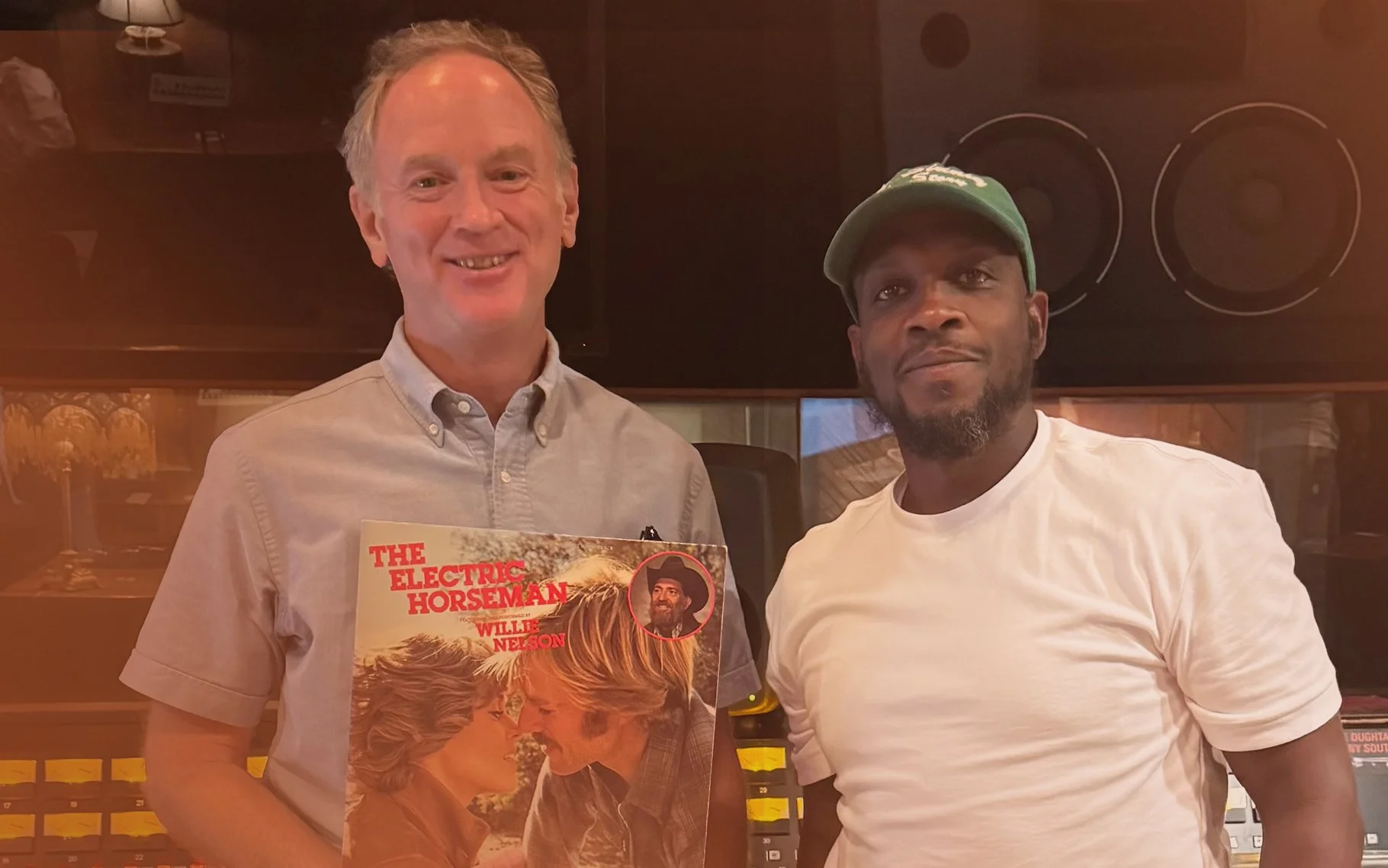
John Spong and Ali Siddiq at Arlyn Studios in Austin, August 5, 2025. (Photo courtesy of John Spong)
For comedy fans familiar with Ali Siddiq’s groundbreaking, 4-part special Domino Effect, his appearance on One by Willie will not surprise. The shows, which brilliant New York Times critic Jason Zinoman called “a genre-defying autobiographical epic,” follow Siddiq from his introduction into the drug trade in Houston’s Third Ward at the tender age of 14…to his career as what he calls a “street pharmaceutical rep” (a typical Ali observation, on flaring tempers in the workplace: “There’s no H.R. for crack dealing”)…to his 1992 bust with 5 kilos of cocaine, $92k, and a gun…to his efforts to not just survive but thrive in prison, and then turn his life around.
So, of course his favorite Willie song is his 1979 cover of the Allman Brothers’ tale of a desperate life on the lamb, “Midnight Rider.” And Ali’s description of the occasions on which he once blasted it out of his old 1979 Monte Carlo will make perfect sense. But from there he digs deep, bringing real wisdom to his take on American culture’s enduring fascination with gangsters and outlaws, and the way he can tell from one look at an old photo of Willie’s longtime drummer Paul English that the man was a real-deal outlaw.
All that, plus such Willie-adjacent lessons as the significance of working every angle to control your destiny, and the importance of taking the gifts that save you—like comedy and music—and paying them forward to save others.
One by Willie is produced by John Spong and PRX, in partnership with Texas Monthly. The PRX production team is Jocelyn Gonzales, Patrick Grant, Pedro Rafael Rosado, and project manager Edwin Ochoa, with graphic design by Joanna Holden and Modular, ink. The Texas Monthly team is engineer Brian Standefer, and executive producers Megan Creydt and Melissa Reese. And Dominic Welhouse provides invaluable research and editing help.
John Spong (voiceover)
Hey there, I’m John Spong…and this is One by Willie, a podcast in which I talk each week to one notable Willie Nelson fan about one Willie song that they really love.
This week, comedian Ali Siddiq talks about Willie’s 1979 cover of the Allman Brothers’ desperate tale of an outlaw on the lamb, “Midnight Rider.” Now, if you don’t know Ali, he first came to national attention in 2015, when his 10-minute bit, “Mexicans Got on Boots,” about trying to avoid a prison riot while he was locked up in the Torres Unit outside San Antonio, went viral on YouTube. It ended up being part of his truly revolutionary, 4-part comedy special Domino Effect, in which he details—in a decidedly cautionary way—his life as what he calls a “street pharmaceutical rep” in Houston’s Third Ward; his 1992 arrest with 5 kilos of cocaine, $92k, and a gun; and his efforts to not just survive but thrive in prison–and turn his life around.
So Ali will get into the surprising—or not—occasions that he used to like to blast Willie’s version of “Midnight Rider” in his old Monte Carlo, plus American culture’s enduring fascination with outlaws and gangsters, the way he can tell just by looking at a picture of drummer Paul English that this man was an actual outlaw, and such Willie-adjacent lessons as the significance of working every angle to control your destiny, and the importance of taking the gifts that save you–like comedy and music–and paying them forward to save others.
With cameo appearances by Aretha Franklin, James Brown…and notorious East Coast kingpin Frank Matthews, aka Black Caeser.
Oh and I gotta throw a whole-hearted shout-out to Willie’s nephew—Sister Bobbie’s son, Freddie Fletcher. He and Lisa Fletcher run Arlyn Studios, one of Willie’s longtime haunts, and they let me and Ali tape this conversation there.
So let’s do it.
[Willie Nelson performs “Midnight Rider”]
John Spong: The place to start is where we always start, which is with the song you picked, which is "Midnight Rider.”
Ali Siddiq: Yes.
John Spong : How come you picked "Midnight Rider?” What's so cool about Willie's cover of "Midnight Rider?”
Ali Siddiq: I was a outlaw. I was a outlaw when I heard this song. Man, he on the run, he’s got one more and he's not going to let them catch him. No. And what's crazy, I heard the Allman Brothers do it first. And then I said, "Huh, who made this song?" Because I always look up the writers. Then I say, "Oh, this Willie Nelson." So let me go back and listen to Willie's version. And then I kinda like Willie's version a little better. So that's been my joint…and then Hank Williams Jr. also remade it.
John Spong: Oh, I didn't know he did it. I know Waylon did it. I've never heard Hank Jr.'s. But no, that sounds like some-...Hank would look for stuff like that.
Ali Siddiq: Yeah. Hank did it too. So it's just a, it’s a dope song. Especially when you living that type of life.
John Spong: So how does it get to you? Are you hearing it…where do you hear it?
Ali Siddiq: On the radio.
John Spong: On the radio. Okay.
Ali Siddiq: I'm from Houston. So we have a lot. We have a vast musical palette…
John Spong: Yeah.
Ali Siddiq: …unlike a lot of other people. They get stuck in whatever coast they're from, or whatever culture they have. But in my house, you listen to a lot of music. Blues, jazz, calypso, country, bluegrass. You listen…folk music. And I'm born in 1973, so I'm definitely going to have a wider palette than most people.
John Spong: Right. So one thing, the Allman Brothers did do it first. But there were two versions, and I wonder which one you would have heard. They did it on a record in 1970, and then Gregg Allman who led the band, did it on a solo record in '73, and that was the hit. Do you have any idea which of those would have been the one? Did it have a lot of electric piano on it? Do you remember?
Ali Siddiq: I would have to hear which one.
John Spong: Let me see if either of these ring a bell for you.
Ali Siddiq: Whatever version, I quit listening to theirs and just start listening to Willie's.
John Spong: That's kinda the thing.
Ali Siddiq: I don't think a lot of...well, some people probably do listen to the Dolly Parton version of “I’ll Always Love You,” but I'm pretty much the Whitney version.
[The Allman Brothers perform “Midnight Rider”]
John Spong: That is the way the Allmans did it.
Ali Siddiq: Yeah, that's the one.
John Spong: Okay. And then...and then Gregg does it by himself three years later. And this is the hit, in '73.
Ali Siddiq: That's a good year.
[Greg Allman performs “Midnight Rider”]
Ali Siddiq: I've heard this version, as well.
John Spong: Yeah, I love that. It's spooky, almost. It's almost haunted, but it's that electric piano. I mean, it reminds me a little of “Riders On The Storm,” which I love. But then Willie's version.
Ali Siddiq: The best version.
John Spong (00:05:56):
All right, I'll do that. And then here, not that you need it, but having the lyrics in front of you sometimes helps.
Ali Siddiq: Oh no, I know these lyrics.
[Willie Nelson performs “Midnight Rider”]
Ali Siddiq: I think it's the harmonica for me.
John Spong: Yeah.
Ali Siddiq: I think it's the harmonica
John Spong: So that’s Willie Nelson…1979.
Ali Siddiq: So at this time, you know, this is me getting the chance to have...you know, when you ride with your parents, you don't control the music. They kind of control the music. So, I was gifted a 1979 Monte Carlo by my stepdad. So when we used to be out late, going...we was, like, damn near like moonshiners because you doing illegal business, you going through these, like...never taking the main street. It's definitely a very scenic route. And I'm like, okay, this would be the song that me and Mike would just be blasting.
John Spong: Really?
Ali Siddiq: Coming down…but I'm in a '79 Monte Carlo. It's just now dawning on me right now. I'm in a '79 Monte Carlo, listening to a song from 1979…“Not going to let them catch me.”--and then they eventually did, but I had a different car at that time, so I should have stuck to my original car.
John Spong: Well, the visual of that is alright. When you listen to it, there's a line in there that gets me, that's kind of the payoff. At the start of the third verse where he says, "I've gone by the point of carin’."
Ali Siddiq: “Gone by the point of carin.’”
John Spong: That strikes me as, if you're living outside the law, it's kind of bound to happen, right? You take a turn to get to there. What's that?
Ali Siddiq: And the bed I’ll be sharing.
John Spong: Hoping.
Ali Siddiq: Yeah. So yeah, that's the...when you get past that point, of caring about whatever which…wherever that starts, you just say whatever consequences happen after this is what it is. And I think that's one of the other things that probably was so attractive about this song. It was…we was always on the run. Like, damn near like the Duke boys. We was always...
John Spong: Well, yeah. And if it's moonshine in the trunk of the Duke boys’ car, I guess it's about the same.
Ali Siddiq: Yeah. Which, you get into these songs, especially when you know the history of how trafficking started. Moonshine was the first trafficking, basically. And then that turned into NASCAR.
John Spong: Right. Absolutely! It's unquestionable. Yeah. Well, but it's weird too, because it was with Prohibition that starts moonshine. Well, moonshine, people were making liquor well before there was Prohibition. But when Prohibition starts, that's when the mafia becomes a bigger deal in America, and organized crime, and that's when they start romanticizing the gangster, and the criminal, and the organized crime figure.
Ali Siddiq: You know, that's a hell of a point. Because that's what this country does. The bad guy. And that may be some of the reason why people do what they do. Because it's the love of being the gangster, that you feel like the love of being [in] a gang. I was a dude that was out there, and what was the saying? Good guys finish last?
John Spong: Good guys finish last, yeah.
Ali Siddiq: And that's not a real good slogan, to be a good guy. “I don't want to be last.” But yeah. And then I gravitated towards these songs that had that type of cache to me, about being on the run all the time. And I don't know. I think Willie Nelson sent me to prison. Now that I'm kind of thinking about this. Thanks, Willie.
John Spong: Well, I'm sure he feels awful about it now that he knows. Now that he's aware–he's a good man. But it's funny because yeah, it's interesting too because it seems, and correct me if I get any of this wrong, like when I think about what you do, you seem to be careful not to glamorize or glorify the outlaws, gangsters, drugs, whatever.
Ali Siddiq: Criminals. You spot on 100%. Because that's...and it's very conscious. Because most people talk about, especially if they were doing [it], most people talk about it in this glamorous way. But it's a lot more that comes with that. And I think that people should understand before they do anything, these are the actual situations that you can find yourself in. Because it's one success story versus 99 failures.
John Spong: Yeah. And by failure, you mean end of life. Like, awful shit.
Ali Siddiq: Yeah, end of…so, even with that one success story, it still ends bad. It's one person that [it] probably ended well for, that I know, that's Frank Matthews. He's the only criminal that I ever known to just disappear. Like, "Hey, I bonded out. I went and got $20 million, and I dipped." He probably liked this song as well. And he gone. But everybody else dead. In the grave or in prison. There's no way around it.
[Willie Nelson performs “Midnight Rider”]
John Spong: With Willie, when people, when country music fans talk about outlaws, it's funny. They oversimplify and they play into that glamorized of the outlaw thing, which is understandable. But there's this thought that outlaw country, when it happens in the mid-'70s, is the introduction of rock and roll, and rock and roll lifestyle, into country music. And drugs and all this stuff, and rebellion for rebellion's sake. And they think there's a sound to it. It's like a rocked-up country, and that's actually not...you know what happened? What happened was Willie and some of the other guys wanted creative control of what they were making. They wanted to be in charge of their own careers, and their own lives, and particularly of their own art. So it's not a sound, it's a process. And it's got this weird glamour around it.
But then the fact of the matter is, everybody that was in Willie's band and organization had a gun. There was this truth to it that I don't think they even realize when they're telling the stories. But like, we're recording at Arlyn Studios, and this is where Willie set up the Austin Opry House as his headquarters for concerts in the '70s. Well, down the road was the Armadillo. One of the reasons he quit playing the Armadillo is because the owner of the Armadillo said, "You guys got to quit bringing guns in my club." And Willie said, "You join my outfit. If you don't have a gun, I give you a gun."
Ali Siddiq: “You join my outfit.”
John Spong: Yeah. That's how they had to protect themselves when they were going to collect money at the end of the night. It's real. They're not doing it for glamour themselves.
Ali Siddiq: Yeah, because they wasn't showing it. It's like the only way you're going to see their gun if you trying to cheat them. Or you trying to rob them. That's the thing even to now, in these times. You still have...now the artist may not carry the gun anymore, but it's somebody that's hired to carry the gun.
John Spong: Yeah.
Ali Siddiq: And this is comedy! This is in comedy! It's crazy! If I was a juggler, I would still have like, "Yo." So, just think about in the music business, which was definitely more ruthless at that time. I think a lot of, especially blues players, and people on what they would call the Chitlin' Circuit, they definitely carried weapons just not to get robbed, not to get cheated, not…for people wouldn't take advantage of them. And a lot of times they were doing drugs. And when you high, you definitely paranoid that something's going to happen. But people was carrying weapons. Comedy is the same. In 2025.
John Spong: Wow.
Ali Siddiq: And I'm not in those positions anymore, but I've been in them. And I've taken precautions not to ever be in them again. And then you got weird fans that take things that you say personal. Or you got fans who want to test what you made of, depends on what stories they heard about you. It's a weird dynamics. I think I've had more fights being a comic than I did when I was in prison.
John Spong: Uhn-uh. No.
Ali Siddiq: Crazy! It's a very crazy-
John Spong: What are they trying to prove? What the-
Ali Siddiq: I have no idea. But I also believe that people in today's society don't understand consequences either. Consequences of your actions. And you think that…you may think that everybody is telling some make-believe story, because you can't tell the difference between a real, for lack of better term, a real gangster or a real street person, versus somebody who's posing as that and can say whatever, because people have free will over whatever narrative they put out there. And never actually have to prove anything.
John Spong: Well, it's funny because when you compare those folks with like, when you were saying, like the people that came up with Willie, or the people that, like...do you know about Aretha Franklin's purse?
Ali Siddiq: Her purse?
John Spong (00:24:38):
Yeah. Anytime you see a video of Aretha Franklin singing, there's a little pocketbook, a little purse on the piano. And that's because Aretha Franklin would not go on stage until she had been paid in cash for the performance. And she would not let that purse with the cash in it...
Ali Siddiq: Out of her sight.
John Spong: ...out of her sight. And so that is a serious artist who came up in the '50s and '60s.
Ali Siddiq: I hope that story is not true.
John Spong: Yeah?
Ali Siddiq: Because…I really do. Because if I think about it, it is a very small purse.
John Spong: She needs more money?
Ali Siddiq: She wasn't getting enough...what they was paying in? Rolled dimes? What was they paying Aretha in? No. I heard Aretha had a lot of checks. When she died, she had a lot of cash in her house and a lot of checks, something about her son. I don't know the story, so I never really quote it. But if they could pay, if all her money could fit in her purse, Aretha was...was this early on? Because Aretha...no, James Brown…because James definitely had guns. James Brown definitely had guns. And he was a wild man…but it was like Willie Nelson, James Brown, and I used to think that George Clinton, had it, together. I thought, man, Funkadelic-Parliament, Bootsy, all that, I say, "Man, they must have a great deal." Then to come to find out they didn't. But James and Willie controlled, once he got out of his situation, he controlled his whole thing. James Brown controlled his whole situation.
I wonder when did that start with artists deciding that, “I got to be able to control what I have going on or I'm going to end up broke.” A lot of these guys got taken advantage of just wanting to be stars.
John Spong: Well, it's interesting because like with Willie, there's two ways he's going to get paid. One will be for shows, and so what he's got for that, and I brought a picture. His drummer, Paul English, was also the money collector. And that's Paul. That's a picture of Paul English.
Ali Siddiq: Oh, he's definitely collecting money. He…with these sideburns? He's definitely coming to get the bread.
John Spong: Yeah. And so he joins Willie's band in the '60s, and he doesn't know how to play drums.
Ali Siddiq: He doesn't know how to play drums?
John Spong: No, not when he starts. Uhn-uh. And this is all well-established, he'd been a pimp in Fort Worth. He had been running numbers and rackets.
Ali Siddiq: This is definitely a...now I see it. I knew I was right. I was like, no, this is not no drummer. This is definitely an outlaw. Yeah, he was a pimp in Fort Worth? That didn't know how to drum? That’s played the drums for Willie Nelson.
John Spong: And so he plays the drums for Willie. But another thing he does is when they're starting to get bigger and they need a better thing to travel in–but they also got to be careful, because they're going to be traveling with money–so they got, I think it was like a bread van or a cargo van and he outfitted it. He armored it up to protect Willie. And they said it was all filled on the inside with like red velvet. Just weird shit.
Ali Siddiq: Back then, because my dad had a van that he definitely had plushed-out on the inside with a bed in it. I mean, it was brown and had a little, one little bubble-window in the back, but it definitely was very plush inside.
John Spong: Okay.
Ali Siddiq: So I could definitely believe that. But he definitely looks like a pimp.
John Spong: His son, there was a quote in an article [and] his son was talking about it. “I was about 10 years old, and I was playing hide-and-go-seek in the house with my cousin, and we opened up the piano. And inside the piano at my dad's house were two sawed-off shotguns and a couple of assault rifles. And so we closed the piano back up.”
Ali Siddiq: “Not hiding here. Something's already been hidden.” That's funny. He said the drummer was the money collector. I could see it because he's a drummer–[Ali points at a colleague who accompanied him to the taping]–and he definitely collects the money.
John Spong: Okay.
Ali Siddiq: Yeah. I guess you got to have...maybe that's what “strong-arming” start. Because you have to have strong arm to be a drummer. Why would Willie hire somebody that didn't know...visionary. “I'm going to hire a person that don't know how to drum and make them into a drummer.” That's crazy.
John Spong: And then you get that signature drum sound that way. It helps with the music too.
Ali Siddiq: “Hey, play it like I want…”
[Willie Nelson performs “Midnight Rider”]
John Spong: In the first Domino Effect, you talk about three rules for living you got from your dad. And rule number one, “You don't hope, you hustle.” That–if Willie Nelson's never said that, I'll be more surprised than to learn he had. That sounds exactly like everything I've ever read about Willie. And he has so much admiration for what he calls “hustlers.” You don't hope, you hustle. What is that?
Ali Siddiq: You don't hope, you hustle. You can't hope that something going to happen. You have to make it happen on your own. My dad was an entrepreneur. His thing was, the same thing you can do for somebody else, put that same energy into doing it for yourself. So every day you got to get up and try to make something happen versus, "Ah man, I hope that I get this job. I hope that..." Nah, I'm not hoping anything. I'm hustling. And he was like that. And I used to...he lived just like that. Like his…whatever he said, that's what he lived by. He stood on it. And you could see it. And my dad got up every day and got at it. When I would see other people trying to find a job, he’s like, “No, I'm going to make a job. I don't need to find anything. The world is big.”
John Spong: When Willie moves to Austin in '72, he's old by music-star standards. He's almost 40. He's 39, but there's this music scene in Austin filled with all these good-looking, 20-year-old dudes. And they're creating this scene, and Willie steps in and that's the scene that he kind of ends up coming out of. But one of the things that's interesting is those guys are all in their 20s, and they haven't been doing it for very long. Like we were saying, Willie's been hiring pimps in Fort Worth for a long time. And he's already there, but he's got the experience. And so those guys would play these clubs, and they would get filled up, and the scene's created, and they're doing all this great stuff, and they get to make records. Willie has been playing the business side, the industry side, for 20 years at that point.
And so there was a radio station that became a famous station around the country, KOKE, KOKE-FM on North Lamar. Willie never once drove by that station during the early '70s without parking, going into the station, taking his guitar in there and playing a couple songs for them. Because that was the game as he understood how to play it. He was always hustling, always looking for an angle, always looking for a collaborator that'll grow the thing. There was always…do not sit still, make something happen. Hustle.
Ali Siddiq: Do you think that Willie, that the people in Tennessee, Nashville, looked at his blueprint? Because Nashville kind of has the same scene as Austin. They have developed towards Austin. A lot of studios there. Who was first? Austin or Nashville?
John Spong: Oh, they were. For that kind of stuff. Yeah, that was the difference. And it's changed in recent years, and I forget how old I am, but it became the center of country music industry–recording and all that stuff–in the late '50s and through the '60s. And Austin develops a scene in the '70s, but it's all performance stuff. You play clubs, you build up your crowd here, and then try to go to Nashville or New York or LA or whatever, with a record contract. But Nashville was always the industry...the industry place. And that's why Willie called it “The Store.” He said, "Grow your product. And you grow whatever you're doing, you got to take it to The Store if you want to get paid. And so I'm not happy in Nashville…” and he had tried to make it in Nashville, but he couldn't make it as a performer that way.
And so he moved back to Texas thinking he might retire, in the early '70s. Or, if nothing else, just play clubs here because he knew he could make a living that way, but that's when it blew up. And it's interesting too, because people always talk about, it's with the outlaw thing. He's shooting the finger at Nashville. As soon as he blew up, he started recording in Nashville again–but at that point, he was the boss. He was in charge of whatever he wanted to do.
Ali Siddiq: See, the parallels. In comedy, I never saw a reason to leave Houston. I never saw a reason to get out of Texas to go to LA or New York, because it didn't make sense to me what people were saying. “You got to go there, or you got to go here, to make it.” Like...I'm a stand-up. I'm not trying to be an actor, not trying to do anything. I'm a stand-up. So I'm going to where I can perform at the most. And build myself up as a performer and actually learn the business at the same time. And that's what I've managed to do. And even though I'm at a certain level, I still don't revere Hollywood like that. And it's one of them things... I'm the black sheep, I'm the outlaw. Still, they're like, "Yo," and I'm doing it on my own, independently, and they don't understand. I don't hope, I hustle.
John Spong: Right.
Ali Siddiq: Yeah. And it's… I put my money behind myself. I do it [on] my own, then I start producing my friends and putting money behind them. But I'm not waiting for somebody to give me the thumbs up or the green light. How long…what would I be, 60 before I... "Oh, we have a part for you now”--I don’t want to do it.
John Spong: Oh, yeah. “And when you give me this part, you're going to own whatever's made. And maybe I’ll get a cut.”
Ali Siddiq: I'm going to own it.
John Spong: If I watched right, that's rule number two from your dad: Never work for nobody. And that's the thing, the idea that Willie comes to Austin to do it his own way, with like-minded people that he wants to collaborate with, and then have control over what he creates, it's a lot like your story. The fact that you're not doing Netflix….my wife and I during the pandemic, we became huge comedy watchers, right? And the easiest way to do it is go to Netflix and see what's new. And then the next step is HBO and see what's new. We're not going to find you that way—and what do you care? I mean, we're finding you.
Ali Siddiq: Yeah. I tried to do...well, they've tried to buy some of my stuff. It just didn't work for me. The deals didn't work for me. And the platform, I think people kind of forget YouTube is a huger platform than Netflix and HBO.
John Spong: Yeah.
Ali Siddiq: More subscribers, more eyeballs. It's a worldwide situation. So my thing now, as an independent, and as an artist…I just can't. I just can't. I’d rather…if you can give me a $100 million and I can make $10 million on my own, I'd rather take the $10 million and keep my own power, versus your $100 million. Because I can do the same thing that you can do with $100 million with $10 million. I can buy a jet. I got $10 million. I can buy a jet. I can buy land. I can live good. And plus, my eyes are not that...I think coming from where I was, uhm–it’s not even where I'm from–[it’s just] the situation I got myself into. In that learning, I learned that the bigger money is not the best thing. Being a bigger situation, you can be modestly rich, you can be well off and comfortable, and not have the problems of this situation. And just be easy.
But if you get into this gluttony of always wanting more, always wanting more, always wanting more, that kind of consumes you and puts you in a prison.
[Willie Nelson performs “Midnight Rider”]
John Spong: You also talk in the specials, and in other things I see you do, about “The Elders” and respect and... I mean, there… just in your tone, there's reverence. Whether you're talking about somebody from prison or you're talking about your grandma, whatever. When you talk about “The Elders”...and this is something I've not really ever gotten into with anybody on here, because it's a tough thing…but Willie is an elder. It's almost sanctified, at this point. How do we treat the elders? What do we do with them? And then what happens when they're gone?
Ali Siddiq: Well, when you lose the Elders, you lose a treasure. And it's almost like losing your wealth, when you lose the Elders. Because that's the history, that's the knowledge, that's the lot of know-how that, you know, you not ciphering. And if you get a chance, you're supposed to sit down with the Elders. Actually, let's go back to how do we take care of them? Making sure that the Elders are comfortable the same way that they made sure that we were taken care of. And I think people sometimes forget what they did before. Because you get independent, but what was your life before you was independent? Who was taking care of you? Who was leading the way for you, before you knew anything? It's your elders. And to not have a reverence for them like a...like, “love” is one word. But a stronger word is to “adore” them.
You should adore your elders. Because this is the...people like, "Oh, you can't see the future." When you look at the Elders, you can. How you can't see the future when you're looking at where you're headed? Hey. You’re…It's a saying that an Elder told me, he said, "You will never be able to out-wisdom me." I said, "What you mean?" He said, "Because I've been your age. You have never been mine." So with him telling me to keep living, and then I will understand…I can listen and understand now.
You look, I was talking to some young boy, and I asked him, "Why don't you know how to grow anything? Because you're talking about your grandfather knew how to grow things. Why don't you know? You never went to spend any time out there with him?" So, you hear people talk about when their grandmother passed, she took all her recipes with her. That's because you didn't spend no time with her. I know how to make my grandmother's gravy. I was in the kitchen with her. I spent that time. I clean greens the same way. If my aunts walk in a kitchen and I'm cleaning greens, it's like they can literally see their mother.
And then I do things, the same thing, just like my aunts, because they my elders. It's…passing on things from generation to generation comes with time. It comes with spending time with the Elders. And it teaches you, also teaches you patience. And see, if you want to understand unconditional love, take care of somebody elderly. It's a huge lesson in being with the elderly. I remember my grandmother had dementia, and we had to take her to get an ID because we was moving her to Texas from Louisiana. We had to take her to get an ID. So she could have a Texas ID to get into this facility.
And my mom and my grandmother–because this is my dad's mom–didn't see eye to eye on some things when my dad separated. And my mom never even talked to her. Like, for years. Just nothing. So I got to drive her down, but I'm thinking, I'm saying, "Well, she going to eventually have to go to the restroom, and I got to try to find somebody to go with me." I'm looking for people, I'm looking for people. And my mom just happened to call me. And she's like, "Hey, what you got going on?" I said, "Ah, I'm just trying to figure out something." "What you trying to figure out?" I said, "I got to take my grandma to Louisiana to get her an ID, but she got dementia. I'm going to have to try to take her to the bathroom at some point." My mother said, "I'll go with you."
And to drive my grandmother and my mom to Louisiana, and watch my mom take care of a woman who she did not see eye-to-eye with on no level. But she took care of her. And my grandmother was so appreciative. She was so appreciative. And I was so appreciative. And my mom was very stern with these people in taking care of her. And when I dropped my mom off, I said, "Hey, you taught me a lot today. You taught me a lot." I said, "Boy, about learning about forgiveness.” People underestimate small acts of kindness. And especially with the elderly. And it's a big part of what we've lost in this country when people don't see the value in the elderly. It's insane.
John Spong: So listen to them, learn from them, take care of them…when they go, what do we do?
Ali Siddiq: If you listen, take care of them, and you learn from them…you keep their legacy going by doing the same thing with your family. And hopefully somebody will do the same for you.
John Spong: Play it forward, play it forward, play it forward.
Ali Siddiq (01:05:47):
Pay it forward.
[Willie Nelson performs “Midnight Rider”]
John Spong: You talk a lot about the TV show, Martin. And it had an important place in your story. If there's folks listening who haven't paid enough attention to Martin, can you explain the importance of Martin just on its own, but then the importance of Martin in your life? And in particular when you were in prison?
Ali Siddiq: Martin, it was more about me giving something to somebody else, and that was the show that I could…that was on at the time, that I could give to other people that didn't have a TV. But then to further learn down the line that Martin opened up with a character in his show every time, because he had auditioned for In Living Color and...
John Spong: Martin Lawrence.
Ali Siddiq: Martin Lawrence. [He] had auditioned for In Living Color, and they didn't pick him. They said that his characters wasn't strong enough or whatever the situation was. And then he would open up his show with a character. So he did Sheneneh, which Jamie Fox did Wanda. He did King Beef, which Keenan did Frenchie. He had Roscoe. He did Bob from the Job. He did all these characters because they didn't think he was strong enough.
John Spong: But, can you tell about...and I'm going to use the term wrong, but the term wasn't solitary, but it was the prisoners who only got one hour out of their cell each day.
Ali Siddiq: Yeah, that was close custody.
John Spong: Close custody.
Ali Siddiq: Yeah. So I would go, I would watch Martin very intensely.
John Spong: Because you're working that unit? Or that row?
Ali Siddiq: Yeah, I'm the janitor over there. I'm the SSI, what they call the SSI over there, and that's my actual block. It's three tiers, and it's F-line. And I'm going to F-line, and I'm doing all of the parts of Martin because they didn't have a television. So I'm doing all the parts, starting from the beginning. That's why I'm watching it so intensely, to know all the parts to give them entertainment. So when Martin went off, I had nothing else to give them, so that's how I started giving social commentary about what was going on in the prison, in a comedic way. And I don't even know I was...it was just how I was telling it. I was telling them what's happening in the chow hall, what's happening on the rec yard, giving them the same visuals that I was getting, giving them from Martin.
John Spong: But those are guys that aren't getting...they're not being treated like humans. They're not being treated with respect. But you said the food would show up an hour after it had been left for them. They weren't given clean clothes. Nobody was treating them like human beings.
Ali Siddiq: At all. They didn't have...it was so secondhand. And even, you in prison and you still trying to treat somebody secondhand, that cold food would send me over though. That sent me over the top, though. I'm like, "It's in a hot box. It's in a hot box. Why is it still sitting here, and they getting they food cold?" Because okay, they in close custody. They've been in here a long time. They not getting out. But what is the further mistreatment? That's my thing. What is the further mistreatment doing?
John Spong : Yeah.
Ali Siddiq: You're only creating a ticking time bomb. That's why they flooding the run. That's why when you coming by, they throwing defecation on you. Because you're not treating these people right. The prison is the prison. We're not saying it's not supposed to be hard, [or] it's not supposed to be difficult. But you're not supposed to serve me cold food. It’s like, so I can't have a pair of underwear that somebody didn't blow the back out of before?
John Spong: Sorry, I'm not supposed to laugh. I don't have that happening to me.
Ali Siddiq: Yeah, man. It was just a weird thing. My run is not supposed to be clean? It's supposed to...what is the protocol here? So when they moved me over there as the SSI, I changed the whole thing. Because I got to be over here too. Yall not fixing to…it don't work for me.
John Spong: When I was thinking about it, that seemed like such a gift you were giving them to be treating them like people, but then it's a gift for you.
Ali Siddiq: I had a built-in, locked-in audience. Y'all gotta listen. Nothing else is happening.
John Spong: But it's adding purpose to your day in a different kind of way, too. And whatever else is going on in that situation on that day, you are making these people's lives better. It just made me think that you've got a gift for storytelling. You get a gift, but it's not really a gift until you actually give it to somebody else.
Ali Siddiq: Yeah.
John Spong: I think that's true.
Ali Siddiq: Yep. 100%.
John Spong: And because I always tie everything back to Willie, but it's like when he's a kid and life is rough and his parents are gone and his grandfather dies suddenly, and he and his sister, all they have to protect themselves is music. But luckily he's got a gift for making music. And on the one hand, he's protecting himself whenever he plays music, because that's how he came up. But on the other hand, every time he plays music, he's paying it forward.
Ali Siddiq: Yeah. A lot of parallels to me and old Willie Nelson.
John Spon: I think that's right. Even though you did the other thing you said on the show was, "I never did meet a good Willie." I didn't know if you wanted to amend that statement or not.
Ali Siddiq: I have to amend it because I've met...well, I've never met...No, I've never met Willie Nelson.
John Spong: All right. So we're waiting. We're going to get a good Willie someday.
[Willie Nelson performs “Midnight Rider”]
John Spong (Voiceover)
All right, Willie fans. That was Ali Siddiq talking about “Midnight Rider.” A huge thanks to him for coming on the show...and a big thanks to you for tuning in. If you dig the show, please subscribe, and stop by our website at onebywillie.com. Oh, and please visit our page wherever you get your podcasts and give us some stars or type in some comments. Or maybe just tell one friend to check out the show. Every little bit of that helps more than you know.
One by Willie is a production of John Spong and PRX, in partnership with Texas Monthly. Our PRX production team is Jocelyn Gonzales, Patrick Grant, and Pedro Rafael Rosado, with project manager Edwin Ochoa. Our Texas Monthly team is producer / engineer Brian Standefer, and executive producers Megan Creydt and Melissa Reese. Our art and web design come from Joanna Holden and Modular, ink. And we get invaluable research and editing help from Dominic Welhouse.
Please follow us on Instagram at onebywillie–all one word–find us on bluesky, and join our ever-expanding Willie conversation at the One by Willie group on Facebook.
I’m your host, John Spong…Thanks for listening.