
Willie Nelson’s Longtime Stage-Lighting Director, Buddy “Budrock” Prewitt, Tells Tales from Fifty Years on the Tour Bus
The man Willie calls “Budrock the Illuminator” digs deep on Sister Bobbie’s light touch and Paul English’s pistols, the relative merits of shows at the Huntsville prison rodeo and Gilley’s, the IRS mess and the Branson exile…and the Willie song that tells his own life story, “On the Road Again.”
By John Spong
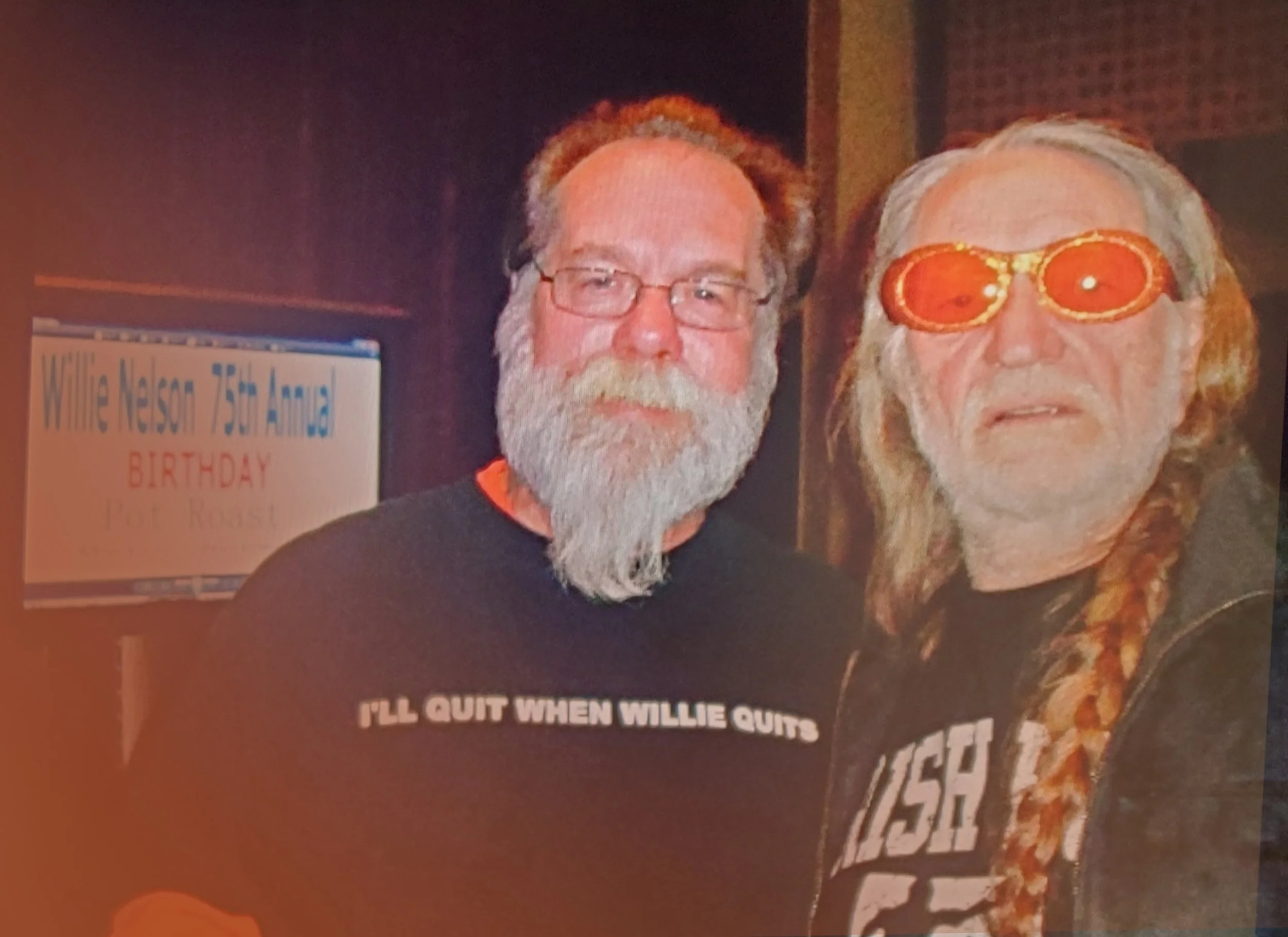
Buddy Prewitt and Willie Nelson at Willie’s 75th Birthday Party Pot Roast, April 29, 2008. (Photo courtesy of Buddy Prewitt)
Buddy Prewitt’s half-century spent at the heart of Willie Nelson’s road crew was born of the same mix of talent, timing, and free-wheeling nature that has fueled Willie’s own success. In November 1977, Buddy was working for Showco, the Dallas-based touring-production giant that pioneered arena and stadium shows for acts like Led Zepplin and Wings. An in-demand lighting director who’d run stage lights the previous summer on David Bowie’s European tour behind Station to Station, Buddy had been sent to the Louisiana Superdome, not to work the concert, but to pick up a semi’s worth of lighting equipment at the close of a Linda Ronstadt tour. Willie was co-headlining and Buddy was thrilled; a north Texas boy, he’d been going to Willie’s club shows in Dallas and Fort Worth for years. But as happened so often while Willie was ascending from local hero to Rock Star, hijinks ensued.
For starters, Willie’s lighting guy had never even seen a 48-channel lighting board like the one Showco used with Ronstadt, compounded by the fact that he had a broken arm. When he asked Buddy to work Willie’s set, Buddy jumped at the chance. That was the easy part. More worrisome was the fact that as opening act Stephen Bishop kicked off the concert, Willie and his stage crew had yet to arrive. “Willie wasn’t even there when the lights came on after set-change,” recalls Buddy in this week’s One by Willie. “Then here comes a truck through the goalposts, and Poodie and the guys, they popped it open and started unloading. It was so not like we were used to.”
Any concern was quickly forgotten. Buddy knew Willie’s songs inside-out and lit the show perfectly. And Willie blew the crowd of some fifty-odd-thousand people away, earning six encores, by Buddy’s recollection. For the next two years, he’d work Willie and Family tours for Showco, as the band became, by some reports, the highest-grossing touring act in the U.S. Then in 1980, Buddy would leave Showco to work full-time for Willie, becoming a vital member of the “band of gypsies” that Willie immortalized, later that year, in his Oscar-nominated anthem from Honeysuckle Rose, “On the Road Again.”
This week, Buddy—or as he’s known in Willie World, Budrock—uses that song and those events as a jumping off point for a ramble though fifty years’ worth of stories about life with Willie. He hits on all manner of highs and lows, from the 1979 San Antonio show when he first heard “On the Road Again” and its nightly set-list companion, “Angel Flying Too Close to the Ground,” through his prep this summer for Willie’s three—count ‘em, three!—4th of July Picnics…with stops in between for memories of countless rounds of golf, buses he’s known, everyday life at Willie’s place in Pedernales, Julio Iglesias’s white suit, bassist Bee Spears’s famous high-flying Vegas act, and so on.
And through every anecdote, the shining light is Buddy’s deep and abiding love for his friend Willie Nelson.
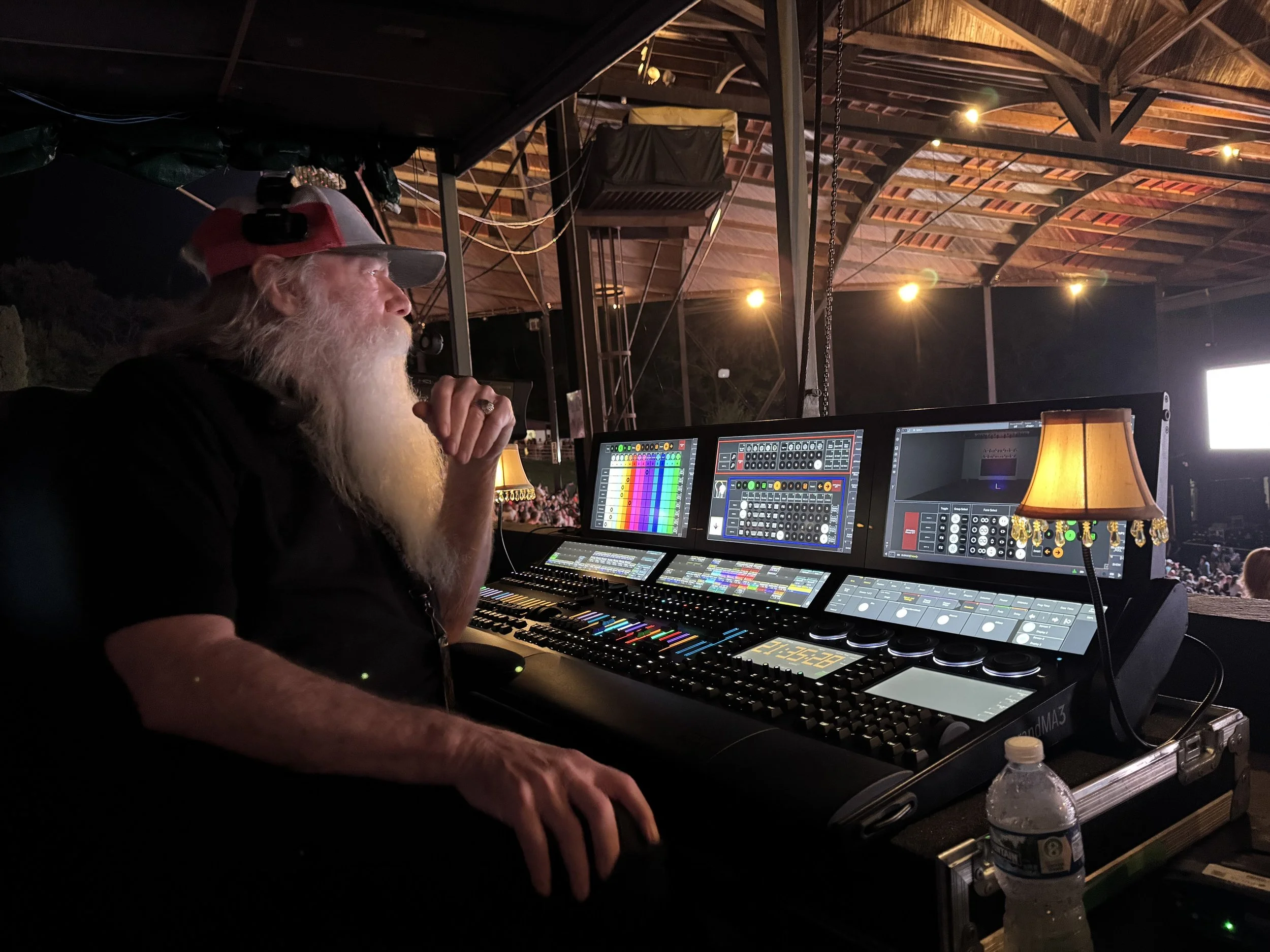
Buddy Prewitt works the lights at Willie’s show in Alpine Valley, Wisconsin, on September 19, 2025. (Photo by John Spong)
One by Willie is produced by John Spong and PRX, in partnership with Texas Monthly. The PRX production team is Jocelyn Gonzales, Patrick Grant, Pedro Rafael Rosado, and project manager Edwin Ochoa, with graphic design by Joanna Holden and Modular, ink. The Texas Monthly team is engineer Brian Standefer, and executive producers Megan Creydt and Melissa Reese. And Dominic Welhouse provides invaluable research and editing help.
John Spong (voiceover)
Hey there, I’m John Spong. And this is One by Willie, a podcast in which I talk each week to one notable Willie Nelson fan about one Willie song that they really love.
This week, something really special, as we sat down this summer with one of the longest-serving members of Willie’s road crew, the man who has run the stage-lights at Willie shows big and small for just under fifty years, Buddy Prewitt—or as Willie calls him: Budrock the Illuminator. And fittingly enough, Budrock’s going to talk about a Willie song that he says tells his own life story, from the soundtrack to Willie’s 1980 star-turn in the movie Honeysuckle Rose, “On the Road Again.”
Now, when I say this is a special conversation, there’s no smoke blown. Budrock’s a vital member of Willie’s famous “band of gypsies,” and his stories from the road are first-hand, fantastic, and often surreal, starting with that first Willie show that he accidentally ended up working, at the Louisiana Superdome, back in November, 1977. He recalls plain-as-day the show two years later, in San Antonio, when he first heard Willie play “On the Road Again,” and the song that it has followed in the setlist almost every night since, “Angel Flying Too Close to the Ground.” And from there come memories and insights into marquee names from Willie World, folks like Sister Bobbie, drummer Paul English, and bass-player Bee Spears, plus lesser-known lights like Poodie, Gator, and Snake. And he also gives a look at the people at a Willie show who matter most to Willie—and that’s the fans.
But where I personally got wound up is when Buddy turned to some history that I’ve just never heard from other sources. Like what life’s been like, day-to-day, at Willie’s place in Pedernales, how hard that life got during Willie’s famous fight with the IRS, and—on the way out of the IRS mess—the truly weird year that the band spent stationed in the country-music tourist town of Branson, Missouri. And what shines through in every one of those anecdotes is Buddy’s deep and abiding love for his friend Willie Nelson.
With meaty cameo appearances by Julio Iglesias, Honeysuckle Rose producer Sydney Pollack, UT football coach Darrell Royal, and a couple batches of prison inmates who, if they weren’t Willie fans before they got some time with him, certainly were afterwards.
So let’s do it.
[Willie Nelson performs “On the Road Again”]
John Spong: We're talking about “On the Road Again.” And so, maybe a weird place to start, because…since this is maybe the most iconic Willie song that there is, rather than asking, like we usually do, “What's so cool about the song?”...how about this: “On the Road Again,” it's a true story, isn't it?
Buddy Prewitt: I lived it. I'm still living it.
John Spong: Yeah?
Buddy Prewitt: Still living it. Going out in less than two weeks. We're going out again.
John Spong: Right. And that'll be ahead of the 4th of July picnics?
Buddy Prewitt: Yes, sir. We're going to do three picnics in three days.
John Spong: Well, since you're a mere child compared to Willie, that shouldn't be too taxing.
Buddy Prewitt: I've only done 40-some-odd picnics, so…looking forward to another one.
John Spong: Here we go. Another three, rather.
Buddy Prewitt: Yeah. Three in a row.
John Spong: Tell me this. Do you, by chance, recall the first time you heard Willie play that song? And if not the first time, maybe some of those early times, before it was a hit?
Buddy Prewitt: I do have a story about that. We were doing…I was working for a company called Showco at the time, and I got sent down to San Antone to do [the] Honeysuckle Rose movie. So we had a big live setup, and Willie did the song that night. He did that and “Angel.” Was the first time I'd heard either one of them.
John Spong: Oh, wow.
Buddy Prewitt: And that was '79? Mid '79? Late '79? I'd been with him about two years, and that was the first peep out of “On the Road Again” I ever heard. Now I hear it every night.
John Spong: Did you get a sense that it was something special?
Buddy Prewitt; Well, certainly did. It grabbed everybody's attention. That and “Angel” came at the same time, and they're still back-to-back, almost every night.
John Spong: Wow. Wow. And the fans got it straight off?
Buddy Prewitt: Absolutely. If you ever look at the Honeysuckle Rose movie, “Angel” in that movie is incredible.
John Spong: Yeah.
Buddy Prewitt; It's really incredible. And “On the Road Again,” I don't remember it being recorded or not, but that's the first time I heard it. The Hemisphere Arena, San Antonio, 1979.
John Spong: Why do you think it grabbed people? It became a hit, I mean, it became an anthem instantly…
Buddy Prewitt: The words just describe everything that happens to us. We do it our way. And we were doing it our way. That was back before corporate America took over the concert business. Everything we did was the way that we wanted to. There wasn't anybody to tell us not to do it any other way.
John Spong: Well then, can I spin it for you?
Buddy Prewitt: Sure.
John Spong: Let me see. Let me share my screen, and let's do this. I'm very excited about this; I always pull up the lyrics when we listen, and I would hate for you to miss one of the words or something.
Buddy Prewitt: Yeah, on that movie, we did it all across Austin, in a bunch of different venues. I believe the cut...are you going to play the cut from the album?
John Spong: Yeah, the album cut.
Buddy Prewitt: I read that that was [at] Soap Creek Saloon. So that was live at the Soap Creek Saloon.
John Spong: Oh, wow.
Buddy Prewitt: That particular version.
John Spong: Wow, that's hallowed ground.
Buddy Prewitt: Yeah.
[Willie Nelson performs “On the Road Again”]
Buddy Prewitt: Now, doesn't that just say it right there?...So John, I can't believe that nobody's done this song yet.
John Spong: Right?
Buddy Prewitt: You've got seven seasons of this, and nobody's done this song yet. I had such a hard time picking. It ended up being an obvious choice, but…you know, all my favorite songs [have] already been done, a lot of them.
John Spong: Right?
Buddy Prewitt: So I wanted to pick something somebody hadn't already done, and I struggled with it for a few weeks. And then this one just, when I got the list from you saying who did what, and I noticed nobody had done it, I couldn't believe it.
John Spong: But honestly, I don't know that I want to hear about “On the Road Again” from anybody but you. Or somebody else in the organization. I mean this is…like I said, it's a true story. It's about y'all. No one can talk about this with the authority and the insight that you can.
Buddy Prewitt: Well, we did everything together back then.
John Spong: Yeah.
Buddy Prewitt; We played golf. We played computer golf. We listened to music on Willie's bus. We did Thanksgiving dinners on the road together. Hell, we did Christmas tours. We were together all the time. Like a band of gypsies, we were going down the highway. We were doing 300 shows a year, 250 to 300 shows a year. It was nonstop. And so the word “family” really fit us.
John Spong: Yeah, yeah. Do you know much about how this song was written? There's, I guess, a pretty famous story about it. Do you know much about that?
Buddy Prewitt: Supposedly written on an airplane with Sydney Pollack. Willie gave him the words, and Sydney didn't quite get it. And Willie said, "Don't worry about it. I'll get the melody." And, of course, he did.
John Spong: And of course he did. When I was reading about it this week, the one little tidbit that I hadn't heard before, that I really loved, was that the plane they were on was a Warner Brothers private jet, and that there was an issue because Willie, and whoever else would've been going from y'all's group on the plane with him, kept smoking weed on the plane.
And Pollack was like, "The pilots are getting stoned. We have to…y'all are going to have to make an adjustment to make sure we get where we're going."
Buddy Prewitt: That doesn't surprise me. I wasn't there.
John Spong: Sounds about right, though?
Buddy Prewitt: But it sounds about right. Back then, you walked on Willie's bus, he greeted you with a joint.
John Spong: Yeah.
Buddy Prewitt: It didn't matter who you were, President, or Governor, or whoever.
John Spong: I read some guy, he said, because it seemed...I remember hearing this [song] when I was a high schooler, and I dug it, but I wasn't necessarily keyed into the depth of it. Because it's infectious. It's such an easy song to dig, whether you know any of the story that goes with it or not.
One of the things that this English writer, who–[and] I've become a big fan of the stuff he's written about Willie, his name's Graeme Thomson–and he said, "The song shared territory in many ways with ‘Night Life’ and other early songs”–and this is the part that I dig–“in its utter simplicity and clarity of purpose." I mean, this is a really plain...
Buddy Prewitt: It's plain and simple, isn't it?
John Spong: …simple example.
Buddy Prewitt: It's just, the words say everything in just those three little verses.
John Spong: Yeah.
Buddy Prewitt: It just explains the whole thing.
John Spong: Yeah.
Buddy Prewitt: And I can see where anybody would be able to interpret it to their way of life. A truck driver, somebody that's going back and forth to work every day, there's any number of ways you could apply it to your own personal thinking.
John Spong: Is there any way to guess the number of moms and/or dads who started singing this to their little kids on the way to grandparents' house, or a road trip for the summer, or something like that? "Here we go." It applies to all of us.
Buddy Prewitt: It certainly does. And it tells me…the audience that Willie draws, I mean we're seeing grandbabies of people who've been seeing Willie since the '50s and '60s.
John Spong: Wow.
Buddy Prewitt (00:15:17):
I mean, he's passed this on, and these parents share it with their kids, and then the kids grow up and share it with their kids, and then their kids. The audience that Willie's seeing now is eight to eighty.
John Spong: Right.
Buddy Prewitt: There's still kids in the audience, and there's lots of older people. A lot of gray hair.
[Willie Nelson performs “On the Road Again”]
John Spong: Well, that's a perfect place to pivot to this and to your job…what color is “On the Road Again?”
Buddy Prewitt: “On the Road Again” is uptempo, bright. It doesn't have a whole lot of changes. I feature the audience in it a little bit. I'd say red, white, and blue.
John Spong: Those are the colors you like to-
Buddy Prewitt: I play with it. There's only a few songs that I do the same every night.
John Spong: Oh, okay. Tell me.
Buddy Prewitt: Well, I do “Angel" the same way every night. And always did “Night Life” the same way.
John Spong: But what colors are these?
Buddy Prewitt: Well, “Night Life's” blues and purples and dark, sky colors. And “Angel,” I picked red and white [a] long time ago, because it's the color of the Hell's Angels. I don't know why, but I liked it. And it's red and white, and it starts out red on Willie, with a little bit of white on the band. And at the solo, it goes white on Willie and goes red on the band. And then it goes back. It's a real simple song. People, you know, they're not looking at the lights. They're listening to the song. I'm just trying to accent it.
John Spong: But that's the thing. They're not noticing what you do…
Buddy Prewitt: If I'm doing a good job.
John Spong: …but if you fuck something up, they're going to notice, sure as shit.
Buddy Prewitt: Right. They notice if it's overdone or fucked up.
John Spong: Yeah.
Buddy Prewitt: But otherwise, I mean, I don't want them to really notice it. I want ‘em to keep the attention on Willie.
John Spong: Yeah.
Buddy Prewitt: That's my job.
John Spong: With all the Willie shows I've been to, one of the coolest was that Alpine Valley show, in Wisconsin, last year.
John Spong: And it was the last stop on the Outlaw Tour, and that was the first time I got to sit with you. And so you've got, for folks who don't know, next Willie show you're at, look either behind you or in front of you for the little short scaffolding, which is your seat. It's the best seat in the house, and you're up there directing all the lights.
Buddy Prewitt: About 150 feet from the stage, 100 to 150 feet from the stage, in a box with the sound engineer. We sit side by side every night, and we have the long shot of the stage.
When I said to Willie one time, "Next time I see you, you'll be this tall," that was about an inch. Because that's about how tall he is from my vantage point every day. He's about an inch tall. I see the big picture. Before I got my eyes done, I couldn't tell whether he had a beard. If he'd shave, I'd say, "When did you shave?" "Ah hell, I shaved last week." That's how far away I am.
John Spong: Okay.
Buddy Prewitt: And so I'm that far away, so a lot of other people in the audience are that far away. So, the lighting does what cameras do on television. It directs the attention.
John Spong: Okay.
Buddy Prewitt: Say, if Mickey goes and does a solo, everybody knows it’s Mickey over here doing a solo, but I light him different when he's doing a solo. Back in the day when Grady and Jody and Willie were all three playing guitar up there, the average person didn't know which guitar player it was unless there were lights on them.
John Spong: Right, right.
Buddy Prewitt: They couldn't tell if it was Jody or Grady. So that's part of my job, directing the attention.
At the same time, I'm coloring the stage with my fingers on the board, picking the next...when it goes to Sister Bobbie, I've got specials going to her, and I dump Willie, and I may smooth the band down. When it goes to Mickey, it may change complete different color, or maybe just half the colors, or just swap colors. Just something to make it different, so it doesn't look the same every [song.]
John Spon: Yeah, but you really are painting.
Buddy Prewitt: You could say that. Some songs are more intricate than others. Some, I use one look for the whole song. I try not to overdo it. I don't like to do carnival lighting. Like–no offense to anybody nowadays–but with these moving head, robotic instruments, there's a lot of shit going on in the audience that doesn't really, in my opinion, doesn't fit our show. Willie likes audience participation. But just wild, swinging [lights], not to the music, not to the beat, just…I don't do it. I don't do it. I think it's irritating to the audience.
I think when Willie cups his ear, he wants to see the audience. He wants them to sing back. So I'll ease something up on the audience so he sees them. On “Always on My Mind,” when he comes to that line, “You were always on my mind,” I slip the backlights up onto the front row, up into the audience, like he's speaking…all of a sudden, they're lit. They know that he's singing, they think, to them–which he is singing to them. But I'm letting him see them. And their reaction.
John Spong: Oh, that's awesome.
Buddy Prewitt: And he catches that energy. That's where Willie gets his energy is off the audience, so he has to see them. But you have to be subtle about lighting them. You don't want to blind them all night.
John Spong: But that is it, that the relationship with those fans is real.
Buddy Prewitt: That's the whole thing.
John Spong: It's the whole thing.
Buddy Prewitt: That's where Willie gets everything, is from the audience. And he gives it back.
[Willie Nelson performs “On the Road Again”]
John Spong: Well then, we're getting into your job, and how you do your job…let's go back to how you got your job. And so tell me about this “road” of which Willie sings.
Buddy Prewitt: My first show, I was picking up a Showco lighting system that was ending a Linda Ronstadt tour, and I was headed out with it, going somewhere else. Willie happened to be opening for Linda Ronstadt that night. I wasn't working; I was just picking up a lighting system that was ending the Ronstadt tour. And I was sitting at the lightboard…
John Spong: Wait, where's the show?
Buddy Prewitt: New Orleans Superdome.
John Spong: So this wasn't at Soap Creek.
Buddy Prewitt: No. Steve Goodman [correction: Stehen Bishop] had opened the show, and Willie wasn't even there when the lights came on, after set-change. And here come the truck through the goalposts, and Poodie and the guys, they popped the truck open and started unloading it. I mean, it was so not like we were used to. Put it that way.
John Spong: At Showco. Because that was the biggest deal-
Buddy Prewitt: At Showco, we were very professional. And we did everything before set-change. Willie didn't even show up till set-change. So they were still setting him up-
John Spong: But at Showco…wait wait wait. I'm sorry, but wait a minute, this is you and David Bowie on tour. And Lynyrd Skynyrd-
Buddy Prewitt: Oh that was my first, my first tour was David Bowie.
John Spong: In what, '74? '5?
Buddy Prewitt: '76.
John Spong: '76. Okay.
Buddy Prewitt: We did 66 cities. Started in Canada, went down the West Coast, went across the country, and then went over to Europe.
John Spong: Okay.
Buddy Prewitt: Since I've gone to work for Willie, and I went to Europe with Bowie, I've been to 48 countries now.
John Spong: Wow. Wow.
Buddy Prewitt: I've done shows in 48 countries.
John Spong: Right.
Buddy Prewitt: So that’s…I was sitting up there at the lightboard, and Willie's lighting director came up, and he had a broken arm. And he looked at the Showco board, and he wasn't used to anything like that. It was 48 channels, which was giant at the time. And he was a little intimidated by it and asked if anybody would do it, and I jumped on it.
I happened to be sitting there. I was a big Willie fan before. I'd been to three picnics before. I kept telling Showco, "Get Willie, get Willie, get Willie." And they kept sending me out with different people. And Willie wasn't on their roster, and he joined their roster in early '78.
John Spong: Okay.
Buddy Prewitt: Well, that was right before he did the Live album, in Tahoe.
John Spong: Yeah.
Buddy Prewitt: So that was really…my first show that I did was in '77. I didn't really go on tour with him until the early '78.
John Spong: Okay.
Buddy Prewitt: And I've been with him ever since.
John Spong: And so, tell me about this outfit, please, that you're hooking up with. Because from my limited understanding, and that's probably about the time...at some point in there, he becomes, by some reports, the biggest-grossing touring act in the country. Certainly bigger than any country act had ever been.
Buddy Prewitt: He was hitting it so big. He got six encores in front of Linda Ronstadt that night in the Superdome.
John Spong: How did she feel about that? I know she's a very gracious person.
Buddy Prewitt: She was crying. She was crying. But they'd put Willie on because ticket sales were lagging. And [they] just played to half-house, but that's still a big place, the Superdome.
John Spong: Hell yeah.
Buddy Prewitt: We did the Live album in Lake Tahoe. And by then, I think that was March or April, we'd been touring a little bit. And so I felt fortunate when they went and took the picture for the inside of the album, with us all laying on the Texas flag…
John Spong: Oh yeah.
Buddy Prewitt: …that they included me, even though I wasn't really working for Will– ...I was a Showco employee at the time, and they put me on the flag. Now everybody that was on that flag, it's me and Willie and Mickey are the only three left.
John Spong: And anybody listening needs to “Google Image” search, if you don't have a copy of that album.
Buddy Prewitt: It was quite-
John Spong: It's such an amazing photograph.
John Spong: Is it 20 of yall? 30?
Buddy Prewitt: I was so excited about it. I mean, who do you know that's got their picture on a Willie Nelson album? Or any album? And here I was 28 years old. I'd been with Willie for just a couple of months, and I was invited to be one of the most iconic albums ever put out. That live album is unbelievable.
[Willie Nelson performs “Uncloudy Day”]
Buddy Prewitt: But I did lights for that the whole time. I got a gold record for it. They gave me a gold record because…
John Spong: Wow.
Buddy Prewitt: ...yeah, that's when I became part of the crew there. And I continued on with Showco doing Willie Nelson shows for another two years before I went to work for Willie in 1980.
John Spong: Full-time.
Buddy Prewitt: Full-time. I did a bunch of stuff. I did Bad Company. I did Iggy Pop. I did Marvin Gaye. I did Lynyrd Skynyrd. I did Steve Miller Band.
John Spong: And then you found a home.
Buddy Prewitt: Well, you know, I was a country boy. I liked country music. Like, when I went out with David Bowie, I only knew one song. That was “Ground Control to Major Tom.” I had no idea the man was so talented. And when I got Lynyrd Skynyrd, hell, I didn't know anything about Lynyrd Skynyrd. When they did the live album, One More For the Road? That caused me to miss my first Willie Nelson Picnic. And it's still the only one I've ever missed.
John Spong: Wow.
John Spong: And what grabbed you about the music?
Buddy Prewitt: Well, I'd been a big Willie fan for years.
John Spong: Yeah. But how come?
Buddy Prewitt: Well, I just liked that it-
John Spong: Because he's good at it?
Buddy Prewitt: Well, it was different. I'd go to Fort Worth to see him. I'd see him every time he'd play. He played clubs around in Dallas. I'd go see him all the time. And he was a very personable guy. Even in the old days, I remember one time he played this joint down on Industrial Boulevard, and I went outside–I was going home at the end of it–[and] Willie was sitting on the trunk of a car, out signing autographs for anybody that wanted them. This was probably ‘75?
John Spong: Wow.
Buddy Prewitt: ‘74 or '75? He's just very down to earth, and we could relate to him. I begged Showco to get Willie Nelson, and they finally got him.
John Spong: And so I read somewhere, I think it was Poodie that was talking about. So at this point–-and for real, country shows previously might've been a tour, and there might be a package deal with four or five artists on it, and it's just not that big a thing. Willie, at this point, if I read correctly, had five buses, two semis full of equipment, an RV for the merch. And that's just not the way...country music had never been performed live on that scale before.
Buddy Prewitt: At one point we were, we did have five buses and two trucks. When I started with Willie in a Dodge van.
John Spong: Oh, wow.
Buddy Prewitt: And there was five of us. And we did that for a couple years. Then we got a box truck. Like, a Chevy van with a box on the back. It had bunks in it, so we didn't have to sleep on the seats and on the floor. And then Paul got us a bus, finally.
John Spong: Nice. Thanks, Paul.
Buddy Prewitt: I rode the Tube for a while, which was Porter & Dolly's old bus that everybody rode on. There wasn't enough bunks for everybody, so the last one…there was always one bunk for the last person up. So everybody tried to wait out everybody so they'd get a bunk.
It was quite the bus. Willie had the bathroom taken out because somebody forgot to dump it one time. And when we started up and moved the bus, and what was in the toilet…moved. It hadn't moved in two months, and he said, "Dump it." And they said, "We can't dump it right here. We're in the city." He said, "Dump it." And the next day the bathroom was gone, and there was a funnel back there.
I've had like 13 buses now. 13 or 14 buses. The last time out, I had a 2025 Prevost, [which is] like a $2 million bus.
John Spong: Jesus.
Buddy Prewitt: It's beautiful. Willie treats us the same as he. Our bus is just as nice as his, except we don't have a shower in ours. We carry eight people on our bus. And it's Willie and his wife and the kids, if they go, on his.
John Spong: Does your bus still get referred to as the Animal House?
Buddy Prewitt: Not so much anymore. We've calmed way down. Most [of] the animals have passed on. We've got a younger bunch around us now. I'm, like, the old man.
John Spong: Okay. Wise old man! I can intercede…interject there. Wise old man.
Buddy Prewitt: Yeah.
[Willie Nelson performs “On the Road Again”]
John Spong: This may seem a little forced, but I want to do almost like–not a word association thing, ‘cause that really is forced–but just, since you know everybody that's been involved, I just want to throw names out, and just get reactions of these people you hooked up with in the late '70s. And so I want to start with…Bobbie Nelson.
Buddy Prewitt: One of the sweetest women I've ever known in my life. Her dog bit me a lot of times. Usually on the way out the door.
John Spong: Sweet people need dogs like that.
Buddy Prewitt: Yeah. Yeah. Yeah. Mr. Mister. I don't know how to explain the love for that woman. She's a pure musician. And Willie's thing was, "If she's not happy, we're not happy." So, she had a little trouble with the monitors, I guess. She likes to hear the pure piano. She didn't like it miced, because she was so used to playing pure.
John Spong: Oh, wow.
Buddy Prewitt: We really had to cater to her a lot to make her happy.
John Spong: And talk about what she provided to Willie because everything changed once she joined the band in terms of him…
Buddy Prewitt: It was-
John Spong: …everything, it seems.
Buddy Prewitt: ...a comfort, I think, because they'd been playing together for their whole lives. I don't know how to explain this, but I think she probably settled the band down a little bit. They were a little more rambunctious, and she gave it a little more structure, I think.
John Spong: Yeah. And I like that you use the word “pure” to describe what she wants to hear, because that's also what her piano styling brings to the music. Whatever Willie's doing, however far out there he gets, it's almost like the music is a little bit rooted in a small-town church, because of the way she played her parts on the piano.
Buddy Prewitt: You could watch her, and you could wonder how in the hell anybody could hear it because she's so light, her touch was so light on the piano. Shoot me another one.
John Spong: Paul English.
Buddy Prewitt: One of my favorite people in the world, my boss. When Willie hired me, he said, "We don't have bosses, but yours is Paul."
Buddy Prewitt: Paul trusted me. I trusted him. He backed me up so many times. I've got some stories about him backing me up that probably don't need to be told.
John Spon: Okay. But find one that can. What kind of situation would you need a back up?
Buddy Prewitt: I can say it because he's dead now, but Sherwood Cryer wouldn't pay us down at Billy Bob's. I mean at…
John Spong: Gilley's. Yeah.
Buddy Prewitt: …Gilley's…
John Spong: Sherwood Cryer. Oh.
Buddy Prewit: …in Pasadena. We were doing a show down there and I was working for Showco, and I was collecting the money for the sound and lights. And so you collected it from the promoter, and the promoter was Sherwood Cryer who owned Gilley's, or ran Gilley's. And he wasn't going to pay me. And so I went back, and I said, "Paul, hey. Sherwood's not going to pay me." He goes, "Let's go." We go into his office, and he says he didn't have the money. And Paul goes, he grabs him by the shirt and says, "All right, I'm going to show you where the money is." He walks out to the first bar. He says, "Open that cash register." He opened the cash register, and he took out all the $20s and, you know, the big money. We went to the next cash register until I got my $1,500 bucks. And then he let him go.
John Spong: That's fantastic.
Buddy Prewitt: Yeah. I mean, he wasn't going to let me get cheated.
John Spong: Well, and the loyalty to Willie. Yeah.
Buddy Prewitt: He was that way. He sat behind Willie, and he had the view of everything. He could see anybody coming. He knew how big the crowd was. He knew everything that was going on. He had Willie's back, literally, every show. Had three guns on him at all times. And he didn't have to use them; I never saw him fire one off. But I've seen him pull ‘em.
John Spong: Mmh-hmm.
Buddy Prewitt: You know, Paul had to collect the money back in the old days when you had to collect the money. Now it's a check, or it's electronic, or whatever. But back then you had to count the tickets, and you got to count the seats, and get the money. And you’d find out they'd print more tickets than they said. I watched him, I watched his back on stuff like that. He had me count seats. He was one of the most honest men I've ever known in my life.
Buddy Prewitt: Willie was lucky to have him. And I think Willie recognized that early, early, early, early, early, early on.
John Spong: Mickey.
Buddy Prewitt: He asks a lot of questions. Mickey is, uh, he's a wonderful guy. He's a great harmonica player, as everybody knows. He works with everybody in the world when he's not with us. I think he's got a pretty good home with Chris Stapleton right now. He's on a lot of different records. He's played with lots of people. He's produced Willie records.
John Spong: Yeah. And it's interesting because when I think about the evolution of the band and its sound, and what was, when you get into the nuts and bolts of what was revolutionary about it, country bands had historically had either a steel guitar, or a fiddle, or both. And Mickey's harmonica replaced those effectively in the lineup. I know Johnny…
Buddy Prewitt: Yeah. It replaced the steel guitar of Jimmy Day.
John Spong: Yeah.
Buddy Prewitt: But when Jimmy Day went away, Mickey filled that hole, I think. And it's, you know, it’s Willie's sound now.
John Spong: Yeah. It's a trademark of what yall do. It’s the signature.
Buddy Prewitt: And when I started with Willie, he had two drummers. Bee had just quit, and Chris Ethridge was playing bass, from the Flying Burrito Brothers. And then when we did the Live album, Bee came back. So Willie just kept both bass players. So we had two drummers and two bass players…and Mickey and Sister Bobbie and Jody…Paul. It's quite the lineup.
John Spon: Yeah.
Buddy Prewitt: Quite the lineup.
John Spong: Which gets us to Bee. Bee Spears.
Buddy Prewitt: The craziest man I've ever known in my life. He was more mischievous…he liked to fish. The one time “On the Road Again” didn't follow the song “Angel Flying Too Close to the Ground”--they come together and have ever since they got put in the set; it's “Angel” followed by “On the Road Again.” One night it was “Angel” and then “Holding Things Together.” Because during “Angel,” Bee flew over Willie's head like Peter Pan. In fact, it was the guys who flew Mary Martin on Broadway, we met ‘em in the bar at Caesars, and they had a rig down there in Caesars already.
John Spong: The afternoon before the show?
Buddy Prewitt: Bee said, "Can you make me fly?" And they said, "Yes." And so we went down in the afternoon and got him in a harness, and got him some pants with these little clips on the side. And he didn't practice very much, as you could tell by the video, if you ever saw the video. But we were checking Willie's pulse all day. Connie was checking it for us. And during “Angel,” so…we had two bass players, so Bee could slip off. He slipped off, and during the solo of “Angel,” here came Bee flying over his head. The crowd's going crazy, laughing. They could tell, because I had put spotlights on him, so you could see him.
John Spong: Of course.
Buddy Prewitt: And everybody's looking up. And Willie sees the spotlights are in the air and not on him, and “Why is everybody laughing? I'm playing a solo.” And then he looks around and sees Bee, and [he] never missed a lick. But instead [of] “On the Road Again” being the next song, he made Bee sing one. And Bee never sang. So, you can't do that and just walk away.
One time he went to Europe with a Easter basket. No luggage, just an Easter basket, period. He'd just buy new underwear, new socks, new shirt, and leave the other stuff behind. A crazy man, very crazy.
[Willie Nelson performs “Angel Flying Too Close to the Ground”]
John Spong: And then the road crew. Tell me about your friend, Poodie.
Buddy Prewitt: Boy, that would take a whole ‘nother show. Thirty-four years, I think, we ran together on the road. He had a lot of best friends. I think I was one of them. In Willie's book...one of my names was Peckerhead. And when Willie wrote the book, my kids asked me, he says, "Daddy, why does it say ‘Peckerhead’ under your picture?" That was a Poodie name, that he gave me. Poodie was the “Ambiance Coordinator.” He got things done by personality, not by physicality. We played golf together. We drank together. We did everything together. He was with Willie probably a year-and-a-half, two years longer than me, when I started. And he took me under his arm, under his wing. And we ended up being quite the team, I think.
John Spong: Gator.
Buddy Prewitt: Gator drove Willie for 30-some odd years. He drove Delbert [McClinton] first, when Delbert was opening for us. I didn't see a whole lot of Gator, because he slept during the day because he drove all night.
John Spong: Oh, okay.
Buddy Prewitt: That's what bus drivers do, so...
John Spong: Yeah. Who was Snake?
Buddy Prewitt: Snake got fired about early '78, or something. I think partying too much, if there was such a thing.
John Spong: Yeah.
Buddy Prewitt: We were kinda out of control, to tell you the truth. We drank a lot. And one day, Willie just said, "No more." Just, “No more.” There's too many incidents. And so, we cleaned our act up. We became more professional.
John Spong: Is that around the time of the “You're wired, you're fired” edict, that's so famous?
Buddy Prewitt: Yeah. The “Wired, you're fired,” it came out of there, same time. Well, it was the '80s. It was everywhere. And Willie said, "Whoever's bringing it is bringing the police with them. So you got to stop it. You got to stop it. This is my show, and you're bringing the wrong people. They're coming in the back door, and if anybody's following them…” So, yeah, that became a rule a long time ago.
John Spong: That's smart.
Buddy Prewitt: It was smart. And we're lucky that Willie didn't fire any of us, because we were just about all guilty.
John Spong: That brings in the wrong people, but then to the right people, the other group in this world of y'all's is the fans, and you were talking about that a second ago. Willie gets his energy from ‘em. Their reaction to him, their loyalty, their allegiance, their affection, their admiration, it's intense what they get from him, as you've described it.
Buddy Prewitt: We have people follow us, take their vacation and they'll follow us. I used to drive the bus some, and we'd notice there'd be cars following us. And we end up making friends with all these people. But there's some women who follow us every year on their vacation. They'll take a week or two weeks off and they'll chase the buses, and you'll see them every night at the show. I've become friends with a lot of them. There used to be a bunch of people that sat on the front row of the picnic every year. There's probably 15 or 20 of them. Most of ‘em are dead now, but it used to be the same people in the front row of the picnic every year.
And those people, they'd get there before the gates open and stand there and wait to get let in. And sometimes you'd see them at Floore’s Country Store, you'd see the same people that came to the picnic, they'd all be on the front row there. And Willie recognizes all those people. He knows them. You can't help but know them because they're at so many shows.
[Willie Nelson performs “On the Road Again”]
John Spon: To Pedernales…Willie bought that place in '79?
Buddy Prewitt: '78, I believe.
John Spong: '78. Okay. I think it was 76 acres in the initial purchase.
Buddy Prewitt: $250,000.
John Spong: What's that?
Buddy Prewitt: [It] said $250,000. I heard it the other day.
John Spong: Wow.
Buddy Prewitt: 77 acres for the nine-hole golf course and a clubhouse that still had plates on the tables. Willie turned it into a studio, kept the golf course. Did a picnic on there in '79, right after he bought it. Did another one in 1980. And by then we were playing golf, and it kind of messed the golf course up, and he said, "No more picnics at the golf course. Let’s play golf." That's what we did on our days off. When we weren't on the road, we played golf everyday.
John Spong: Everyday.
Buddy Prewitt: 36 holes, 54 holes, sun-up to sundown.
John Spong: Oh, wow. Well, and that's thing because y'all all live out there. Or many of you, right?
Buddy Prewitt: Used to.
John Spong: Used to?
Buddy Prewit: Used to. I still live in the area. I've still got a condo over there at the golf course, but I've got it rented. But, you know, Luck is across the road. Willie owns a few condos still, still operates the golf course–which is in really good shape right now because [of] all the rain.
John Spong: Well, I'm curious because there's always been this kind of communal aspect to Willie's way of doing things. Like, when he was in Ridgetop, his mom and stepfather were living there. His dad and stepmother were living there. Paul was living there. Johnny Bush lived there for a while. Willie was there. I think his kids were there, with their kids.
Buddy Prewitt: It's kind of like when he bought the Pedernales, almost every condo was given to somebody in the band, and everybody had their own golf cart. So, there's 15 condos. There's, like, 12 of us had condos and golf carts. It was great.
John Spong: But why does he do that? Everybody–well, not everybody loves their family, or the people they work with, either–but even when they do, they don't invite them to live with them.
Buddy Prewitt: Like I say, we were a band of gypsies. We did the things our way. I mean, we did everything together. So, why not live together, too? We were playing golf, it made it convenient. I mean, there's a few people that didn't live there. Mickey didn't live there. Jody didn't live there. They were down there visiting all the time. Paul didn't live there. Bee didn't live there. Mostly us guys, road crew. The guitar-tuner lived out there. Both the Koepke brothers lived out there. Willie had a condo out there.
John Spong: So, what's life like out there? If you're on the road 300 days a year, you're not out there all the time. Or even halftime. But what's life like when you're living there? Lot of golf?
Buddy Prewitt: We're playing golf. Free golf. I mean, golf was our life; music just paid for it.
John Spong: Okay.
Buddy Prewitt: That was one of the Poodie-isms. “Golf is our life. Music just supports our habit.”
John Spong: And who all rolls through? Because Willie is one of the most…biggest stars in the world through the '80s. Who all's rolling through Pedernales when y'all are out there?
Buddy Prewitt: Okay, I got a good one for you. So, Willie and Julio are going to do something in the studio. We're out playing golf. Willie's wearing his little gym shorts. We're all wearing these little Texas flag shorts. They're like our underwear. And you're wearing golf shoes and underwear. And no shirt. Probably got a hat on for the sun. We're all sweaty. We've been playing golf all day. Here comes Julio rolling up in a white limo, in a white suit.
John Spong: Julio Iglesias, by the way, for anybody that’s not on board...
Buddy Prewitt: “Julio's here!” So, we all go up there and Willie greets him. We were all sweaty, and Willie just gives him a big old hug. I mean, it was hilarious the difference in the culture there. Yeah. I used to play golf with Coach Royal out there a lot. He had his own cart. Nobody could touch it, because it had to be ready for him whenever he came out there.
John Spong: Oh, nice.
Buddy Prewitt: He was Willie's main golf buddy at the time. They played golf all the time.
John Spong: What's Willie like as a golf partner?
Buddy Prewitt: I played hundreds of rounds of golf with Willie. And that's no exaggeration. Willie's really, really good around the green, the short game. He wasn't great on the long drives, but he had a short game and a putting style. He putted one-handed.
John Spong: Huh?
Buddy Prewitt: He putted one-handed. I don't know if it was a show-off thing, but he putted pretty good that way. One time, we were playing golf somewhere in Illinois, with the governor of Illinois. The guy who helped, uh…Jim Thompson.
John Spong: Oh. Who helped with Farm Aid. That first one.
Buddy Prewitt: Yeah. He and Willie were talking about Farm Aid, [and] we were playing golf. We all went in Willie's bus, and he went in his Sikorsky helicopter. And I guess it was a state-owned golf course. They had prisoners working there. Prisoners keeping the greens and mowing the grass. And of course, they all wanted to meet Willie. Well, back in those days–I probably shouldn't tell this, but I'm going to tell it anyway–we carried a baggy full of joints. Smoked, like, a joint a hole. We had a big baggy, and Willie sees all these prisoners, [and says] “Give me a few of those joints.” Now we're with the governor. Every one of these prisoners he meets, he palms him a joint.
John Spong: [Snort.] Excuse me.
Buddy Prewitt: Poodie did the same thing in Huntsville, only with liquor. The prisoners were coming, and we were playing a prison rodeo. And the stagehands would come in the truck and get a piece of gear and then roll it out to the stage. Well, they were prisoners, were the stagehands. And so, Poodie's in the truck, feeding them the gear, sending them out. And as they'd come in the truck, he'd give them a little shot of whiskey as they took the gear back out. So, they were rushing to get back in that truck, get another piece of gear.
John Spong: A slight aside, which venue did you look forward more to playing? Huntsville or Gilley’s?
Buddy Prewitt: I hated Gilley’s. And Huntsville we only did that once, so it's not a very good comparison to anything.
[Willie Nelson performs “On the Road Again”]
John Spong: We've not talked on the show very often, with much specificity, certainly with not anybody that knows about it, about the IRS mess and that period of time. And if you could tell me a little bit what it [was] like,
Buddy Prewitt: It was sad.
John Spong: But maybe where do we start? Do we start...IRS Day is my understanding of how it's referred to in Willie World. What was IRS day?
Buddy Prewitt: It was sad, it was cold…
John Spong: What happened that day?
Buddy Prewitt: ...they auctioned off Willie's stuff at the golf course. In the parking lot. There wasn't that many people there. I think they were expecting a lot more. They had stuff in boxes, equipment out of the studio, and they had lots. What they called “lots.” And you could bid on lots, and they were selling posters, and they sold his headdress that the Indians gave him.
I mean, they were auctioning off his golf cart, mementos, all kinds of shit. And they weren't getting much money for it because people weren't bidding on it. The people that did bid gave it back to Willie, a lot of it. And I think the golf course went [up] there. I think Coach Royal got it for $100,000 or something. They wouldn't let him have it because it was worth so much more.
John Spong: Right.
Buddy Prewitt: It was a really, really sad day.
John Spon: But back up. The raid though, were you out there the day of the raid, which is November in ‘90?
Buddy Prewitt: No, no, no. No, I wasn't there. Willie wasn't there.
John Spong: Right. But when they came, I mean, from what I read, there were helicopters overhead. They showed up like this was-
Buddy Prewitt: I heard that as well. I didn't see it. I didn't witness it.
Buddy Prewitt: I think it happened while we were on the road, to tell you the truth.
John Spong: Oh, okay. How was Willie through those intervening months, years, before the auction?
Buddy Prewitt: Well, you know, I think he took it pretty well. I don't think he believed it, through the whole time. It was just like he said, “How in the hell could y'all let a country singer owe you $32 million? How does that happen?” He just didn't believe it. It is hard to believe. I mean, even after they knocked it down to $16 million, but…
John Spong: At some point in there, y'all end up in Branson?
Buddy Prewitt: Yeah, we ended up in Branson.
John Spong: What was Branson, if people don't remember what Branson was, at least at the time?
Buddy Prewitt: Oh my god. Branson was full of country singers who were kind of on their way down, I guess. Weren't drawing that many people in concerts, so they, you know, they had a little theater.
John Spong: In Branson, Missouri, right? So, they had all these-
Buddy Prewitt: Branson, Missouri is full of theaters. And like Andy Williams had one, and Shoji Tabuchi had one, and Mel Tillis had one, and Moe Bandy had one. I don't know who all had one. Johnny Cash was going to build one. We shared a theater with Merle. They called it the Willie Nelson Ozark Theater, and it used to be Mel Tillis's. We did two shows a day there for about a year.
John Spong: Oh, geez.
Buddy Prewitt: We'd do three weeks on, and then we'd take off a week or two, and Merle would come in. And on those week or two, we'd go off and tour. But we all lived there, and we'd do an afternoon show, and then some of us would go home and have dinner, like a normal job almost. Then come back for the dinner show. Willie'd still be signing autographs from the afternoon show.
John Spong: Jesus.
Buddy Prewitt: I think Willie worked harder in Branson than anybody. He just stayed at the theater between shows and signed autographs. You could see, at the end of those shows…first off, they'd bus people in.
John Spong: Yeah, because it's a Mecca. People are coming from all over the country to go see Moe Bandy.
Buddy Prewitt: Yeah. Well, they'd see somebody different every day. They'd take a vacation, and they go see somebody different every day. And these bus tours would come in there with 40, 50 people on a bus, and they'd all get out. I don't know what the theater held, a thousand, or something like that.
John Spong: I think Mickey…everybody that's talked about it, words like “prison” come up. It's like it was just an absolute dark place, awful time.
Buddy Prewitt: It was…I can think of places I'd rather be, and I'm glad I've never had to go back. It was not very satisfying. It was a lot of wheelchairs and old people; I know when I walked from backstage to the front-of-house every day, the way the lighting was, it reflected on everybody's eyeglasses. So it was gray hair and eyeglasses, a sea of it, everyday. And some of them would be asleep by the end of the show, and the others would be lined up down the wall waiting to get an autograph. And that was the whole thing, they wanted to get Willie's autograph. So he signed...that's how he probably got carpal tunnel.
John Spong: Wow. And I did read, it was like y'all are caged animals in a sense. “Band of gypsies rolling down the highway?” Not for this stretch. It's like all of, most of 1991 [correction: 1992] spent in this place.
Buddy Prewitt: Right. Stuck. Stuck.
John Spong: Willie pitched a tent in his hotel room, because it felt a little better.
Buddy Prewitt: Yep. Yep. Yep. Well, the hotel was unfinished to begin with.
John Spong: What?
Buddy Prewitt: The ones who lived in the hotels…the hotel adjoined the theater. I mean, they didn't even have to move his bus. About half of them lived in this motel. I had just had a baby, so I didn't want to be in a hotel. No, I lived on a golf course. Poodie lived on the golf course. That was the only good part about it. That, and the fish hatchery was just right above the river that ran behind my condo.
John Spong: So Bee had something to do.
Buddy Prewitt: Yeah. Bee had something to do. It was horrible. All the shows let out at the same time. So an eight o'clock show let out at 9:00 or 9:30, and it was chaos. You couldn't even get out of the parking lot, because the streets were jammed with people that had shorter shows than us–and everybody had shorter shows than us. Everybody got out after an hour. We did an hour and a half. So we're stuck in the parking lot. You couldn't get out of the parking lot, literally, after the show.
John Spong: Well, so you've got the IRS stuff going. You've got Branson to pay off the IRS. We don't need to go too far into it, but I know that there was a lot of personal loss for Bobbie and Willie during that period. It's all really hard. And Sony and Columbia–we talk about this on the show a fair amount–Columbia was…Willie's contract was fixing to run out, and they were going to put him out the pasture, as like a legacy act. And they weren't... 1992, this comes up a fair amount on the show, is the only year that Willie didn't release any music going back to, I think, 1958. That's different. And people are thinking it's over. He settles with the IRS in March [correction: February] of '93 and then puts out Across the Borderline.
Buddy Prewitt: A great record.
John Spong: A great record. Tell me your opinion. Tell me what you love about Across the Borderline.
Buddy Prewitt: Well, it's got different people on it, and it's one of my favorites, along with Teatro. I really like Spirit, as well. There's so many albums that I really like. Across the Borderline…I’d have to look to see what tracks are on there.
John Spong: Well, it’s, you know, there's two Lyle Lovett covers. There's the Bonnie Raitt duet. There's the Sinead O'Connor duet. There's two Paul Simon covers.
Buddy Prewitt: It's a strong album.
John Spong: Yeah. It's just beautiful. And there's a Dylan co-write and duet. From this vantage point, it looks like a rebirth. Did it feel like that at the time? Did it feel like you're finally on the other side of this awful crap?
Buddy Prewitt: Well, Willie was certainly happy. Happier. I think during the IRS thing, he wasn't going to do anything that somebody else was going to get the money for. He was going to wait till he got out of his mess before he went back. And Willie's always had stuff in the can. There's so much stuff that I've heard that never got released. Willie used to share all that stuff with us. "Man, listen to this." Or he'd give me a CD, a rough CD of something.
And he was so proud of his music, and so proud of what he was doing, he wanted to share it with us immediately, right after he did it. Because we weren't in the studio with him, because we were the crew. It's like his show-off time. "What do you think about this?” “All right, this is great!" And I used to get the albums six-months-to-a-year before they come out. I would know them. I’d know the records.
John Spong: Well, that makes me go a little crazy. Because it drives home this idea that, while Willie might have released Across the Borderline…after the IRS mess…he cut it during the IRS mess.
And so, there’s another song that you almost picked to talk about today, and it’s at the end of that album, “I Love the Life I Live.” So let me spin a little bit of that…because it really does make me a little crazy to realize: While all that impossible stuff was happening…Willie cuts this…
[Willie Nelson performs “I Love the Life I Live”]
Buddy Prewitt: Oh yeah. Yeah, yeah. …Yeah, that would've been a good one too. I had trouble picking a particular song. I've got so many Willie songs. “Touch Me,” unbelievable. “Home Motel,” I wanted to do that one. That one touches me. It's really, really old.
John Spong: And the first one you picked, you wanted to do “The Great Divide.”
Buddy Prewitt: Yeah. We used to do that one live, on-stage, and the reason I originally wanted to do that, I think, is because it used to make me cry during the show. It was over a broken relationship, and that song just took me back there every night, and I decided I didn't want to do something that was such a tear-jerker and down.
John Spong: But so…yeah, Willie's music, it has soundtracked your life in a different kind of way, even from the most diehard fans.
Buddy Prewitt: I feel very fortunate to have been a part of this for as long as I have. “On the Road Again” really sums up…and it fits what I've been doing for the last 49 years. 50 years. It just says it.
[Willie Nelson performs “On the Road Again”]
John Spong: My friend Dominic, who helps me with these–and is a lot smarter than me–he said, "One of the most powerful lines in that song," and as simple as it is, he says, "‘The life I love is making music with my friends.’" Dom pointed out, “Budrock's one of those friends. He's in that band of gypsies. This song is about Budrock. You get to talk to Budrock about this song.”
Buddy Prewitt: Well, I never thought about it like that, but I certainly have been living that life. And I certainly was living it before that song was written. So, I don't know. It suits me. It tells the story of my life.
John Spong: Yeah. So then we've talked about the music. And we've talked about the milieu. What…sorry. What's your friend Willie Nelson like?
Buddy Prewitt: He's the most kind, genuine...he's like a father and brother combination. At least he was when I was hanging with him. Since COVID, it's a whole nother story. Everything's changed. Nothing's the same. I feel very fortunate to have got the time with him that I have, in the past. Now I see him, he's one inch tall. By the time I get back there, he's gone. I don't see him at all anymore, except when he's on stage. And I'm sad, but I'm grateful.
John Spong: He listens to these sometimes.
Buddy Prewitt: Well, I don't know what else I could say that would...he's probably the most genuine, giving person I've ever known. All these country singers are worth millions of dollars, big millions of dollars. Willie's on the lower tier of that, I think, because he's shared. With us, with his musicians…he's treated us crew as well as any crew I've ever been on. We have the same bus that he has. We have the same kind of bus he has. We always have. He's treated us as equals. We have single hotel rooms, when almost every other tour [would] double you up. There's just these little things that he gives that nobody else does. They're so appreciated, but they're so unknown. I could go on, but it goes without saying; he's one of the most genuine people I've ever known.
John Spong: One story you told me once, out in Pedernales, because it was a country club, there was a swimming pool. And y'all used to all swim a lot in that pool, families, the whole thing. And then at one point it ended up getting a fence around it, and you were like, "Hey, Willie..."
Buddy Prewitt: Let me back up a little bit. Willie didn't own all the condos then. And people who lived in the condos, some of them thought that just because they lived in the condos, they could go down to Willie's swimming pool and get in there.
And so there was some stuff going on over there at the pool that we'd hear about…and so it got a fence. [And] the door got locked on it. And I was like…my kids were raised in that pool, just about. I was like, "Willie, does this mean we can't swim anymore?" And he goes, "As long as you work for me, you're welcome in that pool." I said, "Well, how do I get in?" He goes, "Go under the fence like I do," is what he told me. "Go under the fence like I do." And he told me where he went under the fence.
John Spong: I think that's my favorite Willie story I've ever heard.
[Willie Nelson performs “On the Road Again”]
John Spong (voiceover)
All right, Willie fans. That was Budrock the Illuminator, talking about “On the Road Again.” A huge thanks to him for coming on the show, and a big thanks to you for tuning in. If you dig the show, please subscribe, and stop by our website at onebywillie.com. Oh, and please visit our page wherever you get your podcasts and give us some stars or type in some comments. Or maybe just tell one friend to check out the show. Every little bit of that helps more than you know.
One by Willie is a production of John Spong and PRX, in partnership with Texas Monthly. Our PRX production team is Jocelyn Gonzales, Patrick Grant, and Pedro Rafael Rosado, with project manager Edwin Ochoa. Our Texas Monthly team is producer / engineer Brian Standefer, and executive producers Megan Creydt and Melissa Reese. Our art and web design come from Joanna Holden and Modular, ink. And we get invaluable research and editing help from the great Dominic Welhouse.
Please follow us on Instagram at onebywillie–all one word–find us on bluesky, and join our ever-expanding Willie conversation at the One by Willie group on Facebook.
I’m your host, John Spong…thanks for listening.