
Ziggy Marley on “Still Is Still Moving to Me” and the Transcendent Spirit of His Friend Willie Nelson
The 9-time Grammy winner looks at the similarities between reggae and country…and the way Willie rises above genre to create music that is universal—just like Ziggy’s father, Bob Marley.
By John Spong
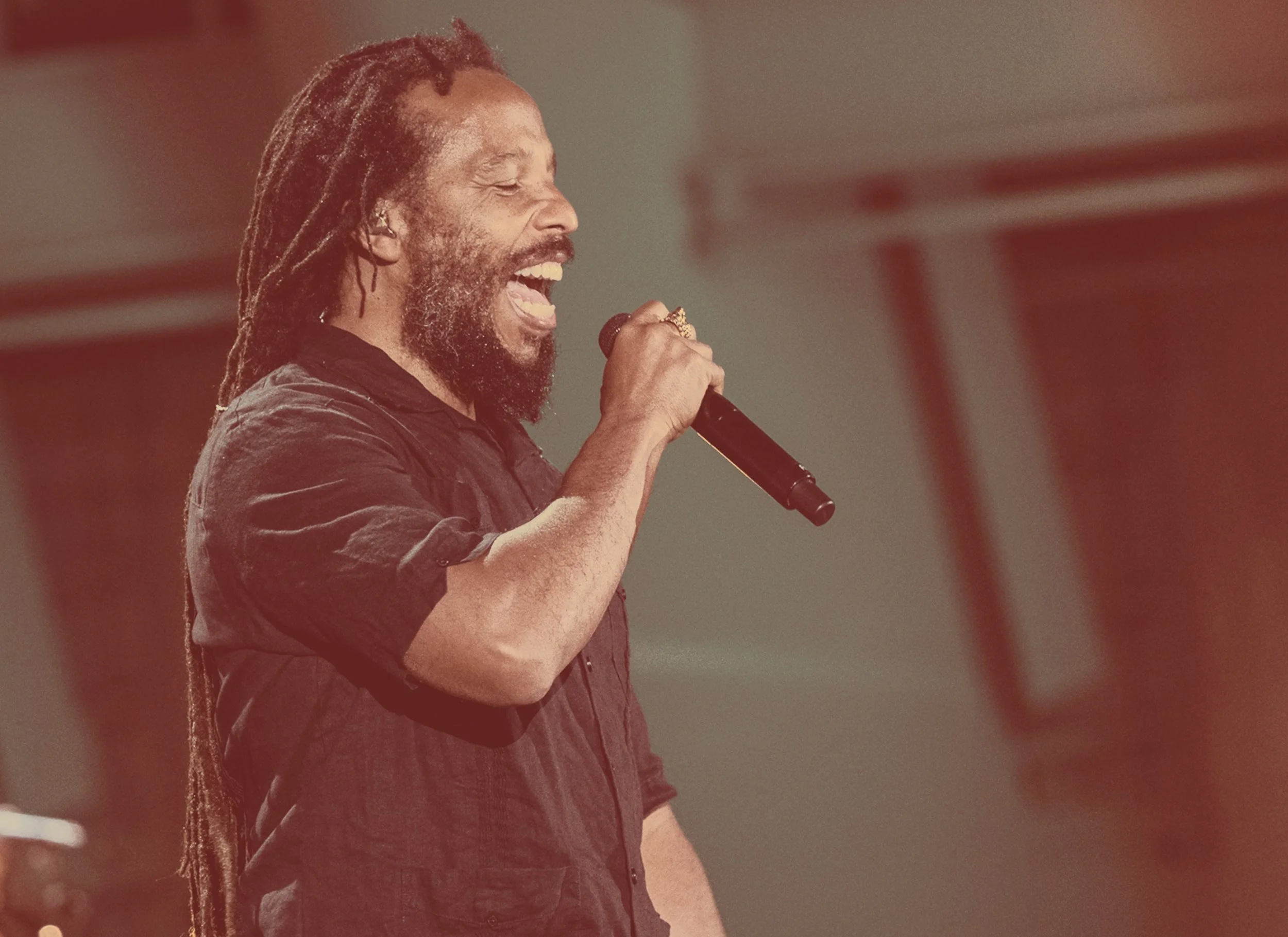
Ziggy Marley performs “Still Is Still Moving to Me” at Willie Nelson’s 90th birthday concert at the Hollywood Bowl on April 29, 2023. (photo by John Timmermans / courtesy of Blackbird Presents)
For Ziggy Marley, a discussion of Willie Nelson is, at its essence, a meditation on transcendence. Take the way he talks about the Willie song he chose for this week’s episode of One by Willie, “Still Is Still Moving to Me.”
“Willie’s is a universal music,” says Ziggy in a reverent, yet spirited tone, like he’s testifying from the pulpit. “It’s not genre based. Because I hear the reggae in this. And the country. I hear everything in this song. You can groove slow or you can groove fast. You can groove any way you want to find it. I’m coming from the reggae world, I’m feeling that groove. You coming from a rock world? Oh, you're feeling the other groove. The country world is feeling the other groove. There’s everything in this song. Every music is in the song.”
It’s a take on the multitudes Ziggy hears in one song—and a microcosm of what he sees in his friend Willie as a person. They’ve collaborated musically, recording a cover of the Black gospel standard “This Train” (see Sister Rosetta Tharpe, the Staples Singers, and so on) in a hotel room in San Diego, which appeared on Ziggy’s Grammy-winning 2009 children’s album, Family Time. And they’ve jammed casually in Willie and his wife Annie’s homes in Maui and Los Angeles.
But it’s the quiet hangs together, just talking, that matter most to Ziggy. He says that’s when he learns from Willie, absorbing lessons on honesty, humility, open-mindedness. “When I met Willie,” Ziggy explains, “it wasn’t like I met a stranger. It’s like I met one of my fathers. And I relate Willie to my father. And to Toots [Hibbert] and those guys. This generation of musicians are special people. They don’t come in bunches. They come in one’s and two’s, maybe. You won’t find Willie Nelson in the next century.”
On this week’s One by Willie, Ziggy gets into all that, explaining that to his ear, country and reggae aren’t all that different—nor are they relevant when you talk about Willie, who like his father creates music that transcends genre. But he also expands on something you cannot transcend, which is the rules at Willie’s poker table, as Ziggy learned the hard way.
One by Willie is produced by John Spong and PRX, in partnership with Texas Monthly. The PRX production team is Jocelyn Gonzales, Patrick Grant, Pedro Rafael Rosado, and project manager Edwin Ochoa, with graphic design by Joanna Holden and Modular, ink. The Texas Monthly team is engineer Brian Standefer, and executive producers Megan Creydt and Melissa Reese. And Dominic Welhouse provides invaluable research and editing help.
John Spong (voiceover):
Hey there, I’m John Spong. And this is One by Willie, a podcast in which I talk each week to one notable Willie Nelson fan about one Willie song that they really love.
This week, we talk to bona fide reggae royalty, 9-time Grammy-winner Ziggy Marley, about the last track on Willie’s 1993 masterpiece Across the Borderline, “Still Is Still Moving to Me.” It’s one of those Willie songs you can dig for a host of reasons, from the hard-driving melody, to the koan-like lyrics, to Willie’s stunning runs on Trigger, and Ziggy gets into all that.
But his focus is on the song’s message. Ziggy believes the worldview expressed in “Still Is Still Moving to Me” to be “transcendent,” which is also the word he uses most often to describe his friend Willie. As Ziggy explains it, reggae and country aren’t actually all that different. But also, they are categories that aren’t even relevant when you’re talking about Willie, because he’s one of those artists—like Ziggy’s father, Bob, and their mutual friend Toots Hibbert—who rise above genre to create a music that’s universal.
Oh but he also gets into one of those things you can’t transcend, and that’s the rules at Willie’s poker table, as Ziggy found out the hard way.
So let’s do it.
[Willie Nelson performs “Still Is Still Moving to Me”]
John Spong: The song you've picked is “Still Is Still Moving to Me.”
Ziggy Marley: Yeah.
John Spong: What's so cool about “Still Is Still Moving to Me?”
Ziggy Marley: Yeah, me like, I like the energy of it. That's the first thing, like the energy Willie have in this, on that song. I like the music so...that attract me.
John Spong: Yeah?
Ziggy Marley: It's uplifting. And then the lyrics, you know? The lyrics. I think it resonates with me because I'm like that too. And I mean, I don't know exactly what Willie meant, but I know what it means to me. And I think I can relate to it in that way. I think Willie's an interesting artist, because him live in so many worlds. You know? He's not just like a country thing. He's not just like, him living at every world. Him transcend musical genres, and that's what's so great about Willie as an artist. And this song is not only a transcendent song, but not just musically or artistically, but also spiritually. Because I think for me, I view the song as a spiritual song. Because I'm a spiritual being.
And my understanding in some of his lyrics, like even just the title, “Still Is Still Moving to Me.” Because how I interpret it is like being still, like, in that meditative space, in that spiritual space, you're still journeying. Even though you're still, you're still moving. Even if your physical is still, like, the journey is still going on. So that's how I interpret that. And it resonated me because that's how I am too. And like him say, if maybe people don't understand what he's saying, but it's real for him, you know? And so that's my life. That's my journey too. My spiritual journey is one that I don't think many people can understand if I try explain it to them. But still is still moving to me. It's like, what? It's working for me so I'm still going on it, you know?
John Spong: Yeah, trust me; it's going to work. Well, that's a perfect spot. Will you listen to it with me?
Ziggy Marley Yeah, please. Yeah. Love it.
[Willie Nelson performs “Still Is Still Moving to Me”]
Ziggy Marley: Yeah.
John Spong: What's that do to you?
Ziggy Marley: Touch my soul, man. Them song is like spiritual songs. It's a spiritual song. It reminds me of...it reminds me of spirits. I don't know. It reminds me of something, or it puts me in a place beyond, like, this physical world that I'm in right now. It put me beyond where I am right now. It carry me to another place. A very deep song, man. Simple, but deep. And then I think that’s him and Trigger, that Trigger guitar there. Much tough Trigger. Trigger highlight. I love hear Trigger, too. So, man, no. Willie just special. Yeah, man. C’mon. He's just special person.
John Spong: Trigger runs pretty wild on that song, doesn't he?
Ziggy Marley: Trigger get let loose, man. It's good though. Because Willie and Trigger is like one being. Yeah, like they're one, you know.
John Spong: They really are. And I feel like that, too. I feel like he didn't really make it as a performer; he made it as a songwriter. But then once he got Trigger, it's like the other half of him was there. And you can have that call and response with his vocals and the guitar. But I mean, it's not fully Willie until you get Trigger. They are. They're one being.
Ziggy Marley: Yeah, yeah. Trigger speaks for itself. Trigger is like, when Willie plays like, him, like, Trigger's doing something to him. It's not just him doing something to Trigger. You know what I mean? Trigger is like giving him some vibe, you know?
John Spong: No doubt. Well, and it's cool because I've talked to Micah, Willie's son Micah, about this song. And one of the things that he said was, he said, "There's that line in the song. ‘It won't go in words, but I know how it feels.’"
Ziggy Marley: Yes.
John Spong: And Micah is like, and then he, "It's like the English language isn't enough to describe what my dad's feeling. So he just starts going ‘La-la-la-la’”--he just loses it, in Micah’s telling, which is cool.
Ziggy Marley: No, but you see even the “La-la-la-la,” them thing there is, what you call that? It is sound, even things that are said without words, ‘cause “La-la-la-la…” is like, "Uhhmmmm la-la-la-laaaaaa." It's powerful vibrations. It's still vibrating. And so “La-la-la-laaaa” is another meditative essence that...and sometimes, I mean, imagine people may not speak English. “La-la-la-la,” everybody can say, "La-la-la-la." So that's the language that you put in music that transcends language barriers. “La-la-la-la.” Everybody around the world can say, "La-la-la-la."
John Spong: Everybody gets “La-la-la.” Everybody gets “La-la-la.”
Ziggy Marley: [singing] La-la-la-la-la-la. It's a worldwide thing.
John Spong: Yeah. I buy that. Well, and it's cool too, because the other thing Micah said was, along those lines, he said at the end of the song…it takes so long for Willie to even start singing. It's a Trigger workout. And then at the end, he just starts going, "Still is still moving to me,” over and over again. It's like a chant. It's over and over, just repeating that line, that mantra.
Ziggy Marley: You know what? I feel like he experienced something.
John Spong: Yeah.
Ziggy Marley: He experienced something, and he wrote about it. It's something that him experience, and he's telling us about it. And it don't take like a bunch of lyrics to express it, because it's not something that he's writing intellectually or technically. It's something that he's feeling, that he experience, that he's putting into music. And it doesn't take like, "Oh, let me write this fantastic song, and with a lot of words, and me..." And it's just something instinctively…I feel this song is a very instinctive song for Willie. It's just an expression of what he experienced and how he feels.
John Spong: And you've covered it. Is it a song that lends itself…is there something about it that lends it to a reggae treatment?
Ziggy Marley: I was going to say, it's a reggae song. It's a reggae song. No, I can tell. That's why, let me tell you, Willie transcend everything, bro. Willie's not genre. Willie’s not a genre. Willie's a universal music. Willie music is not genre-based. It's not. Because I hear the reggae in this. And I hear the country. I hear everything in this song. And so, I was listening to...when we were playing it, I said, "This is reggae music." Because you can groove slow or you can groove fast. You can groove any different way you want to find it. I'm coming from the reggae world, I'm feeling that groove. You coming from a rock world? Oh, you're feeling the other groove. The country world is feeling the other groove. There's everything in this song. Every music is in the song.
[Willie Nelson performs “Still Is Still Moving to Me”]
John Spong: Can you talk a little bit about the relationship...to me, there's a lot of ways that country music and reggae are alike.
Ziggy Marley: Yeah. No, true.
John Spong: But what you think is going to be more interesting than what I think. What do you think?
Ziggy Marley: No, one of my favorite songs was from Glen Campbell, when I was a kid growing up. “Rhinestone Cowboy.”
[Glen Campbell performs “Rhinestone Cowboy”]
Ziggy Marley: We love country music. We love the storytelling. Technically speaking, it's a simple switch of the drum, where the drum drops, that makes it reggae or country. For us, when we listen to country music, it's just where that snare is dropping. If you change that, you're getting, “Chang chang.” You're getting the rhythm section of the reggae music, still. So we definitely have a connection with country music vibes. And the cultural significance of it also, the roots of it and where it's coming from. The roots of it is coming from the real people, you know what I mean? The people from the land. That's the roots of it. It's not coming from, like, the high-risings, the high rising. You know what I'm say? So that also relate too, that also connect with us too, because the origination of it is from that roots. Strong roots. Yeah.
John Spong: There's a rural element to it. And then there's also a real pride in where you're from. Because that's a big thing that I've always kinda sensed around Jamaican artists. And being in Jamaica. I mean, you just love your place. And similarly, Texas is that way, country music's kind of that way. They're talking about where they're from. And what they love about it.
Ziggy Marley: True. No, no. Yeah. Even, it's funny, because we love it even when it rough. Even if it rough and tough. We still have that love for it.
Ziggy Marley: Like, well, it’s like, yeah, we like living a nice, easy life. But the rough life have something to it that we love, that just builds our character. Like, we always stay connected to that roots. That's the roots. That's what makes us. Where we come from, and how we’re brought up, and the type of environment that we grew up in, it kind of build our character. And so, I see that correlation of like, yeah, it doesn't have to be perfect for us to love it. It's just that we love it because of what it did to us. The good and the bad of it is an experience that makes us grow.
John Spong: Yeah. The whole thing. The whole thing. And…I don’t know. There’s something in the middle of all that that makes me think of, like, Toots and the Maytals’s version of “Take Me Home, Country Roads.”
Ziggy Marley: True.
[Toots and the Maytals perform “Take Me Home, Country Roads”]
John Spong: Were you a Willie fan before you got to know him?
Ziggy Marley: Yeah, man. I mean, I heard about Willie and was listening to Willie and watching him in some movies long before I met Willie. But when I met Willie, I was like, “Still Is Still Moving to Me;” it's hard to explain. As I said, when I met Willie, we already was…we already had a...I don't know, just like when you meet, beings that are...I don't know if he's like-minded, or whatever it is. But when I met Willie, it wasn't like I met a stranger. It's like I met a father. A father of mine, one of my fathers, you know? Yeah. So Willie's like a father figure to me. And him, like, he's been through so much experiences in life. And he’s so, like, his energy is so calming to me. Him so cool, you know? It's a very inviting energy Willie has about him. And still, you know he has an edge to it too, you know what I'm saying?
But him so powerful in his coolness that you know there's something else there, too, but he doesn't need to show that. But you know it's there. I don't have to show you that you know it's there, you can feel it. Yeah, man. C’mon. Willie is an outlaw, too. He's an outlaw, but he's a hero. I tell you, he lives in all different type of worlds.
John Spong: Yeah.
Ziggy Marley: That's the thing with Willie. He's a bad guy, and he's a good guy.
John Spong: But it's interesting too, because he has. He's been through some real difficult stuff. The most obvious one was the IRS mess, when he owed him all that money. And he kept his cool. He kept his center through that. And as you mention this, it occurs to me, I don't know that he would have been…whatever night he won the most Grammys he ever won? Or whatever? He was probably just as cool that night. It was just another day, another moment to be in. We’re gonna…the point is to make music. It's not these other things.
Ziggy Marley: Yeah, yeah. No, I feel like Willie’s life experience, when you go through certain things in your life, it's hard for the other stuff to affect you. To be like, try for change who you are, or try to shake you. I don't think by the time that stuff happened, I mean he had the Farm Aid stuff going on. Willie, I mean he was already sitting...there's nothing that they could have done that could have shaken him or given him, the awards or the issue with the IRS. His foundation was so strong that, I mean, he's been through the fire. This is nothing. He can go through that. So I feel, like, just what he's been through before tempered him enough that he could withstand the good stuff and the bad stuff. So yeah, that's the type of person he is.
And he's a good example for someone like me, who was very like, “Why are they doing that to Willie?” Like, c’mon, bro. Willie's a good guy. He's doing so much good for people. Like, "Why are you going after Willie Nelson?" C’mon, man. It was like, "Really? You're really going after Willie? C’mon, bro." If Willie needed us to defend him, we would have come. Just say, "Yo, I need you guys."
John Spong: Well, and that's the thing. And we don't have to go too far down that road. But yeah, when the IRS sold all of his stuff, his buddies bought it all. They bought it all and gave it back to him.
Ziggy Marley: Yeah, man. So, that's it. But imagine that, though. The type of person you have to be to have those type of people love you that much.
John Spong: Take care of you.
Ziggy Marley: Yeah. Yeah.
John Spong: Yeah.
Ziggy Marley: Because he would do the same thing for someone else, too.
John Spong: Yeah.
Ziggy Marley: He would sacrifice for someone else too. Yeah, man. Willie's like, for us, it’s like he's the Don. He's the Don, you know. The Don, you know.
[Willie Nelson performs “Still Is Still Moving to Me”]
John Spong: How'd you become buddies with the Don? When did you meet him? Was it through your wife? Was it through Orly? Or, how did you become buddies?
Ziggy Marley: How become buddies...I don't even know how it started. I don't even know how it started. I think I have a respect for him. And I remember when I was working on a record, my kid's record, Family Time, I always wanted to do something with Willie. And you know, Willie is good friends with Toots.
John Spong: Yeah.
Ziggy Marley: So, like, Toots is another one of my fathers. So I know Toots. Toots and Willie work together. I know some…Don Was work with Willie too. And Willie is always open-minded too, which I like about Willie, too. He's an open-minded person. So the first time I did a song with him was for my kids' record. And we did it in a hotel room, because he was on tour.
John Spong: Oh, you were there with him when they did it?
Ziggy Marley: Yeah, man. Yeah, man. He was on tour. And then I was like, "All right, we're going to do it in a hotel room. Because Willie's in a hotel room."
John Spong: Mickey told me about doing this, but I didn't know that y'all were all together.
Ziggy Marley: Yeah, man. Yeah, man. Mickey, yeah.
John Spong: So the song is “This Train,” right?
Ziggy Marley: Yeah.
John Spong: How'd you pick that song? Why did you want to do that one with Willie?
Ziggy Marley: I don't know. It felt like, it felt like a Willie song to me.
John Spong: Okay.
Ziggy Marley: That's why I choose that one.
[Ziggy Marley and Willie Nelson perform “This Train”]
Ziggy Marley: Yeah. So, we went there, Trigger was there, Willie was there. And I think that's really the first time I “met him” met him. Physically meet him. I think that was the first time. And it was like meeting an old friend. And I relate Willie to, like, my father. Like, Toots and those guys. These generation of musicians are special people. They are special people. They don't come in bunches. They come in one’s and two’s, maybe. But you won't find people like Willie in the next century. Or like my father. Or Toots and these guys. I don't know. These guys are built differently. They're different type of people, bro. And when I met him, the warmth I felt and I felt like he was...I felt a fatherly thing for him. I just felt that from him.
Yeah, that's the respect I have for him. Don’t even have nothing to do with his music right now, really. Just have to do with his energy and just the vibe that I get from him. And as I say, he's like a father figure. And that's what I love about being around him, just going to see him or checking him. It's just like checking my father. So in that way, it's very special. It's deeper than just the artistic stuff for me.
John Spong: When do you hang? Has it been in Maui, or LA, or both, or everywhere?
Ziggy Marley: Yeah, it's been in Maui. It's been in LA. Yeah. I mean, when we went to Maui, the story, I think Willie put it in one of his books too, about this poker game we had.
John Spong: I might have heard a little about this one.
Ziggy Marley: Yeah, so I was in Maui with my wife. I think we were on vacation. So we say, “Alright, we’ll go check Willie and Annie.” So we would drive over the house. And I didn't know what was going on, but when I went there... yeah, Willie's whatever, he's in the whatever, the garage or wherever they were. The man cave, or whatever it is.
John Spong: The poker room.
Ziggy Marley: Poker room. The gambling den. The real gambling. Like, this ain't no joke-gambling. This is not like some friendly gambling stuff. This is like real money and real gambling, you know? So, I was like, all right, I’m going check him. So listen, I never played poker before. I mean, I played it on my phone or something. I did some poker stuff. And I watched it on TV. So I have an idea. I have an idea of what it is. So Willie now, Willie, I'm odd person, right? I go in there, and Willie was like, "Come on, come play." I'm like, "I don't really play now, Willie. I’m not really…" So Willie wants to take my money now, right? He's like, "Come play cards.” I'm like a newbie, a rookie. So he was like, "Yeah, come play.” And them smoking. I think Woody Harrelson was there, and a bunch of guys that look really, like, weathered and worn. Like, these guys...them guy look rough. Yeah, these guys look like the real deal. So I'm sorry, let me get that shot.
So them dealing me the hand and stuff, and real money, bro. Real money. Them money I play for, real money. It's not a friendly. It's real money these guys are playing for. So yeah, me take some money from my wife, alright? And put some money down. And I won. I won some hands. But then my wife was like, "Yo, we got to go. We have a dinner appointment." So Willie was very upset. Willie felt like we scammed him or something. What's the name of that movie? The movie with Paul Newman and Robert Redford.
John Spong: Oh, The Sting?
Ziggy Marley: The Sting. Willie think I stinged him. It was a sting. I didn't sting you, I got lucky! And from ever since he's wanting to get back at me for that. Because I took the money but I didn't give them a chance to win it back. And that's what hurt the most.
John Spong: My limited understanding is you're supposed to give him a chance to win it back.
Ziggy Marley: So, Willie's still waiting for me to come and give him chance to win it back. I don't think I'm going to do it though. I think I'm going to keep that money. That's gonna be the story. That's going to be my story for life. But it was, I mean, it was an experience to hang out with him, and being around his friends, and just the vibe and the energy. And it's so cool man. Willie's a real person. He's a real person. He's real.
John Spong: When y'all are there, is there music playing in the room? Or do you play music with him? Do y'all ever just sit and pick or jam?
Ziggy Marley: Yeah, we do some little jamming sometime. But it's not that though, for me and him. It's not that. It's just being around and talking.
John Spong: Yeah.
Ziggy Marley: Because when you go to the music side of it, it's like, all right, it becomes like a career. No. As I said, we just be real. It's just life.
John Spong: Yeah.
Ziggy Marley: Music shouldn't even come into the equation. Because that's what we do all the while. So when I do go with him, it's like sitting down and talking and chatting. Sometimes we'll play some dominoes or something. Play some game there, or something like that. But it's usually just chilling and just relaxing and just talking.
John Spong: Did you give him any money back at dominoes?
Ziggy Marley: No, we never gamble for the dominoes. But I did. I'd started writing a song about that experience I had. And so, I think…I haven't finished it yet, but it's called “A Good Time at Willie's.”
John Spong: Tell me more. Tell me.
Ziggy Marley: No, but I have that idea, and I have a verse of it. Like, “Playing some poker, smoking some herb, you know how Willie do it…something, something, something.” I haven't finished it yet, but from the experience, it remind me just like having a good time at Willie's, man. We always have a good time at Willie's.
John Spong: It is. It's such a different world now. Once upon a time, like growing up in Austin, everybody knew, “Oh, Willie Weed is special,” back when it was illegal. And now it's not. But is his weed good?
Ziggy Marley: Yeah, man. One time upon the bus, and I remember I went to a show of his. Yeah, Willie Weed strong. Some strong stuff Willie smoke, man, back in those days. Yeah, I remember going on the bus and, yeah, taking a draft from Willie herb. Some of the best herb, really. Some of the best. And that's why, like, him just remind me of my father and them people. I just see him energy. Those guys had the best herbs. Willie had the best herb. And the best vibes to smoke herb with Willie is just like a chill vibe. Oh, man. I'm going to get chills just talk about it. Because Willie, I'm going to say a special...he's just a special person, bro. Yeah. I'm going to get chills when we talk about him in these ways. He's just a special human being.
[Willie Nelson performs “Still Is Still Moving to Me”]
John Spong: Annie told me to ask you about Willie's reggae album.
Ziggy Marley: The reggae album, yeah. I don’t know, he do something with Toots. I think Don Was the one who produced that album.
John Spong: Yeah, it was Don.
Ziggy Marley: Yeah, Don produced that album there. Yeah. I mean, like me say, there's a mutual love, I think, between Willie and reggae music. I don’t know, bro. Like me say, if Willie came to Jamaica, he would just be one of us. He wouldn't be like some guy from Texas. Him just fit, he fits in. He fits in with us. He fits in with us. With…all the people I know like Willie from Jamaica. They fit in. We all fit in together.
John Spong: Yeah.
Ziggy Marley: I mean the reggae album is right up his alley because he's one of us. We're one of him. It's weird because it’s not, it’s not…I can't find that anywhere else, in terms of which other artists like Willie could [do] the reggae thing, and we have so much synergy with. Even beyond the friendship, but musically. How the heck did Willie get to the reggae stuff? There's nobody else I can think about that could just do that from his world. It's very interesting to me.
John Spong: So much of the record, a lot of it, it does. It sounds–you were talking about genres–it sounds a little bit like genre, but if I could play one more little thing for you for a second, if it's cool. There's one song, his cover of “The Harder They Come,” on the record. It makes me think of “Redemption Song” a little bit, because it's just so heavy on the acoustic guitar, but it is such...it is really special.
Ziggy Marley: Let me hear it. Let me hear it. Because I think I haven't listened to that album in a while.
[Willie Nelson performs “The Harder They Come”]
Ziggy Marley: I mean, that's a Willie song.
John Spong: Yeah.
Ziggy Marley: Yeah. Right? That's that synergy, bro, I'm telling you. That's a Willie song right there. Yeah. And I know I feel like he relates to it. He singing it from a tree…he’s not recreating…I can hear Willie experience in that song. I can hear his experience in it. That's why it’s so cool.
John Spong: Yeah. You keep talking about the “fathers.” And I talk sometimes to other people about “elders.” I wanted to ask about that. There is…have you ever talked to Willie about your dad, I guess, maybe? Does that come up?
Ziggy Marley: Not in any extensive way. No, no, no. I don't remember if I told him….whenever me talk to Willie, I would say, "Yes, father." I call him father.
John Spong: Oh, wow.
Ziggy Marley: And I call him father sometimes. I don't know if he picks it up, but within me, I know what's going on. But no, I never spoke to him about my father. No.
John Spong: But when you were talking about that generation and those figures…and I really do, I see a lot of overlap, or similarities, or there's just something wonderfully complimentary about your dad and Willie Nelson, in my mind.
Ziggy Marley: Yeah, maybe that's why I connect with him like that too, though. Because it's a similar energy. It's a similar energy they carry. Like, I don't know if I explain it. I don't know how to really explain it. But it reminds me of that energy. It remind me of my father energy. Same with Toots, a lot of these...I don't know what it is. And maybe it's me and not them. Maybe it's what I'm picking up. And maybe they don't even know what it is, but I do. Because I'm receiving it from them and they're not consciously giving me anything, but I'm receiving something from them that they might not...Willie might not even know.
John Spong: Yeah.
Ziggy Marley: Or realize it. But I, as a recipient of his energy, his aura, his vibes, I know what I'm feeling. And it's a very familial vibe and a very disarming energy. And comfortable. Like, when we’re going…Willie presence is just right there, with all the amount of respect that you feel for this man. The amount of respect you feel for him is, as I said, it's not just about him being a great artist. It's about when you go into a room and you see somebody or meet somebody, how do they make you feel? And you just feel respectful, you know?
John Spong: There's a spiritual quality to both of them. I mean, your dad's a prophet. And [his] songs are more overtly topical, I guess. But not more spiritual. Willie's sets are filled with gospel music. Reggae is gospel music. But there's something…Mickey Raphael said that one of the things about your dad and Willie is that they both use music to heal people. And I feel that. There's a connection that's on some other level. I guess that's what you're getting at. I guess that's what's hard to explain.
Ziggy Marley: Yeah, it is hard to explain. It's hard to put in a words just like...I think Willie says it in the song. It's the same thing. “Still is still moving to me.” It's hard to explain these things. “It's hard to explain how I feel. It won't go in words, but I know that it's real.”
John Spong: Right.
Ziggy Marley: This is what we're talking about.
John Spong: Yeah.
Ziggy Marley: This is the experience. And no matter how much we try, like, talk about it, it's difficult to explain. But still is still moving to me, bro. It's just that's what it is.
John Spong: I've spent a lot of time watching old concert footage of your dad. And Willie, as well. And I feel like when your dad was doing his thing, he would get lost in the song, it seemed. He would go deep inside himself and kind of get lost in the song. But I think–I think–what's happening is, wherever he goes inside himself, he's tapping in to something else, something universal. Maybe Willie's talked about how songs live on the air. And if you are in the right mind, you can grab them. And that's how you create them. They're there waiting for you. They seem like two people who are tapped into something that the rest of us are lucky to learn from.
Ziggy Marley: Yeah. But Willie, you see, because of where Willie's coming from, and that genre thing, he stands out. He stands out differently than everybody else in his world. And I think it's because of that…he transcended to that spiritual level. And so he could reach many, many more people with where he was coming from. People can relate to him because him…as me say, I don't know, but that's what it is. Willie, out of every other artist, whether that be Waylon or, you know, his buddies,…
John Spong: Yeah.
Ziggy Marley: …Cash, or whoever it might be, Willie is still, is like a phenomenon. Because his tentacles reach so much further. Outside of that where he's from. His tentacles reach so much further than anybody else from his world.
John Spong: Yeah.
Ziggy Marley: Yeah, and I think it's that he tapped into something else, beyond that physical space. That spiritual space that he goes to, I think it gives him that ability and that energy to touch many more people. He wasn't just content to being where he was. He wanted to grow.
John Spong: Yeah.
Ziggy Marley: Willie wanted to grow. He wanted to be more than...his open-mindedness is what, is another asset that he has. [Because] the close-minded are...and him love people. Him love all people.
John Spong: Yeah.
Ziggy Marley: He love all type of people. He didn't get into that box that a lot of times we think a lot of these people get into. He didn't get into that box. He didn't get into that, like, snobbiness about what he is or who he is or what he does. He was very humble about it too.
John Spong: Yeah.
Ziggy Marley: And that's the next thing about it, that humility that he has is a great strength of his, you know?
[Willie Nelson performs “Still Is Still Moving to Me”]
John Spong: Is there a great lesson from his life?
Ziggy Marley: From Willie life? Yeah, man. I think the great lesson is to be free. And to be, uhm, like him say, "Just roll me up and smoke when I die." Who says that? That is a freedom...that is a freedom that...I want that freedom. I want to say that. I wish I had come up with that. That is a type of...that is a heavy thing. It seem like fun, but it's a heavy thing. It's a heavy thing, bro. He's gone. He's transcended all of this shit. It doesn't matter, all that stuff, it doesn't weigh on him. These things don't weigh on him. He's gone. He's past that.
John Spong: Yeah.
Ziggy Marley: And he's been past that. And he's been on that journey. So that's that powerful thing that, I tell you, you know it's there but it doesn't have to be upfront. He doesn't have to say it, talk about it. But you know Willie's a powerful being. Because only a powerful being could say that. You couldn't be like some like, shake now. You got to be strong. And it's an inner strength too. It's like, no, that's what I'm going to tell you. Willie's special, man. Nah, sure. C’mon. No, it's not normal. He's not normal.
John Spong: What did I forget? What else? What's your other favorite Willie story? What am I leaving out?
Ziggy Marley: Let's see if I have another Willie story. No, I mean, listen. My experience with Willie…because I'm a student. And to be around a legend like him, I'm also, I’m learning. I'm learning from him. I'm learning from how he is, his presence, how he talks, how he acts, how he acts around people. I'm learning as a young guy, just being around him in his presence is a lesson for me. His music, his honesty, the rawness, the openness of him, musically speaking…I mean, yeah, he's a teacher. He's also a teacher. He's like a professor for me, in that way. So I mean, that's my story really is that…that learning by observing and even osmosis, just being around him makes me a better artist, a better person, a better human being. Yeah. I mean, I learn a lot. I think I learn a lot from him…unbeknownst to him! He doesn't know he's teaching me!
John Spong: That's awesome. I mean, I think that's everything. Sometimes at the end we say, you know, Willie and Annie listen to these on occasion. Do you have anything to say? Tell him when you bring his money by?
Ziggy Marley: Well, all right. No, Willie, Annie, we love you guys. You know, you’re family. Deep respect and love for you guys. Yeah, I think I like how that poker story ended. I don't want change the ending to that story.
John Spong: No changes.
Ziggy Marley: I don't think I want change. I think it's a great story. And no, just thankful that I know Willie, thankful I know that the family, and thankful for their energy. Because it means a lot to me to be able to be in the presence of Willie Nelson. It's a gift. I don't take it for granted. It's a special gift to be around someone like him.
[Willie Nelson performs “Still Is Still Moving to Me”]
All right, Willie fans. That was Ziggy Marley, talking about “Still Is Still Moving to Me.” A huge thanks to him for coming on the show, and a big thanks to you for tuning in. If you dig the show, please subscribe, and stop by our website at onebywillie.com. Oh, and please visit our page wherever you get your podcasts and give us some stars or type in some comments, or maybe just tell one friend to check out the show. Every little bit of that helps more than you know.
One by Willie is a production of John Spong and PRX, in partnership with Texas Monthly. Our PRX production team is Jocelyn Gonzales, Patrick Grant, and Pedro Rafael Rosado, with project manager Edwin Ochoa. Our Texas Monthly team is producer / engineer Brian Standefer, and executive producers Megan Creydt and Melissa Reese. Our art and web design come from Joanna Holden and Modular, ink. And we get invaluable research and editing help from the great Dominic Welhouse.
Please follow us on Instagram at onebywillie–all one word–find us on bluesky, and join our ever-expanding Willie conversation at the One by Willie group on Facebook.
I’m your host, John Spong. Thanks for listening.