
Emmylou Harris on the High-Wire Act of Trying to Sing Harmony with Willie Nelson
In an Icon-on-Icon birthday tribute, the 14-time Grammy winner and Country Hall of Famer takes us back to the ‘70s…to touring with Willie, revolutionizing country music, and “Till I Gain Control Again.”
By John Spong
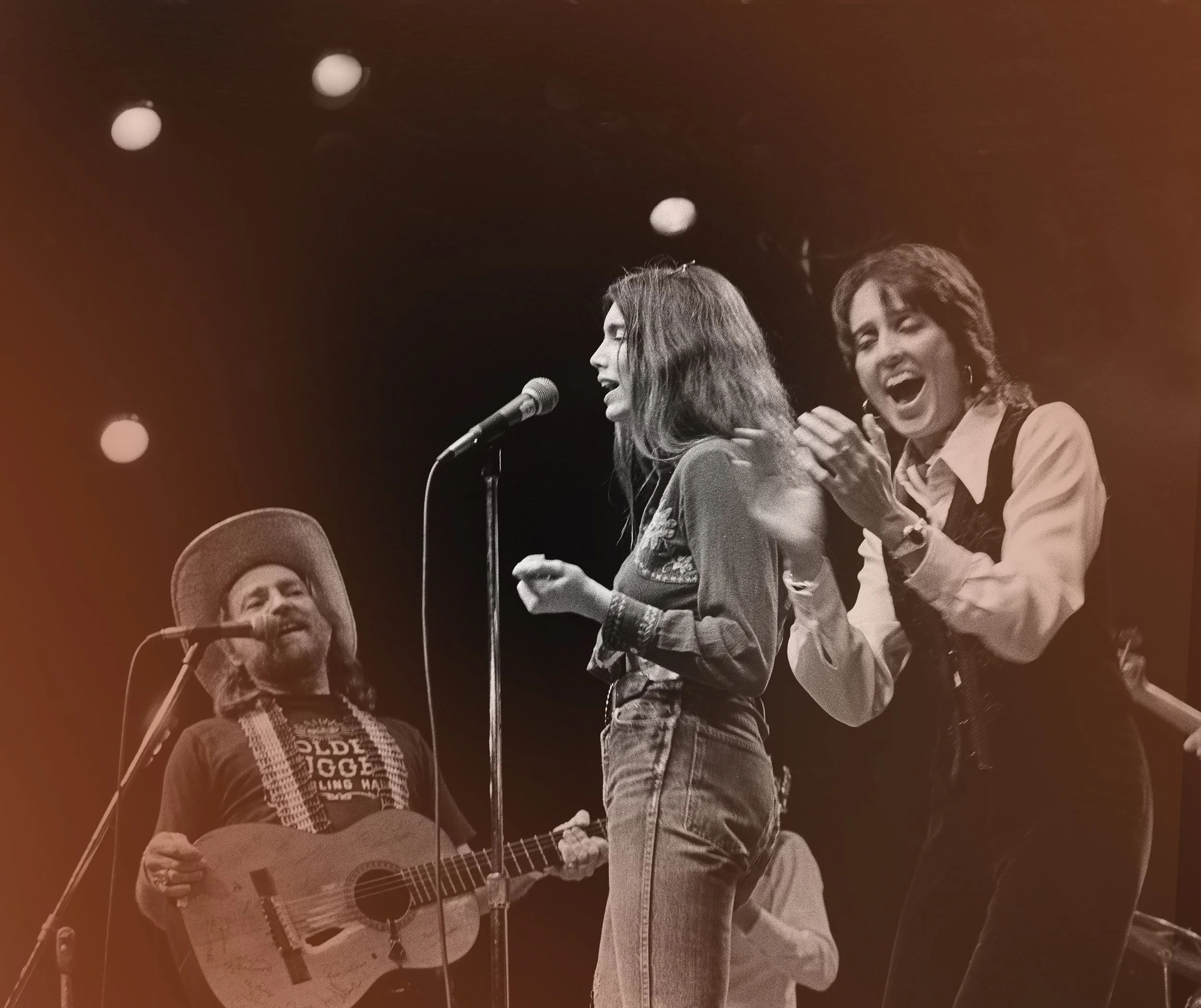
Willie Nelson, Emmylou Harris, and Joan Baez perform at the Circle Star Theatre in San Carlos, California, on March 5, 1976. (Photo by Richard McCaffrey / Getty Images.)
In 1975, Emmylou Harris and Willie Nelson each released landmark albums that would change the course of American music. Emmy’s offering, her major label debut, Pieces of the Sky, came out first, in February, followed by Willie’s Red Headed Stranger, in May. Both artists chose to record far from the Music Row studio system and its A-Team session players, Emmylou in Los Angeles and Willie in Garland, Texas, and they took advantage of that distance like kids throwing a party while their parents were out of town. Pieces of the Sky and its big hit “If I Could Only Win Your Love,” an all but forgotten Louvin Brothers’ song, were highlighted by tight, bluegrass harmonies and, of all things, a mandolin. Likewise, on Red Headed Stranger and its near silent, pop-crossover smash, “Blue Eyes Crying in the Rain,” a similarly overlooked old Fred Rose song, Willie stripped away every bit of the high-gloss production sound then dominating Nashville country. “We were sneaking it in, weren’t we?” remembers Emmylou. “Back to, really, the roots.”
The two would then spend the balance of the decade touring together, and on this week’s special birthday episode of One by Willie, Emmylou focuses on a song she sang on stage with Willie every night back then, “Till I Gain Control Again.” It was, of course, written by one of her and Willie’s all-time favorite songwriters, Rodney Crowell, who happened also to play guitar in Emmylou’s Hot Band at the time. It was the first song Rodney ever played for her the night they met, an instant standard that she’d soon record for her second album, Elite Hotel, in 1975, and that Crystal Gayle would take to #1 in 1982. But as Emmylou points out, once she heard Willie sing “Till I Gain Control Again,” she retired it from her setlist. “After Willie did it,” she recalls, “to me, it became Willie’s song.”
All that, plus Emmylou’s memories of being a young artist witnessing the deep, almost spiritual connection Willie forges with his fans, the show she played with him the day Elvis died, the making of Teatro, the near impossible task of following his phrasing when they sing harmonies together…and her sweeter-than-sweet best wishes for Willie’s big 93rd birthday next week.
Music video by Willie Nelson performing My Own Peculiar Way. (C) 1998 The Island Def Jam Music Group
One by Willie is produced by John Spong and PRX, in partnership with Texas Monthly. The PRX production team is Jocelyn Gonzales, Patrick Grant, Pedro Rafael Rosado, and project manager Edwin Ochoa, with graphic design by Joanna Holden and Modular, ink. The Texas Monthly team is engineer Brian Standefer, and executive producers Megan Creydt and Melissa Reese. And Dominic Welhouse provides invaluable research and editing help.
Transcript
John Spong (voice over)
Hey there, I’m John Spong, and this is One by Willie, a podcast in which I talk each week to one notable Willie Nelson fan about one Willie song that they really love.
This week, we celebrate Willie turning 93 with another one of our special, Icon-on-Icon birthday tributes. This time we’ve got 14-time Grammy winner and Country Music Hall of Famer Emmylou Harris, who will talk about a song she used to sing every night with Willie when their bands toured together in the ‘70s, “Till I Gain Control Again.”
It was, of course, written by an all-time favorite songwriter of both Emmylou and Willie, Rodney Crowell, who was also in Emmy’s band back in those days, and it gets her thinking about being a young artist witnessing the deep, almost spiritual connection Willie forged with his fans, and the way she and Willie—and her old producer Brian Ahern—worked to reintroduce country music to its roots back in the 70s. All that, plus the day that Elvis died; the eternal influence of her original country duets partner, Gram Parsons; the making of Willie’s Teatro album; and Emmy’s, shall we say, fool-proof strategy for following Willie’s phrasing when they sing together.
So let’s do it.
[Willie Nelson performs “Till I Gain Control Again”]
John Spong: Well then, Emmy are you…should we get going?
Emmylou Harris: Yeah, I'm here. I'm ready. I'm chomping at the bit.
John Spong: Well, we never get that, so what a thrill. Well, the place where we typically start, and it's always a goofy question, but particularly in this instance…just as a song, what is so cool about “Till I Gain Control Again?”
Emmylou Harris: Well, that song was the first song that Rodney ever sang to me in person. And of course, Rodney's been so important in my life, in music and everything else. And I ended up recording it for an album called Elite Hotel that came out in '76 [correction: 1975]. And then I guess Willie heard it, and a few years later, it seemed like all my touring was opening for Willie, which was a wonderful experience. And he would have me come out and sing harmony on it. And of course, I loved the song so much. And that was just a part of the tour.
We'd do our show, open for Willie, and then he would do his marathon show, which was wonderful to just be an experience there, because you felt the audiences for Willie, it was like going to church for them. There was something more than just coming to a concert. And I don't mean that he did a lot of spirituals. I mean, he did, but it was just a celebration of all the things we share as people, love and loss and joy. And then at the end I was able to come out and a lot of my band members would come out and sit in with him, and we became part of the family, Willie's family, for those several years.
John Spong: I love the spiritual, vaguely religious way you describe it, because it's funny. I talked to Willie's longtime manager, Mark Rothbaum–who's essentially a co-star on these shows, he appears so often, and is such a big part of Willie's life. But I was asking him about this song in particular, and he said that “‘Angel Flying Too Close To The Ground’ and ‘Till I Gain Control Again’ are as close as I get to religion.” He said, “With ‘Gain Control Again,’” he said, “all the years that Willie would do that song, at that point in the show everything got quiet. And all the craziness stopped. And everybody listened.” And then he said, and this was really beautiful. He said, "There's a Jewish prayer called the Shema. It's a peaceful moment in the service. There's a calm that lays over you, and that's what this song always did at Willie's shows."
Emmylou Harris: Right. Well, I agree, because really when you think about it, it can be a song about a person that you love and that helps you through life, or it can be about your own personal relationship with where you find that spiritual part of your life, that remains a mystery to all of us, but we know that something is there.
John Spong: Yeah. That strikes me as a good place to listen to the song together if you're up for it.
Emmylou Harris: Oh, of course.
[Willie Nelson performs “Till I Gain Control Again”]
John Spong: And that version was off of the famous, the great Willie Nelson and Family Live album, from Harrah's Casino in Tahoe. You were on that, right?
Emmylou Harris: Oh, that was me singing.
John Spong: What's it do to you now? Does it take you back?
Emmylou Harris: Oh, yeah. I mean, we did that every night when I opened for him. And then he would do, “Will The Circle Be Unbroken.” You know, it was just a…it was always a celebration. A Willie Nelson concert was a celebration every night.
John Spong: Knowing the song as well as you do, are there lines in it that really stand out? Is there…what's the magic in that song?
Emmylou Harris: Well, I think thinking back to, let's see, "There is nothing I could hide from you, you see me better than I can." And that idea, that song was actually one of my father's favorite songs.
John Spong: Oh, really?
Emmylou Harris: And so that was always special to me.
John Spong: I asked Rodney about writing it, and he said, "I have no memory really of writing it." He said, "I feel like it just appeared to me." And then he said, "I swear I didn't steal it. I swear I didn't steal it. But I am convinced that if I hadn't played “Help Me Make It Through the Night” a hundred times in a Holiday Inn in East Texas, I never would have written that song."
Emmylou Harris: Yeah. One song, you know, it's like you ingest it and it becomes part of you, and then it comes out in your own words.
John Spong: Yeah. And then Rodney's words, there's something…to listen to it just now and to look at it with lyrics. I'd always thought it even had more words in it than it actually does. It reminds me a little of Guy Clark's “Heartbroke.” The words are pretty...it's simple. There's not a bunch of SAT words in it or anything, but there's this intelligence in the way the words are deployed.
Emmylou Harris: It's harder to write a simple song that works than it is a complicated one.
John Spong: Is it?
Emmylou Harris: But that's, I think, what makes country music so powerful.
John Spong: Yeah.
Emmylou Harris: You only have three chords and the truth, as Harlan Howard used to call country music.
John Spong: Right. Is it fun to sing? Have you always dug singing the song? Because you cut it before Willie did.
Emmylou Harris: Well, I did. And it's funny, after Willie did it, to me, it became Willie's song. And the only time I perform it now, really, is when Rodney and I do things together, like guitar pulls or something. And I sing the chorus, as I did with Willie. And I usually sing the last two lines of the second verse. I put a harmony on that. And so, I do enjoy revisiting that song in that way.
John Spong: Rodney said that for as many times as he's sung that, he feels, he says, "I don't step into it as comfortably as Willie does when he sings it."
Emmylou Harris: Well, that's his problem. He wrote it. He doesn't have to do anything else, you know? I mean, to write a song like that at, I don't know, what was he, 21 years old or something?
John Spong: Just a punk kid.
Emmylou Harris: That's just not right.
John Spong: It's not fair. Certainly not fair.
Emmylou Harris: But that shows what a gifted writer he is.
[Willie Nelson performs “Till I Gain Control Again”]
John Spong: Talk about Willie's strength as an interpreter. What is it that Willie does that ends up giving him possession of all these songs that other people wrote?
Emmylou Harris: Well, first of all, nobody has a voice like Willie's. Well, we can hear it a little actually in his children, you know Lukas. And one of his daughters, they did a duet together of a John Fogerty song just recently that came over the radio.
John Spong: Oh, yeah. He and Paula. He and Paula did that, “Have You Ever Seen the Rain?”
Emmylou Harris: So I went, "Okay, I hear that Willie gene in there." And of course, the way that he plays guitar and sings, I think Rodney once said, "Willie sings, it's like fly fishing, his phrasing.” That's meant to be a compliment, by the way. But I did have to watch Willie. I did have to watch him to get his phrasing. And that was particularly true, not just live, but when Daniel Lanois did the Teatro album. Because I might have been vaguely familiar with some of his old catalog that he did on that album. I was watching like a hawk. I was watching his mouth, trying to catch it like a fish.
John Spong: I was going to ask about that, because yeah, and it's funny, when we had Rosanne Cash on here very early on in the show, it was one of the moments when we realized, "Oh, we're doing something kind of special." Because she attributed the fly-fishing line to you, not Rodney. She said-
Emmylou Harris: No, that was Rodney. I'm not clever enough to come up with something like that.
John Spong: But it's that hard, right?
Emmylou Harris: Well, he just has a way of doing a song. And maybe even changing the melody. But whether it's his melody or someone else's, he puts the Willie in it.
John Spong: But like you've said that for you, harmonizing, I feel like at times that I've read quotes from you where you've said that you prefer that even to singing by yourself. It's that “third voice” thing that, as you describe it.
Emmylou Harris: It's a different thing. Because it's like a dance and you're following the leader. And so, they're leading you into the emotion of the line, but basically I'm just thinking about following the phrasing. And it's not the pressure to tell the story in the song. You're just adding something to it. You see what I mean?
John Spong: Yeah.
Emmylou Harris: I'm the Ginger Rogers to his Fred Astaire.
John Spong (25:02): Well, I cannot argue with your take on what you do, but when I hear you do it, it occurred to me a long time ago, I never hear you in a supporting role. It always sounds to me like a full-on collaboration when you harmonize with someone.
Emmylou Harris: Well, it is. It's definitely...but as I say, you are singing to a lead. And I mean, that's what duet singing is. But it is true that, for me, because I'm not a schooled, musician-singer, what's the tenor, what's a baritone, whatever. For me, it's a second lead.
John Spong: Right.
Emmylou Harris: It's a second lead.
John Spong: Well, and it's interesting, because I don't know who said it first, but Ann Richards used to always talk about how you might think that Ginger Rogers was dancing in support of Fred Astaire, but she was doing it backwards and in heels.
Emmylou Harris: And in high heels, yeah. Yeah. Oh, yeah, I've used that before. Although, I can't wear high heels anymore. And never could do them very well.
John Spong: Can I…I don't want to spend all day on the phone making you listen to things, but can I show you a clip from Teatro? Because since you brought it up, that is fascinating.
Emmylou Harris: That was a wonderful, wonderful film that Wim Wenders did.
John Spong: That's how I learned to start pronouncing it “Wim Wenders,” because I kept telling everybody about it.
Emmylou Harris: I always felt that that album, Teatro, could have won, been nominated for and won at least three Grammys in different categories.
John Spong: Which ones?
Emmylou Harris: And then the documentary…well, Country, Jazz, Willie. Just have a category for Willie. And of course, the film was just spectacular. I wish more people had seen it, and I wish more people knew about that album.
John Spong: Mickey told me once, he said, because for people who aren't following, y'all did the album in the theater in Oxnard, California, that-
Emmylou Harris: Teatro.
John Spong: Daniel Lanois. Yeah, the Teatro that Daniel Lanois had created with Mark Howard. And then once the record was finished, they brought Wim Wenders in, and y'all just ran through all the songs again live and created this documentary. And Mickey said that he feels like the music in the movie is better than the stuff that they got on the album.
Emmylou Harris: Well, I'm so glad they both exist. I think right after that, I think there's another whole album in the can somewhere, because we recorded many more songs than what appear on the Teatro album.
John Spong: Oh, wow. I’ll wait for that.
Emmylou Harris: But Willie had to get back to his other job of playing golf. There's a quote from, I think, that is attributed to Willie that he was asked when he was going to retire, and he said, "Well, all I do is play music and play golf. Which one do you want me to give up?" But Willie did life his way. He did both.
John Spong: Right. Well, we will send the listeners to YouTube to find this video, because the video from that movie does exist on YouTube. And so, let me hit this. You see it?
Emmylou Harris: Yeah.
[Willie Nelson performs “My Own Peculiar Way”]
Emmylou Harris: Wow. I can't believe I followed him on that 4-chord at the end, because I hadn't seen these songs. And as you can see how I had to watch him. It was lovely to see Bobbie, an image of Bobbie there for a second.
John Spong: Yeah.
Emmylou Harris: Yeah.
John Spong: When you're following Willie, what do you look for? Are there ticks? Are there tells? Are you studying? Are you getting a sense of his inhalations? How do you follow?
Emmylou Harris: I have no idea. But you just try to be in the moment with him. You get the feel of the groove. And yeah, what can I say? It's a miracle. So delighted to have been a part of that.
John Spong: It's such a beautiful record. And we actually, we did one of these with Adrian Quesada, who's in the Black Pumas, and he knows all about Latin music. And he explained how you can hear so much of the Flamenco and Latin influence in Willie's guitar playing on that album.
Emmylou Harris: Well, that's another Grammy, you know?
John Spong: Yeah, right.
Emmylou Harris: Latin album.
John Spong: He said that when he listens to Willie's guitar solos, that it makes him think most of Cuban jazz pianists like Ruben Gonzalez. And I'm like-
Emmylou Harris: Well, right.
John Spong: ...that shit's over my head. But it's cool, because I saw a quote from you once talking about this and you said that when you're talking about singing with Willie, "Thinking is the enemy of performance. There's a leap of faith you take when you're singing with people like Willie, and you know that they're not looking for perfection, they’re not looking for every note sung exactly the same way. They’re looking for something in the key of life.”
Emmylou Harris: Oh, that sounds wonderful. I actually said that?
John Spong: Apparently. It got past the fact-checkers.
Emmylou Harris: Yeah.
John Spong: Are there other songs that Willie has done with you that you dig in particular?
Emmylou Harris: Well, I'm trying to think. Well, we sang together…I did a Christmas album, one of the better kept secrets in the music business, where we actually recorded a song of Rodney's called “Angel Eyes.” And that was a duet between me and Willie, and he played the solo.
[Emmylou Harris performs “Angel Eyes”]
Emmlou Harris And then I did a bluegrass album in 1980, that came out in 1980, Roses in the Snow. And I had recorded an old gospel number called “Green Pastures.” And we wanted it to be very, very...I like to stray and go around and not...stray outside the lines. But on this record we said we're going to make a pure bluegrass album. But the one thing that Brian and I did that went outside the lines was, for “Green Pastures,” [which] was a very, very traditional bluegrass spiritual, we had Willie play the solo. And Dolly and Ricky Skaggs did the harmonies with me.
John Spong: Wow.
Emmylou Harris: And I love that solo. He made it work, even though it wasn't like the other instrumentation on the album.
John Spong: It's interesting when he did the bluegrass album a couple of years ago, and Buddy Cannon, his producer got all the great pickers, bluegrass players to play on it, Willie opted–and it was all old Willie songs–Willie opted not to play any guitar on it, because he said, "I'm not a bluegrass player, and this is supposed to be a bluegrass project. And so I want to ..." almost to honor that…
Emmylou Harris: I think I missed that record. He makes so many. What was it called?
John Spong: It was called Bluegrass.
Emmylou Harris: Oh, okay. Well, I got to check that out.
John Spong: It's pretty strong. It's great. But yeah, his guitar is so interesting…and I'd read that because the record label didn't want you making a bluegrass record in 1980 or '81 or whatever it was…
Emmylou Harris: Well, there was one particular person who...yeah. But Warner Brothers, a very, very creative record company who understood why they'd even signed an artist. And so, they got behind everything I did. And I think for all the artists that were on that label had that freedom.
John Spong: That's cool. That's cool. I'd wondered if trying to get a bluegrass [record] past them wasn't a little bit like Willie trying to get Stardust past Columbia a couple of years before.
Emmylou Harris: No. There was a little worry in the beginning, but it really just came from one person. And ultimately, it became my first album that I'd recorded to go gold.
John Spong: Oh, Wow.
Emmylou Harris: Yeah.
John Spong: Emmy wins.
Emmylou Harris: Yeah.
[Emmylou Harris performs “Green Pastures”]
John Spong: When did you first become acquainted with Willie's music? If you didn't grow up on a lot of country, when did you first start listening to him?
Emmylou Harris: Oh, I don't know. I guess around the time he made Red Headed Stranger, and that made a lot of noise around musicians and people who, as I say, color outside the lines. And then of course, I don't remember how I actually got the gig to open for him. And then it was Willie and more Willie every night. I always loved, I loved “Blue Eyes Crying In the Rain.” There's something about that song, the starkness of it, and the simplicity of it, and his reading of it. Every night I waited for that.
John Spong: I love that, because that album comes out in '75, I want to say in May or June. A couple of months before that is when your first Warner album, Pieces of the Sky, comes out. And just like Willie's record was so ...Red Headed Stranger was so stripped back, and it's just the roots. It's just the core of this great music. Pieces of the Sky was that way too.
Emmylou Harris: It had more production on it, but I don't think that his record actually impacted me in any way. I think I was inside of a bubble. Yeah.
John Spong: Well, but yours predated it, is what I mean. And so just to give a sense, “If I Could Only Win Your Love” went to number four, if I remember, off of that record, and that was in September. And so, when it went to number four, this is the song...this will give a sense of what country music was like in 1975. And this is a song I love with all my heart, but this is what keeps you from the top spot.
[Glen Campbell performs “Rhinestone Cowboy”]
John Spong: Can you hear that?
Emmylou Harris: Oh, yeah. Glen Campbell.
John Spong: I mean, I love that song, but to go from that to …
[Emmylou Harris performs “If I could Only Win Your Love”]
John Spong: And then as you say, to this.
[Willie Nelson performs “Blue Eyes Crying in the Rain”]
Emmylou Harris: Yeah. I mean, we were sneaking in, weren't we? Back to, really, roots. I mean, I was a huge Louvin Brothers fan. It was Gram [Parsons] who turned me onto the Louvin Brothers. And I think that's probably the first time a mandolin...there was a mandolin solo played by Byron Berline on “If I Could Only Win Your Love.” I think it was probably the first time a mandolin had been heard on country radio in God, maybe decades.
But that was because of my friend, John Starling, who was the lead singer in The Seldom Scene, sort of a local, very popular bluegrass group who went on to be sort of popular worldwide, with John Duffey and Michael Auldridge. And when I played the rough mix of “If I Can Only Win Your Love,” because we didn't cut it with a mandolin, and he said, "Man, that's great." He said, "You just need to add a mandolin solo." And he was right. It just added that little beautiful sparkle to it. And yeah, we were surprised when that did as well as it did though.
John Spong: Did it feel like you were doing something transgressive?
Emmylou Harris: Well, it was something I loved, and I knew I wanted to do something like that, and the Louvin Brothers stuff, because I had come up through folk music, and so that's kind of where I started. But then when I got immersed into country, the Louvin Brothers…and, you know, it's what floats your boat. I mean, there's no other way to say it. And I was, as I mentioned before, with a record company that…and I had a producer with a very successful track record with Anne Murray. But on the other hand, I knew I wasn't an Anne Murray. And Brian had the brilliance and the understanding that you don't try to take an artist and make them like another artist. You find an artist's strengths and the passion that a particular artist has. So, I was lucky. I fell in with the best crowd, you know what I mean?
John Spong: Yeah.
Emmylou Harris: That walked me through those records and the bands I had, and sort of set the tone for the rest of my career.
John Spong: And talk about the bands you had, because the idea of seeing you guys, The Hot Band, and Willie and the Family, I think if I could go back in time, that would be one of the tour stops I'd want to see. I mean, two very different bands, right?
Emmylou Harris: Yeah. I mean, we were both doing country music, but Willie's stamp was so different. And my band, The Hot Band, of course, named that because early on the first guitar player was James Burton, and then we had a completely different stylist playing country music in Albert Lee–but they were both hot. They were hot guitarists, as well as Glen D. Hardin from Elvis's band and Emory Gordy, just a wonderful group that I was so lucky to have that, to be presented sort of to the world with these musicians backing me. I mean, I look back on it now, I almost have to pinch myself and say there was some other force at work. It was like this was supposed to be. Do you know what I mean?
John Spong: Well, and then Willie's band is almost a jam band. There's two bassists, there's two drummers.
Emmylou Harris: It's because Willie could never fire anybody. Two drummers, two bassists.
John Spong: What were the guys in his band like? Because one's Chris Ethridge. He had worked with Gram.
Emmylou Harris: Well, I actually had very, of course, Chris Ethridge from The Flying Burrito Brothers. And I wasn't around Gram then. My meeting him came much later, but of course I knew Chris. I think that Gram and I had had a dinner with him and his wife at one point when we were working on our record together. But I didn't really know Chris that well. But yeah, but I got to know him a little bit, and Bee Spears, and the drummers and everybody...we did become like a big family. We socialized together and traveled separately in buses, but there was obviously a lot of time hanging out with each other.
And Willie said it best, "So, the life I love is making music with my friends." And that's such a simple statement, but anybody who's been a musician in a traveling band, where the people really get along and like each other–and that's always been the case with my bands, it was the case with Willie's band–it's just an experience that is priceless.
John Spong: From what I've read, for you, a big thing, a big expression of friendship and camaraderie with the bands would always be like just staying up and playing guitars and harmonizing and singing until the sun comes up. Would that be the kind of thing you would do with Willie's band back then too?
Emmylou Harris: Well, you know what? If you're going to do a show every night, you don't do that. I mean, obviously there was a bus, we laughed and played funny comedy tapes. And so, we almost developed our own language. And I guess Willie and them had theirs too, but somehow we understood each other, so it worked out.
John Spong: This may sound like a weird question then, but with all the touring together…where were you when you learned that Elvis had died?
Emmylou Harris: Oh, okay. That's a story. I was in Memphis. I was in Memphis opening for Willie. And I was in my hotel room getting ready to go to soundcheck or getting ready for the show, because it was in the afternoon, I think. I was listening to the radio, and I heard the news. And that was a strange night, because people didn't know how to absorb it. And Willie never said a word. He never said a word. He never does. Willie only sings. He might introduce the band, but I'm saying normally. And I think he just realized that people just needed to hear music.
Although, Jerry Lee Lewis did show up, and he kind of tried to take over for a couple of songs. I think he was only for...I don't know. I don't know what I can say, but it was a very strange night, because I had never met Elvis. I had several of his…of the TCB band in my band, and had heard a lot of wonderful Elvis stories. And I had planned on going to see him the Christmas before he died that August. I was living in LA, and Brian and I said, "Let's go see my band members”--they would play with him, and then when they didn't play with him, they would play with me–”let's go see Glen D. and everybody play in Las Vegas." And it wasn't that far of a drive. And you know how it is you say, "Oh, I'll do it next year." When you get an idea to go see somebody, you should do it. Because you never know what's going to happen.
John Spong: Yeah. When Rodney talked about that day, he said that he's flying from Nashville to Memphis for the show and meets up with, I think, James and Glen D. at the airport. And so if there's young people that don't have an idea of what a huge day this would have been, especially in the life of a musician in 1977, when this happens, this is like when Kennedy was shot, right? This was this huge figure, but it was these guys' friend. And Rodney said it was so difficult. I think from what I've read that a lot of things in Memphis just got canceled that night.
Emmylou Harris: It could have been, I don't remember that. I just remember there was a...people didn't know how to deal with it. You felt something in the audience that was not as celebratory as Willie shows usually are. But Willie just gave them the gift of his music and his presence, which was always something that was...just seeing Willie on stage, somebody that was doing what he loved, so well, who was in that zone, there's a certain comfort in that.
John Spong: Yeah, I was thinking, because I had also heard that Jerry Lee Lewis was something of a problem that night, and according to some reports was storming around the stage saying, "Now I'm the king."
Emmylou Harris: Well, I heard that. I didn't hear it myself, but you know, whatever.
John Spong: Right. But also if he…he sat down at Bobbie's piano, and you don't mess with Bobbie's piano. And so, some people said that Jerry Lee was assisted away from Bobbie's piano and off the stage, and that's how that ended. And if that then later in the show you get to these more spiritual moments like “Gain Control Again,” that would be the way Willie pays tribute.
Emmylou Harris: Right.
[Willie Nelson performs “Till I Gain Control Again”]
John Spong: You're writing a memoir. Is Willie in it?
Emmylou Harris: Of course.
John Spong: What's Willie do in your book?
Emmylou Harris: Well, I'm just talking about going on the road with him. And also, I don't think I actually talk about this, but once when…Willie was so, he was protected from the public, but he was open to the public in the sense that…I think there was once, I can't remember if I actually witnessed this or I actually heard it–you know how the years come in and fog your mind–but someone working at this huge venue…you know how the band goes on before Willie and they start the downbeat to “Whiskey River” and “dun-dun-dun,” and he was accosted. I don't mean accosted, but just somebody who worked there–I don't know whether they were janitor or just somebody who worked at the venue–just came up to Willie and just had to say what Willie meant to him.
And Willie knew how important it was for this man. This was the person that he sang his songs to. That was his audience. And he stood there and let this man go on while the band for...I mean, I don't know how long it was, but anything like that would seem like a long time when the audience is waiting for Willie to go on. And then finally, when Willie realized that the man had had his say, so gracious, walked on stage and, “Whiskey River break my mind.” And I realized that it is important to make yourself available in certain instances to people who want to say hello to you, who want your autograph, who want you to sign something, who want to tell a story.
And so, whenever possible when I'm on tour, even after a long show, after getting myself together and getting on the bus to either go back to the hotel or take a long drive to the next...if someone waits, has been waiting outside, I will sit and sign. Because I feel I wouldn't be able to do what I love if it weren't for these people that show up at the shows. And buy the records. And we do have a connection.
John Spong: It's a very real relationship, isn’t it?
Emmylou Harris: Perhaps it's an unnatural relation. It's not someone you have an intimacy with–but there is a certain intimacy, because you are singing those songs to them.
John Spong: And those songs make such a difference in their lives. And they mean different things to everybody that hears them.
Emmylou Harris: Well, the fact that you can do something that touches another person's life is an extraordinary thing. And not anything to be taken lightly. And something to be grateful for.
John Spong: Yeah. And it's interesting, because when I think about how the songs mean different things to different people, every time I hear “Gain Control Again,” I'll think of it differently, because you earlier made me think of it as a gospel song. And it fits that.
Emmylou Harris: Well, that second verse. It's almost like he talks about our earthly love, and then you can think of it as that search.
John Spong: Yeah. Yeah. What is, do you think, Willie's impact on music history? Or in what way is his impact most felt?
Emmylou Harris: Well, I don't know. I mean, as far as music, I mean, here he is, he brought a lot of young and old people together. He brought generations together. He's still doing that–in a time when we desperately need that. I mean, we always need it, but we desperately need it now. And I think if they don't add Willie to Mount Rushmore, they should create another one. He's larger than life–and yet he is Everyman at the same time.
John Spong: Yeah.
Emmylou Harris: Johnny Cash was like that too, I think.
John Spong: Huh. Willie and Annie actually do listen to these. She'll text me afterwards and let me know how I did. Since it's a birthday episode, do you have a birthday wish for ...
Emmylou Harris: Oh, I just say, God bless you, Willie. I'm so glad I was born in the same time, lived part of my life in the same time as you, Willie Nelson. You just heal my heart. I love you, and I want to see you…I want to see you on your next birthday next year.
John Spong: There we go. And I cannot tell you how much I appreciate this.
Emmylou Harris: I'm glad we were able to get it done. I thank you very much.
John Spong: All right, bye.
Emmylou Harris: Bye-bye.
[Willie Nelson performs “Till I Gain Control Again”]
John Spong (voice over)
All right, Willie fans. That was Emmylou Harris…talking about “Till I Gain Control Again”…and sending Willie the happiest of 93rd birthday wishes. A huge thanks to her for coming on the show...and a big thanks to you for tuning in. If you dig the show, please subscribe…maybe tell a couple friends...and stop by our website at onebywillie.com. Oh, and please visit our page wherever you get your podcasts and give us some stars or type in some comments. Every little bit of that helps more than you know.
One by Willie is a production of John Spong and PRX, in partnership with Texas Monthly. Our PRX production team is Jocelyn Gonzalez, Patrick Grant, Pedro Rafael Rosado, and project manager Edwin Ochoa, with graphic design by Joanna Holden and Modular, ink. Our Texas Monthly team is engineer Brian Standefer, and executive producers Megan Creydt and Melissa Reese, and we get invaluable research and editing help from Dominic Welhouse.
Please follow us on Instagram at onebywillie–all one word–find us on bluesky, and join our ever-expanding Willie conversation at the One by Willie group on Facebook.
I’m your host, John Spong…Thanks for listening.