
The lead singer and lyricist for The National looks at “All of Me,” Willie’s great singing, his dad’s bad whistling, and the healing power of music.
By John Spong

(Photo by with Graham Macindoe / courtesy of Matt Berninger.)
If you think about it, Willie Nelson was essentially traveling through time when he created his 1978 masterpiece, Stardust, taking listeners back to the front room of his childhood home in Abbott, Texas, where he and Sister Bobbie, on guitar and piano, would work up their versions of the Tin Pan Alley songs they were hearing on the Hit Parade. So, it’s fitting that when Matt Berninger hears songs off that album now, he’s taken back in time as well—only he heads to the Cincinnati suburb where he grew up in the 80s. His dad was and is an inveterate tinkerer, always futzing in the garage, and always with music on. Stardust was his favorite Willie record, and he played it on heavy repeat. “Every time I hear Willie’s voice,” says Matt, “I hear my dad singing along.”
As Matt got older, he found his own reasons to love Stardust, digging the album’s warm, spare sound, appreciating its depth and the hint of melancholy Willie’s voice brought to its otherwise uplifting tunes. Fast-forward forty years to when Matt, now frontman of beloved Brooklyn rock band The National, was preparing to record his first solo album, 2020’s Serpentine Prison. Stardust was on his mind, so he enlisted its producer, Booker T. Jones, to produce, and Willie’s harmonica player, Mickey Raphael, to play harp. “I reached out to [them] specifically because of how beautiful Stardust sounds.”

Booker T. Jones and Matt Berninger during sessions for Serpentine Prison, 2020. (Photo courtesy of Matt Berninger.)
On this week’s One by Willie, Matt recalls all that, starting with Willie’s cover of “All of Me” and picturing himself shooting hoops in the driveway and marveling at his dad’s inability to whistle in tune. From there we get into the song’s pre-Willie history, the decidedly unorthodox sessions in which Willie recorded it, the humble steadying genius of Booker, and the healing power of music—with brief cameos by Roberta Flack and Barry Manilow, a meatier appearance by legendary jazz sax player Lester Young, and a full-on co-starring role for Mickey, who sat in on the interview and added his own detailed memories of the recording of Stardust.
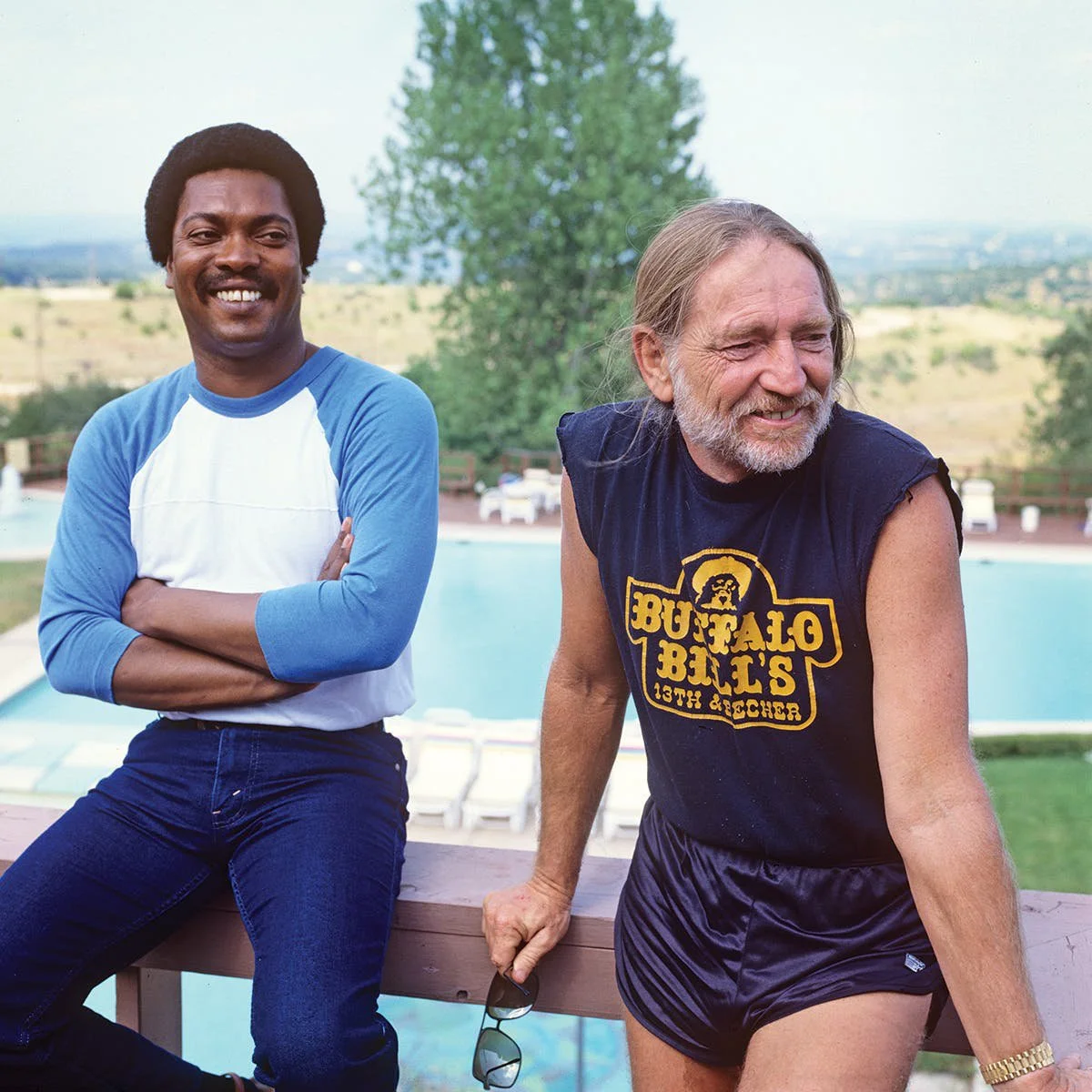
Booker T. Jones and Willie Nelson outside Willie’s Pedernales Recording Studio. (Photo by Scott Newton.)
One by Willie is produced by John Spong and PRX, in partnership with Texas Monthly. The PRX production team is Jocelyn Gonzales, Patrick Grant, Pedro Rafael Rosado, and project manager Edwin Ochoa, with graphic design by Joanna Holden and Modular, ink. The Texas Monthly team is engineer Brian Standefer, and executive producers Megan Creydt and Melissa Reese. And Dominic Welhouse provides invaluable research and editing help.
Transcript
John Spong (voice-over)
Hey there, I’m John Spong, and this is One by Willie, a podcast in which I talk each week to one notable Willie Nelson fan about one Willie song that they really love.
This week, we get with Matt Berninger, the lead singer and lyricist of beloved Brooklyn rock band the National, to talk about “All of Me,” off what is probably the wider world’s favorite Willie record, 1978’s Stardust. It’s a song that automatically takes Matt back to the Cincinnati suburb he grew up in, complete with his dad’s unfortunate attempt to whistle along.
But it’s also an album with a warm, spare sound that Matt loves so much that, in 2020, when he went to record his own first solo record, Serpentine Prison, he brought in Stardust producer, Booker T. Jones, to produce, and Willie’s harmonica player, Mickey Raphael, to play harp.
We’ll get into all that, plus the pre-Willie history of “All of Me,” the decidedly unorthodox sessions in which Willie recorded it, and the humble, steadying genius of Booker T. Jones…with brief cameos by Roberta Flack and Barry Manilow, a meatier cameo by tenor saxophone great Lester Young, and a full-on co-starring role for Mickey Raphael, who sat in on the interview and added his own detailed memories of the recording of “All of Me” and Stardust.
So let’s do it.
[Willie Nelson performs “All of Me”]
John Spong:
Well then, we will, we'll just start with where we always start. What is so cool about the song “All of Me?” Even just as a song, what's so great about that song?
Matt Berninger:
Well, that one, I picked…there's, you know…I don't know, 500 incredible Willie Nelson songs. But I think I picked that one for personal, nostalgic reasons, which ties into my kind of childhood sort of experience with, particularly, the album Stardust. My parents had…they had a small record collection. And it included...I remember a lot of Roberta Flack and Joni Mitchell and even, like, Barry Manilow. But there was a lot of Waylon and Willie. And not ‘a lot,’ like two or three records, I think. But Stardust was one that was just always on repeat.
And I know that's a covers record, but for me, whenever I hear that record or even any of the songs on the record, I'm just, I’m reminded immediately…I mean, my dad's alive and well, lives in Seattle. Both my parents are alive. But I'm taken back to my suburban house with my dad singing along, working on something in the garage while I'm, like, shooting hoops or out in the yard. And he was always in there. So Willie, the sound of Willie's voice, I can hear my dad singing along. Like, every time I hear Willie's voice, I hear my dad singing along. And my dad's got kind of a terrible voice. Not a terrible voice; he sings like I do–which is not as good as Willie, at all.
Yeah. And then particularly “All of Me,” I not only hear him singing along, I hear him whistling incorrect melodies, often just all over the instrumental, the bridge, or whatever. And I remember he would just freestyle whistling. And he’d, he would just dance around in the garage while he's working on something on his tool bench or something, with a saw in his hand, or a drill, or something, he'd just be dancing around whistling, particularly to this song. And just because it's got this great mid-tempo, whatever, swing to it, or whatever. I don't know what kind of specific song it is. But my dad could dance to it–and whistle and drill at the same time.
John Spong:
And if you're a middle schooler and none of your friends are around, it's fine that your dad's dancing.
Matt Berninger:
Oh my gosh. No, I loved it. My dad cannot sit still. He's a guy who...he would never just sit down and listen to music. It was like he always has to be in the garden or in the garage or in the basement tinkering with something. But he would play music as he's doing it. And when somebody's whistling, it's hard to whistle when you're not happy. Nobody whistles involuntarily. Or when they're sad. Nobody's just like, "I'm so depressed." [Whistling.] Nobody does that.
Mickey Raphael:
There haven't been any blues whistlers that I know of.
Matt Berninger:
Exactly. So whistling, unless you're a professional whistler and have to be brought in to do whistle on some piece…people, when they're whistling, it's just, it’s just, it’s just a pure, a pure joy and contentment. It’s just escaping subconsciously. And that would always happen with my dad and Willie.
I think just Willie's voice. And I don't know what it is. I've always tried to sing along to Willie, and I can't. Even though my speaking voice kinda sounds more like Willie than my singing voice, but when I sing, trying to...those tenor notes, there's something only he can touch. It's something right between the soul and the heart. And it's almost this effortless thread of empathy or something or truth in the tone of Willie's voice that is...not many singers have that. Like Otis Redding and Roberta Flack and somebody like that. But there's certain singers that just...the poignancy, the sadness, or something. Even in a lilty song, the sadness is, there's a laser beam of sadness right through the center of it in the way he sings a song.
John Spong:
Yeah. There's wear on his voice in a way. So it's kind of like you hear experience a little bit, even because this is such a playful melody, but I land at that place where you land, too.
Matt Berninger:
Yeah. There's sandpaper to it, but it's also got this very poignant, empathetic tone. This sweetness. It's a warmth. It's a sweetness, as if...even the songs, the self-deprecating songs where he hates himself or whatever, he still cares about himself. There's something...Mickey, when you think about Willie's, specifically the tone of his voice, when you're collaborating with him, is it something that...
Mickey Raphael:
Well, it's like he has empathy for himself. I mean, his songs from the '60s, I used to...when I maybe have or couldn't get ahold of my therapist, I would go back to his songs because he's been everything, through everything and more than I have with relationships. But he's experienced everything emotionally. And you can go back and draw from that. So in his voice, there's a certain tone of empathy, I think, that comes across in the songs, whether he's showing empathy for somebody else or himself, saying, "I'm going to be okay."
Matt Berninger:
Yeah.
[Willie Nelson performs “All of Me”]
John Spong:
Does either of you know much about how this song was written?
Matt Berninger:
No, actually. Yeah. Who did write it? Every time I look up who wrote something, it's always Hoagy Carmichael or somebody, but-
John Spong:
Well, and it's interesting because this is one of the ones that's not. It's not Irving Berlin or Hoagy or one of the Gershwins, one of the lions. Gerald Marks and Seymour Simons, who…it's really the only, certainly, standard, but really even big hit [that] either had.
Matt Berninger:
Wow.
John Spong:
And it's cool because it's in 1931. Gerald Marks is a piano player in a big band orchestra in Michigan, where it's cold. And so, between sets and to warm up, he was coming up with these exercises for his hands. And so one was this three-note exercise. "All of Me. Why not take all of me?" It was variations on that three-note bit, that line. So between sets, he's the only one up on the bandstand. And he's trying to keep his hands warm and nimble, and he's just working that out. And it becomes his first ever fully-formed melody that he writes. So he's doing that between sets one night, and this dude who happens to be there at this summer resort, comes walking over and says, "Hey, man. I write songs for vaudeville. I've written a lot. Can I write lyrics to this?" And Marks says, "Why sure." So the guy goes up to his hotel room and comes back down an hour later. And those three-note variations are now, "All of me. Why not take…all of me?" which is, I don't know. It's really cool.
Matt Berninger:
So, the guy who wrote the top line, "All of me," what a unbelievable, just killing sentiment to just, like, the rest of the song then just supports that one thing, every little line about...and what a defeated song. “You broke my heart so much that I'm, like”…I've tried to write songs like this. I have a song called “Junk,” which is sort of like, "I'm just junk. There's nothing left without your love," kind of a song. It's like, "I'm nothing without you," basically. But I wonder if, those three words, when that happened for him, “All of me” fits that melody. And then he goes out and writes the rest of the song just about that…when you find the center, the nucleus of the song, then you’re just, you have to be careful just to keep it suspended in space without blowing it up. Yeah. It's a marvel of a lyric in the whole thing.
John Spong:
Well, and it's kind of like the way you guys write, as I think about it, because all Gerald Marks had was “dun-dun-dun…dun-dun-dun.” And then someone comes up with, "Oh, here's the kernel: All of me” are these three words.
Matt Berninger:
But I wonder...my question for the guy who...Who wrote the lyrics?
John Spong:
Seymour Simons. When he heard Gerald Marks playing it that night, there were no words. He just heard...
Matt Berninger:
So when Seymour, did he have a bunch of different ideas? Did he have, "Kiss me here," or, "Take a walk?" Or did he have-
John Spong:
"Go away."
Matt Berninger:
"Go away." Yeah. Did he have a bunch? Or when did, "All of me; just take all of me," come? That's what I'm saying. You can have a great melody and, I mean, I do that. I write with The National, with everybody I write with, because I'm not playing the guitar. I'm with a guitar player, or somebody sending me some sketches. And I'm listening to a thing I love–and then how do I not ruin that great little spot with a melody? He's singing right along with...he's singing the melody of the piano, or whatever piece. And I'm always trying to sing something, a different melody. And sometimes I feel like I should just sing along with the damn guitar or piano. I mean, the guys in The National, like Aaron's, like, "Why don't you just sing along?" And I'm like, "Ah, I don't want to sing..." It's one of those things. But to get a lyric, to get a good lyric, it takes a long time, sometimes. But other times, it's all of a sudden, you hear the melody and it comes quickly. I just wonder if he had a bunch of bad versions.
John Spong:
Well, I don't think he had time. If he was up in his hotel room for an hour, I mean…that's, that’s inspiration, man.
Mickey Raphael:
Well, it started...the first version was, "Where's my dog?"
Matt Berninger:
Yeah. Yeah. "One more beer." Yeah. Right. I know. It could have been anything, but then he goes up to his hotel room. And then, who's he thinking of?
John Spong:
Yeah.
Matt Berninger:
Who's he thinking of? That's real. When he's saying that, he's like...he's got nothing. He's useless. It's a song of complete devastation. But then the music is so...that's the other beautiful part of it. The music's so uplifting, ‘la-la-la, la-la-la...’ That's why my dad, him whistling and dancing around to it. And I was like, "Dad, do you ever listen to these lyrics? It's like this guy just wants to kill himself. He wants to end it." And I just-
Mickey Raphael:
It's total submission.
Matt Berninger:
Yeah. Complete, complete submission to his misery. And it's great. Yeah.
John Spong:
Yeah. So one of the things that I like to do, especially with these Willie trips into the Great American Songbook, is play the version that he probably grew up on. And sometimes we know which one it is.
Matt Berninger:
Yeah. Cool.
John Spong:
And so with this one, I don't know for sure from all the research. I know Louis Arm...It comes out in early '32. And two weeks later, Louis Armstrong's like, "Oh, this is great." So he cuts it, and has a big hit on it. But Willie's not born yet. Willie might've heard that growing up, but the...and of course, he loves Sinatra. And so, any Sinatra version is one that would've registered with him. But the one that's kind of considered definitive is Billie Holiday's from 1941, and I bet that played on the radio for Willie. And one of the things I got so excited about when I dug deeper into that version is that she’s…that Lester Young plays on it with her. And Mickey and I talked about this last week. But Matt, do you know much about Billie and Lester?
Matt Berninger:
No. I know a little bit of Billie. No, but I don't know that much about Lester.
John Spong:
So, tenor saxophone player, right? And weirdly, [he] was kind of maligned at the time because people thought his playing was too soft. It was a little sissy almost, I think they would've thought. Coleman Hawkins was the honker. So Lester's not as much…he and Billie had this incredible, incredible friendship. They're these two really vulnerable, delicate, almost fragile artists, and all the racism they had to endure, all that kind of stuff. They took care of each other. It was always platonic, but they really had this incredible connection. And when they're on records together, her singing's a little...got a little something more in it. And Lester's playing…it's a perfect complement to each other. And so if I can share my screen, can I play that with you?
Matt Berninger:
Oh, please.
John Spong:
It's really something. And it's from back then, so it's like two and a half minutes. So it's not a long-ass, John Coltrane solo.
[Billie Holiday, with Lester Young, performs “All of Me”]
Matt Berninger:
Wow. Well-
John Spong:
That's cool.
Matt Berninger:
I mean, the thing about that song, there's not a missed...that's one of those songs. Those are so...every single word is perfect, and the rhymes are so wonderful. And, "You took the best. Why not take the rest?" It's so effortless, but so perfect. It's like one of those rare, rare songs. Another thing, listening to the lyrics specifically, then we can talk about Lester and the saxophone, but I think I...Willie's song...the way the lyrics dismantle the body and use “the lips,” “the arms,” and “the eyes,” and the thing, and the rest, the same way, like, Willie with “Hello Walls” does that with a house, right? And it's the windows and the door and the walls and all the things. He dismantles just all the pieces of a house and uses that as a metaphor or something. But another one where every word's perfect, right?
John Spong:
Yeah. And whatever words he leaves out, they'll fill in with their own experience.
Matt Berninger:
Yeah. Yeah. Those are hard.
John Spong:
Yeah. And we can't talk about Billie and Lester all day, but you had a Lester thought, too?
Matt Berninger:
Well, specifically I can sense that, yeah, there's the softness that he's playing with. I mean again, it’s…the melodies are so happy and sweet. And then I think he's tapping in, pulling it into a place that's less “BUM-ba-ba, do-DO-DO-do-do,” and he's making it, it's almost like someone is trying, trying to make themself happy when their thoughts are so dark, right? And so he's allowing the truth of the darkness and the sadness of this song to...because when we go out in the world, we go out often devastated with sadness and have to put on a happy face, right? And someone who's just had their heart broken has to do that. Then when Lester brings that out in the melody of the song and then in the tones of the songs…the piano is very bright, but he's bringing in the melancholy. And then that allows Billie to sort of just tune in with that, I think. And that's why that song's so...that's such an amazing version.
John Spong:
He's the one that nicknamed her Lady Day. And she nicknamed him Prez because she said, "You're the president of the saxophone players." And so they're Lady Day and Prez.
Matt Berninger:
Well, Mickey, listening to Lester and the saxophone, somebody who's, like, comes into a song and often, like, I had you come in because, you know, “Make this more emotional, find…” and I know that you always talk about when you come in, you're there emotionally reacting, all the time. That's what you were doing with me. It was improv, emotional feeling when you were playing. And I guess that's what I'm hearing in what Lester's doing there.
Mickey Raphael:
Yeah, you know, his tone was so amazing, Lester's. I was just listening to that. And it was so soft. I don't want to say “soft.” It was just a tone. It was a tonal thing. And that's what's unique about all players, I guess. Or at least for me, what's more important to me than the notes is the tone and the texture. So that was so unique to Lester. And you could tell that it was Lester before you knew it–
John Spong:
Right.
Mickey Raphael:
–I mean, just by his tone.
Matt Berninger:
Would you say that about yourself, Mickey?
Mickey Raphael:
Yeah. Because yeah, I have this particular tone and timbre, I think, tamber to my notes, because I'm not a fast player. I don't play a lot of notes, but I know how to read the lyric and respond to it. And I think what my strong point is, is just being able to play one note in the right place. You know, the most important thing about, I think, harmonica playing, somebody asked me, “Do I teach?” I said, "I can't teach you how to-"
Matt Berninger:
That was me.
Mickey Raphael:
Oh, yeah. Yeah.
Matt Berninger:
That was me. I asked Mickey, I texted Mickey because we'd been touring, and I'd been whipping out…because I can't play…I mean, I can peck around on a guitar and piano, but I'm not a player. And for some reason, I was like, "Oh, harmonica’s so easy. Just give me the one in the right key, and I can do whatever I want. It's going to sound great." I learned quickly that that's not the case at all. And so I texted Mickey. I said, "Hey, Mickey. Can you teach me how to play harmonica?" And he responded, "Absolutely not. YouTube."
Mickey Raphael:
Yeah. Yeah. Well, for the basics, yes, there's some great stuff on YouTube. I have to admit, I still go on there to learn stuff. But what my strong point is, is I can teach you, after you learn how to play, I can teach you when not to play.
Mickey Raphael:
And I think that's the most important thing. Because I've always been fortunate, or my thing, I think, is to play with singer-songwriters. My style of playing, I think, is not so much soloing, but like a pad or coloring or reacting emotionally to a lyric.
Matt Berninger:
Yeah.
Mickey Raphael:
And like Lester Young, you don't want to take away from...you don't want to compete with the singer, for one.
John Spong:
You complement. You don't compete.
Mickey Raphael:
Yeah.
John Spong:
Well, all that then…let's hear your tone in service of the song. Let's listen to Willie's version.
Matt Berninger:
Yeah.
[Willie Nelson performs “All of Me”]
Mickey Raphael:
Boy, I haven't listened to that in a while.
Matt Berninger:
So there's, like, Booker, it sounds like Booker is doing that Hammond that has that melancholy. He's kind of bringing, against the guitar, that low emotional melancholy. And Booker, talk about…has a tone like no other person on the Hammond. And then, Mickey, you're kinda sliding in and out with Booker, and then with the melody and stuff here and there, right?
Mickey Raphael:
Yeah. And I think another, a great guide when you're playing, either a harmonica…and that Willie shows on this, is stick close to the melody. I mean, he varies a little bit, but he's not just playing hot licks. He's playing the melody and then the little variations off of that. So Willie's a great study in that. And Booker is just the coloring. It's just the pad underneath that just fills so much. And there's so much more he could play, but it's not needed. So if he just plays one, holds one chord, maybe makes a change or something.
Matt Berninger:
So, what was the studio experience with this record? And where was it made? And I know the origin, that Booker saw Willie jogging on the beach? Or vice versa? Either, one of them was in Malibu, Booker or somebody is sitting at their house, and one of the other one was jogging by. And they're like, "Hey, Willie!" "Hey, Booker!" And they started hanging out and talking in Malibu. And that's how this record kind of...that was the beginning. That was the seed. But yeah. What was your experience?
Mickey Raphael:
Well, they both had apartments at the Malibu Antibes, which was a apartment house on the beach in Malibu, right down from the pier, from Alice's Restaurant.
John Spong:
And Willie was actually in the apartment below him, right? When he came in after jogging on the beach, Booker said, "Wait, that guy, who looks like Willie…is Willie–"
Mickey Raphael:
“It is Willie!” And-
John Spong:
“–and he's walking into the room below me!”
Mickey Raphael:
Yeah. I don't know if they had met before, but Booker was married to Rita Coolidge's sister, who was married to Kristofferson at the time. So he was Kristofferson's brother-in-law. So there was a connection there. So they met. And I think they just started jamming at the house. And they both had this love for the American Songbook. And I think Willie asked Booker, "Maybe we should go in and do a record." And I was living-
Matt Berninger:
Did they pick the songs together? Did they pick…choose the songs?
Mickey Raphael:
Yeah.
Matt Berninger:
Wow. Wow.
Mickey Raphael:
Mm-hmm. They picked the songs together. And then I was living at Emmylou’s. Emmylou Harris had a house in Beverly Hills with a studio. That was their studio, actually, where she cut all her records. And there was the Enactron Truck, which was a mobile...it was a semi-truck with a mobile studio. The control room was in the truck. And a little overdub studio was in the driveway.
Matt Berninger:
How old are you, by the way? Right?
Mickey Raphael:
How old am I?
Matt Berninger:
At this point?
Mickey Raphael:
Oh, what is it? ‘78? So I was born in '51.
Matt Berninger:
Okay. Right. So you're living at Emmylou Harris's place–
Mickey Raphael:
That's a studio now. Emmylou and her husband moved out, and then myself and the engineer rented rooms in the house.
Matt Berninger:
So what year is this?
Mickey Raphael:
So '77, probably. 1977.
Matt Berninger:
Okay. So you're in your 20s, your mid-20s.
Mickey Raphael:
Yeah. Yeah.
Matt Berninger:
God. Sounds like you're living the dream.
Mickey Raphael:
Yeah. Surviving the dream. That's what I say now. Yeah. Yeah. So we set up. The living room was where we recorded. Everybody was set up live. Actually, I, because I had worked on a bunch of Emmy's records–and for separation, there are no baffles in the house–so they set me up in the bathroom, in the shower, off the main living room. And Booker had his organ in there. And then the drums and guitar and bass were all in the main living room.
Matt Berninge:
You're in the bathroom.
Mickey Raphael:
Everybody could see everybody. But I'm in the bathroom.
John Spong:
Well, I thought Booker said that he did have them at some points in back bedrooms. Because like Jody, he said, had an amp. And he had to put him in a back bedroom. And I thought he said Paul was back there. But you're remembering everybody being in that same room?
Mickey Raphael:
I think, I don't remember Paul being out…maybe they put Jody's amp in the back bedroom. But I think we could, everybody could see everybody, except me. Maybe I could see through the door. But I was so used to that configuration, having worked with Emmy on that.
Matt Berninger:
That's funny.
Mickey Raphael:
And it was all cut live. I don't think there were any overdubs. Maybe a few, but Willie's kind of-
Matt Berninger:
Oh, really?
Mickey Raphael:
…one or two. It wasn't like we built a track and then put Willie's voice on, which is kind of the way we do it now. But it was pretty much live.
Matt Berninger:
So those vocals are live too, you think? I wonder.
Mickey Raphael:
I don't remember exactly. But-
Matt Berninger:
That's crazy. Yeah. Beautiful.
Mickey Raphael:
Could have been. They had a vocal booth in the truck...but we sang all together. He sang as we're playing.
Matt Berninger:
Yeah.
John Spong:
Wow.
Mickey Raphael:
With my recollection.
John Spong:
What's the house look like? Because I think it's a ranch-style house?
Mickey Raphael:
Yeah. It was ranch-style, one story, ranch-style with all the...at the top of the street. It was on Lania Lane. And there was a small pool. And behind the pool was just brush up to the top of the hill. And coyotes would come down and drink out of the pool and...
Matt Berninger:
And how long were the sessions? Did you guys work for a couple of weeks? Or how-
Mickey Raphael:
No, probably a week.
Matt Berninger:
The whole record?
Mickey Raphael:
Yeah. Yeah.
Matt Berninger:
Yeah. And you said in such a small place…but you barely saw Booker and Willie in the same room together.
Mickey Raphael:
Yeah. We were talking about how they're both so spiritual. And both Buddha-type figures. And I thought, "Well, I don't know if I ever saw them in the same room at the same time. They might be the same person."
Matt Berninger:
Oh, man.
John Spong:
But it sounds like they had you locked in the bathroom a little bit, too.
Mickey Raphael:
Yeah. The shower was great, though. That's just that natural reverb that I’ve always tried to get.
Matt Berninger:
Honestly, I've been sequestered to many bathrooms in recording studios because of the isolation. And sometimes you get a good…stand in that shower. That's why people sing in the shower, because you sound so great.
Mickey Raphael:
And that's what I'll tell an engineer sometime, "I want to sound like I'm in a small shower. Not a huge, not a stadium shower, but a small, tight shower."
Matt Berninger:
No one wants to be in a stadium shower.
Mickey Raphael:
Yeah. Yeah. Yeah.
Matt Berninger:
If you're in a large, really large shower, you're in a place you don't want to be. Or you don't want to be showering. That's funny. Oh, man. Yeah. Are you on most of the tracks somewhere? Are you really-
Mickey Raphael:
I think so, yeah. On all of them. Because we all played live. And we came up with the arrangements. I think that little–and I'm playing chromatic, which is not my main instrument. But the–
[harmonica playing]
Mickey Raphael:
Keeping it simple, keeping it to the variation of the melody.
Matt Berninger:
Yeah.
John Spong:
And so did Booker bring y'all arrangements? How do y'all figure out how they're going to go? It's not like you had iPods or phones back then to just pull up a version and listen to it. How-
Mickey Raphael:
No, we'd listen to it probably on whatever, a cassette.
John Spong:
On the Hi-Fi?
Mickey Raphael:
Yeah. We'd listen to the original, and then we would just come up...Willie had a way he wanted to interpret the song. And then we would, maybe Booker would kind of direct us, in a very generous way. Kind of like a, I call it a benevolent dictator, where he's very nice about not telling anybody what to do, but “How about…this is the feel.” And with Booker just playing, you're going to follow in and play with him. And if he's just being very subtle, we want to build that vibe. So we'd listen to the song and everybody would learn it or write their charts, whatever. And we would just play it a few times till we learned it. And eventually, the arrangements morphed into what they are.
Matt Berninger:
Yeah.
John Spong:
Wow.
[Willie Nelson performs “All of Me”]
Matt Berninger:
When we worked with Booker together in Venice, California, when we made Serpentine Prison, my record, one of the reasons why I reached out to him was because of specifically how beautiful Stardust sounds. But also, I just, I had never...the truth is I've worked with a lot of producers up until that point, but never...they were always sort of engineers, mixers, but not so much that capital “P” Producer where, like, “I want you to be in charge.” Like, “Here's the captain's hat.” And I'd never done that.
But with Booker, in those sessions we did in Venice, I knew I needed that because I was bringing in...you know, I wrote…there's 10 songs in that, but with eight different writers. And I needed, I knew I needed Booker, someone who was just going to have that galvanizing sort of presence and vision and be listening. And it was, he was only benevolent. But also very, very focused. And he would always tell me to quit goofing around because I would be smoking weed and laughing and joking and coming in and out.
And he'd be like, "Matt, come here. Sit down. Just..." And he would sit me down with the piano, and he would look at the lyrics. He would go over the lyrics with me. And nobody does that with me, except for my wife. And nobody in the National, because I kind of don't want anybody looking over my shoulder and asking me about the lyrics too much when I'm in there, because it's a little bit...he would put his hand on my back when I'm kind of talking to him about the lyrics and pat me on the back.
Because some of the lyrics on that record are really, really dark. Yeah. I never worked with anybody–and still haven't worked with anybody–that made me just feel so confident as an artist? And understood, and kind of appreciated. He really wanted to know what I'm trying to communicate to this song. Even no matter how blurry it is, just like he was very, very focused on that, on the emotional communication.
[Matt Berninger performs “Serpentine Prison”
Mickey Raphael:
But your record was very spiritual. The Serpentine Prison was a very spiritual record. So he was the perfect guy for that, I think.
John Spong:
Y'all guys know Booker as friends–I've had some interactions with him and everything–and so y'all can speak to this in a way I never could. But one of the huge takeaways from the time I had with him was humility. Just this incredible sense of humility. And one of the reasons that I think to bring that up is because when I listen to Serpentine Prison, and when I listen to Stardust, and when I listen to, like, Bill Withers's first record, that he produced, there is. There's a spiritual quality to it. There's a peace. There's a quiet. And it's not just choices on leaving space between notes and players or anything. I think it comes from...well, what do y'all th–...Does that humility play in there? What is it?
Matt Berninger:
I think maybe Booker gravitated towards the Hammond because the Hammond matched the sound of his soul or something, in a way. His personality, you know, not just the kind of poignant, slow and tender things, which is...that's just what he...but even the songs with the energy. The energy has a communal joy to it. And you keep saying the word “empathy.” There's something in the sound where he's...and he's in a band with guys that don't always get along. The M.G.'s were not as harmonious on issues of the time as maybe they were kind of presented to be, for marketing reasons. And so either…in Memphis was where Martin Luther King was killed, in the hotel where Booker and the M.G.'s would...that was their hangout hotel.
And so I think, I think his experience with all of that…and then, there is something. There is something there. There's a wisdom and a perspective and a love in the way he presents himself as a person, but it's also there in his sense of what's making a song work and how he plays and everything.
Mickey Raphael:
And he doesn't have to prove himself, which is a great place to be musically.
Matt Berninger:
Yeah. There's something about…you can hear when you listen to Stardust, you hear, you can sense there's people enjoying being in a room together. Sometimes that's, for certain bands, for The National, it's like, when we're not enjoying being in a room together is when we make our best music. But this, it has a organic groupthink happening, even though Willie's front and center in his tone. He's the focus. But the whole thing feels just really, really, really in tune with each other. Not just literally, but emotionally in tune.
[Willie Nelson performs “All of Me”]
John Spong:
Yeah. One thing that's kinda always in the back of my mind when I listen to Stardust–not always, but sometimes–is that these are songs that Willie and his sister, Bobbie, [the] piano player, grew up on. And that in a real way kinda saved their lives, at least in my thinking about it. And we talk about this a fair amount on the show, but they grew up during the Depression. And their parents haul ass within about a year. And so they're living with their grandparents. It's the Depression, they're picking cotton, for real. Willie's grandfather–Willie's sister plays piano real early; she's learning from Grandma–Willie's granddad, who they called Daddy, I think, if I remember, gives him a guitar for Christmas when he's about five. And then a few months later, he dies.
And so they just have...I don't know that there was ever a time in their lives when they weren't aware of how tenuous and difficult life can be. But when they got to the piano, when Bobbie played the piano, and Willie sat next to her trying to figure out how to strum stuff on this guitar from Sears…and they would play mostly old gospel tunes, but also the Gershwins and “Blue Skies,” and these Tin Pan Alley songs, these standards, they were safe. And years later, Willie's career, whatever reasons people give for why he finally took off in the '70s, a big part of it was getting Bobbie in the band and being able to re-...and so in my mind, they're recreating that whenever they play. And then especially when it's these old songs. And it's the kind of stuff you were talking about earlier. Music has a very unique way of doing that.
Matt Berninger:
Yeah. I mean, also, a kid, when they’re feeling like...sometimes like a lot...just don't know what to do with their lives. And I think art, like, children and art, whether it's scribbling and stuff like that, there is something to the act of creating something out of nothing. Whether it's on a guitar or a piano or with magic markers or crayons…to create beauty, something funny or interesting or exciting or moving that wasn't there before, it came out of nothing–that's what art is. And it's creation of something that's useless. It serves no practical...it ain't going to put any food on the table, I mean, when you fall in love with art. There's some other draw to it that children have. Music, paint, everything, stories.
And when a child feels like, "Hey, maybe I’m…I can draw a good drawing. Or I can play a good little melody on the guitar," even when they're five or six, suddenly they have, they are tuned into something that's valuable. That gives them a self-worth. And it gives them a sense of identity of, like, "I'm a…I’m an artist." And that sense probably centered him and gave them both, him and his sister, a thread to hold onto when everyone else, everything else was probably...there weren't many threads to hold onto, as a kid.
John Spong:
Yeah. And it's a place that they can return to and, in my mind, do return to whenever they create together. And one of the reasons I thought to bring it up is because you were so open in the run-up to the First Two Pages of Frankenstein album with the depression that had gripped you in trying to create that. And some of the ways you talked about it…because you said music is what helped you climb out of what seemed to be a hole too deep to even get sunlight in.
Matt Berninger:
I mean music…my life in music was kinda was part of what had built, had dug the hole.
John Spong:
Dug the hole. Yeah.
Matt Berninger:
So part of my depression was…I went through, for context, I went through about a year, six or eight months of, like, real depression, where I couldn’t barely leave the house and get out of bed, that kind of thing. And it was triggered by the pandemic lockdown, some of those things. But what the scariest part about it was, [was] that I'd felt like all this art and everything I'd done…I had devoted so much of my life and time to performing and trying to write songs and stuff. And I was like, "And now look where I am." I almost had felt like the thing, my magic, had failed me. I felt like it wasn't doing me or anyone any good. And that was where I think that was a extra level of depression, where even art, even listening to Stardust didn't…
John Spong:
Wow.
Matt Berninger:
…in that part, I couldn't look out the window, and I couldn't look at a butterfly, and find any joy in it. But getting back into the studio with the guys in The National and just getting back to it, and even though it was very, very hard…suddenly putting some seeds in the ground and just hoping they sprout up into a melody or an idea for a lyric. And then songs slowly coming together in that record. Then once it started happening where I was writing a lot–and I had a lot to kind of process–we made two records really fast. But even after the records were done and getting on stage to tour them, it was still a slow process.
But it was, like, seeing people singing old songs that I'd written about old girlfriends, and seeing them with their kids on their shoulders crying, that's when I was like, "Oh my God. I forgot what music does to people. I forgot what it did to me. I started soaking in other people's happiness. And that made me happy again. And now, on the other side of it, I even appreciate...I think about and appreciate it so much more, of how magical and healing, not just music, but all art is. But specifically music. Music somehow really makes people feel less desperate and alone. And it's better than any antidepressant. And I tried lots of them. I tried ‘em all.
John Spong:
But that's the thing. It's that connection. And so it's Willie and Bobbie. And it's Billie Holiday and Lester Young. It's you and the guys in your band. You had even said...what was it? “Therapy and antidepressants, getting totally sober, none of it made a difference. Writing a song about nothing making any difference was the thing that made the difference.” And, “Lexapro doesn't work on me, but Aaron and Bryce's sketches do.” Those are the...those relationships are born out of music. Stardust connects you to your dad. It takes you to a place in your mind where you're sitting with your dad or you're shooting hoops while he's sawing on a deal.
Matt Berninger:
Well, everything, all art has to connect you to a person. And not necessarily a person you know, but, like, a great novel, or a great movie, a TV show…it's like, for it really to be one of those movies that lasts, that you want to watch over and over again, you have to feel like you're actually seeing a true, genuine thing. And it's always the imperfect ones, the weird movies, like Being There or Harold and Maude or The Graduate. The one where it's all imperfect, blurry, complicated…there aren't crystal clear emotional plot points. They're all kind of these kind of complicated, knotty, knotty rings on a rope or something. That's the only time you really trust and believe a performer or an artist, is when it is that kind of blurry place between truth and posturing. Or the way the world is supposed to be, but the way we all really think and feel inside. There's a tension between there, and the best music always has both.
John Spong:
Well, that sounds a lot like the way you were describing the tone of Willie's voice earlier.
Matt Berninger:
Right. Yeah. Yeah. So when Willie sings, he's not thinking about singing. It doesn't sound like he's thinking about singing at all. But sometimes you hear a lot of songs and you're like, Oh, they're more in a mechanical, academic mode than they are in that blurry, true emotional place. That's why things that aren't quite in tune sometimes sound better. A little up or down. Or somewhere, there's a little rub. There's a little yellow in the tonalness of it, is where you believe it.
John Spong:
To hear Willie sing is to hear him be alive, which is the pain, the joy, the ups, the downs, the pros, the cons. It's both sides of the scale. Maybe that's why it connects so well.
Matt Berninger:
Yeah.
John Spong:
Did I forget anything? Is there anything left out? Anything about Willie you want to throw in?
Matt Berninger:
No. Yeah. One of those things is there aren't that many artists that the second almost any Willie Nelson song comes on, you're just in a good place. And I’ll feel like, Ahhh. Everything, the room just got a little better. The sun just got a little warmer. The rain just got a little less cold.
[Willie Nelson performs “All of Me”]
John Spong (voice-over)
All right, Willie fans. That was Matt Berninger, talking about “All of Me.” A huge thanks to him for coming on the show, and a big thanks to you for tuning in. If you dig the show, please subscribe, maybe tell a couple friends, and stop by our website at onebywillie.com. Oh, and please visit our page wherever you get your podcasts and give us some stars or type in some comments. Every little bit of that helps more than you know.
One by Willie is a production of John Spong and PRX, in partnership with Texas Monthly. Our PRX production team is Jocelyn Gonzalez, Patrick Grant, and Pedro Rafael Rosado, with project manager Edwin Ochoa. Our Texas Monthly team is engineer Brian Standefer, producer Patrick Michels, and executive producer Megan Creydt. And we get invaluable research and editing help from the great Dominic Welhouse.
Please follow us on Instagram at onebywillie–all one word–find us on Bluesky, and join our ever-expanding Willie conversation at the One by Willie group on Facebook.
I’m your host, John Spong. Thanks for listening.