
George Saunders Unlocks the Secrets of “Pancho and Lefty,” the Elegance of Willie Nelson, and the Very Nature of Creativity
The beloved, best-selling author walks us through Townes Van Zandt’s mysterious tale of betrayal and his own lifelong appreciation of Willie
By John Spong
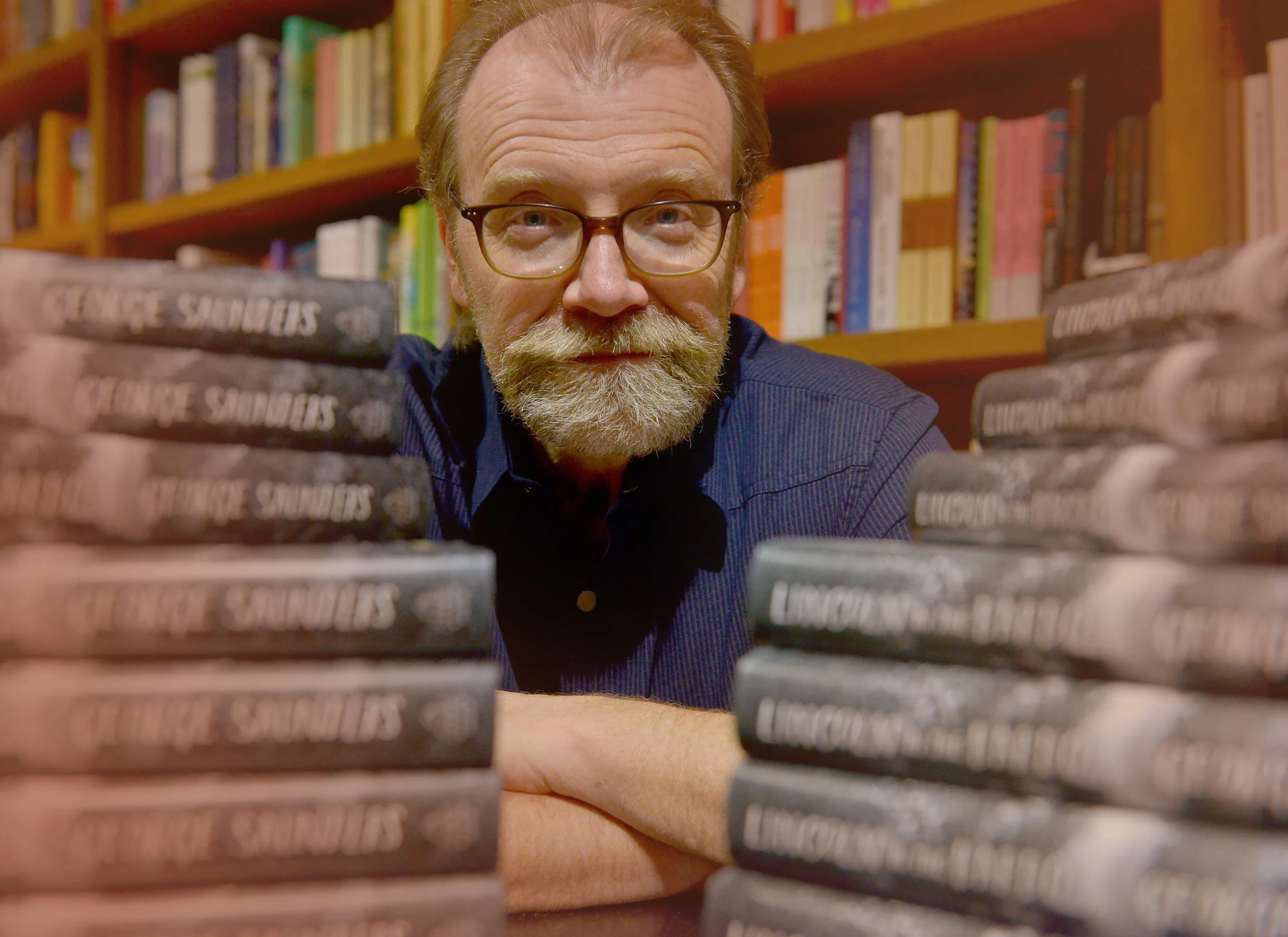
Author George Saunders signs copies of his Booker Prize-winning novel, Lincoln in the Bardo, at Books and Books, in Coral Gables, Florida, February 19, 2017. (Photo by Johnny Louis / FilmMagic / Getty.)
When I initially invited writer George Saunders to talk about Willie, he sent an intriguing email back. “I love Willie, as does everyone,” he wrote, “and we could talk about how he came to me by way of…card parties on the South Side of Chicago, circa 1968.” Late-60s Chicago was a hotbed for many things, but country music is seldom mentioned among them. As for Willie, in those days he was famously having a hard time finding fans even in country hotbeds—if they were outside Texas.
But George’s mom was from Amarillo. That’s where she’d met George’s dad, who was in the air force, and where George had been born. And when dad moved the Saunders family to Chicago, mom took her Willie records with her, including his debut album on Liberty, 1962’s …and then I wrote. On Friday and Saturday nights, the young parents would get with friends to play cards, drink whiskey, and listen to Willie. And little George, who’d often lounge under the poker table while they played, paid close attention.
“I have a feeling that these early songs,” recalls George on this week’s One by Willie, “like ‘Funny How Time Slips Away’ and ‘Touch Me’ and ‘Hello Walls’ and ‘Crazy,’ got into my DNA under the category of ‘Elegant.’ I think as a young artist, you notice that, like ‘Oh, whoa. That’s interesting.’ And I liked that in ‘Hello Walls,’ there’s so much narrator present. It is a particular guy, and it seemed like a guy I kind of knew even then.”
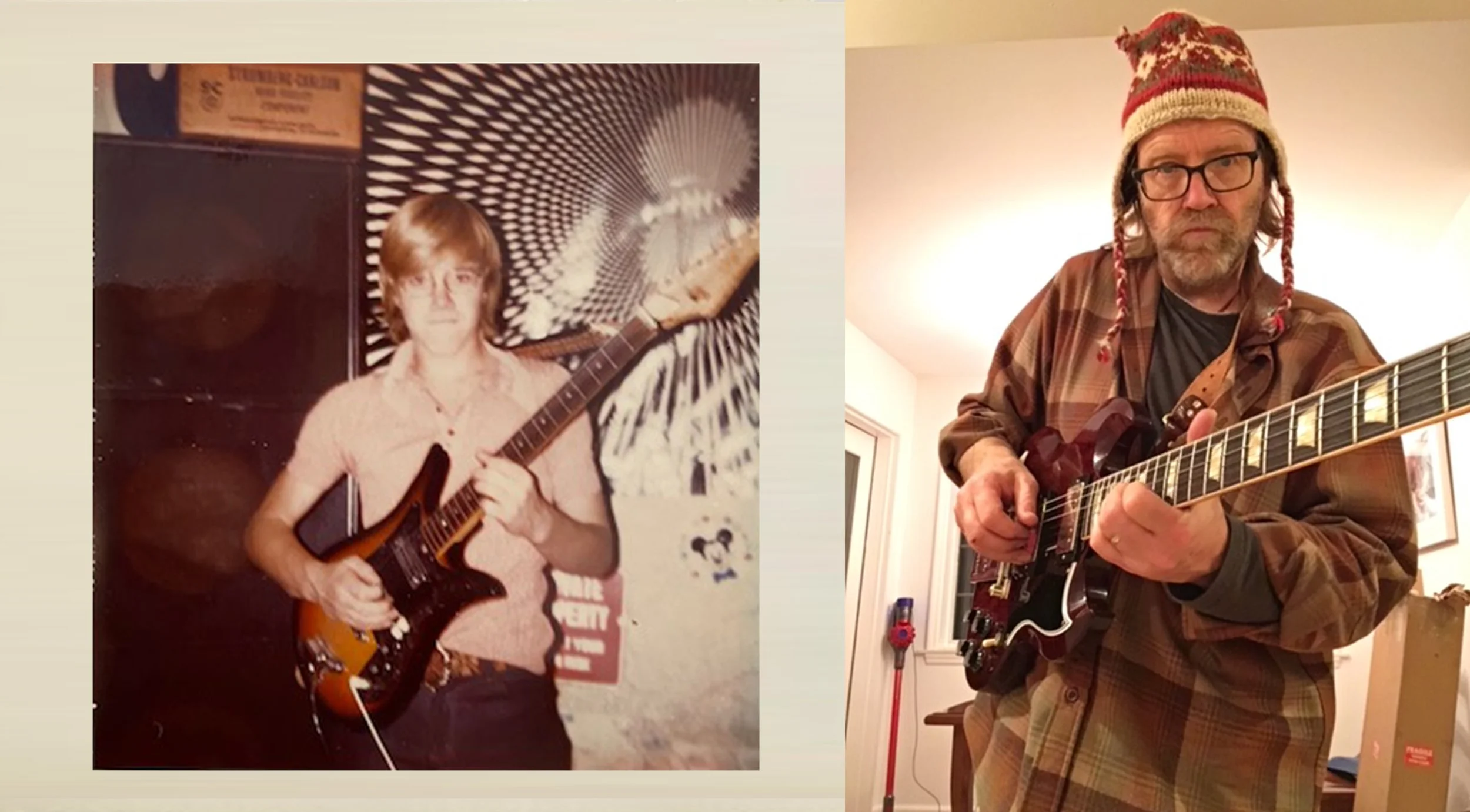
Saunders with guitars, circa 1974 (L), and in an otherwise quiet moment during the COVID lockdown (R). (Photos courtesy of George Saunders.)
But those memories are merely the amuse-bouche of this episode, the jumping off point for a deep examination of the mysteries of “Pancho and Lefty.” It’s a different kind of Willie-talk than we typically have on the show. George Saunders fans know him to be a brilliant writer and storyteller; his most recent novel, Vigil, was a #1 New York Times best-seller earlier this year, as was his previous novel, 2017’s Lincoln in the Bardo. And it’s worth noting that the NYT deemed Bardo, along with George’s short story collections Pastoralia and The Tenth of December among the 100 best books of the 21st century.
But George also has a day job, teaching in Syracuse University’s renowned creative writing program, with an emphasis on unlocking the wonders of Russian short fiction for young writers. (His delightful, 2021 essay collection A Swim in a Pond in the Rain, another NYT best-seller, was essentially a semester of that class.) And that analytical framework is what he brings to “Pancho and Lefty.” Because no matter how well you know the song, it’s one filled with unanswered questions. What even was the relationship between Pancho and Lefty? Why did the federales let Pancho slip away so long? And are we really sure we know whose breath was hard as kerosene?
So George will take us verse-by-verse through the song as we try to figure all that out—plus the way that Townes and Willie and Merle Haggard made us care so much, and what “Pancho and Lefty” tells us about what it means to be human. With cameos by Chekov, Dostoevsky, Jeff Tweedy, and Ernie Banks.
One by Willie is produced by John Spong and PRX, in partnership with Texas Monthly. The PRX production team is Jocelyn Gonzales, Patrick Grant, Pedro Rafael Rosado, and project manager Edwin Ochoa, with graphic design by Joanna Holden and Modular, ink. The Texas Monthly team is engineer Brian Standefer, and executive producers Megan Creydt and Melissa Reese. And Dominic Welhouse provides invaluable research and editing help.
John Spong (voiceover):
Hey there, I’m John Spong, and this is One by Willie, a podcast in which I talk each week to one notable Willie Nelson fan about one Willie song that they really love.
This week, we talk to beloved American author George Saunders about one of the best loved songs not just in Willie’s catalog but in all of American music, Townes Van Zandt’s mysterious tale of betrayal, “Pancho and Lefty.”
Now, this episode will be a little different from the rest, and that’s because of what George brings. On the one hand, he’s a brilliant, if humble, storyteller. His most recent novel, Vigil, was a #1 New York Times best-seller earlier this year, as was his landmark first novel, 2017’s Lincoln in the Bardo, which also won the Man Booker Prize. And note further, that the New York Times deemed Lincoln in the Bardo—along with George’s short-story collections Pastoralia and Tenth of December—among the 100 best books of the 21st Century. So listen closely to George’s eye for detail when he talks about being a little kid growing up in Chicago, crawling around under the poker table while his parents, aunts and uncles played cards, drank whiskey, and listened to Willie’s first album, …and then I wrote. He says that even at 7 years old, it was Willie’s lyrics that awakened him to the importance of elegance in art.
But George also has a day job, teaching in Syracuse University’s renowned creative writing program, with an emphasis on unlocking the wonders of Russian short fiction for young writers, and that analytical framework is what he’s going to apply to “Pancho and Lefty.” Because it’s a song filled with unanswered questions. What was the relationship between Pancho and Lefty? Why did the federales let Pancho slip away so long? And are we really sure we know whose breath was hard as kerosene?
So George is going to take us verse-by-verse through the song as we try to figure all that out—plus the way that Townes and Willie and Merle Haggard made us care so much, and what the song tells us about what it means to be human.
Oh and George also does a wonderful job at the end of explaining what people might mean when they say Willie’s got more than a little bit of Buddhism in him. It really is a special conversation.
So let’s do it.
[Willie Nelson and Merle Haggard perform “Pancho and Lefty.”]
John Spong: So because we're fiddling with the format a little bit…you know, usually, we start with, “What's so cool about this song?” and you and I are going to talk about “Pancho and Lefty.” But before we get into that, I would like to talk about your relationship with Willie and his music, because when I did, when I first emailed you way back when, I remember your response was something along the lines of, "Ah, Willie Nelson, it always takes me back to Chicago in 1968." And I was thinking, "Oh?" Like most people, I've read a fair amount about Chicago, specifically in 1968. And Mayor Daley comes up, and Abbie Hoffman comes up, oftentimes Ron Santo will come up, or Gale Sayers-
George Saunders: Ernie Banks. Ernie Banks comes up.
John Spong: Ernie Banks comes up, Dick Butkus comes up. Willie Nelson almost never comes up. So…what?
George Saunders: Well, right, that was...Okay. So my dad was in the Air Force back in Amarillo, Texas. He was a lifetime, South Side of Chicago guy. And he met my mom there at sort of a USO dance, they fell in love, got married at 19, had me at 21, and then he sort of kidnapped her back to Chicago. And so she was this lovely, young Texas girl, thick accent, on the South Side of Chicago. She'd literally never been out of Texas before, I don't think. So they somehow...they had friends named the Harts, Art and Karen Hart-
John Spong: Art Hart? I love that. I’m sorry…
George Saunders: Art Hart. Yeah. It was always fun for us as kids to say that, “We’re going to see Art Hart. Art Hart.” But his wife, Karen, was also from Texas, and they had also met when he was in the military. So certain, now mythic Friday or Saturday nights, we'd all go over to the Harts’ apartment, Art Hart’s, and they would play cards, and drink, and talk, and the kids were just given free rein over the whole apartment. And the soundtrack for that was, as I remember it, was all country. And in thinking about it, I made a list, and my mom contradicted the list. I said David Houston, Ray Price, and Willie. And she said, "No, it was more the Platters, and maybe Elvis…and Willie.” But the Willie, she agreed with. And she said that was her first move into sort of contemporary country. So I think, I did a little research talking to her, and she said all she really remembered was that she loved his voice and that he was very clean-shaven on the cover.
And I think this might've been a little earlier than '68 actually, maybe '67...maybe not. But I think it's probably the …and then I wrote album, I think, is what I suspected. So I went and downloaded it, and sure enough, I listened to the first song, which is “Touch Me”...
[WIllie Nelson performs "Touch Me.”]
…and I got this weird like, "Oh my God, I'm eight! And there's a fun night ahead.” And so I think that was the album; they would just put the record on, of course, and then just flip it over. So I think that's the first of Willie I heard. And again, just thinking about it for the last couple of weeks, I have this feeling that when a person has artistic inclinations, there's that period when they're little, and they first run into a work of art that lands on them. And I think looking at...especially I think “Hello Walls,” I remember thinking about the part where he talks about a teardrop running down the pane? That was such a clever, kind of risky, funny kind of thing put in a very serious song.
So I think I have a feeling that these early songs, like “Funny How Times Slips Away,” and “Touch Me,” “Hello Walls,” and “Crazy,” I think those kinda got into my DNA under the category of “Elegant.” You start off [with] a certain idea and then the delivery on that, whether it's a story, or a song, or a novel, if the delivery is elegant, and we could talk about what that means, I think as a young artist, you notice like, "Oh, whoa. That's interesting." So for me, I've always had that kind of a bit of a jones for elegance, and minimalism, and also for heart. And, like, that “Hello Walls” sounds like there's so much narrator present in it. It is a particular guy, and it seemed like it was a guy I kind of knew even then. So I think I have a feeling that these songs got into my artistic aesthetic DNA pretty early.
John Spong: One thing that's always kind of fascinating to me is people that got Willie before he was Willie. Because 1972 or so, the hippies and the cool kids start to get it, and then in '75, “Blue Eyes Crying in the Rain,” and Stardust, and it's going out to the wider world. But then, in the '80s, you get universal, “We Are The World,” “To All the Girls I've Loved Before,” “Always on My Mind” Willie…but in the 60s, it's discerning ears. And quite often, a Texas thing, too. I think of Don Meredith, he might've been the first...I think he brought Willie to national attention before anybody else, because nobody knew for sure he had written “Crazy.” But when Don Meredith would sing “The Party's Over” at the end of a Monday Night Football game and introduce his buddy, Willie-
George Saunders: Oh, that's interesting.
John Spong: ...at least figuratively-
George Saunders: And I think too, there was some little youthful confusion, because I would hear Patsy Cline do “Crazy” and then go, "Oh wait, but she didn't write it?" In a certain way, that album, I think it's '62 or something, and that's kind of like the...I mean, you talk about singer-songwriter movement–that's it! He was writing them, these incredible classics, and then delivering them in an incredibly iconic way. So that's a pretty beautiful combination.
And you know, I do this exercise with my students at Syracuse. We get 700 applications a year, and we pick six people to come. So they're off the charts, great writers already. But I always say that what we're trying to do is get them to do the one thing that nobody else could do. It's quite a difficult charge. But it's not to be good, they're already good. It's not even to get published, because a lot of them are going to get published anyway. But to find the one note that they can hit that nobody else can.
So one of the exercises we do along those lines is, I say, "Okay, take a sheet of paper, and across the top axis, divide your life into five-year increments. So zero to five years old, 5 to 10, all the way up to however old you are." Then [on] the other axis, we list things like stories, novels, movies, songs, and “other.” And also people. So then we take an hour or so, maybe even longer, for them to very, sort of meditatively, fill in those boxes. And one of the ground rules is, this is not the kind of “influence listing” that you do when you're interviewed, where it's, "Oh, Shakespeare!” Or, “Dostoevsky!” But it's just honest, honest, what kind of...and especially in the spirit of what artistic thing first kicked your ass as a young kid. Before you even knew that you were going to be an artist, or you knew anything about it, what really bowled you over?
And it can be low, of course it can. So for me, when I did that, I found that one of the biggest influences was those Charlie Brown Christmas specials and Halloween–not the actual strips, but the TV things. And I can trace it back, and I can find all of that stuff in my work right now, the early aesthetic principles that you get injected with. So, it's interesting. And I think that this is what is interesting to think about Willie’s songs in that light, because I never would've, off the top of my head, named it as an influence, but the first time you run into something truly efficient and elegant, I think you go, "Oh, that's possible."
John Spong: Can I show you something cool? If I can get it up to the camera just right. My wife and two little boys for Father's Day a couple of years ago splurged. And they got me every Willie album that's on vinyl, a vinyl copy. And my friend, Dominic, who helps me with the show, is a vinyl collector. And so he was put in charge, and he got OG pressings of every one. So, the first one–
George Saunders: That's it!
John Spong: That's it.
George Saunders: Beautiful. Even that looks familiar to me. I think that was hanging around the apartment there.
John Spong: Oh, that's awesome.
George Saunders: Beautiful. Look at that list of songs, you can't imagine anybody writing those songs in a whole lifetime.
John Spong: Uhm...do you want to listen to “Hello Walls” real quick?
George Saunders: Yes, please. How could anyone say no to that?
[WIllie Nelson performs “Hello Walls.”]
George Saunders: Oooof.
John Spong: Right?
George Saunders: That's amazing. And it's interesting, that is a model of constant expansion. Because he’s had...first of all, he's got a constraint, which is we're talking about walls. And then he expanded-
John Spong: Definitionally restraining.
George Saunders: Yeah, that's right, right. So walls, okay. And a lesser songwriter would make the whole song about the walls. But he goes, "Okay, wall. All right, windows…ceiling." And so expanding structurally, in that way. And then the emotion of it gets kind of harder and darker, I think. It gets to be kind of like, he's really hurting. And his sanity is at stake. So obviously, it's something he...a great songwriter like this just does it. But in story-world, I think one of the underlying principles is Always-Be-Ecalating. Whatever, always make your story get bigger and bigger and more inclusive. So often, it goes from a very specific thing, “Hello walls,” outward to the biggest thing, which is existential loneliness and how am I going to keep my sanity. So it's…a principle of a beautifully made thing is, it just keeps growing. It doesn't stall out.
John Spong: So that's, I think, probably intuitive on Willie's part, but then the other intuition that's going to appeal–intuitively–to [a] seven, eight-year old is that...because that is, that's dark, and especially since a song like that hadn't been written before, it could sound like somebody snapping. That could be a dream sequence in Cuckoo's Nest, by [Ken] Kesey, or something.
George Saunders: 100 %. Yeah, and I think-
John Spong: But it's got that playfulness. It's got that playfulness that a kid crawling around under the card table will also be drawn to.
George Saunders: Yeah. It's funny how...the feeling is, it kind of...like, there is…we would've heard hundreds of songs during those parties, but that one has such a human presence. And also, this is kind of 101, but it grounds it in physicality. I remember I could see a particular, not-particularly glamorous apartment, which I would've put in Amarillo, Texas. Because at that time, I had some uncles who were, maybe at that point, they're in their late 20s, but they were kind of a group of young people, and some of them were married, and some were divorcing, and they were drinking or whatever. And I think I would've put that in one of those little apartment complexes where people go in-between marriages. So it's just amazing. And I think, again, I don't think you can plan it, but there's just a human voice in that thing.
And it kind of reminds me a little bit of…both Gogol and Dostoevsky have a story that mentions sort of like Notes from the Underground, or from the Underground Man, and it's kind of got a touch of that too, like here's a guy who's...you don't get the sense he's got a lot of friends to talk to, and he's in that apartment, maybe in a town he didn't start out in, and it is pretty dark. And then also, the ending of “Funny How Time Slips Away,” I think I'm thinking of the right song, he says something [like], "You're going to pay," Which is really kind of a pretty dark turn. Amazing, amazing.
John Spong: Yeah. I had an editor ask once if I thought that was a threat of physical violence, and I was like, "Well, as the guy who grew up lovelorn, I just thought it was very hopeful that she'll actually miss me one day."
George Saunders: Right. I prefer to think of it as karmic, that it's a cause and effect. So she's going to pay in terms of deeply regretting leaving this guy. Let's just go with that. I think that's better. But it is amazing. And I was thinking too that...I talked, I'm lucky enough to be friends with Jeff Tweedy, and he told me–and I think he's written about this too–that when he was a kid, he heard “Born to Run,” and he went to school and told his friends he'd written it. And that's actually why he had to start playing guitar because he had to sort of...and so I was thinking too, like when I was little, about the same time of these card parties, I remember one time being in the bathtub at my grandma's house, and from another room, “Swan Lake” was playing, (singing) “Nah nah-nah-nah-nah-nah,” and I thought it was so beautiful. And I went, "I wrote that." And I couldn't be convinced otherwise. But maybe, like, a kind of a harbinger of what my life would look like, I also thought that about that song, “Tie Me Kangaroo Down,” remember that one?
[Rolf Harris performs “Tie Me Kangaroo Down, Sport.”]
George Saunders: It's a real crazy novelty song from Australia, and it sounds like he's singing, “Tie me kangaroo down, sport,” but it's a real cheap...it's kind of a fun, but it's a novelty song. But that one I also wrote. But there was something about...it's the identification of, "Oh, that's so beautiful. I have to get in there somehow. It has to have something to do with me," which is such an interesting misfire of the ego. But I guess it's the same ego that you're going to use to try to be creative yourself later.
John Spong: It'll get you somewhere.
George Saunders: Yeah.
John Spong: Well, then to “Pancho and Lefty.”
[Willie Nelson and Merle Haggard perform “Pancho and Lefty.”]
John Spong: And to set it up for people who've heard the show before, we are, we’re doing it a little differently. You teach short fiction at Syracuse, in addition to writing it and other kinds of things, and so you analyze short stories, and we are going to analyze–you are going to, maybe we will–“Pancho and Lefty,” the song.
George Saunders: Yeah. And actually, come to think of it, let's take the first two verses and then we'll take a pause after “and sank into your dreams,” and we can start talking there maybe. Okay. This technique, I use it in this book called A Swim in a Pond in the Rain, and it's a really cool way to understand that our interaction with a work of art happens a beat at a time. So if you're reading a short story, you start it with a blank mind, you start reading, and by line two or three, something's going on, a series of expectations have been created, little pleasures, maybe little bumps, and that's actually what the artist makes the experience out of, is those initial kind of micro-reactions.
So it's a really nice way, especially with young writers, to kind of slow things down and get away from that big thematic conceptual talk and just say, "No, what kind of experience are you having?" And often, people say that kind of opens up their creative process as well, because when you realize that your job as an artist is to cause an experience in your beloved, respected reader, it kind of affects the way that you work.
John Spong: And so how does Townes, I guess, do that? Townes Van Zandt, the song's writer, how does he do that with the start of “Pancho and Lefty?”
[Willie Nelson and Merle Haggard perform “Pancho and Lefty.”]
George Saunders: Okay. So what it does to me always, the first two stanzas are a little... they're beautiful, but they're also a little confusing because you're not sure who's narrating. It says, "Living on the road, my friend, was going to keep you free and clean, and now you wear your skin like iron and your breath as hard as kerosene. Weren't your mama's only boy, but her favorite one it seems. She began to cry when you said goodbye and sank into your dreams." So I think, okay, this song is about whoever that person is, the “you” in that. And then we come to find out that it's a little more complicated than that. So my view of this song is it's got a weird mushroom cap on it, that cause a little bit of tangled-footedness as we go ahead that turns out is one of the most beautiful things about the song.
So yeah, in other words, if you watch it...I just watched the video, the Merle Haggard and Willie video, and in there, Willie sings almost the whole song, which tells me that he's meant to be Pancho. And so he's depicted in these first stanzas not looking particularly healthy, on a horse. So we understand that this is Pancho, maybe after the time of his betrayal. But I think when you're listening to the song, it's pretty unclear whether this refers to Pancho, or to Lefty, or to both. There's something about that that's kind of nicely destabilizing for the rest of the song. And even now when I came back to it last week, I was a little tangle-footed the first three or four stanzas, and then it kind of settled out.
John Spong: So one of the lessons from A Swim in a Pond in the Rain is that a great first line takes care of a lot... well, it's got a lot of work to do. Done right, it carries a lot of weight. Back up even a little bit, the title, “Pancho and Lefty,” they’re just perfect names for this. Pancho suggests a bandit, it just necessarily does, whether Townes meant Pancho Villa or not, he knew that it would apply that. Lefty, I assumed, especially when you get into later and you find out that he sings the blues or once sang the blues, I think Lefty Frizzell. But also, Pancho's a serious name, and Lefty, as a nickname, is almost automatically suspect. It's like “Lucky,” or something, you've got a little tension right there. But then when you get, "Living on the road, my friend, was going to keep you free and clean," that past tense of “was” suggests we're about to find out that there's something completely unexpected happening.
George Saunders: Yeah, things haven’t gone…You know, there’s a great…I also watched a video of Townes doing this song, and if you can find it, it's beautiful. It's just him in a kitchen, and there's a guy sitting behind him, and there's a really beautiful girl back there smoking and listening. I don't know who they are, but he has a great line, he says, "I'm going to do a medley of my hit." And then before that, he says, "This is a song I wrote about two bandits I saw on TV…two weeks after I wrote the song."
John Spong: See, and that’s him. He loved to create mystery. And that’s the thing. This song, I've seen this song compared to “Ode to Billy Joe.” It's like the two greatest mysteries in pop songcraft are “Who are Pancho and Lefty, and what actually happens in this song?” And “What in the world did Bobby Gentry throw off of that bridge?” And nobody knows.
George Saunders: Well, it's an underappreciated thing. I won't go all the way with this, but I'll make the claim that we're living in kind of straightforward, materialist times. So we're not big fans of mystery or ambiguity, and the great songs have that quality where you come out of them...it's like getting off a rollercoaster. Something just kicked your ass; you're not sure what, and God knows you couldn't handily reduce it necessarily. Who needs that? That's an equation. So I think these great songwriters, they're able to inhabit a certain moment that probably is mysterious to them as well. And when you come out, you wouldn't have it any other way, even though it might not be 100% clear. It's an interesting thing that one of the reasons we stay engaged in a work of art, I'd say, is because we're a little confused.
I had a producer one time talk about a famous actor, and they said, "This person was very hard to look away from on-screen, because depending on which angle you looked at this person, they were either really attractive or not so attractive." So your eye was always, on some deep level, trying to figure out who this person is–which was exactly equal to continuing to watch. So within this whole rubric of how a work of art unfolds and how we interact with it, interest is really the big one. You read the first three lines of a Chekhov story, are you compelled to keep going or not?
And I had a conversation with this great editor at the New Yorker, Bill Buford, and he gave me this handy idea for what...I mean, it's sort of like a capsule of all literary criticism, he says, "Well, I read a line of your story, and I like it…enough to keep going." And that was it. That was the philosophy of the New Yorker fiction editor. So it's kind of cool.
John Spong: Yeah. So to my mind...actually, those two stanzas, that comprises the first verse to me. It ends at, "Sank into your dreams." And so then, and it's interesting, they end with...or it's in the second person. It's addressing whoever, one of these characters. But then you get to the next verse and that is, "Pancho was a bandit, boys." Now, he's telling this story, whatever it might be.
George Saunders: Right.
[Willie Nelson and Merle Haggard perform “Pancho and Lefty.”]
George Saunders: So now, I think it's funny. If you lopped off what you're calling the first verse and just started with “Pancho was a bandit, boys”...it’s a pretty good song. But we understand that this song is about Pancho. That's it, Pancho. And Lefty isn't going to show up for a long time. So there's something...again, I would just say, what I tell my students is, "Just sit on this a minute and just ask yourself: put that first verse in, take it out. Put it in, take it out. Play it with it in, play with it out." And in the end, it's just better with that first verse. And of course, as a working artist, you don't have to say why, actually. You just have to say that it's better. But I think there's a little misdirection there that...I mean, I think in the end, what I think it does is it makes the story feel like God's telling it. It’s in different…technically speaking, it's in different points of view, but this narrator knows everything about the whole story.
So then you get the next verse up to, "Nobody heard his dying words, ah but that's the way it goes." So it's the narration of Pancho, and then that great chorus. And this is another thing, I think, I have this theory that as you're reading or as you're listening, you're kind of looking for a little boost, some kind of…like, that window-pane thing is a boost for me in “Hello Walls.” You think, "Oh, I didn't expect that." And it almost has the effect of renewing your faith in the writer. Somebody does something…"Oh, okay. I'm all in–again." So here, I always thought this bit about “They only let him slip away out of kindness, I suppose,” is really beautiful because, of course, it implies that…they didn't let him slip away–he slipped away. But that line right there just shows...in an already super-intelligent song, it shows just a little extra bit of engagement, the writer is really inside this thing, imagining it in three dimensions.
John Spong: Yeah, I always heard a sarcasm in that line, and that's one of the things that's so great about it. Because when you talk about renewing faith–there's so many levels on which to dig this song–but it's like the language is so beautiful, and it's so economical, like when he says, "For all the honest world to feel," “honest world,” that's not a cliche, it's not a pat expression…I know exactly what it means, and that is the quickest way...since it's in opposition to Pancho, that's the quickest way imaginable to figure out “criminal,” if nothing else.
George Saunders: What world he's living in. It’s the not so... yeah.
John Spong: Yeah. Yeah.
George Saunders: The other thing, I just was downstairs and I played this, I played through it–and I'm not a good singer, but I played it–and what's amazing is, in addition to them being incredibly vivid lyrics, they're so easy to sing. They just roll off the tongue as if, “Of course that's the line.” There's none of that kind of trying to stretch or something, it just comes out so naturally. It's a real pleasure to sing, actually. Even if you sound like shit, it's a pleasure to sing.
George Saunder: Yeah. So then out of the chorus, then now, we switch, Lefty. So now, we're doing like-
John Spong: Oh, wait, but just before we get there, you brought it up, "Nobody heard his dying words, that's the way it goes." The two things that I love about that, "Nobody heard his dying words," there's more...that's explicit mystery added in: how did he die in the first place? And “That's the way it goes,” is so heartless. Which is going to be such a contrast–everything in here sets up something that comes in a little bit–and that's such a contrast to what we're asked to do with Lefty at the end of the song.
George Saunders: Right. Right. And also, it underscores [that] this is something like a God telling it, because how does he know nobody heard? Yeah. Yeah. No, it's brutal. It's brutal. And also, the other thing is, "Pancho met his match…you know," that's just a nice little touch there. Do I? Okay. That's awesome.
[Willie Nelson and Merle Haggard perform “Pancho and Lefty.”]
George Saunders: So then we switch to Lefty. So I think if you were a little bit cross-footed with the first verse, which I always am, this now says, "Don't worry, I just told you about Pancho, then we had the chorus, and now I'm going to tell you about Lefty." And we get...yeah, the next verse is kind of a...it's telling us who Lefty was, [and] it's also the first mention of Lefty in the song. And then there's the great line, "The dust that Pancho bit down south, ended up in Lefty's mouth." That's the perfect way of saying, to my mind, he betrayed him. Lefty betrayed Pancho down south somewhere. They killed Pancho.
And Lefty...and this is another thing, "He split for Ohio." That I love. A Lefty belongs in Ohio, for sure. He's not going to Palm Springs, he's going to Ohio. And then the thing that for me completes the actual story of the song is, "Where he got the bread to go, there ain't nobody knows." Well, that resonates with the, "They only let him slip away out of kindness, I suppose." Because this narrator is kind of like...he's not going to tell you directly, but he's going to tell you through a little bit of sarcasm. So, "Well, where he got the bread to go?" "I don't know. What do you think?" That kind of a feeling.
John Spong: Well, so it's funny because...So when I hear this [for the first time]...and I'm in high school, to go back to that first verse where he says, where the narrator, perhaps God, says, "You weren't your mama's only boy, but her favorite one it seems." That set me up as a listener to think Lefty might actually be his brother: The guy who makes the right decisions, but still isn't favored.
George Saunders: Right. Right. That's nice.
John Spong: And I've got a problem, because I tend to be a little literal. And so, I would've heard this when it came out; I was probably waiting for it to come out because Haggard and Willie were my favorites, it didn't occur to me until the early 2000s that Lefty had betrayed him.
George Saunders: It's subtle.
John Spong: I missed it. But similarly, I didn't figure out until about that time that the guy in “He Stopped Loving Her Today” dies. I thought the wreath…I thought it was a Thanksgiving setting, but that aside-
George Saunders: You're an optimist. But also, I have to say though, in your version, it's interesting because that mother who favors one of the sons names one, Pancho, and she named the other, Lefty. That's kind of like the Smothers Brothers.
John Spong: Which one’s the Yo-Yo Man?
George Saunders: You're named Magnifico, and you're Dipshit.
John Spong: But to follow it through–because I was trying to be consistent or logical–the dust that ended up in his mouth was more grief than guilt, because of his brother. And there was an idea in my mind that the illicit “bread” was because he knew where Pancho had hid his loot. And so in my mind, Pancho's almost redeemed here. It's like an inheritance, it's like money he left to his brother. And so Pancho was redeemed–until the early 2000s, in my mind.
George Saunders: And then he was un-redeemed, poor guy.
John Spong: Precisely.
George Saunders: He had to give it all back.
John Spong: He became human again.
George Saunders: But you make a good point, because I would say, actually, it's interesting. Sometimes, people will read a story of mine, and they'll take a meaning from it that I didn't intend. And I always feel like if it's kind of a literal meaning, they misunderstood that someone was dead when they weren't, I always want to correct that. Because I really try hard to make sure that the facts of the matter are clear in the story. But there's a whole other realm of meaning that they certainly are free to take from it, which is just how it lands on them at the moment. And I've become more generous about that. I don't think you really know what you're going to cause, necessarily.
In storywriting, I hope I'm going to cause something. And I kind of know where things are going to happen to you, but I don't necessarily know what they are. So my job is to increase the amplitude of what happens to you, but without necessarily knowing the flavor of what's going to happen to you. So again, it's the rollercoaster designer; the rollercoaster designer doesn't know you, but he does know that if he follows this curve with that drop, you're going to be in a heightened state. So that's the way I think about all this stuff.
John Spong: Yeah. And so, it's interesting because when you talked about it with the first verse off, I was like, "Oh, I never even thought of that." Because I know that that is an exercise you do. But I was thinking of [removing] this upcoming fourth verse, because supposedly, when Townes wrote it, it was just the first three, and it ended with, "Ain't nobody knows." And basically, everything, I feel, with Townes is legend. Perhaps even one that he made up himself, quite often. But supposedly, he thought he was finished, he sang it at a club in Dallas. B.W. Stevenson, the singer-songwriter who did “My Maria,” if you remember that one, he was in the crowd, and when Townes was done, they were hanging out afterwards, and B.W. said, "That is such a beautiful song–and it's almost finished."
George Saunders: Oh, wow.
John Spong; You’ve got to…it needs a fourth verse, it needs something more.
George Saunders: Did he say what more?
John Spong: Not in Townes's reporting, but of course, there's a possibility Townes made up the whole thing.
George Saunders: That reminded me though of that bit in Amadeus when the king says, "Oh, Mozart, it's a lovely piece of music, but it just got too many notes." And he said, "But don't worry, you could just cut some." And Mozart goes, "But Majesty, which ones?" That's interesting. That’s a beautiful place to end it, of course. But what it does, I think, is it makes the takeaway, kind of like, that reveal, that there was a betrayal…The End. And that's good, that's a really good sub-ending. I always think in stories, you keep writing until the escalation is exhausted. So in other words, if you get to [the] end, you're writing a story, and you get to a certain place, and you say to yourself, "So what?" Or, "What else?" Or, "Tell me more." If the more that you tell doesn't do anything to increase the real story, then you're just repeating, you're just doing a slow fade. But if you can find one more beat that, even in a little way, increases the resonance of the story, then you do it. And that's escalation.
So, Chekhov was a master of this. You'll get to the end, and you're very satisfied, and he'll just instinctively take it somewhere else that gets one more little drop of deep and clarifying meaning out of it. So I think that's actually true. If you look at this...the last verse here…Yeah, what does it do? Let’s see what it does?
[Willie Nelson and Merle Haggard perform “Pancho and Lefty.”]
George Saunders: Now, this is funny, the lyrics that I printed out, and I think this is true to the Willie version, says, "The desert's quiet.” But when Townes sings it, he says, "The border's quiet."
John Spong: Oh, I think, I bet he sang it different ways at different times.
George Saunders: Yeah. "And Cleveland's cold," back to Ohio, "And so the story ends we're told." And this is the one that... this verse is it, "Pancho needs your prayers, it's true, but save a few for Lefty too. He only did what he had to do, and now he's growing old." That does the essential work, I think, of a short story, which is to say, "Come over here, dear reader, we're going to look at this person, and we're going to have a lot of fun judging him. Or her. Isn't he a schmuck? Or isn't she great?" "Yes, yes, yes, yes." And at the last minute, it's almost like the writer steps away and turns the character slightly and says, "What? Oh, look at you, dear reader, you're feeling sympathy for the person we're supposed to be disliking." So it's always that kind of move of...I would say, it's a move from conventional, everyday mind, which is, “You cut me off in traffic, I know your political party.” That kind of thing.
And it starts off there, and it has a lot of fun in that very human mode. And then at the end, there's often something, either structurally or philosophically, that makes us notice how intensely we've been judging. And somehow, the writer makes us realize that there's more to us than that. We can be more than a simplistic judger. So I think that's what he does here, very, very, very sweet. And probably, if in our imagination, we have been feeling a little sympathy for Lefty already. It's buried. He's a traitor, he betrayed his friend–but then you think, "Oh God, if I betrayed my friend, I'd be so unhappy. And I'm living in Cleveland, and I'm broke.”
So then that's why I think...now, for me, I think this is not probably the...I mean, this is according to the video, it's not correct, but I think then I go to that first verse, and I like if that's Lefty. Because now, we see, I mean, one of the consequences of his betrayal is, "He wears his skin like iron and his breath’s as hard as kerosene." He wasn't your...So I think that's totally open to interpretation, but it works beautifully with that ending if we started with sympathy, moved away from it, and came back to it.
John Spong: Yeah. Well, that's the thing because if it had ended with the betrayal...I mean, it's so beautifully written, and you don't see what's coming necessarily, so it's great storytelling. The takeaway would be what? I would be something like, be careful because actions have consequences that you can't outrun, whether that be choosing to be...If you're learning from “Pancho and Lefty's” example, it’s if you're a bandit, you'll probably get shot, and if you turn somebody in, you'll probably die alone and be unhappy. I don't know that that's...that does not have the depth of the narrator, the troubadour saying, "Don't judge. Where are you in this equation?”
George Saunders: It's an early exit ramp. And sometimes, we do, we take the first exit ramp when we're writing something because we just want to get out of there without messing it up. But then if you can kind of come back to it, you'll find, exactly as you described it, it's like the troubadour now has a responsibility of stepping back and looking at his own work. "What have I done so far? Is it enough?" And I think the “enough” has to do with this feeling of taking everything into account. Having that wisdom point-of-view that says, "Okay, somebody commits a grave sin when he's a young man, betrays something important. Okay, how does that play out over the next X number of years?"
And one of the really beautiful things–it's just a brush stroke–but in the two repetitions of the chorus at the end, the first one says, "All the Federales say we could have had him any day." The next one says, "A few gray Federales say..." So to me, between those two iterations, like 40 years pass, and all these Federales are still talking, and Lefty and Pancho are both gone. And they've paid their price. And it's an incredible piece of work.
John Spong: Well, and it's cool too because the gray Federales, another thing that we haven't mentioned, but in my mind, there's a fair amount of time-traveling in this song, especially as Willie and Merle do it. Because that intro, which sounds very 80s, and if you're not from there, it might not be the most pleasant sound to you, but it's a variation on the chorus, as I listen closely–you can play guitar, you can probably tell me if I'm right or wrong on that–but it's a variation on the chorus, but it's in double-time, and it's expansive in terms of instruments being played. But then it slows down to take you back to the Old West for this Old West tale. But then Townes slips in what would be, I guess, anachronistic terms, it's like, "split for Ohio," they didn't “split” for anything in the 1890s. And if they did, they didn't take “bread,” they take-
George Saunders: They departed anon.
John Spong: Yeah. And so all that, but then the gray Federales, that's one of the ways we're moved very far forward. And the fact that people are still talking about it has this implication of import. And legend. It all dovetails.
George Saunders: Well, also, I can remember that time, and there was a lot of taking on the Old West in a kind of '70s…I mean, even restaurants, remember, they used to have that sort of saloon lettering. But even like there was a...I think I had a poster of Hendrix, the Hendrix Experience, in my room, and all three were on horseback, and wearing bandoliers and guns, but also some psychedelic headscarfs and stuff. So I think I remember...and the Eagles, Eagles were a big...a lot of that kind of look. So yeah, there's a sense that he's writing a '70s song, and I suppose it kind of predates the whole Outlaws movement. That's how I hear it. It's the first time that somebody said, "Let's play Old West," but talking about our actual experiences and lives. It's beautiful, it's really beautiful.
John Spong: So it sounds like in your thinking, the relationship between Pancho and Lefty is maybe both bandits.
George Saunders: Yeah.
John Spong: I think that's the most widely accepted thought. Townes, being Townes, supposedly, I read in one of the biographies, told his mother-in-law that Pancho and Lefty were Jesus and Judas.
George Saunders: They are. I think that's right. Although I don't think Judas ended up in Cleveland, but he-
John Spong: He had some bread.
George Saunders: No. Yeah, no, it's a beautiful metaphor of betrayal, and I think you can find that in all kinds of literature. But of course, the thing that makes it wonderful is, it's interesting because in art and in criticism, we're often talking about what happens. But from the artist's end, it's always about how it happens. So if you tell nine million people, tell a betrayal story, not too many people come up with this. It's in the shorthand, it's in the way the words flow, it's in the...Even the guitar playing is really...Townes does a beautiful fingerpicked version on the video, and it's just perfect.
[Townes Van Zandt performs “Pancho and Lefty.”]
George Saunders: So, I don't know, it's one of the things...I teach writing, and that book was all about some kind of codification of writing. But when I actually sit down to do it, I always have to go, "Okay, just that's all..." as they say in Buddhism, "that's the finger pointing at the moon."
When you're trying to write, that's the moon. There's lots of ways to gesture at “How do you write, how do you write?” But in the end, it's very mysterious. And I don't think you get there by a system of rules or methods. You can certainly, and there's always a lot of fun in trying to explain after the fact how it happened, but I know from teaching all these years, one thing you have to sort of cleanse your students of is the idea that if you know how to do it, you can do it. That isn't true, actually. And sometimes if you know how to do it, you can't do it. Because you're just trying to play by the rules. So, it's really something.
And even for a given artist, it doesn't always work. You can have all these ideas and you can have a record of past success, but if the magic doesn't blossom, it doesn't. So that's kind of a humbling thing. And makes it that much more wonderful when you see something, I would just call it an offhanded beautiful poetry. It feels like he just dashed it off, I'm sure he didn't, but it's so beautiful and multilayered as we're discovering.
John Spong: Well, it's cool because Townes's version of the writing of the song was that he was stuck in a hotel room, and he opened the window, and it floated in through the window, and he just happened to be sitting in the exact right chair to catch it, and anyone could have written it.
George Saunders: I'm going to go write it right now.
John Spong: Yeah, exactly.
George Saunders: Just gonna type it up. I mean, the stories that I've written that I really am happy with, they always took a lot of time, but I don't remember the time. And I don't have any sense of pulling it out. It did come in through the window. But in what I do, you have to stand by the window for six months.
John Spong: In A Swim in a Pond in the Rain, you wrote, "A short story is a scale model of the world. They ask big questions, how are we supposed to be living down here? What are we put here to accomplish? What should we value?” I guess you just said it, is the great truth of this song “Don't judge?”
George Saunders: Well, I would say that's the kind of McGuffin of the song. That's the thing we think. If you talk about it, that's what you...or the multiplicity of experience. Yeah. But I also think the...again, you could ask a bunch of people to write that song, but something about the combination of that kind of beautiful and very delicately revealed message, which is...actually, it's not don't judge, it's go ahead and judge, but lest not you be judged. If you're the one who's harshly judging Lefty, what are you doing?
But I also think it's that, just the alchemy of that quite sophisticated message coming up just at the last minute when you thought the song was done, but also the whole kind of, I don't know, gestalt of the song, the music and the lyrics. I could write a shitty version of this in 10 minutes with the same message, with the same message. So that's where you get into...I think that's why we revere people like Townes and like Willie. Because somehow, they're in touch with this mystery that lets them, in two minutes, change your life forever.
And when you go to say why, you actually can't say. We've been trying, but there's something...I guess it's about the head space that the writer's in at that moment, but it's also probably about all the bad songs they've written, or mediocre songs they've written. And so it's just...I feel like as I'm getting older and kind of more experienced in craft, when I hear something like this, I just want to praise it. It's like, "Damn." Yeah, not much else to…
There was a story when I was a student at Syracuse back in the '80s, Raymond Carver, the great short story writer, was living there. And I just missed him as a teacher, to my regret. But there was a story going around about him. Again, I don't know how apocryphal it is, but he would teach a class on the short story. So he'd pass out a story by Chekhov, or Tolstoy, or whoever, Grace Paley, I don't know. And the students would read it, and they'd discuss it, and then all the eyes in the room would turn to this new master, Raymond Carver, and “So tell us, how did we do?"
And he would just sit there sheepishly and go, "Goddamn. Wow. What a story. Sheesh. Wow. Wow.” And then he'd get up and walk out. I'm sure he did more than that, but I love that. In the end, that's what a master would say. Hell, yeah.
[Willie Nelson and Merle Haggard perform “Pancho and Lefty.”]
John Spong: On an unrelated note, to kind of wrap up, when…I think the first time that Texas Monthly magazine wrote about Willie, Jan Reid was one of the writers. And the story ended becoming this famous book down here, The Improbable Rise of Redneck Rock, and he was writing about the Austin music scene as it was developing in the 70s, kind of coalescing around Willie. One of the things...his line about Willie when he introduced that section was, "A 37-year-old small town Texan, Willie Nelson has a smile that would make Buddha nervous." And so, I'm guessing that was the first ever Buddha, Buddhism reference in somebody writing about Willie, but they started to come fast and furious. As his career rose–crazy highs, really difficult lows, in his life or whatever–critics and fans and everybody have always made these little Buddhism adjacent comments about Willie.
And usually, they'll refer to a song as being “Zen-dipped.” The word Zen comes up a lot. And for me, I always thought that was kind of a lazy code for, “He sounds stoned again. Or, still.” But as I've gotten to pay more attention to him, and his work, and his life, I think there's real truth in it. But as a practicing Buddhist, I wonder, do you see truth, something Buddhist in Willie, what he does, who he is, his art, his example?
George Saunders: Well, yeah, yeah, because–and I am not really a very good practicing Buddhist. But I kind of–one of our friends said I'm a fellow traveler–but I think as I understand it, that word “dharma,” it just means, like, truth. So anybody who is in a position where they're open to what's actually happening in front of them, without a lot of monkey-mind or a lot of denial, they're being Buddhist. So I think when you look at a great songwriter and performer like Willie, the thing that he has in common with Buddhism is that, when he's writing “Hello Walls,” and he finishes that first verse, he knows just where he is, and he's open to what's coming next. He doesn't have a lot of preconceptions and thoughts about what has to happen, he's just there in the moment and has that kind of...and this is something I notice in him to this day, this kind of…it's a 10-cent word, but capaciousness. He's got a vastness and an openness. So when the song says, "Go left," he goes left.
And also, of course, I've never met him, but it certainly seems that he's someone who is willing to accept a moment for what it is. And that's a great superpower. It means you have confidence in not only yourself, but in the situation, and your ability to respond to a situation. And that's actually what that Russian book of mine is about, is when you're creating a work of art, you have to get out of the way. And you have to make a very nice path for the person who's going to read it. And both of those, I think, are forms of confidence. Because why wouldn't you do that? Well, because you're scared you're going to mess up. And so you're going to invoke all this conceptual ideas about stories and all this kind of stuff. And in that process, you're going to forget to pay attention to the reader.
So I think I definitely feel in his music for sure, and in what I see of his public presentation, that there's an acceptance of things as they are. And now, someone can mistake that for stoned, blah, blah, blah, but that's a cheap…that’s not really what it is. Because I know a lot of people who get stoned and aren't very accepting of... So I think that there's some kind of...and I would guess, and this is totally a guess, but if you think about the path he took in life, it's amazing. He went from being a songwriter to become this international, beloved icon. But the early...I would bet you any amount of money, the early wisdom came from struggling with the songs. I felt like I learned so much in the first...well, when I finally broke through and was writing my first book, it was about a five, six, seven-year thing. And I learned so much about art, but in learning about art, I was learning about who I was and what the world was.
And so I would love...actually, it would be a great movie for somebody to go back to that first...whatever, I don't know his life well enough, but, say, the first three or four years where he was starting to write songs. Because people learn deep, not only artistic things, but spiritual things, when you struggle openly with a form. You can't trick a song form. You can't trick a short story. So you have to submit to it in a way that I think alters your relation to the rest of reality as well.
John Spong: I think there’s so many different ideas about what it was that allowed Willie to make it big in the '70s after struggling for so long. And let's remember, he was like 30 when he got to Nashville, or almost. And so when he gets to Austin and hits, he's 40. His first big hit's when he's 42. But that knowledge of self, that awareness of self, that being very defined, but also recognizing who that is, I always thought that the reason that he had the songwriting...I've come to believe that he had the songwriting success first because when he was alone, he knew how to write songs. He could do that.
Now, when he was in the studio...and there was tension, because they weren't allowing him to be himself–I'm not sure he even knew exactly who he was as a performer yet. I think it was kind of like getting Trigger later, and hearing this other voice that was going to blend with his, and I think it was those things, that was when he kind of finally was like, "Oh, this is who I am. This I can take out into the world." And I think that it was that knowledge of self, but finally getting kind of fully-formed.
George Saunders: Yeah. I think that's brilliant. And I think also from my experience, to have a little bit of time to do that on your own without the world breathing down your neck. I see young writers who get successful, and it's a real struggle, because you're...I mean, I'm still learning at 67, and all these books. So when you get a big success right away and you're in the public eye, I think it has the potential to impede your growth. So that model makes sense to me. If you're struggling on your own to learn to write a song, it gives you a confidence that you bring forward. And yeah, well, we're lucky to have him, for sure. It's so funny how people like Willie, I mean, he's been with...as we were talking, he's been with me my whole life, one of my earliest memories. And it's almost like he's like oxygen.
But I'm really grateful for the chance of these last couple of weeks to look closely at it, because you go, "Oh my God, oxygen…that's amazing!" You don't get to just be oxygen. You first have to be a virtuoso, and you have to be...there's a generosity in his songs and in his personhood that is just not normal. It's not natural, not everybody has it. So we're lucky.
[Willie Nelson and Merle Haggard perform “Pancho and Lefty.”]
John Spong (voiceover):
All right, Willie fans. That was George Saunders talking about “Pancho and Lefty.” A huge thanks to him for coming on the show, and a big thanks to you for tuning in. If you dig the show, please subscribe and stop by our website at onebywillie.com. Oh, and please visit our page wherever you get your podcasts and give us some stars or type in some comments, or maybe just tell one friend to check out the show. Every little bit of that helps more than you know.
One by Willie is a production of John Spong and PRX, in partnership with Texas Monthly. Our PRX production team is Jocelyn Gonzales, Patrick Grant, and Pedro Rafael Rosado, with project manager Edwin Ochoa. Our Texas Monthly team is producer / engineer Brian Standefer, and executive producers Megan Creydt and Melissa Reese. Our art and web design come from Joanna Holden and Modular, ink. And we get invaluable research and editing help from Dominic Welhouse.
Please follow us on Instagram at onebywillie–all one word–find us on bluesky, and join our ever-expanding Willie conversation at the One by Willie group on Facebook.
I’m your host, John Spong…Thanks for listening.