
In a conversation taped at last year’s Luck Reunion, the blues legend recalls fights with the record industry, finding a home at the Armadillo, and Willie’s “Bloody Mary Morning”—with special guest co-host Mickey Raphael.
By John Spong
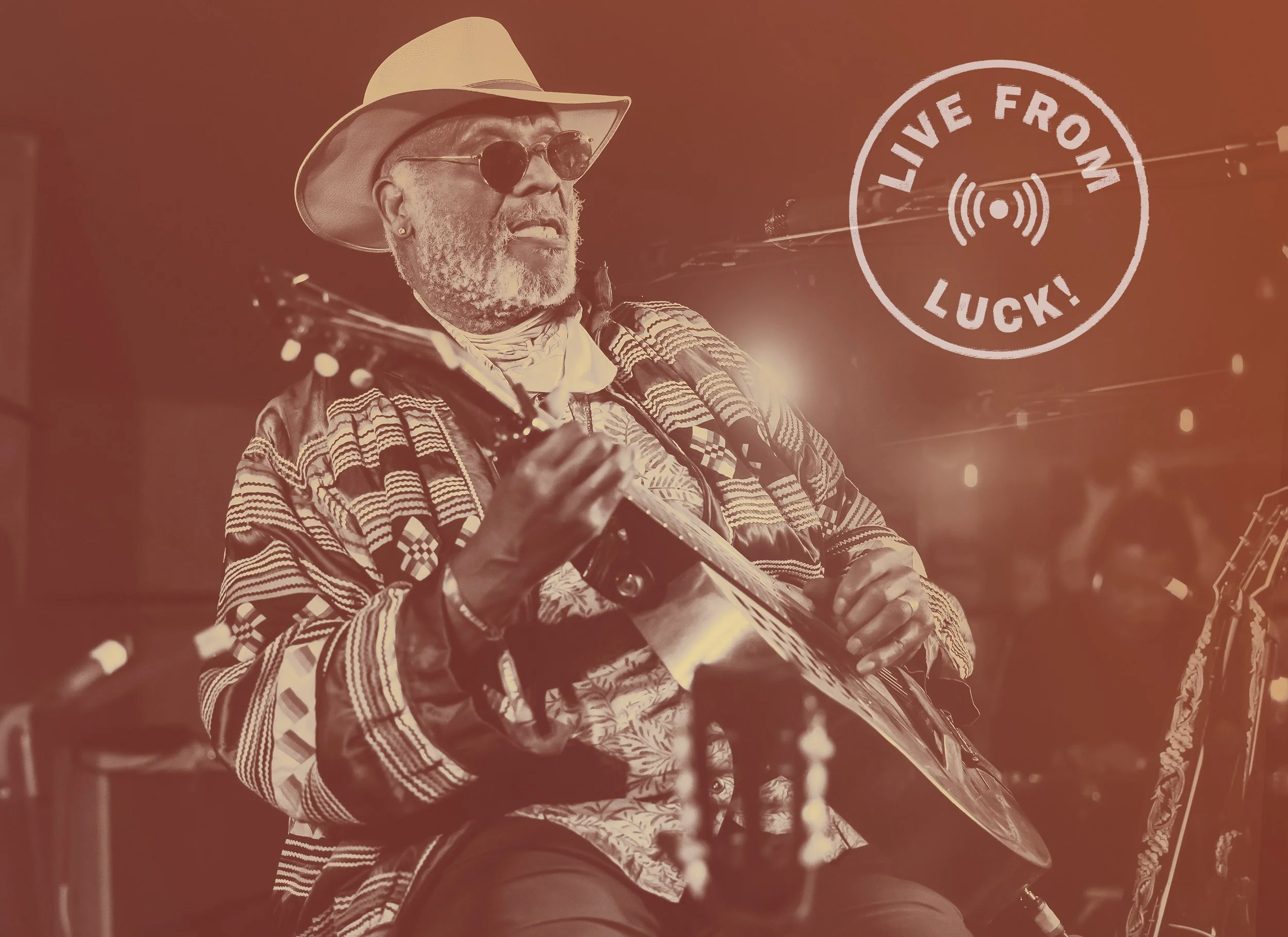
Taj Mahal plays the Luck Reunion on March 13, 2025. (Photo by Dan Leyendecker / courtesy of Luck Reunion)
As the 1960s faded into the ‘70s, Willie Nelson and Taj Mahal were on essentially the same path, with Taj a few short steps ahead. Willie, who grew up loving, among other things, honkytonk and western swing, was still stuck in the Nashville machine and its ill-fitting, cookie-cutter, contemporary country sound. Similarly, blues man Taj, a Springfield, Massachusetts-bred player adept at everything from guitar and banjo to piano and harmonica, was a faithful lover of old school, acoustic country-blues that sounded a century removed from the heavy-handed, electric update of million-sellers like Led Zeppelin.
But when Taj’s first label, Columbia, had pressed him to sound more modern, he’d flat-out blown them off, releasing three albums—Taj Mahal, The Natch’l Blues (both in 1968), and Giant Step/De Ole Folks at Home (1969)—that echoed in the true, early blues he’d grown up on. Like the pivotal, non-Nashville albums Willie would release on Atlantic, Shotgun Willie (1973) and Phases and Stages (1974), the sound was both new and old, equal parts course-correction and revolution. And sandwiched in between, both found a ready audience at Austin’s Armadillo World Headquarters, with hippie kids hungry for a music that was genuine and authentic. Taj and Willie, like minds who’d become friends, delivered.
On this week’s One by Willie, Taj recalls those heady days, starting with the first song on Side 2 of Willie’s seminal Phases and Stages album, “Bloody Mary Morning.” “There ain’t no corporate [in that] at all,” he says now. “And it was real nice to hear somebody that still had that taste for what to do and not be threaded through the needle.”
Joining us for the conversation was Willie’s longtime harmonica player, Mickey Raphael, who, when he learned we’d be taping with Taj at the 2025 Luck Reunion on Willie’s ranch, insisted on sitting in. Mickey calls Taj one of his all-time favorite harmonica players and a huge influence on his own playing—and thus a pivotal element in the groundbreaking sound of Willie’s Family Band.
From there we get into an adoring look at Willie’s old soulmate, Ray Charles, plus give a listen to Willie’s live, 1974 cover an old Texas blues song, “Fishin’ Blues,” that Taj had popularized on Giant Step—and that Willie used to make Mickey sing onstage in his early days with the band, in a move that seemed almost a challenge to Mickey to prove his place in the group.
One by Willie is produced by John Spong and PRX, in partnership with Texas Monthly. The PRX production team is Jocelyn Gonzales, Patrick Grant, Pedro Rafael Rosado, and project manager Edwin Ochoa, with graphic design by Joanna Holden and Modular, ink. The Texas Monthly team is engineer Brian Standefer, and executive producers Megan Creydt and Melissa Reese. And Dominic Welhouse provides invaluable research and editing help.
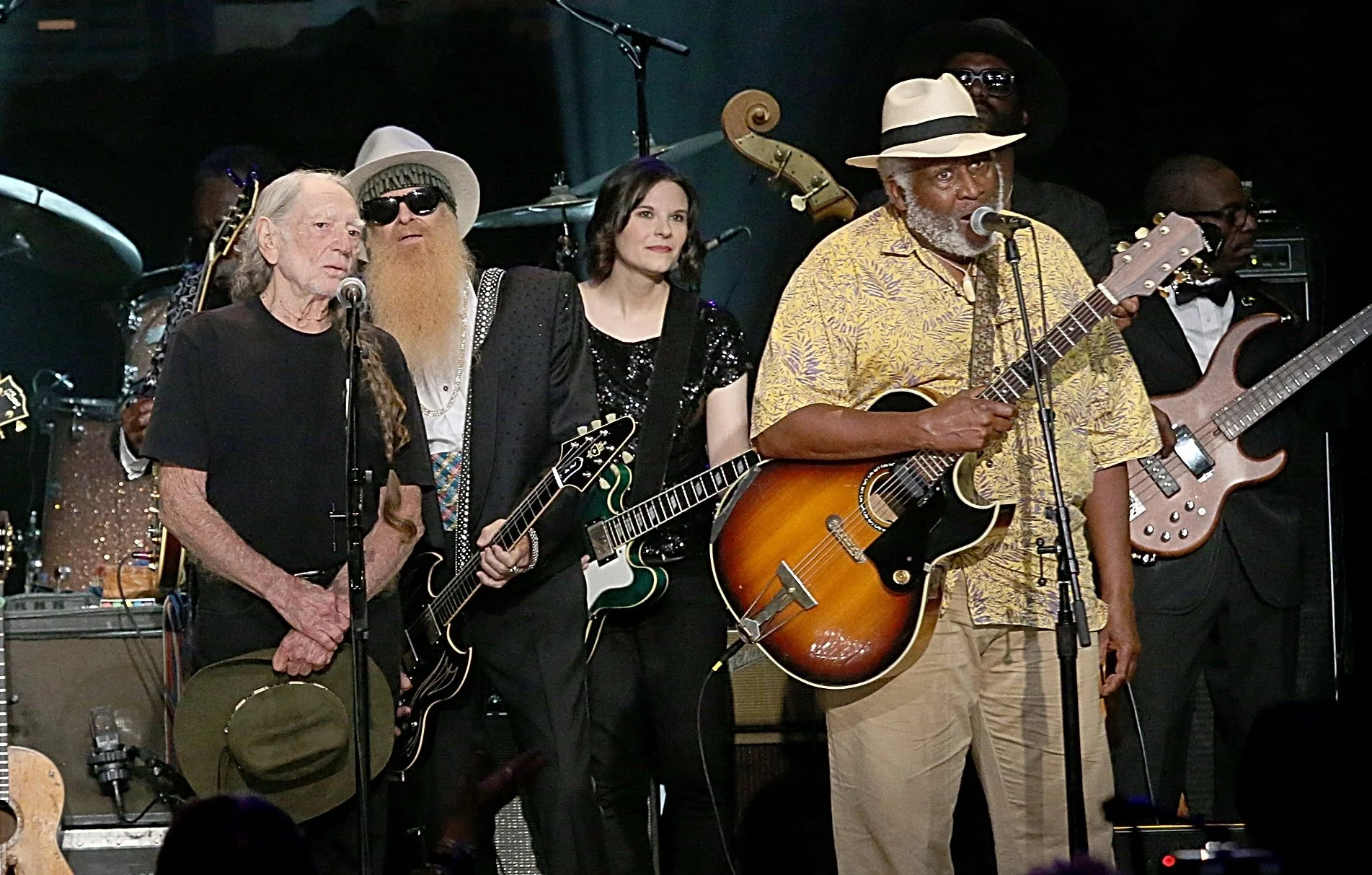
Willie Nelson, Billy Gibbons, Eve Monsees, and Taj Mahal perform at the ACL Hall of Fame ceremony in Austin, October 12, 2016. (Photo by Gary Miller / Getty Images)
John Spong (voiceover)
Hey there, I’m John Spong…and this is One by Willie, a podcast in which I talk each week to one notable Willie Nelson fan about one Willie song that they really love.
This week, one of the true geniuses of the blues…and really, roots music from all over the world…Taj Mahal, talks to us about the first song on Side 2 of Willie’s 1974 masterpiece, Phases & Stages…“Bloody Mary Morning.” It’s a song and album that were, of course, among the earliest and best realizations of what Willie could accomplish once he broke free from Nashville…a fight for creative control mirrored by Taj’s own battles with record execs at Columbia back in the late 60s.
Where all that takes us, and our conversation, is to Autin, Texas, in the ‘70s…and specifically to the Armadillo World Headquarters. It’s a scene that Taj actually found a home in before Willie got here, and joining Taj to describe that moment in time and that music, we have a special guest co-host, Willie’s longtime harmonica player, Mickey Raphael.
Which is part of what makes this episode extra-special. We recorded with Taj live in Luck, just a few hours before his performance at last year’s Luck Reunion. And when Mickey heard we were going to talk to Taj, he insisted on sitting in, calling Taj one of his all-time favorite harmonica players, a huge influence on his own playing, and thus a pivotal part of the revolutionary sound of Willie’s Family Band.
All that, plus an adoring look at Willie’s old soul-mate Ray Charles…and a listen to a 1974 clip of Mickey singing “Fishing Blues.” It’s a Taj cover that Willie used to make Mickey do in their early live shows…in what seemed almost like a challenge to Mickey to prove his place in the band.
So let’s do it.
[Willie Nelson performs “Bloody Mary Morning”]
John Spong: This is the first one of these we've done with a co-host, so it's thrilling to be with you, Taj, and really cool to have you here too, Mickey. But the place to start is where we always start, which is what is so cool about “"Bloody Mary Morning?”
Taj Mahal: Just the tone for me. "Bloody Mary Morning,” I mean, I'm like swiveling across the sound universe. And I don't mean just the dial on the radio. I'm talking about music on the planet. That's how I've always been since I was a kid. And you hear stuff come in, and you can tell the stuff that's being pushed. I mean, that's pretty much what the American music business is. And pretty much once the '50s got in, and the Boomers became of age with rock and roll, then they looked at them kids as a golden goose. So, I come from 1942, and parents were…and all that music that came before…so, we had it a lot. And the culture was like music was flying from everywhere. It was like what you would hear in terms of songs was like messages from ancestors and little anecdotes from over here. And it wasn't driven by the corporate structure.
And even with rock and roll, it still didn't quite get to be what it became in the '60s and the '70s and the '80s, when corporate really got a hold to it and could decide which way it wanted to go, and who was going to be the recipients on the front of it. But for me, what I noticed, there was less and less and less music that, when I heard it, it affected me from the inside. A lot of it was just coming in my ears, and it went straight on through or hung out there for a little while, and I just went and shook my head and it fell off.
But this guy came in, and he was covering all bases. And his tone was not, he wasn't squeaking trying to get by, or trying to create anything. He just was laying it down. And then somewhere along the line I heard, when I finally started catching up with him, he said, "There ain't but two songs, ‘The Star Spangled Banner’ and the blues." Hey, you got me by “the blues.” Just like the way his approach to music was, it was so organic and real. And you just didn't hear a lot of people who would do that. A lot of people who were borrowing from real, to sound like they were real, but being a real person coming through.
And then I heard about other tunes, some that I had heard from other artists, like “Crazy” with Patsy Cline, and KD Lang, and maybe a lot of other people, but those are the two that stick out in my head. And then “Funny How Time Slips Away.” Well, I mean that was a long time I'd been listening to that tune. Had no idea that that man wrote those songs. So then later on, I mean, this is early on. And then took time to get in there and see what he did. And always liked what he was doing. Every time he popped up somewhere, always checked him out.
John Spong: And that's it. It's '74 when "Bloody Mary Morning” comes out and yeah, that's not...well, let's just listen to it. Can I play it for you?
Taj Mahal: Certainly.
John Spong: Because yeah, this is not what people were doing in 1974.
Taj Mahal: Oh no, it got nothing to do with it. It was already baked and ready to be served on the table.
[Willie Nelson performs “Bloody Mary Morning”]
Taj Mahal: There you go.
Taj Mahal: Yeah. Baked and ready to eat.
John Spong: I didn't hear much corporate in that.
Taj Mahal: No. They ain't no corporate at all. No, that came through. That just bore itself right through there. Yeah, it was real nice to hear that somebody had that, still had that kind of taste for what to do and not be threaded through the needle.
John Spong: What do you think of the way he plays guitar in there?
Taj Mahal: Oh yeah, yeah, yeah. All the time. Everything he does. It's complete! It's not like…oh no, I don't have nothing to say about anything. Plus, I mean, he's kept that guitar around forever.
John Spong: That stayed with him. It's one of the things that's interesting to me about that record because that's Phases and Stages, which is his second record with Atlantic. And so the first record with Atlantic, a year earlier, is Shotgun Willie, and that's the first time he gets his own band in there, which is creative control, which was unheard of for Nashville, right?
Taj Mahal: Yeah, yeah. Well, that was always…see, that's always the problem. It’s that…it's like any other empire, when the empire decides that they know what's right for you. Okay.
John Spong: When he does Shotgun Willie, it was so funky compared to Nashville country at the time. It's laid-back. It's louche. It's behind the beat.
Taj Mahal: It’s real.
John Spong: So, Jerry Wexler and them at Atlantic, I think, they finished that record, this kind of vaguely funky record, and he says, "All right, the next one we're going to do, we're going to Muscle Shoals. And we're going to get with the Swampers." And so that's recorded with the Swampers, and it's pretty straight country. Which was interesting to me when I compare those two records.
Taj Mahal: I didn't know about the other record. All I did is came is on that, and that's where I went forward from. I didn't go backwards. The only backwards I went was once I knew the songs he wrote, and I was like, "Oh, okay." I heard previous stories about him trying to get through Nashville, and what kind of things that they were doing, putting him through. And so, I had some empathy there. And I could relate to him on that level as much as anything else. But no, really good. He was an upright guy.
John Spong: Well, and I remember reading about you, when your second record is to be made for CBS? (Correction: Columbia.) You were saying, "No, I'm not sending you guys any demos. I know what I'm doing." And then it's that kind of...
Taj Mahal: Oh yeah, no, I learned that. That was the first thing I learned. Because I went in the studio with the guy, the producer, and he suggested some people to work with. Which really wasn't my idea, but okay; I'll go along to get along. And all the different people they got, and it was a simple tune and they wrote charts out and everything–and boy, this was like Rube Goldberg. No, that ain't how we do it.
So then we took the Damon-Jay Z route, which is Dame did the business, and Jay-Z did the music, and so that's how it worked with me. I did the music and the producer did the business. And so then we confer about one thing, this [and] that thing and the other, but it was like we both had our territory.
And it was good that it went that way because that's how I was able to get through all that phalanx of gatekeepers and people who don't know what they're doing. I mean, it still didn't really make it that much better in terms of the bigger terms, meaning that they didn't turn around and say, "This is Taj Mahal music…click!” It was, there was no place for me. Because I had my own place. So, anyway, we just went along until I did what I needed to do and kept doing it.
John Spong: Which is the Willie story too, 10 years in Nashville and then, "Nah, I got a way. I'll get it out there."
Taj Mahal: Yeah. We'll find a way.
John Spong: We'll find it.
Taj Mahal: Yeah, right. And if it was good enough, people will get it. Because all the rest of the music is coming in a certain kind of way, and after a while people hear you go like, "What is that? How come that sounds so different than this over here?" And there's a full-on corridor right to the artist, right up close.
[Willie Nelson performs “Bloody Mary Morning”]
John Spong: I wanted to ask you about Austin in the early '70s, but before that, how did you get to know Willie? When did you meet Willie?
Taj Mahal: Well, I briefly met Willie on a couple of different occasions. See, I think, well, the first time I knew about him was I'd come down to Armadillo World Headquarters. I knew about his big parties. And I also heard, I don't know whether this is a country legend or urban legend, that you know, he had these big parties, and then 30- to 50,000 people would show up.
Mickey Raphael: The 4th of July picnics. Yeah.
Taj Mahal: Yeah, yeah. Okay. And so the idea that there's a guy–I'm sure with the record companies–there's a guy out there that can draw that many people? Without them? Without their machinery around him? I'm telling you, they must have been licking their chops and rubbing their hands together.
So anyway, I thought that was obvious that this guy had some charisma, had some chutzpah, had something going. And it makes you think, “Yeah, I'm glad there are guys out there like that.” Barry White was another one. He didn't kowtow to the industry. He did his thing. And so yeah, it was very nice to feel him being out there doing that.
Mickey Raphael: Well, Willie had escaped from Nashville and come back home to Texas. And you had already, I think you'd been established here. I mean, the crowds, the kids [had] already fell in love with you and were, I mean, you had a good following in Austin in the early '70s. And Willie had just come back into that.
Taj Mahal: Yeah. Well, it started out in the late '60s. It was the first time I went to Texas, back in the days of when Jesse Davis was playing with me. Because see, when the '70s came, he kinda split and went off and played with the Small Faces and Rod Stewart and all those guys, after we had played at the Rock and Roll Circus with the Rolling Stones. Which would have been a great send up. But Stones were up a bunch of days, and they thought Brian looked a little bit off. The Who gave a great performance. I mean, everybody gave [a] great performance. Jethro Tull, The Who, we did. And then the Stones finally got to get up and play, and Mick felt that day just…it wasn't their best. Plus he had gone off and started working on Fitzcarraldo and all these other things that he was doing. And so it languished for 30 years. But it's out there now, so that's all good.
But yeah, the first time I came to Texas, came through here, went to…Jesse Davis and Gary Gilmore and Chuck Blackwell, we came through here, played all across Texas.
John Spong: I was going to say, I wanted to go to the Armadillo in those years, because you got the Armadillo before Willie did. I've seen pictures-
Taj Mahal: Really?
John Spong: Yeah. And I was wondering what it was in Austin in 1970, '71. There's a great picture of you playing banjo backstage…on the couch, playing banjo with Mance Lipscomb…[Mance Lipscomb performs “So Different Blues”]...Oh, it's a banjo mandolin. Yeah.
John Spong: There was something happening in Austin…and you got here. What was it? Was Austin that different from the rest of the country?
Taj Mahal: Yeah, the place was packed with musicians who really knew music beyond what was being fed, force-fed to them. I mean, these are guys that knew about Johnny Clyde Copeland...[Johnny Copeland performs “Down on Bending Knees” ]…there was music that happened up along the Texas Coast, in and around Texas, you had all kinds of people there. Juke Boy Bonner…[Juke Boy Bonner performs “Call Me Juke Boy”]…Lightnin’ Hopkins…[Lightnin’ Hopkins performs “Mojo Hand”].
And every now and then you got a little zydeco coming over with Clifton Chenier…[Clifton Chenier performs “Eh, Petite Fille”]…I mean, you had different...T-Bone was coming out of Oak Cliffs…[T-Bone Walker performs “Call It Stormy Monday”]...One of my favorite guys, I didn't know where he was from, but in that band that I had when I was in college, when I brought this song, which was “Linda Lou,” by Ray Sharpe…[Ray Sharpe performs “Linda Lou”]
Oh man, I'm telling you, Ray was from over there in that Dallas area. Let me think of all the tunes, all different kinds. Freddie King, “San-Ho-Zay”...[Freddie King performs “San-Ho-Zay”].
Mickey Raphael: Yeah, one night you could go see Freddie King, and the next night you could see Taj. Or Mance.
Taj Mahal: Mance. Yeah, right. Or, or…I mean, anybody was here, man. They were all playing there. Muddy would come through. This one would come through. That one would come through, or playing through. If they wasn't at Antones, they were at Sixth Street Live. Or old Stubbs.
Mickey Raphael: Yeah, Big Walter Horton. I saw him one night.
Taj Mahal: And I mean, they came through. I mean, this was like a music polyglot.
John Spong: And the kids, they dug…you were playing, through some of those years, a lot of acoustic, like country blues. You were playing the roots music.
Taj Mahal: You were playing real stuff.
John Spong: And the kids here got it. And I just wonder because, how does Willie fit into that? He comes, he's not playing blues, he's not playing-
Taj Mahal: But blues is involved with what he's doing. It's like, however we absorbed that, when I heard him, it translated to me. It’s like, I listened to a lot…over the years, I listened to a lot of country players. I get back with Ferlin Husky…[Ferlin Husky performs “Wings of a Dove”]…because I was listening to this music and realizing that it basically is about telling a story. And that's the whole thing is storytelling in song. And if you've got a good story, and you take your time telling it, invoking those pictures in your mind, there you go.
John Spong: When I listen to your records from that period, and it's all with this backdrop of the Armadillo, when I listen to you through there, and I listen to Willie through there, another guy I always think of, that just comes up, is Leon Russell, because it's like y'all are playing a traditional music, but you're introducing these kids to the roots of it.
Because the kids that wanted to listen to Chicago and Memphis, electric blues, or Led Zeppelin or whatever, you're like, "No, this is where it comes from. This is what I do." And Willie, whatever Nashville is doing at that time, he's like, "Well, this is where it comes from. This is Bob Wills. And this is Western Swing."
Taj Mahal: Exactly. Exactly. And Spade Cooley.
John Spong: It's a little bit course-correction…and a little bit revolution.
Taj Mahal: Yeah, yeah. Well, it's just not damning those that came before you because it's not what everybody's listening to. It's like, "Hey, if you get it, if it's supposed to be for you, okay, that's your drink." What you want.
Mickey Raphael: I think we're so used to putting a label on it, Blues, country, rock, jazz. It's just good music. And I think that's what the kids…in the '70s, in Austin, what drew the audience to see the bands play was, it was good music. You didn't care what genre it was.
Taj Mahal: Yeah. It was not built by the genre. And see, that's like, that’s like, that’s like a trawl net. Here up above, you've got the corporate music indu–you know, something's happening, [and] they drop the net down. And everybody doesn't realize that they get in the net, and they're playing…and the money's going up. It's going up. But once the money stops going up, they pull the net up. And everybody freaks out, going like, "What are we going to do? Well, what's going on? Well, where are your moneys to go?" And then they come up with a new thing, here comes the net again, drops down. That's how they do it.
I just tried to follow my way through it. In 1970, I said, "You know what? You spend 10 years trying to put yourself in a position to get noticed….forget that. Just go do you and don't worry." It's more important to see the gleam in your grandkids' eye than it is to make some kind of foolish statement now.
[Willie Nelson performs “Bloody Mary Morning”]
John Spong: Around that time, this is where I think it'll be time for me to listen to y'all two, because it's around that time, Willie has Jimmy Day playing steel guitar for him. And that's who's on that Shotgun Willie record in '73. And then it's Weldon Myrick on what we just listened to.
Taj Mahal: Oh, Weldon Myrick. Yeah, I remember his name.
John Spong: But Jimmy Day was the steel guitar player in his band. That's a traditional country sound, whether it's done great or not. But instead, Jimmy Day leaves the band, and we get Mickey in the band. And you were saying the influence Taj had on you.
Mickey Raphael: Yeah, because I was just, I was 21 when I started with Willie. So I'm learning…in high school, I was listening to you and that Giant Step, I remember taking two records with me to college. One was The Band, and one was Take a Giant Step.
Taj Mahal: Really?
Mickey Raphael: And I knew I didn't want to be Little Walter.
Taj Mahal: Too many guys trying for that. Man, that was great. I mean it really is. I listened to him the other day. I heard the greatest hits of Little Walter…[Little Walter performs “Juke”]...I mean, the tempos are just so perfect. And the way he plays, man, and what he thinks of playing. And how he does it…how, if you listen to it, at first you think he always comes in at the same place. No. He comes in when he feels it.
Mickey Raphael: And that's so unique. You can't teach that. And you can't copy it.
Taj Mahal: No.
Mickey Raphael: But using your records, though, was my gateway-drug to music, to learning how to play. When I heard that, I thought that's what I want to do. I want to play the harmonica. And if I can interpret, get anywhere close to that…but put it in my own words. I don't want to copy. I don't want to be Taj.
Taj Mahal: No, that's the signature, right there. That's the difference between a lot of other guys and Keb' Mo'. He get it. He got it. He got it. No, you go down the road and you put yourself in place. That's the whole thing. But see, all those records that I did with those first three records there, Jesse Davis had an awful lot to do with configuration, in terms of those records. To me, like one of my, on Giant Step, the introduction, the way that “Farther On Down the Road” comes in, it struts. When you play that, it struts in.
And that strut on there was what, after we had...here's how the song goes. I come into the studio on Monday or Tuesday night, whatever it was. And I pull up…and I walk in the door and I'm hearing this tune go down. I said, "What is that?" And there was…“Heh-heh, a little something we worked up.” I said, "I'll be back."
Twenty minutes, I came back, and the lyrics that you hear on that record are what I wrote down in twenty minutes. And sang, just came in and sang. Because I knew what the story was…and then I sang. And then because the harp comes in the beginning. But when we got done, Jesse said to me, he says, "You know what? I think you could put a little banjo on that." I said, "Really?" So when you hear it come in, it comes in, [singing] “Strut-strut-strut-strut-strut-strut…Be-ba-daa…ba-dee-da-la-daa…the harmonica…be-da…Dee-da-la-daa”...Further on…” [Taj Mahal performs “Farther On Down the Road”] And that was the one thing that he could do. He did. Always working with him, he knew how to set the song up so that the singer came in and it was actually introduced to your ear, mind, soul, everything. It was great.
Mickey Raphael: Was it his idea to do like a strut? Because it could have just as easily been a shuffle, and it would have been a totally different song.
Taj Mahal: No, no. When he said, "I think we should put a banjo." No, he just gets, I want, "Chick, chick, chick, chick, chick, chick." So, okay. And I always like to hear the banjo come through. When you play that record, man, and even though it plays all the way through, it's that introduction where it just cuts in. I just still, some days, I'll be sitting around and going like, "Man, I need to hear that."
So yeah, the whole thing was looking at what people were looking at, people say, "Okay, political music," and whatnot. I saw all the politics that was going on. I saw what was going on in the world. And I decided to be 100% some other place, where people could get respite from all that craziness. And they could.
Mickey Raphael: And you could just be yourself. You could be Taj. You didn't have to-
Taj Mahal: Right. But also the people who were listening found that they could be themselves through that.
John Spong: So where am I going to hear the influence of him on you? Because that's such a signature thing of Willie as we know his music, where–
Mickey Raphael: Anywhere. I would not have gotten to where I…in anywhere, playing the harmonica. I mean, I put what I learned from Taj in my own interpretation.
Taj Mahal: Vernacular.
Mickey Raphael: Yeah. But I mean, I just happen to have it… [Mickey pulls something from his pocket]...
John Spong: Ah yes.
Mickey Raphael: …but just a simple little lick… [looks at his hand] …Well, that's a pocket knife.
John Spong: Don't put that in your mouth. I mean… [plays harmonica] …those are the notes from “Farther on.” But it's-
Taj Mahal: Right. [singing] “Da di-da-da.”
Mickey Raphael: It's just three notes, but it's kind of...and then you take that and then you put your own spin on it.
Taj Mahal: Something else.
John Spong: Put your own spin on it.
Mickey Raphael: There's only 12 notes.
Taj Mahal: But if you take it from that position, you get in trouble. You take it from the music. And the music is in us.
[Willie Nelson performs “Bloody Mary Morning”]
Taj Mahal: He might have come on as a country boy, but he ain't afraid of nothing. Not nothing at all. And I don't care…or to get up and sing with anybody. It's like you got Leon Russell, Ray Charles, and you got Willie Nelson…all singing the same song. And everybody's stepping in where they get in, get in and bringing it, all three of them.
John Spong: Well, and I love–and I don't want to go too far down that road–but God, when I watch that video, the three of them doing it together, they are all heroes. I'll get emotional. They're heroes, and the way they regard each other is with absolute awe of each other. The way Willie Nelson looks at Ray Charles, the way Ray Charles just seems different when he's around Willie, the way they all love Leon.
Taj Mahal: Ray….see, before Ray left Florida, he played in a country band. Played piano in a country band. And besides, also too, which I had both albums, bought them with my own money picking tobacco, was Modern Sounds in Country Music. Oh, man, you know I listened to that. In fact, I used to sit cross-legged on the floor with my head between the console–we had one of them consoles with the radio on one side and record player on the other side–put my head right between the speakers. And listen.. [singing] “Born to lose…” [Ray Charles performs “Born to Lose”] How do you sing a song like that? You talk about somebody I listened to? Boy, I listen to Ray a lot. Because he could just bring it. Whatever song it was, he could turn it into his own.
And he didn't write a lot, at all. Hardly wrote, but he could interpret so many different songs. Plus he worked on the music.
Mickey Raphael: Yeah, his arrangements.
Taj Mahal: Oh, please! I heard…see, what did he do? See, I saw him…I was a Ray Charles fan from the first album I bought. I bought the two before What'd I Say here, because I just liked what he was coming from, his sound and everything. And I took my band, my college band, I said, "Now you guys need to go come with me, and you need to hear a real band play this music." And this is the 1962 band with Teagle Fleming on drums, Edgar Willis on bass, Marcus Belgrave and Joe Newman on trumpets, Hank Crawford on alto, Fathead Newman, from Texas…
Mickey Raphael: A Dallas boy.
Taj Mahal: …yeah right, on tenor and Leroy Hall Cooper from Texas on baritone. And the show was supposed to start at 8:00. So everybody's cool. 8:05, there's a little murmur in the audience. 8:10, a little bubble in the audience. 8:15, people was getting rowdy. You could hear things moving. And about 8:20, you hear some shuffling backstage. And then the musicians come on out, and then the audience relaxes. And I forgot the guy's name that was his guy, walked him out to the piano, and of course everybody went crazy. And then, because the big song was out was “What’d I Say?” And so they was expecting him to come right in and start [singing].
By then he had “Georgia on My Mind” out. So what the guy did is he took the whole theater down to just a spotlight on Ray on stage. So everybody was inside the womb, now. And he played, [singing] "Georgia." And I mean, when he got through doing that, he could do anything he wanted to. And he did. It was a great concert. The Springfield Municipal Auditorium. I'll never forget that.
Mickey Raphael: Wow.
John Spong: Tell him about “Fishing Blues.”
Mickey Raphael: Oh, yeah. That, uh…I do not sing. I'm one of the few harmonica players that does not sing. I just don't hear pitch. But I guess maybe, I might have been on drugs or something…anyway, I learned back in the day, I learned “Fishing Blues,” and I thought I'm going to risk my reputation, because I love that song so much. And I would sing it, and Willie, I don't know if it was a tribute to Taj, or to intimidate me, but he'd ask me to sing it every night. And it was terrible. But I did it, and Willie made it part of his show. And I was so terrified doing it. It's just something I had to get over. But of my whole career with him, 50 years, the only song I've ever learned to sing was “Fishing Blues.”
Taj Mahal: Well, thank you very much, man.
Mickey Raphael: I don't know if that's a compliment, but it's like I risked my life and my reputation.
Taj Mahal: Hey, it's a compliment. It's actually to another Texan…Henry Thomas is the guy that wrote the tune.
John Spong: Oh, wow.
Taj Mahal: Henry “Ragtime Texas” Thomas. He's also the one that wrote that Canned Heat tune, “Going up country, baby, do you want to go?” Yeah, he wrote a whole bunch of tunes. But anyway, that's my interpretation of his tune.
Mickey Raphael: And I like…you have different interpretations. With the hula band ? Or even at the beginning when Jesse Ed was playing with you in the band? But that's what's great about that song. I mean, you could do it really slow. Or some of your versions are really fast or just…it’s a very versatile song. It's kind of a song that stuck with you through so many years.
Taj Mahal: Well, I didn't do any of those songs. “Carina,” I probably known it for a while. The only thing I did was “Mailbox Blues.” No, I really didn't do a lot of those tunes because I mean, what was happening is that they were pulling me into a place that would make it easy for them. And I'm saying, "No, you need to stretch. You've got to stretch." This is an incredible, this is a great music.
And it's like, what did George Carlin say? He said, "My job is to go get ahold of these people and bring them screaming and kicking across the line. And when they get on the other side finally, they thank me for doing it." Because they don't want to go to this. “I'm safe.” A half-a-degree on this side, half-a-degree on that side, not too much. But anything other than that, I get scared. I don't know what it is. “Well, what kind of music is it?”
Mickey Raphael: Well, that might have been Willie's whole thing. It's like, “Mickey can't sing, but I like the song. We're going to honor the song. We're going to honor the tune.”
John Spong: There's no wifi though. There's no wifi in here, so I can't pull up the video, but there's one video that was, it was a TV show, a precursor to Austin City Limits. This is shot in like '73 or '74 and Willie says, "Well, now we're going to let Mickey sing a song here." And then he just turns to him, and puts his arms on top of the Trigger and just kind of looks. And Mickey does a great job of not looking afraid…and then he sings, and it's kind of a Leon Redbone thing. It's kinda cool. It's passable, but it's cool because Willie does…he doesn't play guitar the whole time. The rest of the band plays, but Willie just looks at you like he's taking your measure.
Mickey Raphael: Like, “I'm not leaving till you do it,” either.
Taj Mahal: You expect to get paid next payday.
John Spong: But then at the end you play your harmonica solo, and it's almost like Willie goes, "All right, he did it." And he starts playing. He joins in. [Willie Nelson and Mickey Raphael perform “Fishing Blues”]
Mickey Raphael: But to bring that song in to, I mean, it's like pitching a song to Willie…Willie's one of the greatest songwriters. I don't want to bring him a song. So for him to pick that one to a...
Taj Mahal: Well, it shows, like, his ears are into where the music is, all the time. There's so many people love that song. Finally, I brought it back, and I'm playing a lot of different ways. Because a lot of people, for me, you have to realize that the way people have been raised through the music business, they often times don't have the ability to be able to hear where the music's coming from. So when they find a song like that, it means an awful lot to them. But I just don't want to get to be, every time they come to see me, there isn't something new. Or someplace that they get stretched.
John Spong: A couple quick things, because if you don't get to the stage on time, I don't want it to be my fault, or something I did.
Taj Mahal: Oh no, you can't do that. Because it's 9:30 is when the stage…we play.
John Spong: So, two things. The first time I came out here, it was for one of these reunions. And I remember asking Willie's colleague and friend, Jeremy Tepper, I said, "So when these artists play, are they playing in Willie's front yard or his backyard?" And he said, "Well, it depends. If he's sleeping in the house, this is his backyard. But if he's sleeping on the bus, which he often does, this is his front yard." And so I just wonder what's it like being here, playing at Willie's place?
Taj Mahal: Oh. I was pleased that we still had some sort of connection that he wanted me to play at one of his events. I played at two of his personal events before.
John Spong: You did some Farm Aid, I know that.
Taj Mahal: Yeah, both Farm Aid. Yeah, that was it. Because that's where I started out. I started out picking tobacco. And then I was, for a couple of years, and then I was a dairy farmer for about eight years. I had 150 head of Holstein cows.
Mickey Raphael: Did you go to veterinary school?
Taj Mahal: Yeah. I mean, I majored in animal husbandry, minored in veterinary science and agronomy and dairy technology. That's where I was headed. I mean, if I've been able to get the loan that I needed from the bank, I would have probably been playing music on Saturday nights in the haymow. But no. Anyway, so music…went on down the road doing that.
Mickey Raphael: I'm glad you did.
Taj Mahal: Oh, I farmed music.
John Spong: There you go. I found an article the New York Times did on you in 1973. And you said, “I'm a man who's having a love affair with the kind of music I play. And the music I'm really in love with is freaky, old-time music, the real stuff. I'm not out to get attention. It's not my ego trip. It's not even my music. It's everybody's music." And that strikes me as true of you, and Willie, and all these guys.
Taj Mahal: Yeah. Anybody that said…I tell you that story, “Ain't but two musics, ‘The Star-Spangled Banner’ and the blues…” I was like, "Okay." I think we can hang out in the same corral.
John Spong: Cool. Thank you so much…
Taj Mahal: You're welcome, man.
John Spong: ...for coming out here and for talking to us about Willie.
[Willie Nelson performs “Bloody Mary Morning”]
John Spong (voiceover)
All right, Willie fans. That was Taj Mahal talking about “Bloody Mary Morning.” A huge thanks to him for coming on the show, and a big thanks to you for tuning in. If you dig the show, please subscribe, and stop by our website at onebywillie.com. Oh, and please visit our page wherever you get your podcasts and give us some stars or type in some comments, or maybe just tell one friend to check out the show. Every little bit of that helps more than you know.
One by Willie is a production of John Spong and PRX, in partnership with Texas Monthly. Our PRX production team is Jocelyn Gonzales, Patrick Grant, and Pedro Rafael Rosado, with project manager Edwin Ochoa. Our Texas Monthly team is producer / engineer Brian Standefer, and executive producers Megan Creydt and Melissa Reese. Our art and web design come from Joanna Holden and Modular, ink., and we get invaluable research and editing help from the great Dominic Welhouse.
Please follow us on Instagram at onebywillie–all one word–find us on bluesky, and join our ever-expanding Willie conversation at the One by Willie group on Facebook.
I’m your host, John Spong. Thanks for listening.