
In a special icon-on-icon birthday tribute, the thirteen-time Grammy winner talks about duetting on one of the most important records of Willie’s career, plus covering “Night Life” with blues legend B. B. King.
By John Spong
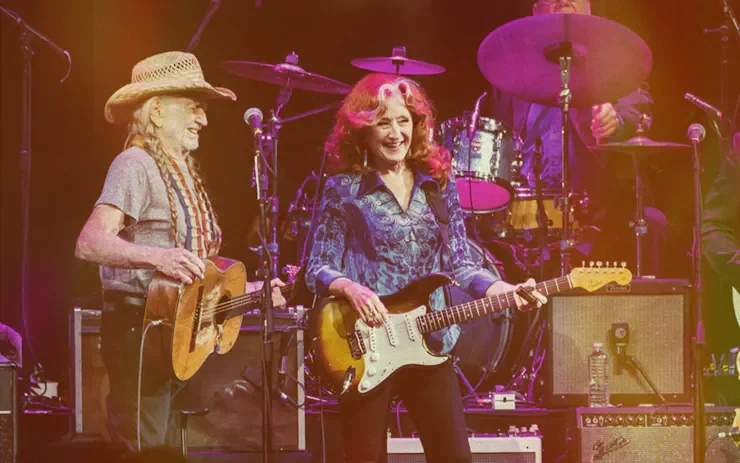
Willie Nelson and Bonnie Raitt performing during the “Texas Strong: Hurricane Harvey Can’t Mess With Texas” benefit, in Austin, on September 22, 2017. (photo by Charles Reagan Hackleman / Courtesy of Bonnie Raitt.)
Given their nearly fifty years of friendship, and all the Farm Aid appearances, onstage jam sessions, and late-night hangs that implies, it’s weird to think that Bonnie Raitt and Willie Nelson have spent such little time in the studio together. In 1979, the two hooked up with Leon Russell for a loping cover of the jazz-blues standard “Trouble in Mind.” In 2002, Raitt harmonized with Willie on an eloquent reading of a pensive pop ballad about regret, “You Remain.” But the hands-down high point of their studio collaborations, and as beautiful a recording as either ever cut, was their 1993 duet “Getting Over You”—which became the cornerstone of one of the most important albums of Willie’s long career, Across the Borderline.
Even the hardest-core Willie lovers tend to forget how difficult the early nineties were for Willie. Artistically, only one of his first eight singles of the decade cracked the top twenty, and three failed to even chart in the U.S. His record label, Columbia, was talking about relegating him to legacy-act status, and there was a real possibility it would drop him, as it had unceremoniously done his friend Johnny Cash, in 1986. Personally, life was nigh-on impossible. His famous IRS tax battle and the $16.7 million the feds claimed he owed had turned him into a late-night talk show punch line. And in December 1991, his oldest son, Billy, died suddenly. 1992 was and remains the only year Willie didn’t release any new music, going back to 1958.
Then, in March 1993, just weeks after he settled with the IRS, came Across the Borderline. Cut with one of the era’s leading rock and pop producers, the brilliant Don Was, Borderline was an unmistakable reminder not just of how important Willie was as an artist, but of the kind of folks who thought so. The song “Heartland” was a cowrite and duet with Bob Dylan. Willie and Sinéad O’Connor covered Peter Gabriel’s “Don’t Give Up.” Working solo, Willie covered two songs each by Lyle Lovett, John Hiatt, and Paul Simon, with Simon pitching in on guitar and production. And at the album’s heart was Willie and Bonnie singing to each other about the endless frustrations of a breakup, “Getting Over You.”
In this special birthday episode of One by Willie, Raitt takes us back to that session. The song, written by legendary Austin music figure Stephen Bruton, her dear friend and former guitar player, was one with which she was eminently familiar. So too was the producer, Don Was, who’d helped her grow from a blues-championing cult favorite to a million-selling, future Rock & Roll Hall of Famer with his production of her albums Nick of Time (1989) and Luck of the Draw (1991). And then, across the recording-room floor from her, was her other buddy, Willie, whom she likens to the Cheshire Cat and Yoda.
From there, she describes covering “Night Life” with B. B. King at Willie’s legendary The Big Six-O birthday show on CBS, the fact that none of the A-list legends who showed up for Willie in those months ever doubted his “mythic status,” and why she thinks he is the most unique guitar player alive, before sending him the most gracious birthday wishes you’ll hear all year.
One by Willie is produced by John Spong and PRX, in partnership with Texas Monthly. The PRX production team is Jocelyn Gonzales, Patrick Grant, Pedro Rafael Rosado, and project manager Edwin Ochoa. The Texas Monthly team is engineer Brian Standefer, producer Patrick Michels, and executive producer Megan Creydt, with graphic design by Emily Kimbro and Victoria Millner. And Dominic Welhouse provides invaluable research and editing help.
Transcript
John Spong (voice-over): Hey there, I’m John Spong, and this is One by Willie, a podcast in which I talk each week to one notable Willie Nelson fan about one Willie song that they really love.
This week, to celebrate Willie’s big ninety-second birthday, we’ve got a special, icon-on-icon birthday tribute from his longtime friend, fan, and collaborator, thirteen-time Grammy winner Bonnie Raitt, who will talk about their sublime 1993 duet “Getting Over You.” That song—written by Bonnie’s dear friend, the late and legendary Austin music figure Turner Stephen Bruton—became a cornerstone of one of the most important albums in Willie’s career, Across the Borderline, which was produced by the brilliant Don Was, who also just happened to produce Bonnie’s own classics, Nick of Time and Luck of the Draw.
She’ll show a lot of love as she gets into all of that, describing Willie as a little bit Cheshire Cat and a little bit Yoda, before talking about covering “Night Life” with B.B. King at Willie’s legendary sixtieth-birthday concert, why she thinks Willie is the most unique guitar player alive, and then sending him the most gracious birthday wish you will hear all year.
So let’s do it.
[Willie Nelson and Bonnie Raitt perform “Getting Over You”]
John Spong: And the only thing is, we usually do start with the focus song, and this one’s kind of a special instance, because the song lived for you and with you before you took it to Willie. And so, I wondered: Usually, we start with what’s so cool about this song—which is funny when the song is “Crazy,” because it’s a ridiculous question—but in this instance, it’s the song “Getting Over You,” that Stephen Bruton wrote. Can you tell me about your relationship with that song?
Bonnie Raitt: Yes. I mean, I have been friends with Stephen since I met him, when he and Kris Kristofferson were a legendary duo. And I played some shows with him when I was just a duo with my bass player, Freebo, in the early seventies. So I think I met him maybe ’71, ’72? He says he—Stephen was in Woodstock when I was making my second album, and I might’ve met him there. But we bonded so much over our relationship with Kris. And then he was in Kris’s band for many, many years, but he was also a solo artist and eventually played in my band for a few years. But I’m a huge fan of both his playing, but his songwriting is so—among musicians, he’s a musician’s stellar example of somebody that deserved a lot wider attention. And he then, of course, went on to be a producer as well, and was cut down too soon, sadly, by throat cancer, and it was one of the most devastating losses I’ve had. It happened within a week or so when I lost my brother, back in 2009.
John Spong: Oh God.
Bonnie Raitt: But we were many, many years of impish misbehaving. I can’t even think about Austin without thinking of Stephen Bruton. And we were sober together years later, and we were partying all those first years, but I’m such a big fan of his music, and this was one of my all-time favorite songs of his. And I think maybe it was Don Was that might’ve played it for Willie, but also, Stephen knew Willie as well. So I just think it’s such a masterpiece, and I was so glad that Willie wanted to sing it with me.
John Spong: And so then, the little bits that people might not know about Stephen, he was a Fort Worth boy, in tight with T Bone Burnett growing up, and the Austin records that he produced in the nineties—he was the guy. It was Jimmie Dale Gilmore and Alejandro and Hal Ketchum, and those albums all went into the canon. But do you remember when—would he have played, would Stephen have played this song for you once upon a time? Because he didn’t record it until ’93, but you probably knew it well before that.
Bonnie Raitt: I did. I think he was playing it live, and it’s hard for me to separate when. There were so many nights and afternoons when I was at his house, or when he spent a lot of time in L.A. as well, where I was living at the time, and I just heard so many of his songs even before he was, a lot of times, just after he’d written them. So I honestly, on this one, I don’t remember exactly when I heard it, how many years before I ended up singing it with Willie, but it was—of the classic [Bruton] ballads, there’s one called “Too Many Memories,” which just, ahhhh. I mean, they don’t get any better, but I also am just a dear friend of his. And I miss him a lot. So when I hear these songs, they bring up a lot of emotion for me.
John Spong: Ooh, well then, I should be careful. Would you mind if I—I’ve got his first record from ’93, when he put this on it . . .
Bonnie Raitt: Oh, not at all.
John Spong: Can I put that on just to hear the first little bits of it?
Bonnie Raitt: I would love to hear it. Love to hear it.
John Spong: Oh, cool. Now, it’s a matter of me mastering my technology, but I get better every taping. So there’s that. There’s that. And here is Stephen Bruton.
[Stephen Bruton performing “Getting Over You”]
Bonnie Raitt: Oh.
John Spong: Mhhh.
Bonnie Raitt: Oh, so great to hear that again.
John Spong: Yeah. Yeah.
Bonnie Raitt: Oh, I remember. I can hear his youth in his voice, too. All the different eras of our voices for each other. We grew up together, so, you know. In our early twenties. So I’ll never forget hearing these records the first times.
John Spong: That’s wonderful. Well, but so then, you guys do it. And what Don Was told me a while back, when I did one of these with him, he said that you had introduced him to Kristofferson, which led to Don meeting Willie, which led to Willie maybe wanting Don to produce him, but before he even reached out to Don, his first call was to you for a reference. Do you remember that call, by chance?
Bonnie Raitt: Yeah. I mean, I couldn’t have raved about anybody as a producer more than Don, except maybe Stephen. Yeah. And I think once Willie heard that song, he immediately knew why we wanted to cut it.
John Spong: That makes sense. Well, why did you think Don would be a good fit for Willie, especially since you know Don’s production and what he does in the studio better than probably anybody?
Bonnie Raitt: Oh, yeah. After we had our unexpected success with Nick of Time, which was a surprise to him as well as me and everybody else in the world—
[Bonnie Raitt performing “Nick of Time”]
Bonnie Raitt: So many people approached him, because the sensitivity of getting out of the Svengali producer imposing a sound of his own arrangements. He really, being an incredible musician as well, he has this wider range of taste, as somebody like me and so many others, he’s able to really distill the essence of what makes someone so special. And he’s as smart as he is soulful. He doesn’t have an abiding ego to lay on people. So what makes somebody very unique and special, he sets them up to get the most perfect—and I don’t mean slick, I just mean the most sympathetic, soulful players to surround people. And let the artist breathe and sing and be their best version. And that’s what I told Willie. I said, “He’s just such a simpatico, wonderful guy, great vibe in the studio.” And he’s not trying to impose himself on anything. He just lets you be your best self with the band that you put together, carefully together.
John Spong: And I was thinking that as you said it, and I know Don this much, but when you lead with your soul, with that beauty that’s inside you, to that extent, then that means when you want to get—anybody you call to come to the session is going to say, “With you? Absolutely.” And so, you’re going to be able to assemble everybody.
Bonnie Raitt: I agree. And I’m so proud that what we did together on Nick of Time was just kismet. And it was a perfect time in his career and in mine, and we were mutual fans of each other. So the other artists that appreciated what we had done, and what the atmosphere of those songs—and the feel of that record is so organic. Like, a lot of slick pop records—nothing against that—they’re just a different sound; it’s a different motivation. I mean, we’re not in it to sell stuff. And Willie didn’t really need a breakthrough commercial record. I mean, if you wanted that, you would go to somebody else, like Sly and Robbie! But the fact that we had Album of the Year was no slouch. I mean, it was wonderful and made it actually [so that] something rootsy and organic could be a success. So that’s fantastic.
John Spong: Yeah. When you all go to record this, though, did you have a sense of what Willie had riding on this and what was going on in his career? Do you remember any of that right now?
Bonnie Raitt: No, I don’t.
John Spong: Yeah. Well, so this is ’93, and so, he hadn’t had a top ten country hit since ’89, and Columbia was talking about farming him out to legacy-act status. But then on top of that, personally, the IRS stuff had been going on for five or six years.
Bonnie Raitt: Oh, I remember that. Oh my God, I remember that now.
John Spong: Yeah. And then in Christmas of ’91, his son died, and in the year, year and a half before that, his sister Bobbie had lost two sons in rapid succession.
Bonnie Raitt: Oh my gosh.
John Spong: So this was an impossible time for him, to my imagination. And the thing is, in 1992, he didn’t release anything, not a single or an album. And that’s the only time, that’s the only year since 1958 that that had ever happened.
Bonnie Raitt: Oh my God, I’m so glad you’re telling me this, because, I mean, I might’ve known about the IRS thing because [it was], you know, legendary at the time.
John Spong: Yeah.
Bonnie Raitt: But he—I mean, when I say legendary, it was like, what’s he going to do? Basically, flip the bird to the government? He was everybody’s outlaw hero, as well as our Yoda for the music industry. So I wasn’t aware of the losses that Bobbie had and the context of the record. It makes it even sweeter to know what an incredible, acclaimed album that was and how important it was. So I’m really glad that he met Don when he did.
John Spong: Yeah. And that’s the thing. Then you all go into the studio to record this song that you already love so much. Take me into the studio. What was it like?
Bonnie Raitt: Oh gosh, what a great band. I mean, had all our favorite players, some from my band, and Mickey [Raphael], we couldn’t make a record without him. And it was—I don’t know where Willie recorded, but I just assumed most of the time would be in Texas. So I knew it was some new people for him, but it was a magical extension for me of what—once Don and I get in the room together, it’s just we love each other so much, and I’ve loved Willie for so long, and all I can remember that . . . what I most remember about that session is the lights were low, as a lot of musicians like the atmosphere, especially on a ballad. And we were facing each other through two different vocal booths, with a light, just a light illuminating our faces, probably. And then we had the light on the lyric sheet on a music stand. You know, one of those little lights that clips on?
John Spong: Yeah.
Bonnie Raitt: So the lights were really low, and I would have my eyes closed, listening, getting ready to sing, and I opened my eyes and Willie looked like, all I could think of was only his face—it looked like the Cheshire Cat suspended in darkness. And I opened my eyes up, and I go, “I’m singing with Willie Nelson.” It was just so surreal to be able to sing this gorgeous song together with—I mean, it’s one of the most incredible heartache songs that I’ve ever heard. And to be able to imbue it with all of the love and the experience that both of us have had, not being young, you know? It has a different resonance when you sing it at this age.
John Spong: Wow. Well then, can I spin that? Because now I want to picture Willie’s head floating while he sings this.
Bonnie Raitt: Yeah. It was just—I’ll never forget it, never forget it.
[Willie Nelson and Bonnie Raitt performing “Getting Over You”]
Bonnie Raitt: Oh. I’m glad I brought my Kleenex out here, because I, on purpose, didn’t listen to this song before. I’m just telling you, that is—the pedal steel just, if ever there was a kind of music that deserved pedal steel, this is it. And I just—all of the feelings that I have about Texas are created from Willie and Stephen and Antone’s, and there’s some T-Bone Walker in it, and so much, some of the blues scene. But I have such an affinity as—people even give me the great compliment of thinking that I am from Texas, when I’m actually from Southern California, but I’ll take it; I’ll take it. All my favorite musicians are from there.
John Spong: Wow. Talk about Willie’s voice in that recording, because it’s so—there’s an intimacy to the way he sings that. There’s always an intimacy in his voice, and in his delivery, and the whole thing, but it’s even more pronounced, I think, on this cut.
Bonnie Raitt: Yeah. He is so respectful of melodies, and he loves a good melody like I do. And the pacing of his phrasing is so astonishing to me. I mean, both his guitar playing, but if we’re talking about his singing, it’s just so, I don’t want to say succinct, it’s just so eloquent in his restraint. Where he places things, and when it’s clipped, and when it’s drawn out, and the melody of this, and the way the words match the melody, it’s not something you need to milk.
John Spong: Yeah.
Bonnie Raitt: And what I love is the economy of how he’s singing. He’s just letting the emotion come through without leaning on it. It’s just beautiful, beautiful vocal.
John Spong: Was there much rehearsal? Because I know Willie’s a first-take guy.
Bonnie Raitt: Yeah.
John Spong: But did you all discuss ahead of time how you were going to do it? Or was that just y’all being artists?
Bonnie Raitt: I don’t think we rehearsed. I mean, I’m a first-take woman myself, and I think we just decided which sections we were going to do together, and we picked a key that was good for both of us. And I was a little nervous because, you know, it’s Willie Nelson, for God’s sake. I mean, I kinda hit the big time for a minute there a year before or two. But this was still—the second bloom of my career was just, this was . . . one of the great trees bearing fruit was to actually have this duet happen, and then this incredible band. So I think two old veterans like us that love each other and have been in and out of each other’s stages and friendships, even though we never lived in the same town, we have great affection and love for each other. And so it was nice to not overwork it and talk about it. Let the magic happen.
John Spong: I’ve known this song, well, since it came out, but when I got this job overthinking Willie for a living, which is awesome, I listened really closely, and I notice—and I think I have this right, but when y’all are singing the harmonies on the chorus, he’s above you. He’s singing the higher part of most of the harmonies, but then when it goes to that guitar solo, Trigger drops down to the very bottom—
Bonnie Raitt: I know.
John Spong: —and plays this thing with no fireworks at all, so that you can come in up above him there and just soar with your slide.
Bonnie Raitt: It’s very complementary. I don’t know if it was a conscious decision on his part. It’s just such a beautiful melody, and I love the way that he uses the bass strings on the guitar. I just love that he voices melodies or whatever he does. I mean, the way he uses all six strings and the whole fretboard is great. And maybe now that you’ve mentioned it, maybe he was leaving that second half to build with a slide, knowing how I played, and it was a beautifully complementary solo, emotionally and guitarwise as well.
[Willie Nelson and Bonnie Raitt performing “Getting Over You”]
John Spong: Well, and so, not long after it comes out comes The Big Six-O.
Bonnie Raitt: Oh, what a blast. I went back and looked at the lineup of that again. I went, “My God, how did we even fit all of us in there?”
John Spong: Yeah, and for folks who don’t remember—and that’s what I think. Like I said, Willie, he was in a weird spot in his career. Things weren’t going great. And so this wonderful album comes out, and then CBS says, “Yeah, we’ll do a two-hour special for your sixtieth birthday,” in April of ’93. And so it’s people you might expect, like Waylon and Kristofferson and Lyle and Emmylou, and then it’s like they squeeze Mount Rushmore in on top of that. It’s Ray Charles and B.B. King and Paul Simon and Bob Dylan, everybody coming together to fete Willie.
Bonnie Raitt: Yeah. Well, he’s so beloved, you know what I mean? And at this point, he had already achieved mythic status for us.
John Spong: Yeah.
Bonnie Raitt: And there really isn’t anybody in our world of music, and even in the whole legacy of putting yourself out there for cultural and political and social causes—he just stands alone and unites people across genres and generations. And that’s the—there wasn’t really the Americana format yet. But Willie, in one guy, he really embodied the ability of people to go past genres. I mean, he would be just as natural to sing with Frank Sinatra—as long as they didn’t talk politics—as anyone else. But he’s so eclectic. I’m not surprised Ray Charles and B.B. jumped at the chance to be paying tribute to him.
John Spong: So I talked about this with Charlie Sexton when he was on here recently, because to have grown up in Austin like I did, we knew how much Willie mattered, and we knew how much we loved him. But there was an extent to which he was taken—not necessarily taken for granted, but I didn’t quite get just how big a thing he was. And so, for instance, he moved his family to the little suburb that I grew up in in the late eighties. And so I was off in college, but his daughter, Paula, was in high school with my younger brother, and directly across the street from the high school was a strip-center hamburger place called Willie’s Hamburgers. It was not Willie-related at all, but it was Willie’s Hamburgers. And I think my brother was over there cutting class one day in the afternoon, and Willie was in there. I think there was a—
Bonnie Raitt: Picking up matchbooks.
John Spong: Yeah.
Bonnie Raitt: With his name on him.
John Spong: Well, that explains it. That’s it. Because my brother said, “What are you doing here?” And Willie looked at him and said, “What’s your name?” And he said, “Pat.” And he said, “If they had a Pat’s Hamburgers, wouldn’t you go?”
Bonnie Raitt: Oh, that’s so great.
John Spong: I was like, “Yep, that sounds about right.” But so—
Bonnie Raitt: That sounds great.
John Spong: That was our understanding of him. And collecting matchbooks like that . . . Bob Dylan is there to sing a duet with him. Ray Charles is—you duet with B.B. on “Night Life.”
Bonnie Raitt: Yeah.
John Spong: Like it was a song written just for you two.
Bonnie Raitt: What a blast that was. B.B. and I have loved each other since I first got to meet him in the late sixties, when I was just, before I even started playing. My manager at the time managed Buddy Guy and Junior Wells and Son House and a bunch of great old Delta blues men. And so with blues festivals, I was introduced to B.B., and then when I started playing, and he complimented me on my slide, we forged a friendship that lasted all of his life. And—
John Spong: Wow.
Bonnie Raitt: I mean, we talked—everybody backstage was interviewed about Willie and why we were there, and not only would we have showed up for any number of his birthdays, but just to be all together and celebrate him. It’s just so great that it was able to raise his profile, especially, as you described, he was having a rough few years.
John Spong: Yeah. There was no mistaking just how significant he was and is, and how lucky we are. What makes “Night Life” such a great song? I guess would it be safe to say that B.B. is the one that kind of introduced the world to it. I don’t know who did it before B.B., but I know his version is so widely loved.
Bonnie Raitt: Yes, I think so. Well, it’s such a classic song. It’s just—before I knew Willie had written it, I was a big fan of that song. And I knew B.B.’s version of it, so there was no question about which tune we were going to do.
John Spong: Yeah.
Bonnie Raitt: And when I looked at the song list, even before I talked to you, I went, “Oh, yeah, that, too. Oh my God, that one was his as well.”
John Spong: Yeah.
Bonnie Raitt: But, yeah, it was clear that B.B. and I were going to do that song together, and it’s just iconic, and yet we breathe some fresh life into it. And I have to say that those few days that we were all there together rehearsing and hanging out, that is always going to remain one of the high points of my life.
[Bonnie Raitt and B.B. King perform “Getting Over You”]
John Spong: Um, can you—how did you find Willie’s music? Like you said, you knew “Night Life” before you knew it was a Willie song. How did you find Willie’s music, or did it find you? What’s the —
Bonnie Raitt: Patsy Cline’s “Crazy” was probably the first time that I was aware of a song but I didn’t know who wrote it. And then I think when that whole outlaw . . . I don’t know what years Rolling Stone decided to—that was the music paper that I was always reading about—but that whole outlaw country, the Willie Nelson story, I probably learned about it from Rolling Stone.
John Spong: Yeah.
Bonnie Raitt: And when, then aside from knowing all of his hits, and “Ain’t It Funny How Time Slips Away,” and so many. “You Were Always on My Mind.” I mean . . . And then you read one profile of Willie, and you see those pictures of him with short hair, and you read his story, and then he becomes a hero because of his position, his hair and his look, and his outsider “I don’t care. I’m just going to go live my life and play great music and smoke as much pot as I want.” Who doesn’t love an outlaw, you know?
John Spong: Yeah.
Bonnie Raitt: I mean, he broke so many barriers. And then I was friends with Kristofferson, and country music for me was a whole different world that I would never really dip my toes in. It wasn’t until I met Emmylou, early in my twenties, and that I got into country music, through maybe the Gram Parsons and that whole, those guys. And then Billy Payne from Little Feat turned me on to George Jones records. And because of the South having the whole reputation of being anti-Black, kind of, which turned out to be not even true because, I mean, look at the multiracial band of Booker T. & the M.G.’s, and so many great soul artists coming out. But there was—for somebody on the coast like me, in Los Angeles, I just thought, “Oh, wow, this is a style of music . . . and big hair and sequins and all that stuff.”
I would watch TV shows and stuff and get a kick out of it, but just not—but I did really love country and western music. We had Cal Worthington in L.A. on the Million Dollar Movie commercials. There would always be a live country and western band, and the Sons of the Pioneers—I loved it. I loved Roy Rogers. I loved Bob Wills and the Texas Playboys. I love the Sons of the Pioneers. So, I kinda got in sideways, and that’s why Texas always appealed to me, because it seemed to be where Black and white music was not—kind of like New Orleans, it wasn’t as segregated as it seemed like. Nashville seemed like a different country to me.
John Spong: Yeah.
Bonnie Raitt: I didn’t even play it for many, many years.
John Spong: I think Nick Offerman talked about how he said he had a similar evolution that I had, which was, you’re a kid in the seventies and you know “Blue Eyes Crying in the Rain” and “On the Road Again.” And so that’s how you learn there’s Willie. And then at some point, you find out, “Oh, he wrote ‘Crazy’ and ‘Funny How Time Slips Away’?” And then one day you realize, “Holy smokes, that’s a hot s— guitar player.”
Bonnie Raitt: Oh my God. Nobody ever is going to touch that style.
John Spong: Really?
Bonnie Raitt: Talk about probably the most unique guitar player alive. There’s just nobody that—I mean, not only does he play that gut-string guitar, which always sounds so great, but even at his age now, he’s just burning holes on the guitar solos that he plays.
John Spong: Yeah. What are the hallmarks of a great Willie solo? And I’ll try to keep up with you if you get technical.
Bonnie Raitt: Well, I wish—and as my disclaimer when I first got on this call was to say I’m not, I didn’t take guitar lessons. I don’t really know how to speak in the terminology of what makes him, “chromatically,” or “he does this and that.” All I know is, the big word for me is soul. And eclectic influence—by Django Reinhardt, Tin Pan Alley, Broadway music, jazz, country music, country swing. It’s all an amalgam that just is fit together in such a unique way. He completely is free, like all the greatest jazz artists. I don’t think he probably plays his solos the same ever.
John Spong: Ever.
Bonnie Raitt: Yeah. I mean, his choices just flow out of him, like his vocal phrasing. So I just think he is one of the most unique and brilliant guitar players I will get to hear.
[Willie Nelson and Bonnie Raitt performing “Getting Over You”]
John Spong: When did you first meet him? His manager, Mark, said, “You’ve got to ask her about Kristofferson.” And so I don’t know if Kristofferson would’ve introduced you, but how did you get to know him?
Bonnie Raitt: I believe it was probably in Texas, and it might’ve been—I think Kris was living in Malibu then, but it’s hard for me to remember, because . . . I don’t know when the first Farm Aid was, but I think the first time I actually got to hang with Kris and Willie together, I honestly can’t remember if it was one of their gigs, but that makes total sense to me.
John Spong: A silly question, but what’s it like—what are those two guys like together? What’s it like being around Kris Kristofferson and Willie Nelson?
Bonnie Raitt: Oh, man. Well, I have to imbue this with the fact that a lot of these hangs were after the shows, and a few cocktails might’ve been had, so—
John Spong: Early days. Okay.
Bonnie Raitt: Yeah, yeah. Well, I mean, one thing I was always impressed was that Willie—I think I remember one time when he sat in with me at the Maui cultural center outdoors, and I remember he was a runner, and I had just taken up running when I was 28, in 1978. And we were on our way to Japan after playing Hawaii, and Willie came and sat in, and that was such a thrill. And I just went, “Wow, this guy can stay up really late and never acts trashed. I’ve never seen him drunk, and he gets up and still runs!” So I wasn’t ever around a lot of guys that smoked pot. Or at least that—most of the people I was hanging with were more like alcohol and drugs and stuff. So it was admirable that he could live that lifestyle and be so healthy and so coherent. And Kris was always really articulate as well. I mean, the level of hilarity and wit and reminiscing and fun. It wasn’t sloppy, stupid, lowbrow stuff. It was—not to say that we were talking about Chekhov or something. But I just remember the full range of their talents and their experience being a little bit older than me, I just sat there like a little puppy taking it all in.
John Spong: I guess. Talk about Farm Aid, because—I mean, you just played so many of them. And there’s this kind of—I don’t know, when I think about Willie and I think about you, the idea that you need to do something to try to make the world a better place seems to be a shared priority—
Bonnie Raitt: Oh, yes.
John Spong: —as much or more than music, to you two.
Bonnie Raitt: I really admired Willie’s desire to use his clout, for even legalizing pot, but especially taking on the farmers’ cause. It was so great because we needed somebody that wasn’t from either coast. And he had so much credibility, and the way that his music is so, cuts across—it’s not just country music, it’s not just roadhouse, it’s certainly not pop. So he brought a tremendous amount of integrity, and his picnics, and everything. I mean, just across the board, I can’t think of an artist that bridged the gap between the two different—country music and, I don’t know, politically, probably what we would call red states, kind of? You know, there’s a lot of coming together for the issues of, I think, the environment as well as the economy. And farmers are beloved, and we owe them so much, and they needed some attention brought to them. And what—it was fantastic of Willie to do that.
John Spong: Yeah. And to keep doing it. This is year forty.
Bonnie Raitt: It’s unbelievable.
John Spong: And the other thing that I love about it is that, it is, it’s—and it’s not a “good cause”; it’s something that really needs to be done, and it’s people that really need this—but the way you do it is you have these incredible shows and these incredible collaborations onstage, and you and Rickie Lee Jones, or you and John Prine, and these moments where these really special kind of unforgettable things happen. It’s different than just carrying a sign around the Capitol building or something.
Bonnie Raitt: Absolutely. I mean, it garnered as much attention and goodwill as it did funds. So I love the way he mixed up the speeches and didn’t hammer people down with issues and whining or whatever. It just was really important to not just have a big party—
John Spong: Yeah.
Bonnie Raitt: —but to have the party couched in some messaging that was handled really just right. I mean, all the press around it—it was inarguable, the need to support this across whatever political affiliation or spiritual affiliation or location, geographically, where you are from. We all eat food, and we all need the farmers, and we have a right to clean water, and they have a right to be paid for their products and supported and defended. And it’s important to protect the farmers, and I think a lot of Washington did not hear as much as Willie wanted them to. So it’s an ongoing battle.
John Spong: Well. So, yes, and just keep telling them year after year.
[Willie Nelson and Bonnie Raitt performing “Getting Over You”]
John Spong: Can I tell you about—back to “Getting Over You”—a place where your song with Willie landed in a pretty significant way?
Bonnie Raitt: Yes.
John Spong: So it comes out in March of ’93. And a short while before that, I think I was 25—no, I was 24. But some months before that, a good childhood buddy had been killed—he’d been run over by a drunk driver, and he was the guy, for high school. He was the most beautiful guy we ever saw. He was the best-looking lifeguard in Austin. And had all this charm and the bluest eyes, and he was nice to everybody. And so when he died, there were twenty to fifty of us that really thought of him as, like, our best friend. And none of us had experienced tragedy before, and sudden loss like that, and one of these people that’s not supposed to ever go away. And so as we’re dealing with this new understanding of reality, we wound up at this dive bar in Austin a lot. It’s called Deep Eddy, and it’s—whatever you’re picturing is it. It’s wood paneling, it’s no windows, and it’s a great jukebox.
And as soon as Across the Borderline came out, it wound up on that jukebox. And every night we were in there, we played this song. The one that came in second was “Have a Little Faith in Me,” by John Hiatt. But this was the main one. And the thing is, it was a transformative time. I mean, everybody eventually has this realization that we’re not in charge, and that life is really hard. To get flowery about it, it’s like we were in the garden, we bit the apple, we realized we were naked and were asked to leave—and then realized there actually is no garden, the world is broken. But your song, which we heard every night, it held our hands as we—it slow-walked us to this realization that, yeah, the world is broken, but there’s beauty in that. There’s still beauty.
Bonnie Raitt: That’s very moving, John. That’s very, very moving. And I remember that those first initial losses that we all went through, I mean, Stevie Goodman was one for me.
John Spong: Yeah.
Bonnie Raitt: It’s just a shock when somebody that you thought was going to last forever—and you realize how unfair it is, unfair life is, and we’re too young for our parents to be going. And it’s nothing like the ache of your first heartache of love. And also that someone being snatched away, from illness or an accident like that, and such a horrible shock and cutting someone’s life. I’m so glad that this song brought you solace.
John Spong: What is it about music that does that?
Bonnie Raitt: I wish I had enough hours in my life to be able to study what it is neurologically. I know that—I remember when Secret Life of Plants, and there was some research that came out that showed whether it was plants moving to classical music and then they would shrivel up with heavy metal. And I just was reading about how cows, they give better milk, they’re calmer when they hear certain kinds of mellow music. The little milker—on one of these travel shows on PBS that was, they were interviewing some, the women that go in and milk the cows, and they say when they sing certain songs, each cow has different songs that they relate to. And one of them hates this one song so much, that he always kicks her, knocks the bucket over.
John Spong: So, it’s pretty basic. It’s pretty fundamental.
Bonnie Raitt: How do you explain why the beautiful Irish ballad singing, or Spanish Catalonian singing, or fado singing from Portugal, or, you know, I’m of Scottish descent, but when I went to Mali to learn more about where the Delta blues came from—that scale, that Arabic scale from the sub-Sahara of Africa, those guys moved up to Spain, conquered Ireland for eight hundred years. So there’s something about that pentatonic scale that will—just like Vaughan Williams, or “Greensleeves,” or “O Come, Emmanuel,” the Christmas carol, or I mean, you could play Aaron Copland for anybody on the earth and I think they would be moved.
So there’s something about certain intervals of melody and music that touches people’s soul. It’s in our DNA, I think. There’s something about music that can uplift you. It certainly can make you feel sexy and misbehave and sexy and behave. But in terms of pain, I’ve had people try to explain why “I Can’t Make You Love Me” has brought their—they’ve never seen their husband cry, and the woman wrote me and said, “I’ve turned to look at him, and he had tears streaming down his face,” for both “Angel From Montgomery” and for “I Can’t Make You Love Me.” And I’m so grateful to be able to be moved by music even now. There are certain songs that I play, like the one you just played, this one—
John Spong: Yeah.
Bonnie Raitt: I just . . . I’m a puddle.
John Spong: Yeah. Well, it’s—I don’t know. It’s one of the things that makes me grateful for folks like you and Willie, because music has affected you this way, and what you’re doing is you’re paying it forward. And sometimes that means, like, when you would pull old blues songs out, or take the old guys on the road with you. And Willie—I think about Willie. I don’t know if I’d know who Floyd Tillman was if Willie hadn’t made such a big deal out of Floyd Tillman, the old songwriter. And, I don’t know—
Bonnie Raitt: It’s important. That’s what we’re supposed to do, is shed the light on who inspired us and share it. Because there’s all these young people now that are just blown away by artists that, if it wasn’t for the internet, they never would’ve heard about.
John Spong: Yeah.
Bonnie Raitt: I mean, for all that we can say of the problems with people being stuck on their phones, and how it’s encroached on our life, the benefit of being able to go down that wormhole and follow all this YouTube footage of people that you never were alive to see. They died before you came of age, or you just never got to see him. The whole world can open up for you.
John Spong: Yeah.
Bonnie Raitt: And that’s such an incredible gift.
John Spong: Yeah.
Bonnie Raitt: And that’s why John Prine will live forever. All the people that we love will just keep living forever. And I say every night on my show, “I’ve been doing this 54 years,” and I said, “But when I look and see Willie and Bob still out there this summer, and Mick and Keith still, and Mavis is still out there, and Taj is still out there. Hell, I’m not hanging it up until they wheel me out in a hazmat suit. If there’s another pandemic, I’m going to sing with a snorkel if I have to.”
John Spong: Oh, I love that. Well, man, this is awesome. Thank you so much. To close, I guess, you were at The Big Six-O. This will be—the Big Nine-Two is coming up, and this will be a special birthday episode for Willie.
Bonnie Raitt: Oh, good.
John Spong: Have you a birthday wish?
Bonnie Raitt: Oh, yes, I will. I would just say, Willie, this is your other redheaded sister, out here in California. I’m so grateful to still be kicking and putting that music out and putting our love and action for the farmers and so many incredible causes that need our help more than ever. To be a sister with you in this musical journey and share Kris and Turner Stephen, and so many of our dear ones gone on, and the ones that we can celebrate forever. But one of my greatest gifts has been our friendship, and getting to sing and play with you and raise some good trouble. And may it happen for many more years for us. I wish you the happiest birthday, my love to the family, and I can’t wait to see you again.
[Willie Nelson and Bonnie Raitt performing “Getting Over You”]
John Spong (voice-over): All right, Willie fans. That was Bonnie Raitt, wishing a very happy ninety-second birthday to her friend Willie Nelson and talking about their beautiful 1993 duet, “Getting Over You.” A huge thanks to her for coming on the show, and a big thanks to you for tuning in. If you dig the show, please subscribe, maybe tell a couple friends, and visit our page wherever you get your podcasts and give us some stars or type in some comments. Every little bit of that helps more than you know.
Please follow us on Instagram at @onebywillie—all one word—find us on Bluesky, and join our ever-expanding Willie conversation at the One by Willie group on Facebook.