
The indie rock, pop, and folk icon on the craft of songwriting, four-track home recordings, and the counterintuitive wisdom of “Undo the Right.”
By John Spong
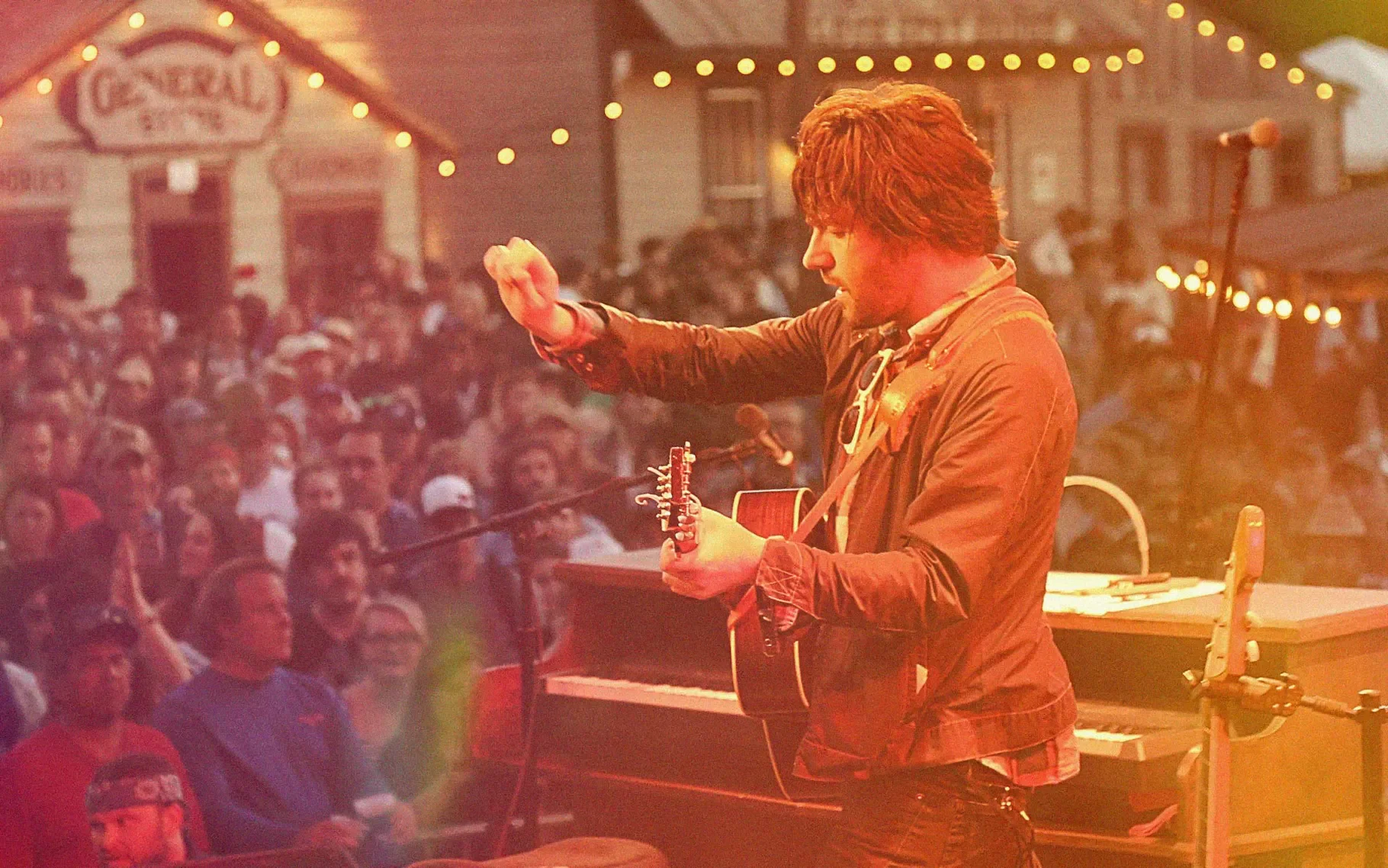
Connor Oberst performing during the Luck Reunion in 2017. (Photo by Gary Miller / Getty Images.)
When boutique bluegrass and Americana record label Sugar Hill released Crazy: The Demo Sessions, a sixteen-song compilation of Willie’s famous Pamper demos, in 2003, cool kids around the country took note. Some were musicians in bands, others just big CD and vinyl collectors. Many had likely come to Willie through their parents or older siblings, who would have passed down his old outlaw-country records from the seventies; his bigger, poppier efforts of the eighties; or his genre-ignoring explorations of the nineties. But the Sugar Hill collection was something different. Some of the tracks featured Willie in a small-group honky-tonk setting, others with just his voice and guitar, sitting at his kitchen table. You could hear his chair creaking. It was Willie at his essence.
(Read a transcript of this episode below.)
Among those cool kids was Conor Oberst. As the singer-songwriter front man of Pitchfork darling Bright Eyes, he was still a year or so away from the mainstream breakthrough of 2005’s I’m Wide Awake, It’s Morning. Just as significantly, he was the focal point and cofounder of a singular indie rock scene in Omaha. Bright Eyes recorded for a label Oberst had started with friends some ten years earlier, Saddle Creek Records. Some of those buddies had other bands on the label, like Cursive and the Faint, and a lot of them lived together and worked out of a big house, almost commune- or co-op-style—much like Willie always has. And when one of those buddies discovered Crazy: The Demo Sessions, the bunch of them spent the rest of the summer obsessed with stripped-down Willie.
This week, Oberst takes us back to that summer and, specifically, to the reasons he fell in love with the song “Undo the Right.” It was one of Willie’s earliest efforts for Pamper Music, a cowrite with Hank Cochran, the legendary songwriter who first championed Willie after he moved to Nashville. That gets Oberst musing about the craft of songwriting, how sneaking contradictory or counterintuitive ideas into songs helps them better reflect what he calls the “big mess” of real life, and how nobody writes a bridge like Willie does.
And then, given Oberst’s own early history of hawking cassette tapes of his songs around Omaha when he was just thirteen, we listen to another old Willie cut, “The Storm Has Just Begun.” It was the B-side to his first single, in 1959—and one that he wrote when he was only eleven or twelve.
One by Willie is produced by John Spong and PRX, in partnership with Texas Monthly. The PRX production team is Jocelyn Gonzales, Patrick Grant, Pedro Rafael Rosado, and project manager Edwin Ochoa. The Texas Monthly team is engineer Brian Standefer, producer Patrick Michels, and executive producer Megan Creydt, with graphic design by Emily Kimbro and Victoria Millner. And Dominic Welhouse provides invaluable research and editing help.
Transcript
John Spong (voice-over): Hey there, I’m John Spong, and this is One by Willie, a podcast in which I talk each week to one notable Willie Nelson fan about one Willie song that they really love.
This week, we wrap up season six of the show with an artist who’s one of my very favorite singer-songwriters, from the bands Bright Eyes and Monsters of Folk, indie rock, pop, and folk icon Conor Oberst, who’s gonna talk about yet another of Willie’s famous Pamper demos, “Undo the Right.” It was one of Willie’s earliest efforts for the Pamper publishing company, a cowrite with Hank Cochran, the legendary songwriter who first championed him when he moved to Nashville, and it gets Conor thinking about the craft of songwriting, about how sneaking contradictory or counterintuitive ideas into songs helps them to better reflect what he calls the “big mess” of real life—and then he talks about how nobody writes a bridge like Willie does.
Oh, and then also, given Conor’s own early history as a songwriter hawking cassettes of his songs around Omaha when he was just thirteen, about halfway through the conversation, I showed him a pdf of a songbook of original compositions that Willie created when he was just twelve. And then we listen to a record Willie cut on one of those songs, “The Storm Has Just Begun,” which was the B-side to his very first single, back in 1959. It’s a pretty cool moment.
So let’s do it.
John Spong: That’s where we start, with your song. What’s so cool about the Willie Nelson song “Undo the Right”?
Conor Oberst: Well, to me, it kind of has that universal feeling that we all have had, maybe at the end of a relationship, where you have all these good memories and you have all the bad ones, but if you could just find a way—and I’ve been on both sides of the coin here, where it’s like if you could just find a way to ruin all the good memories, then this will be a lot easier. Yeah, it’s such a simple but effective turn of phrase, I think. And yeah, I think it just speaks to how we all digest our memories and what we choose to carry with us. Sometimes it’s the good memories you don’t want to remember, because they can be the most painful sometimes.
John Spong: Yeah. It’s like if that relationship left a hole, the good memories are shining a very bright light into that hole and making you very aware of what’s not around any longer.
Conor Oberst: Yeah, exactly.
John Spong: Yeah. And you found this—I think I saw in an email, you stumbled upon this collection of old Willie songs one summer or something?
Conor Oberst: Yeah, yeah. I’m trying to remember what summer that would’ve been. At least twenty years ago. I don’t know if you know when—I don’t really know when this little compilation thing came out, but I remember my friend had it on CD, and it was one of the hottest summers in Nebraska, and he had this screened-in porch, and it was one of those, like—Nebraska’s not exactly the South, but it’s one of those Southern days from the movies. In my memory, there’s condensation on everything, and there’s some sad old fan blowing in the window. And I swear to God, we just sat on that porch for a whole summer, just smoking cigarettes and listening to this. And to me, I was like, “Oh my God.” Because growing up in the nineties, it was a mixture between folk and punk and stuff we were all doing, but a lot of the early recordings we made were just on a four-track in the house, and then making little cassette tapes and selling them locally. So to hear someone, obviously, as revered and amazing as Willie Nelson singing on what, to my ears, sounds like an old four-track recording, I don’t know, it just kinda—it really brings it home that, like, even though, you know, someone that can just seem so otherworldly in their talent and stuff, it’s like, yeah, Willie was making little four-track recordings at some point, you know? And—
John Spong: Oh, hell yeah.
Conor Oberst: —that kinda sounds the same, sounds like someone playing a song, which is, I think, obviously why his stuff is so timeless.
John Spong: Well, that’s perfect. That takes us back to the screened-in porch. Can I play the song for you?
Conor Oberst: Yeah, absolutely. Take me back.
[Willie Nelson performing “Undo the Right”]
Conor Oberst: Yeah. You can picture, right? The sweat dripping off our brows and stuff, and—
John Spong: And Willie’s, too.
Conor Oberst: Yeah.
John Spong: It sounded like a basement or something.
Conor Oberst: Yeah, exactly. Yeah, I love that song. It’s strange how his voice, and his music in general, can be so heartbreaking and really get you in your most secret little painful spot, but also is so comforting. I heard it my whole life, with my parents listening to him and stuff, and [it’s] just one of those voices, it’s like, just—yeah. I don’t know; it just makes you feel like everything’s all right for a second.
John Spong: Yeah.
Conor Oberst: Yeah.
John Spong: Well, so that—he wrote that with Hank Cochran, and I think, if I saw that the collection that you got it on, it may have been called Crazy: The Demo Sessions.
Conor Oberst: Yes, exactly.
John Spong: Yeah, I think Sugar Hill put that out. And those are the famous Pamper demos. Does that term mean anything to you?
Conor Oberst: No.
John Spong: Okay, so it’s kind of awesome, and it feeds perfectly into this song. Pamper publishing was a Nashville publishing company in the early sixties, and Ray Price was co-owner. And so Willie gets to Nashville in ’60 or so, and can’t get any work. He’s got three kids, but he’s hanging out at Tootsie’s all the time with the other songwriters, playing their song, his songs. And Hank Cochran is a big old deal. He writes for Pamper, and Hank’s got “I Fall to Pieces.” He’s the real deal.
[Hank Cochran performing “I Fall to Pieces”]
John Spong: And he loves Willie’s stuff, so he tries to get him a job at Pamper, and Pamper’s like, “Eh, I don’t think so. He’s a little weird.” And so Hank is making $50 a week. He’s about to get a raise of another $50 a week, and he tells ’em, “Let’s give my $50 to Willie. I think this guy is real.” They said, “It’s your $50, man.” And so that’s how he gets hired.
Conor Oberst: Amazing.
John Spong: So when they’re working on this song, though, Hank’s got the melody, and Willie takes him the lyrics, and the first line is, “If you can’t say you love me, say you hate me.” And Hank says, “That’s confusing. Can you be a little bit more clear about what you’re trying to say?” And Willie says, “If I try to straighten out my thoughts, they won’t make sense.” And Hank says, “Yeah, they don’t make sense now, Willie.” And Willie says, “Well, maybe that’ll make them listen to it a little closer, and a second time, and they’ll have a good time trying to figure out what’s on my mind.” And Hank said, “What’s on your mind?” He said, “I don’t know.” Hank had a lot riding on that, but Hank said, “Okay. Okay, Willie, you win.” And so they do it, and it becomes this song.
Conor Oberst: That’s amazing. Yeah, I know—what are some other Hank Cochran songs that I would know? Because “I Fall to Pieces,” I know that one, but—
John Spong: He did, was it “Make the World Go Away”? He did “The Chair” for George Strait years later.
Conor Oberst: Oh, okay. Yeah.
John Spong: “Don’t You Ever Get Tired (Of Hurting Me).” “Set ‘Em Up Joe.” “Ocean Front Property.” “I’ve got these little things”—“She’s Got You.”
[Hank Cochran performing “She’s Got You”]
Conor Oberst: Oh yeah, I know that one. Yeah, that’s cool. Yeah. Well, good on him for seeing it ahead of time.
John Spong: Well, but it’s cool because in the song, there’s these contradictions, and it’s a tension in the ideas in the song, which is what I think is the magic of Willie’s lyrics. Basically, there’s a line in the song, “Help me face the new tomorrows,” which is positive, and the way to do that is by telling me you hate me, which is counterintuitive. And you do that. I think of a line in “Lua” where you say—it’s like a doomed-hookup love song, and you’re like, “But me”—and you’re talking to the woman you’re trying to spend time with, and you say, “Me, I’m not a gamble. You can count on me to quit.” That’s just this wonderful contradiction that adds depth to the song.
[Bright Eyes performing “Lua”]
Conor Oberst: Yeah. Yeah, I think it’s also the way people think when their heart is a little beat-up or something. You have these ideas about yourself which sometimes are pretty self-defeating. It’s like not feeling worthy of all the good memories that Willie has, in this song, with this other person. It’s like, “Okay, we’re never going to get the good back, so let’s just, like, destroy everything.” There’s another one on that, like, “I’ve Just Destroyed the World (I’m Living In),” on that same compilation. So we were pretty neck-deep in that sentiment that one summer, so it’s all coming back to me now.
John Spong: Well—it’s the other song that you thought about maybe talking about—”I’d like to take this opportunity to cry” [“Opportunity to Cry”]. That’s it right there. “I’d like to take this opportunity”—that’s all positive—“to cry.” It’s just, it’s a much more interesting way of saying, “You’ve really hurt my feelings.”
Conor Oberst: Yeah. And there’s a slight bit of humor in it too, which makes it nice. Makes a spoonful-of-sugar kind of thing, so that’s good.
John Spong: Like I said, “Me, I’m not a gamble. You can count on me to quit [Correction: split]. . . . The mask I polish in the evening in the morning looks like s—.” There’s a back-and-forth that keeps me fascinated, keeps me staring.
Conor Oberst: Yeah. I think all those little details that might seem counterintuitive at first, I think does—just like you’re saying, adds to the complexity, or just the more, like, the way life really is, which is sort of a big mess of emotions and confusing thoughts. But yeah, I always think that with any great song—and what I try to do when I write songs, if I can write it down, I can get clarity for myself. Because I can relate to that, like what you were saying that Willie said. He was like, “What are you thinking?” Like, “Not much.” Sometimes these things are so—they’re just part of your personality, or they’re built into the cake of your psyche, that that’s just how it comes out. And so what maybe seemed like a natural expression or way to express yourself to the writer seems novel to the listener, and that’s what’s really cool about the way stuff’s transferred like that through art.
John Spong: And so I’ve always wondered—and tell me if this is right or wrong—if something difficult happens and you’re trying to make art out of that, you are, in a sense, exercising control over this really difficult thing that, in point of fact, you had no control over it. One way to put it is you’re trying to understand it better, but you are also actually—it’s on a page. You can move parts of it where you want them to be. You get to examine the cause and effect, or present a cause and effect. You don’t necessarily get to a fix, but in that moment, in that expression, you do—you got authorship.
Conor Oberst: Yeah. Yeah, exactly. I think whether people intentionally do it or not, when you’re telling a story—which essentially, you kinda are, in singing a song you wrote—you, whatever, the victor—I guess it’s not quite the same as the victor writes the history, but you’re the one telling the—it’s coming from your perspective. So everyone’s picking and choosing what they leave in or put out, you know what I mean? So you make yourself look a little better in your song.
John Spong: I’ve seen both you and Willie do that.
Conor Oberst: Yeah, exactly.
[Willie Nelson performing “Undo the Right”]
John Spong: So, you grew up in Omaha in the nineties. And for one thing, Willie’s not on the radio a whole lot in the nineties, you know? How do you become a Willie fan there and then? Or when does it happen?
Conor Oberst: Well, I was real lucky because I had two older brothers that were big into music, and then my parents as well. So my parents were like, I mean, definitely Willie, but, like, their wheelhouse was kinda like Jackson Browne, Joni Mitchell, Neil Young, seventies folk-rock type stuff, I guess. But Willie was just, like—he was grandfathered in. He was always part of the lexicon. So yeah, we had the “Pretty Paper” at Christmas. They definitely always loved Willie. Because really, in my house, like, country country music wasn’t really a huge part of it. There was some country-adjacent stuff, but I feel like Willie really—he was in a league of his own. It’s not even country, it’s just Willie.
John Spong: Yeah. And seriously, because it comes up sometimes: On that demo we just heard, I’m almost sure that was the famous steel player Jimmy Day, and Jimmy was part of Willie’s band forever. He ended up getting fired. There was a problem between him and the drummer. And after the drummer, Paul English, tried to shoot him, Willie said, “Jimmy, I love you with all my heart, but I got to go with Paul. But you shouldn’t have said that. You shouldn’t have said that, Jimmy.” But he replaces him with Mickey Raphael, the harmonica player, and that’s when it goes from being country music—no matter how different the songs are, that’s when it goes from being what you expect of country music to a jam—he also adds a second bass player then too, so it becomes like a jam band thing. There’s no fiddle, there’s no steel, but there’s this harmonica, and then there’s Willie’s crazy-ass guitar playing, and it becomes something new. It’s on the radio, but it’s not radio country.
Conor Oberst: Yeah. No, it’s totally, I guess, whatever the preferred term is. But yeah, that outlaw, whatever, that just—yeah. Obviously we’ve all heard the variations of the stories of just like, yeah, he was just too weird for Nashville, and they didn’t want him to sing. That’s the thing that makes me crazy. I’m like, “You hear this guy’s voice, and you’re like, ‘Oh, he’s got good songs, but someone else is going to be able to sing them better.’ ” And so it blows my mind, but I get it. It’s like whatever was expected, or milquetoast, at that point, is what they were probably going for.
John Spong: That brings up a thing. Because I’ve only, like you, only ever lived in a world with Bob Dylan and Willie Nelson in it, and so when people would—I’ve always heard people talk about Willie’s phrasing, just because that’s what you talk about. I didn’t realize that there was a real resistance to what Dylan was doing when he started because of his phrasing and the way he sang, because it was just unprecedented.
Conor Oberst: Sure.
John Spong: And so let me—have you ever heard the commercial version of “Undo the wrong / Undo the right” that Willie released on his first album, in ’61 [Correction: ’62]?
Conor Oberst: I don’t know. I don’t know.
John Spong: I don’t have to play the whole thing for you, but let me do that, because his phrasing on it . . .
[Willie Nelson performing “Undo the Right,” 1962 version]
Conor Oberst: Yeah, yeah.
John Spong: Somebody had a problem with that?
Conor Oberst: I know, it’s great. That bass player’s getting a lot of love in that mix for sure. That boh, dun, dun, dun, dun, dun, dun.
John Spong: But it had never occurred to me, as someone who is not a musician—I listen to music, and so if I dig it, I dig it—but that phrasing is this element that makes something singular.
Conor Oberst: Totally.
John Spong: Your phrasing, when I first heard you, one of the things that struck me—because I came to you as you were happening, as opposed to something that’s always been there for me—it seemed you had a very unique way of phrasing. And I’ve never listened to a lot of hip-hop, and so I may have this wrong, but it seemed to me that the way your cadence, the way you broke words up and stuff, you might’ve been somebody that grew up on hip-hop, and that’s one of the things that made you singular to my ear.
Conor Oberst: No, that’s, um, I definitely listened to a lot of hip-hop, rap growing up. But yeah, I think I agree with you. I think that phrasing really does—I don’t know, I guess you get a sense of the person’s personality more? Because anyone can kinda hit a nice note or be in pitch, but the delivery is—I think also what you’re saying about hip-hop is that’s where you get the swagger of the person.
John Spong: Yeah.
Conor Oberst: You can hear where they drop the line. And I’ve always thought people will be like, “Oh, do you write the lyrics first?” or whatever, and to me, it’s not even a contest. I always write the vocal melody first, and I write the words to the vocal melody for that very reason. Because I feel like if I just had a piece of paper with words on it and then had to make a melody around it, I feel like it would be a lot—I don’t know, it wouldn’t have that same sort of, like, I don’t know, nuance or individuality as when you’re writing to the melody, I think.
John Spong: I like the word “swagger” in there because the confidence, it’s a familiar—especially when Willie does something out of the [Great American] Songbook, like Hoagy Carmichael or George Gershwin or something. He knows those songs well enough [that] by phrasing them his way and in a way you haven’t heard before, what you are hearing is his familiarity and his comfort and his confidence in his relationship with the song.
Conor Oberst: Yeah. Yeah, that’s great. When they say an “interpreter of song,” that’s a real gift when people can do that, like Nina Simone or someone. It’s like, you can hear someone sing the phone book if they’re good enough.
[Willie Nelson performing “Undo the Right”]
John Spong: In a number of magazine articles that I’ve read about you, there are Willie mentions. There was a New York magazine story, and I think the opening line of the story is you getting up and going to the turntable and flipping Willie’s album The Sound in Your Mind from side A to side B. That’s not a Willie record everybody knows. How many Willie records do you have? How deep did the fandom get?
Conor Oberst: Well, I have a very big vinyl collection at my house in Omaha, and that’s been assembled by various roommates and wives and girlfriends and et cetera. So, big, extensive, and I’m sure there’s a lot. I’m kind of . . . my one roommate who was really good at keeping everything organized actually finally moved out of the—we got this big house-compound thing with our studio and stuff in Omaha. But anyway, I’m not exactly sure how many Willie albums I have, but quite a few.
And that one, again, it’s like the way—this demo thing. I love that about—because it’s fun; you can look something up, but when a record finds you in a weird way . . . like, there’ll just be a record sitting out in the, we call it the fun room. It’s got shag carpet and all these records, and it’s fun. So yeah, we listen to records in there, and, I don’t know, I think that it’s just nice to have a physical thing that’s just sitting there. Because if I find a record I like, I’ll play it six times in a row before I put it away. It just sits on the turntable. But yeah, I don’t know.
John Spong: You want to see something cool?
Conor Oberst: Yeah.
John Spong: Let me see if I can pull this up.
John Spong: Can you see that?
Conor Oberst: Yeah.
John Spong: And so since this is an audio medium, can you describe what you’re looking at?
Conor Oberst: Yeah, it’s a—it looks like a cassette tape, “Songs by Willie Nelson. Waco, Texas.” Is that what it says?
John Spong: Yeah, it’s scrawled on there. And it’s not a cassette tape. That’s a songbook that Willie made when he was eleven years old.
Conor Oberst: Holy s—. Okay.
John Spong: Yeah, and it’s great. One of my favorite things is, you’re right, it says, “Waco, Texas,” in script that he made to look like a lariat, a Western rope—and that’s because he’s from Abbott, and I think Waco, Texas, would make him seem more cosmopolitan.
Conor Oberst: Right.
John Spong: But so, this is fifteen songs that Willie wrote when he was eleven and twelve years old.
Conor Oberst: That’s amazing.
John Spong: It’s in an archive, a library down in San Marcos at the Texas State University. And so—
Conor Oberst: That’s so cool.
John Spong: Yeah.
Conor Oberst: “The Moon Was Your Helper.”
John Spong: Yeah, that’s one—there’s a couple that I wanted to show you, because it’s—“Only True Love Lingers On,” “You Still Belong to Me” . . . “Faded Love and Wasted Dreams” is one; “I know I’ll never forget that day we parted. I knew our love was just a memory. Your eyes showed that you were glad that it was over. Mine showed only pain and misery.” I’ll point out too, so, this would’ve been like 1944. That’s six years before the song “Faded Love” came out, so I don’t think anybody robbed—Bob Wills didn’t steal that idea from Willie, but that’s how good he was at this at twelve. And then one other one, “The Storm Has Just Begun.”
Conor Oberst: Damn. “Each night, the clouds . . .”
John Spong: Yeah. “They take away the moon, and each day, the same clouds take away the sun.”
Conor Oberst: “If I was smart, I’d realize my heart was just a toy you have used to have fun.” Wow, okay.
John Spong: And so—and so with it, the other thing that’s really cool with that, that song right there that he wrote when he was twelve, actually became the flip on his first single, ten to fifteen years later.
Conor Oberst: Oh, nice.
[Willie Nelson performing “The Storm Has Just Begun”]
Conor Oberst: That’s beautiful.
John Spong: Well, and he’s just a punk kid?
Conor Oberst: Yeah.
John Spong: And I guess it should have occurred to you why I would show you that. You put out your first cassette at thirteen, started a record label at fourteen.
Conor Oberst: Yeah, that was the deal. And like I was saying, at first it was just the TASCAM four-track and making it, and then making our own cassette tapes, going to Kinko’s and making the covers, and selling them for three bucks at the local shows or the local record store. So yeah, we were going—I mean, where we’re from, there wasn’t a lot of people really interested in championing the arts or the music, so we sort of learned to just do it ourselves out of necessity.
John Spong: And Willie was from a world like that too, although he had to work in cotton fields and s— like that, which y’all didn’t. But lots of kids have dreams like that, and lots of kids make notebooks and journals, and “precocious” is the word that gets used—until eighty years later, they’ve released 153 albums, like Willie, or thirty years later, and you’ve done what you’ve done. How do you summon the nerve and the wherewithal to actually do it? Or is it just what you do?
Conor Oberst: I mean, I think we were kind of—myself and my friends who all had bands and started a label, we were just lucky because in some ways we were just, sort of, not like happy idiots, but we didn’t really, like, we didn’t really plan much past, like, “Okay, we got to get these tapes or these seven-inches ready for this show that’s coming up.” Everything was just in really small increments, as far as what we celebrated. It was like, “Okay, first time going to South by Southwest, and first time going to Europe.” Or, I don’t know, every little mile marker we passed, I feel like we celebrated it as if it was, like, going to be the biggest thing that ever happened, you know? And so it was like, “Oh, then we get to play on Letterman,” or, you know, it was just—every little thing was such, seemed like such a big deal, that we’re kind of the opposite of, like, overnight success, you know? It’s like we had a lot of time to think about it and be ready for stuff. So, that—in that sense, we had—and we had a big support group of friends in other bands, and our bigger crew that helped put out the records and stuff.
John Spong: But it’s cool because, like, you were talking about the house just now. When I did a Spoon story once, I interviewed you, and it was a Wednesday night, we’re on the phone, it’s nine o’clock, and one of the things we were talking about was, well, Saddle Creek, and the indie model, and how it was different or whatever, and I was trying to get a sense of how many records you and your friends had sold, to get an idea of what the scale was and how it was changing, because y’all were making it work without millions having been sold. And I think I asked you about Cursive and the Faint and Rilo Kiley, and you were like, “Well, I can get you those numbers.” And I was like, “Cool. Well, if you just want to call back during the week, or I can get it from your publicist or whatever?” And you were like, “Oh, no, no, no.” I think it was Nate [Walcott] or Rob or somebody, and you went, “Oh no, we all live together. He does the math for Saddle Creek. . . . Hey, Nate! How many records sold?,” and y’all had it. Those are your guys. And so even now, y’all are still working together, all these people. That’s legit. And it’s a Willie thing. The reason I hammer it—(a) because I admire it. But (b) like, so, with Willie, his bass player through the sixties is this guy, David Zettner. Zettner gets drafted to Vietnam in ’68, and when he comes back, there’s no—he’s been replaced on bass by the guy—he said, “Get Bee to do it instead.” And Bee Spears is the bass player for the next forty years. [Zettner’s] a visual artist too. He becomes the resident artist—and Willie doesn’t have any money back then—he becomes the resident artist in Willie World, and he ends up painting the murals on all the buses for the rest of his life.
Conor Oberst: Yeah.
John Spong: There’s a dude, Bucky Meadows, who’s the other guitar player besides Willie and Jody Payne on Red Headed Stranger. Great jazz guitar player. He works for Willie the rest of his life, but he’s not on a whole bunch more records. His job later was—I think, if I heard right, he would be the guy that locked up the studio at Willie’s place at the end of the day, after sessions. But what I had heard from people in Willie World was, the real key to those two dudes is when Willie came in off the road, he’d be tired. And the first couple of days, he’d sit around and do nothing. But on day three, he gets bored and he wants to pick. Bucky and Zettner are on the payroll so that when Willie needs somebody to play with in the saloon or his office, they can come. That’s the world he created, and that’s the world you’ve created, kinda.
Conor Oberst: Yeah. Yeah, yeah. No, I think that so much of it, of business—like, don’t mix business and pleasure, that’s completely not true for me. Everything has been friendship-based, and between the studio and the label, and it really is like a co-op- or a commune-type mentality, where it’s like, people are good at different things. And so some of our friends were always good at artwork, and other people were good at more business stuff. And then the ones of us that were songwriters, it’s just like, everyone had a common interest and a common goal, which was to try to get this music out into the world and be able to tour and make enough money to not have a shitty job.
Those were basically our goals at first. And everyone pitched in, and it really was a kind of utopian situation for a while, but as everything, it kinda, like, money and time and blah, blah, blah. So it changed eventually, but we had a good run there. And I think that it’s still pretty amazing that it worked out the way it did, I guess, still. So, like, we’re going to go on tour with Cursive next month, and it’s like us and those guys literally, since, like you’re saying, since I was like, no joke, thirteen years old, been playing with those same people. So, it’s cool.
John Spong: Yeah, yeah. I don’t know, it’s a cool thing for me to have learned from you and from Willie. It’s just a great example.
[Willie Nelson performing “Undo the Right”]
John Spong: This is a goofy pat question. Is it safe to—has Willie been an influence on you? Is the songwriting, you listen to the songs? Do you teach yourself to play them? Do you study him when you’re listening to ’em?
Conor Oberst: I don’t know if I would study him in that sense. Willie has that secret jazz component, where there’s these chords that I couldn’t figure out. But someone in my band probably could. I could ask. I could farm it out. But yeah, the other thing that me and another friend of mine joke, he’s a big-time Willie connoisseur, but we always talk about how in songs, bridges are really—there’s just the pointless bridge. There’s the classic example of, you can tell someone, “Put a bridge in the song just to say they did,” and then it would make the song complete.
And that’s why some bridges are just so weird and just don’t make a whole lot of sense. But Willie’s bridges are always amazing, and I think that is that, whatever, that jazz part of it, or something. But yeah, I’m always like, “Damn, Willie, another great bridge.” Because so many of them are just—I guess I do study that part of it a little bit, because I’m like, it’s hard to get a nice bridge that doesn’t seem way out of left field musically, like, why are they doing this? But he’s got it going on with that.
John Spong: When you mentioned the jazz stuff, it’s occurred to me with this idea that, yeah, to find his influence is tough, because there’s not—nobody can do what he does. If only the phrasing, the voice, you’re just not going to. But where the impact is seen to me, by me, is inspiration. Because it’s like the stuff you were talking about earlier, the insistence on—the perseverance, the independence. That’s the kind of thing that, when you put one of those records on and realize what he went through, and how he insisted on doing whatever’s on that record, that makes a difference.
Conor Oberst: Yeah. And I’m just blown away that really, he—because when would you say his, not songwriting career, his performing career took off, and how old was he? He was in his forties or something?
John Spong: Yeah, yeah.
Conor Oberst: Yeah.
John Spong: Red Headed Stranger is when it took off, and he was 42.
Conor Oberst: That’s great.
John Spong: Yeah. He did—
Conor Oberst: It makes me feel better.
John Spong: Well, and Across the Borderline came out in ’93. That was a comeback record, and he was sixty [Correction: 59]. That was renewed life. It’s inspiring in a bunch of ways. Sometimes he ends up listening to these.
Conor Oberst: Mm-hmm.
John Spong: You said earlier that you haven’t met him, but, anything you’d like to say to Willie?
Conor Oberst: Well, Willie, I’d like to say thank you, my friend, for everything. I did go—I did play at the Luck Reunion once, and that was real fun. I saw them all play. But yeah, Willie, you know where to find me. Call me up anytime. We’ll go hang out. But no, sincerely, if you do hear this, thank you, brother, for everything. Mwah. Mad love.
[Willie Nelson performing “Undo the Right”]
John Spong (voice-over): All right, Willie fans. That was Conor Oberst, talking about “Undo the Right.” A huge thanks to him for coming on the show, and a big thanks to you for tuning in. If you dig the show, please subscribe, maybe tell a couple friends, and visit our page wherever you get your podcasts and give us some stars or type in some comments. Every little bit of that helps more than you know.
Oh and as I mentioned at the top of the show, that’s a wrap on season six. But we are already recording episodes for season seven, which should get going again early this summer.
Please follow us on Instagram at @onebywillie—all one word—find us on Bluesky, and join our ever-expanding Willie conversation at the One by Willie group on Facebook.
I’m your host, John Spong. Thanks for listening.