
Jamey Johnson on Willie Nelson and What It Really Means to Be an Outlaw
The million-selling country star goes deep on songwriting and poker, faith and forgiveness--and Willie’s “It Always Will Be.”
By John Spong
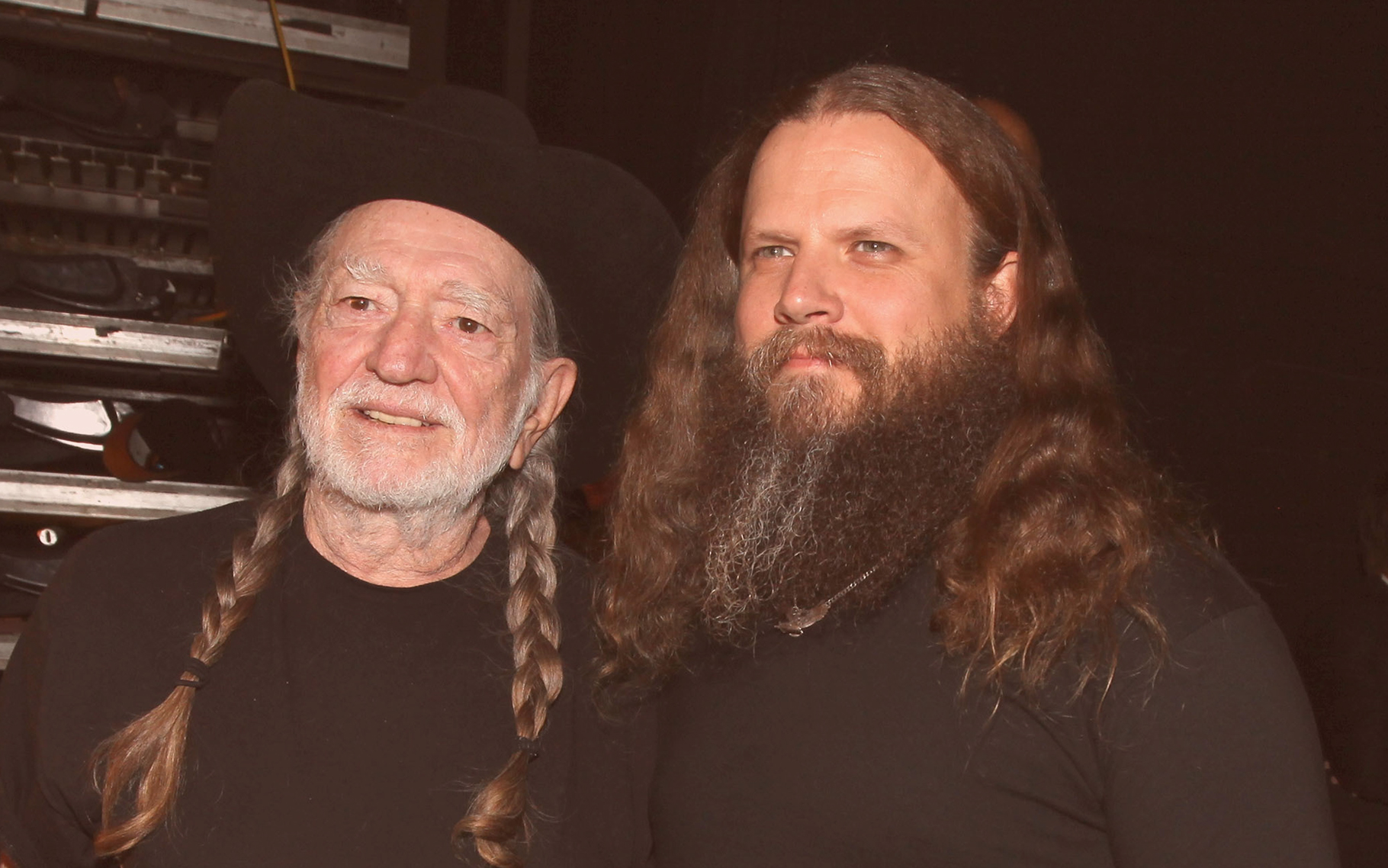
Willie Nelson and Jamey Johnson at the CMT Music Awards in Nashville, 2012. (Photo by Christopher Polk / Getty Images.)
“It Always Will Be,” off Willie Nelson’s 2004 album of the same name, is not a song that casual country fans would likely identify as “Outlaw.” For one thing, it’s a simple, hymn-like ballad of devotion. What’s more, it was produced in Nashville by hitmaker James Stroud, who’d been instrumental in the careers of mainstream stars like Clint Black and Tim McGraw, and it featured a lineup of polished, A-list session players like pedal-steel player Paul Franklin, pianist Matt Rollings, and drummer Eddie Bayers. If your definition of Outlaw requires a hell-bent, rock and roll attitude, with a middle finger pointed squarely at Music Row, you’ll not find it in “It Always Will Be.”
Which makes it all the more perfect as the song Jamey Johnson chose to focus on in this week’s episode of One by Willie. Jamey’s one of the finest country singer-songwriters alive, a two-time winner of the CMA’s Song of the Year award, first as co-writer of George Strait’s #1 single “Give It Away,” in 2007, and then two years later as co-writer of his own top ten hit, “In Color.” He’s also an artist unwilling to play by anyone’s rules but his own and generally considered the walking embodiment of Outlaw Country. When he describes what that term—and this wonderful song—mean to him, it all starts to make sense.
From there Jamey roams far and wide in thinking about his long friendship with Willie, describing poker, domino, and chess games; big figures from Willie’s life, like his longtime stage manager Poodie Locke and legendary songwriter Hank Cochran; the way Willie helped him get sober; and what Willie means to him, both as a friend and as an example of how to live your life.
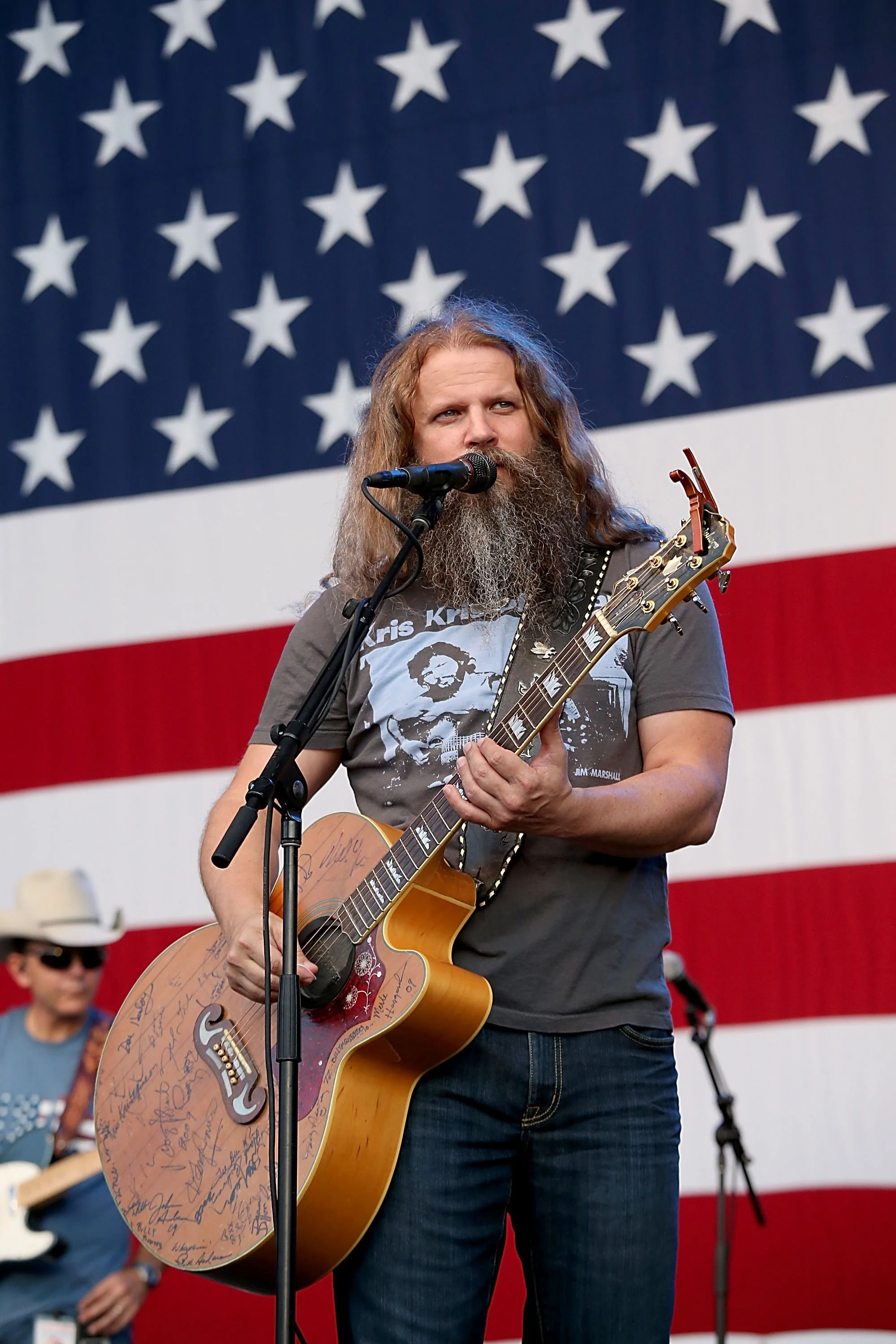
Jamey at Willie’s 4th of July Picnic in Austin, 2016. (Photo by Gary Miller / Getty Images.)
One by Willie is produced by John Spong and PRX, in partnership with Texas Monthly. The PRX production team is Jocelyn Gonzales, Patrick Grant, Pedro Rafael Rosado, and project manager Edwin Ochoa, with graphic design by Joanna Holden and Modular, ink. The Texas Monthly team is engineer Brian Standefer, and executive producers Megan Creydt and Melissa Reese. And Dominic Welhouse provides invaluable research and editing help.
Transcript
John Spong (voiceover)
Hey there, I’m John Spong, and this is One by Willie, a podcast in which I talk each week to one notable Willie Nelson fan about one Willie song that they really love.
This week, we talk to Jamey Johnson, one of the finest singer-songwriters alive, and a man generally regarded as the modern-day embodiment of Outlaw country, about the title cut to Willie’s 2004 album It Always Will Be. The song’s a simple, heart-felt ballad, and maybe not the first thing you’d think of when you hear the term “outlaw country,” but that will all change when you hear Jamey’s explanation of what that term—and what that wonderful song—mean to him.
From there Jamey ranges far and wide in thinking about his long friendship with Willie, describing poker, domino, and chess games; big figures from Willie’s life, like his longtime stage manager Poodie Locke and legendary songwriter Hank Cochran; and what Willie means to him both as a friend…and as an example of how to live your life.
It’s a truly special conversation…and I think you’re going to dig it.
So let’s do it.
[Willie Nelson performs “It Always Will Be”]
John Spong: Then the place to start…the song you've chosen is “It Always Will Be.” What do you love so much about “It Always Will Be?”
Jamey Johnson: It's a very simple melody. It's not a very complicated structure–which somehow feeds me better, to kinda dumb it down a little for me. Most of the time I'm listening to Willie like a jazz guitarist, and I'm sitting here trying to grab all 13,000 chords. This song, it really hit me when he and I started spending time together, playing poker or golf or that sort of thing.
I remember the words of it just sinking into me one time, and it was right where I was in life. And I couldn't believe that somebody else had been almost in the same place, in the same spot, and had written this beautiful song. So, there's not much context in the chorus, the chorus is all the same. But it's almost like every time he says it, there's a reassurance. “And it always will be.”
John Spong: Yeah.
Jamey Johnson: He just keeps singing it, and finally it sinks in. “It always will be.” It's always going to be like this. “Sometimes I think that love is somewhere living on an island, all alone. I can see it in the darkness, and I can feel it in the distance, and then it's gone. And then I know that it is time for me to go and find my favorite girl. Because when I look into her eyes, I see all the love there is in all the world.”
I think at the time, for me, my favorite girl was my daughter. And it sank into me in a way that that song could have probably never reached me before. Because I wouldn't have been open to those kinds of feelings. But being a girl-dad and hearing him say, "It's time to go and find my favorite girl”...that was…you know dads; we have so many nicknames for our kids. Well, I only had the one kid, and so she got all the nicknames. The fact was she was my only girl. She was my only kid. Which naturally made her my favorite.
John Spong: Yeah.
Jamey Johnson: So that's what I would always say to her. “You're my favorite ever. You're my favorite in the whole world. All the little girls in the world, you're number one.” And so listening to that line again as an adult, and him saying, "It is time for me to go and find my favorite girl”...that's where I gravitated to. And I think, I think that the line, "It always will be," was something that I took at the time to be a gradual, like I said, a reassurance. “It's okay.”
I was just missing her. And I wasn't worried that she wasn't going to love me, but I was worried that too much time apart isn't good. And it wasn't. It's still not today. It's still too much.
John Spong: My little boys are 9 and 11, and always somewhere inside me is an awareness that I'm not going to get as much time with them as I wanted.
Jamey Johnson: Yeah. That's hard.
John Spong: Yeah. But we get the moments. And honestly, we've done so many of these…that is the most wonderful way to set up listening to the song together. Can I play it for you now?
Jamey Johnson: Sure.
John Spong: Can you hear it?
Jamey Johnson: Yeah.
[Willie Nelson performs “It Always Will Be”]
John Spong: So one of the things that's so great...a great Willie song, anybody's great song, it'll mean something...it'll mean whatever the writer meant, but it'll mean something different to the listeners. And so for you, the “favorite girl” is your daughter. And when I hear it, I think about Willie and Annie, his wife. And there's a couple of places where there's lines in here that really, really hit me when I think of it that way. One, when he says, "There are some things I think about and every time I do it breaks my heart”...in the context of how much he leans on Annie, I mean, we know what those things are in Willie's life, losing a kid. There’s things that, as Willie said, "You don't get over them, you get through them."
So that is really powerful to me. But then there's this other thing, and it's in the construction of the song, in a way. There's this corollary between the end of the second verse and the fourth verse–and I know how important your faith is to you–when Willie sings at the end of that second verse, "And then I see your face, and when I look into your eyes, I see all the love there is in all the world." But then, in the next time he gets there, he sings "I see all the love there is inside of me." And he's equating those two things. And at the risk of overthinking it, you know, all the love in the world actually lives inside of him, also. It’s that idea: God is love, love is infinite, and it's kinda the mystery of faith. It's everywhere, but also all of it is in here…like you said, it's a real simple song. I don't know that anybody wants to spend that much time thinking about it, but that's a pretty profound thought. All the love in the world lives inside of me, and I feel it when I see you.
Jamey Johnson: Yeah, that's powerful. That's a stout emotion.
John Spong: Yeah, but then it's Willie. And so like you said, in the chorus, there's nothing remotely flowery or mushy or even overtly romantic. “It always will be.” It's an immutable truth: My love for you.
Jamey Johnson: That was a superpower, I think that Willie and Merle, certainly Hank Cochran, Harlan Howard…that's why they're the legends in our business. They made a practice out of taking the most complex of human emotions and putting them in the simplest of terms, so that everybody can appreciate it alike. It was important to me not to ask Willie, "Who's your favorite girl?" Or to bother him with mine.
I remember when I had the conversation with him about this song. For whatever reason, I got emotional. And he just reached over and put his arm around me like, "It's okay, pal." He's like, "You'll be fine. You'll be fine."
[Willie Nelson performs “It Always Will Be”]
John Spong: One thing, also, that's interesting about the song, I was so thrilled when you picked it because however one would describe this song stylistically, a word they probably would not use is one that gets thrown [around] a lot when people are talking about Willie and talking about you. And that's outlaw. I don't think anybody's going to say, "Oh, that's outlaw country, right there." What do they even mean when they say “outlaw?” I have a complicated relationship with that term myself, but nobody calls me that. They call you that. Where am I headed? What are you thinking?
Jamey Johnson: Well, I know what they mean. They're talking about a style of music. They're talking about a sound. They're not talking about a lifestyle. Even Waylon had to ask the question, "Don't you think this outlaw bit’s done got out of hand?"
John Spong: Right.
Jamey Johnson: We're not that. And if you want to describe me in some way, “outlaw” is just as acceptable as anything else because you're just talking about the music, you're not talking about a lifestyle.
John Spong: Right.
Jamey Johnson: I'm no more outlaw than Willie or George Strait, Randy Travis or Alan Jackson, for that matter. Now were those guys outlaw? Yeah, if you ask me. As far as a mindset, you didn't go around shoving ‘em into a corner. They did what they wanted to do. So did Don Williams. Was he outlaw?
John Spong: Don Williams, yeah.
Jamey Johnson: There were some, a few songs that Waylon did that Don Williams also did…
[Don Williams performs “Amanda”]
Jamey Johnson: …does that make him an outlaw? Or is he just still the Gentle Giant? I don't take any offense to it at all, but I certainly don't put it on like it's a badge of honor and go beat my outlaw chest out there for the world to see. You get to taking that too, too heavy on the chin, it’s gonna…eventually it's going to be the only way everybody else sees you.
John Spong: I love that because I think that is the truth of it. I think too (many), maybe it's because I live so close to the University of Texas campus and all the frat houses, but I think a lotta like, maybe…or maybe just when I was a younger guy myself, I thought outlaw was some kinda lifestyle thing, and it was all about sex and drugs and rock and roll and shooting the finger at somebody. But it’s about…at its bottom, it's about creative control, and being true, and creating music that sounds like what you are hearing inside, and what you want to, and it’s integrity. And that's what you just described in a way (that) some of the conventional wisdom, I think, is different.
Jamey Johnson: I think when you first think about just the term “outlaw,” if somebody wasn't talking about music, the first thought in your head might be somebody like Jesse James.
John Spong: Right.
Jamey Johnson : And so if you're a child, which is...this is one of my favorite Willie quotes, he said, "There's nothing a child hates more than a good example." So, I wrote that on the wall at the studio, just to be sure I never forgot that. “There's nothing a child hates worse than a good example.” But if you're a kid, your outlaws, your favorite thing about them is that they're not afraid. They'll do whatever they want to do, and they'll get away with it until they die. They're not trying to be anything, they just are the hell out of something [that] they already are.
John Spong: Oh, man.
Jamey Johnson: That's what I think of when I think of my outlaw musicians. Those are the traits about them that make them so alluring. For that reason, Johnny Cash is an outlaw. So is George Jones. Kris Kristofferson, obviously. And there's been women out there who are more outlaw than most of these men, that were pictured up as some good girls.
John Spon: I feel like it's been a while since anybody told Dolly Parton what to do.
Jamey Johnson: Me too. I think Dolly, Dolly is accustomed to doing things her way, exactly how she sees fit and when. And same could be said for Loretta Lynn, Patsy Cline, Reba.
John Spong: Uh-huh.
Jamey Johnson (00:24:29):
I mean, there's some tough gals in this business. It makes me more proud to be a part of it. I mean, you follow that all the way down to Carrie Underwood. Ella Langley now. Lainey Wilson? Megan Moroney? We got a lot of outlaw girls in country music these days.
John Spong : A lot of examples to ignore until we wise up. Until we grow up and wise up.
Jamey Johnson: Yeah.
[Willie Nelson performs “It Always Will Be”]
John Spong: Take me back in time. How did you become a Willie fan? When's that start? Well before the friendship.
Jamey Johnson: I don't know. I think he was just such a big celebrity in my youth.
John Spong: That's the '80s?
Jamey Johnson: Yeah. I was born in '75.
John Spong: Okay
Jamey Johnson: And so, Willie was there. I mean, in a massive way. I would've heard him on the radio…just every day, we would've heard some Willie song.
John Spong: Yeah.
Jamey Johnson: And so I think it was just natural. He was the song that was always stuck in my head in elementary school, whether it was “Whiskey River” or “To All the Girls I've Loved Before.” Some massive hits. “Crazy.”
John Spong: Mm-hmm.
Jamey Johnson: When I became a musician, when I was trying to become a musician, it was…a lot of times it was his songs that I would put on and see if I could learn some version of it or at least follow this guitar pattern around. Try to, anyway.
John Spong: Yeah.
John Spong: Since you know Willie through different eras, do you see a way that his songwriting has evolved? From '60s to '70s to '80s and beyond?
Jamey Johnson: Not his songwriting, just the musical preference of the day and age. In other words, “Crazy” was released to a different audience than something he would put out today, which–like you hit on a while ago–that song, “You don't get over it, you just get through it,” I was sitting on the bus with him one day when he told a woman that exact piece of advice. I think Buddy Cannon was there too, because we both remember that moment. It was something that I...I didn't jot it down like, "Hey, I need to write that." I jotted it down like, "Hey, I need to remember that."
John Spong: That's awesome. Because Buddy on the other hand, jotted it down and two years later was like, "Oh, I know what to do with that now."
Jamey Johnson: Well, but that, that's the Buddy that's also a songwriter, at the same time as being Willie's producer.
Jamey Johnson: But being a good producer means you're always looking for good songs, both externally and internally. I love the fact that Buddy captured that same moment, turned around, and him and Willie got together and wrote that song. This might be Two by Willie today.
John Spong: I read a book recently, and I really dug it. I've got it on my desk somewhere. It's maybe the first biography of Willie, big one, that came out in '82. It was by a woman named Lola Scobey. And so she writes it…she probably started it in '79 or '80, and the myth isn't set in stone yet. So it's fun to read for that reason. Well, the memories are fresher for the people she's talking to, but also there's no conventional wisdom yet to tell her what the story is. And so she's getting to write it.
And one of the things that she said that I had never heard about before, she talked about how she really felt Willie's writing changed after he quit drinking so much in the early '70s. And talked about...because there's such a darkness–the songs are fun; there's a joy in the songs, there's joy just in his writing–but I mean, the songs: “Darkness On The Face Of The Earth,” “Just Destroyed the World I'm Living In.” “Home Where Nobody Lives.” “Permanently Lonely.” I mean, there's darkness.
Going forward, the songs are still plenty sad, but they're a little more ruminative, it seems. I'm overgeneralizing, but they're a little more ruminative. There will be a little light in the corner of the frame. And so you've got “Angel Flying Too Close To the Ground.” And you've got, “Why Do I Have to Choose?” You've got, “Forgiving You Was Easy (But Forgetting Seems to Take the Longest Time).” There seems to be kind of a pivot, and-
Jamey Johnson: At least he's on the topic of forgiveness. And I think that's the point when a little light does start to shine in on you, you recognize that forgiveness is something that, in order to receive, you have to give. In order for you to eat at the table, they're going to start passing dishes around, and if you keep passing it that way, you're going to keep receiving it from that way. And forgiveness is one of those dishes.
And I think for Willie, maybe he was getting into that part of his life where he was starting to forgive himself a little bit and give himself a little bit of grace. Maybe that's why the songs of destruction and darkness and all that kinda have a glimmer of hope, you know? In songs like “Permanently Lonely”–which I'm not so sure he wasn't talking about himself.
John Spong: Oh, wow.
Jamey Johnson: And I think it was probably something he intended as an observation, but also as a prediction. If you keep doing what you're doing, this is going to be you. I think every man reaches a point in his life where he has to grab himself and say, "Hey, we're getting out of this. We've been in this darkness and this despair for long enough, and it's time we forgive ourselves and stand up and go do something else good."
[Willie Nelson performs “It Always Will Be”]
John Spong:
How'd you become friends with him, how'd you end up meeting him?
Jamey Johnson: The first time I met Willie, it was 1997, and it would've been in Auburn, Alabama. He had come to town to put on a concert. After the concert, there was a big line of people out by his bus, and I heard one of them in the line say he was going to be coming out and signing things. So I ran to the truck and got my guitar. And I was standing there with Old Maple in my hand. And sure enough, he got off the bus, stepped outside, stood there for what seemed like an eternity. And he would talk and visit and shake hands and take pictures. And he signed Old Maple, but he signed it up on the top of the guitar.
John Spong: Mm-hmm. On the ridge. Not the face, but the top.
Jamey Johnson: Yeah.
John Spong: Yeah.
Jamey Johnson: Yeah. As I'm looking down playing it. [Because] that's where I wanted it. I wanted it there so I could see it. And the years' worth of putting that guitar in and out of the case rubbed off every bit of that autograph.
John Spong: Well, maybe some sweat from your forearm at a show or two.
Jamey Johnson: Yeah. And so the next time I was...the next time I met him, it was 2008, at Farm Aid that year, that September. I had some songs that were just starting to take off, and I had written some songs that were already big hits. I also was…had become friends with Willie's “Vibe Coordinator,” as it said, on his business card. Poodie Locke.
John Spong: Uh-huh.
Jamey Johnson: I came across Poodie over at Exit/In in Nashville. We were both there to see the same show that night. And all I knew was everybody said, "That guy works with Willie." And I remembered him because I had seen him before down in Auburn. I knew he was on tour with him. I saw him, but I didn't meet him, in Auburn. I just saw him. I walked up, and I might've told him a joke or two. But Poodie, right off the bat, it was like we were old friends. It wasn’t long after that, anytime he came to Nashville, he'd holler at me, we'd go get a drink. We connected in that way.
John Spong: What was he like? And forgive me for interrupting, but he had Poodie's Lounge or Poodie's Bar or whatever over the hill from Willie's place, and I used to go there and see Johnny Bush play and Dale Watson play and Shaver, Billy Joe would play, but I never met Poodie himself. He's just this kinda larger than life...I mean, he's named Poodie.
Jamey Johnson: Poodie's real gig, I think, wasn't just to set the tone for the show, because he did that every day. Everybody in that group woke up to Poodie and his mood, his enjoyment of life. And everything about him just set the tone for the day. But he also handled friends and family, the 1,500 people a night that get backstage passes. He would never be able to do that today.
John Spong: Right.
Jamey Johnson: But back when he could, Willie was a champion. An absolute champion. To spend that kinda time…that's exactly what made me start doing that. I'm an introvert, and I don't look for a lot of visiting. But after seeing how Willie did that every night, it made me do that. And I did it for over a decade. Every show we would do ended with me standing outside the bus signing autographs and taking pictures and getting to know people, and really feeling the love from them. And hearing, over and over, the impact that these songs have on them.
John Spong: So then you see Willie at Farm Aid in 2008.
Jamey Johnson: Well, Poodie walked me around the corner and said, "Hey, you want to see the boss man?" I said, "Sure." And he just opened up his door. He said, "Go on in." I walked in there, and it's Willie Nelson sitting at his table, on his bus. I walked up and introduced myself. I said, "I didn't just open the door and come in."
John Spong: “I promise!”
Jamey Johnson: Yeah. “Poodie got the door.” We sat, we talked a little while. I had my guitar with me because I'd just come off the stage. And so since I had it with me, I handed it to him, and he signed my guitar. And he also took a picture with me and my daughter, Kylee.
John Spong: That's awesome.
Jamey Johnson: And ever since then, we've been good friends.
[Willie Nelson performs “It Always Will Be”]
Jamey Johnson: He's also the reason I started golfing. He invited me to play the first annual Willie Nelson July 4th Tournament at his golf course, which as far as I can tell, turned out to be the only one. That was in July 2012. I think by September I had already gone to Montgomery and bought a golf course–bought into one, anyway. Golf ain't even really the worst habit I got from Willie, if I'm being fair. He either took great pity on me or he really liked me being around, especially since I would lose so often in poker. I learned to consider that as a...that's a rent payment or something that I'm paying on his property.
John Spong: I was going to say, what are the poker games like? And so are you playing just in Luck or are you playing in Maui too? Where all do you play poker with Willie?
Jamey Johnson: Well, I started playing poker with him in Luck in 2008. That didn't switch over to golf until 2012. He also taught me how to play dominoes.
John Spong: Okay.
Jamey Johnson: I had never played dominoes before. And after him going over the rules and some of the strategies and teaching me some little tips here and there, I've gotten to be a pretty good dominoes player.
John Spong: And are y'all playing just straight fives and tens? Or is it like Moon or 42?
Jamey Johnson: I'm sure he knows all them other games, but to me it was fives. And it was like the first one to 250. We would also play chess. If he got to where I was beating him in poker, pool, and every now and then dominoes, if I got lucky, he would always find a way to clean up on chess. He was a deceptive chess player. He was one of those that have one hand over here…it seemed like his focus was on the right side of the board–and he turns around and mates you from the left, and you never saw it coming. It wasn't deceptive.,I don't know that he intended it…but he probably did. He's a very, very smart, gifted chess player.
John Spong: Well, if you learn to play with Ray Charles, you get good at it.
Jamey Johnson: Yeah. He said Ray used to make him play in the dark.
John Spong: But at the poker table...and I don't need to pry, but I wonder who all you've played with. I talked to McConaughey once about this, and he was describing a poker game for me, and he said it becomes his turn to call the game. It's his hand. And he called Mexican Sweat. Do you play Mexican Sweat?
Jamey Johnson: I ain't heard all these card game titles in so long…no, I don't. I have left the poker table.
John Spong: I am no kind of poker player. Mexican Sweat, it's a game...it's nerves, but it's also luck. It's not strategy. And so McConaughey said he called Mexican Sweat. They go around the table, it's his turn to call again. He calls Mexican Sweat a second time. And he said the look Willie gave him, let him know he would not be calling for Mexican Sweat a third time.
Jamey Johnson: Yeah. That wasn't a look, that was an instruction.
John Spong: In fact, in fact, in fact. But who's at those games? What's that like?
Jamey Johnson: Oh, you learn ‘em as you go. That's all I can tell you. You sit at that table long enough, you hear about a thousand different games get called. And what I have learned is if you don't understand the game, don't ante up.
John Spong: That's a fair lesson in life.
Jamey Johnson: Yeah. If you don't understand the rules of the game, there's no way you're going to get lucky and win. Stay out of it.
John Spong: Annie mentioned to me that there was a bus accident following a game once?
Jamey Johnson: It wasn't my fault.
John Spong: She didn't tell me any more than that. I made no assumptions.
Jamey Johnson: Yeah, well, I wasn't even there. I don't know anything about that.
John Spong: All right.
Jamey Johnson: Unless I'm being implicated, in which case I better call an attorney, I guess. Babe?
Brittney Eakens: What?
Jamey Johnson: Might need some legal advice.
Brittney Eakens: Oh, what now?
Jamey Johnson: I'm still on the podcast. We were kidding. I told him I might need to call my attorney.
John Spong: Well, then it sounds like...I am assuming then, that's not a story for public consumption.
Jamey Johnson: I don't know. I don't know anything about an accident that was caused after a card game.
John Spong: Well, was there ever a tremendous loss of money in one? Could that have played in?
Jamey Johnson: Yeah, that might be the terrible accident she's referring to. Ah. No, she's right. So, not only did I get punished at the table one night, but I was trying to get through the gate and the gate rammed the side of my bus on the way out. I think that's what Annie's talking about. I had to get the paint and body guys to fix up this big gash that was cut down in the paint. It was like the gate was trying to kick my ass on the way out. Insult to injury.
[Willie Nelson performs “It Always Will Be”]
John Spong: You've talked about your friendships with Haggard and Hank and Willie, and Haggard and Cochran were such important friends and people in Willie's life. And I wonder, have you learned anything about them from each other? Or about that generation of artists?
Jamey Johnson: Well, I learned that all three of them considered Hank Cochran the greatest songwriter. That was one thing Hank, Merle, and Willie, all three agreed on. Yeah, man. You learn all kind of stuff from each of them, about each of them, from the others.
John Spong : Did Hank talk about what he admired about Willie's songwriting? Because without Hank…Willie would've happened anyhow, but Hank was pivotal in the way it happened.
Jamey Johnson: Well, so-
John Spong: Oh and who was Hank Cochran? Just for anybody who's listening who's not paid enough attention, how would you tell somebody who Hank Cochran was?
Jamey Johnson: Well, I'd start with “Make the World Go Away.”
[Eddy Arnold performs “Make the World Go Away”]
Jamey Johnson: Too many great songs to mention. I can tell you about one right off the bat. While you were talking about Hank's appreciation of Willie's songwriting. Hank loved his songwriting so much, he would borrow chord progressions and phrases and all kinds of stuff from Willie's songwriting. One case in particular happened on Hank's boat down in The Bahamas, him and Dean Dillon. And they were writing this song called “The Chair.”
John Spong: Uh-huh. I've heard of that.
Jamey Johnson: And when they get to that critical part in the chorus, Hank just reaches over and grabs about four bars from “Crazy” and plugs them in right there. And they end up writing one classic country song that's in a lot of ways based on another. That was one of Hank's favorite things to say. He would grab a guitar and say, "Let's go write some new words to these old melodies."
John Spong: Dean Dillon told me that story once, and he said...and I was trying to follow, because I'm not a musician, but I know both of the songs really well. And he said, "No, you know the end: ‘Oh, I like you too. And to tell you the truth…’” He's like, “I'm crazy for lying. I'm crazy for…” He said, “We finished that song, and I said, ‘Hank, that's “Crazy.” We just stole that song from Willie.’" And Hank said, "Oh, hell. Willie stole it from somebody in the first place. Don't worry about it."
Jamey Johnson: Well, no but Hank knew...he said, “Willie won't mind.” And what he meant was probably twofold. It was probably, he won't mind because of all the things Hank's done for Willie over the years. But he won't mind too, because Hank knows exactly that 1940s jazz song that Willie got that progression from. When COVID, when the lockdown was instituted, I kept my radio on that 1940s Junction channel, and I was-
John Spong: That's my wife's favorite.
Jamey Johnson: I would listen to all these songs. And one day I was out in the garage listening to this song, and I kept hearing that progression, and I went, "I bet that's the song." And I never did get to the title of it to see what it was. But I bet you anything Hank Cochran knew exactly what that song was. “Willie won't mind.”
John Spong: Willie won't mind.
Jamey Johnson: That's also an understanding of Willie's character too. It doesn't matter. He ain't going to mind.
John Spong: You did that Hank Cochran tribute record after he passed, and one of the things that struck me about that, aside from the fact that the music's so great…I mean, you had just had your first number one album. And you followed it up with a tribute album, a songwriter album, which is...I don't know; the way we were talking about “outlaw” earlier, that qualifies. That's you being you and being true to what is important to you. How’d you pick the…did Willie pick the song yall did?
Jamey Johnson: I would say Buddy Cannon probably had a lot to do with that, and so did Dale Dodson. Those two guys, they were the producers on that record. Let me…I'm pulling it up right now…Yeah, wow. Right off the bat, one of the first things that comes to mind was, in our conversations, Hank said that Alison Krauss has never recorded one of his songs. And he was hoping that she would. It was, he said, "She's just got the most beautiful voice, and I know her voice and my songwriting go together." So one of the first things we did on this record was we made one of Hank's dreams come true, and he finally got his Alison Krauss recording.
[Alison Krauss and Jamey Johnson perform “Make the World Go Away”]
Jamey Johnson: So the ones we did with Willie-
John Spong: “Don't You Ever Get Tired (of Hurting Me).”
Jamey Johnson: Yeah. Well, he also sang on “Living for a Song.” We had Hank’s vocal on an earlier recording that he had done, and so we borrowed that and put it over our own.
John Spong : Oh, wow.
Jamey Johnson: And we were able to hear Hank sing one more song with us.
[Hank Cochran, Jamey Johnson, and WIllie Nelson perform “Living for a Song”]
John Spong: The element in there of paying tribute to people you love and then paying it forward is wonderful. When I worked on the Willie's 90th Birthday show, I did musical consulting. It met once a week. I would get on a Zoom with Willie's manager, Mark Rothbaum and Mickey Raphael and Don Was, and we would be talking about the artists that they were getting and what songs they were going to sing and what they're going to do and all this. And there was this great moment, kinda close to the show date, actually. It was probably two or three weeks out, where somebody said, "Well, we haven't heard back from Jamey yet."
And Mark Rothbaum looked impatient–and not with you. He looked at them and said, "Let me tell you what's going to happen. Jamey will reach out, it might be two weeks before, it might be a week before the show. He's going to tell us what song he's going to play. He's going to kill that song. And then he's also going to let us know that he wants to sit in with the band and play all night. Can we please move on to something else?"
Jamey Johnson: Mark and I had a wonderful friendship, had a great understanding. He was there for me in a lot of ways in those times when I didn't have management, or when I just really needed some good advice. I got to sharpen my axe quite a bit, thanks to Mark Rothbaum's advice. So he’s, uh, I have no doubt that he said it exactly that way. I can almost hear him now.
John Spong: Well, that’s it. “Can we please move on?” But that's the thing it's loyal...also, he knows…that was loyalty to Willie. I guess that's where I'm getting to, and that's where to close. I've seen quotes from you. "I couldn't have handcrafted a better role model. I think that Willie's musical sense is only a small portion of his genius."
Jamey Johnson: Yeah. It's just an illustration of it, really. I don't know if “genius” is the best word. And sometimes it's “savant.” And sometimes it's a “spirit.” The way that Willie is, I think, is the way we hope God is. I think if there’s a…if Jesus was the only perfect example, but Willie ain't been bad either. He's a really good example…and a really bad example in so many different ways.
John Spong: Well, Yeah. No, we've all heard Yesterday's Wine. We know that album. It's imperfect man. But, if the musical ability is an illustration of what's so special underneath, what is that? What have you learned? Was he helpful when you got sober?
Jamey Johnson: Oh, yeah.
John Spong: How?
Jamey Johnson: Well, in a couple of ways. One, I knew he was sober. And before I even quit drinking, we did a show together in some baseball stadium, and when we were walking back to the buses after the show, we stopped off at this bar. Not because I wanted to; I was just following Willie. And he ordered him a double Jack on the rocks, and I’m standing there knowing that he don't drink. We were walking away, and he was holding that cup. I said, "Why don't you let me handle that?" And he just handed me the drink. And maybe that was his point the whole time.
John Spong: Oh…wow!
Jamey Johnson: He didn't intend to drink it. He was getting me a drink. But what it did to me was it made me think, "Don't do that. I know you don't drink. Or at least, I know you say you don't drink. And you're not supposed to." And I reached over and grabbed the glass, and I think his point was, when you don't drink, it's not a big deal to hand somebody else the only drink you got.
John Spong: Yeah. “I don't need this.”
Jamey Johnson: “I don't need it.” And that's what made me think, I don't need it either.
Jamey Johnson: That's when you realize you were using it for a crutch, or you were using it for some other support that you should be getting from somewhere else. So out went the alcohol and in came the family and friends, and followed by God. And when you get to God, you find out you don't need anything else.
John Spong: One of the most beautiful quotes I've ever seen, you said, "I always knew I'd love Willie Nelson, but I didn't know he'd love me back."
Jamey Johnson: True. True story. The same could be said of Jesus Christ.
John Spong: Yeah.
Jamey Johnson: I always knew I'd love Jesus. I just didn't know he'd love me too.
John Spong: It's not about deserving it, it's about accepting it.
Jamey Johnson: That's right.
John Spong: Annie and Willie sometimes listen. Got anything to say in parting?
Jamey Johnson: I love you both. Thank you for so many wonderful memories. It's been enough to fill my life with joy at times, and it's enough to last me the rest of my lifetime. So, thank you. And, uh, Annie, thank you for tolerating me on times when I was probably taking up your time. I see the sacrifice. There was a...Sorry, just one quick story comes to mind because I don't think Annie ever knew about this.
We were out at the poker table in Maui, and Woody had lit this joint [and] handed it to Willie. They both had a good pull on it, [and] Willie handed it to me. And about that time, Annie walks in, and I had just handed it to Woody. But when Annie walked in, Woody threw it back over to me. I just caught it in my hand, and I had just got it out of my hand and looked up and Annie was looking at me and just, "Oh." Willie wasn't supposed to be smoking at the time, and Annie thought I was the one bringing these things in there.
John Spong: Woody?!
Jamey Johnson: Well, it was either rat him out or just take the scolding.
John Spong: Yeah, yeah. Holy smokes.
Jamey Johnson: We were walking to the stage one night, and Willie hands me this lit joint. He said, "Here, hold this. The cops are coming."
[Willie Nelson performs “It Always Will Be”]
John Spong (voiceover)
All right, Willie fans. That was Jamey Johnson…talking about “It Always Will Be.” A huge thanks to him for coming on the show...and a big thanks to you for tuning in. If you dig the show, please subscribe…maybe tell a couple friends...and stop by our website at onebywillie.com. Oh, and please visit our page wherever you get your podcasts and give us some stars or type in some comments. Every little bit of that helps more than you know.
One by Willie is a production of John Spong and PRX, in partnership with Texas Monthly. Our PRX production team is Jocelyn Gonzalez, Patrick Grant, and Pedro Rafael Rosado, with project manager Edwin Ochoa…our Texas Monthly team is engineer Brian Standefer, producer Patrick Michels, and executive producer Megan Creydt…and we get invaluable research and editing help from Dominic Welhouse.
Please follow us on Instagram at onebywillie–all one word–find us on bluesky, and join our ever-expanding Willie conversation at the One by Willie group on Facebook.
I’m your host, John Spong…Thanks for listening.