
I’m With Her on the Intense Simplicity of Willie Nelson’s “Wake Me When It’s Over”
The Grammy-winning, supergroup folk-trio—Aoife O’Donovan, Sara Watkins, and Sarah Jarosz—discuss the ways they each came to appreciate Willie’s genius…and how thrilled they are to play this year’s Farm Aid.
By John Spong
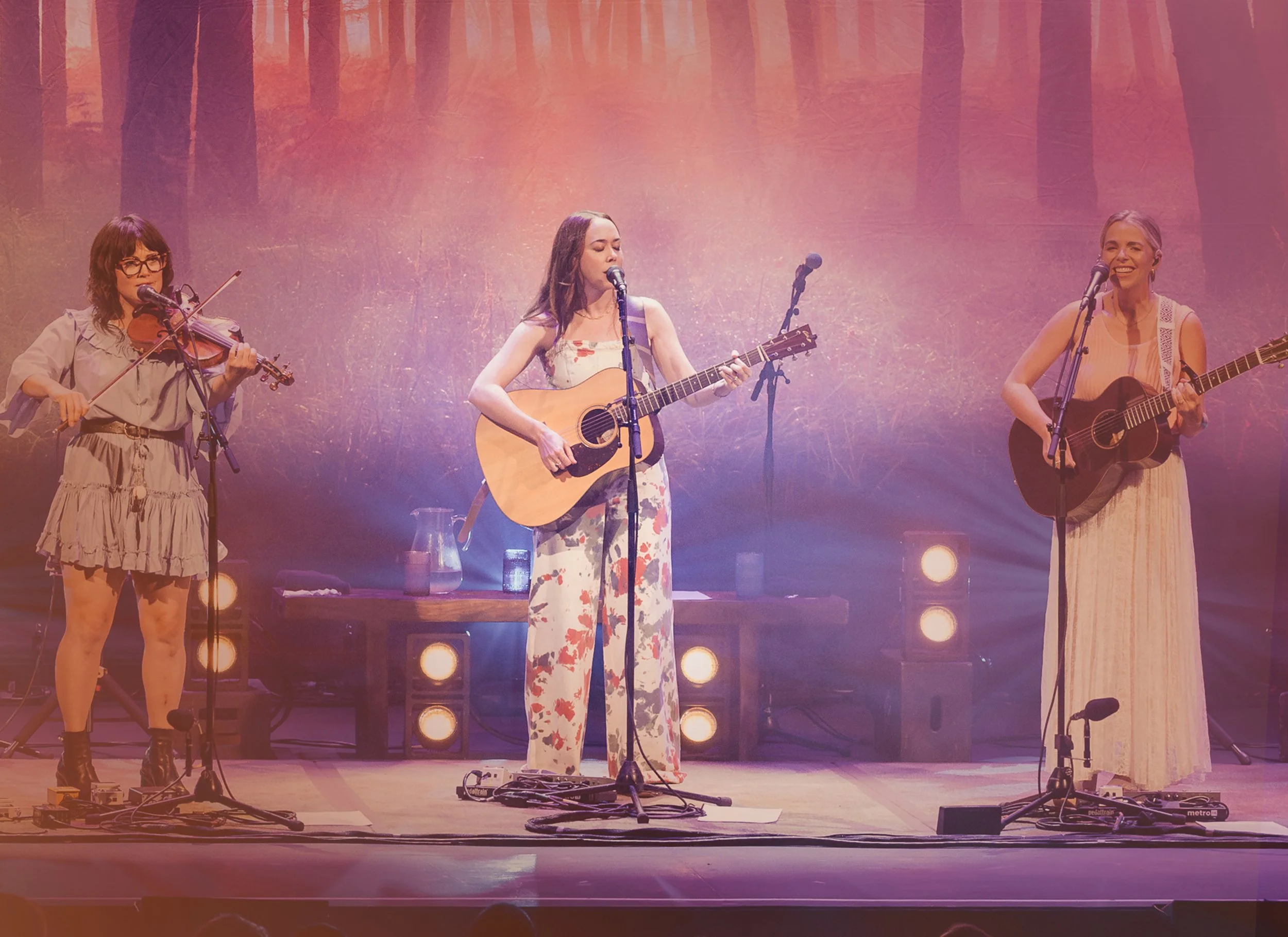
I'm With Her perform at the historic Paramount Theatre in Austin on September 27, 2025. (Photo by Rachel Parker / courtesy of the Paramount)
Given the varied phases of Willie Nelson’s career and the sheer scope of how long he’s been at it—he’s been playing live since the mid-40s, recording since the late-50s—it’s always interesting to learn how other world-class artists first come to love his music. And that’s particularly true when the fans in question are millennials, people who came of age when there was a whole host of entry points to appreciate Willie’s brilliance. Did they enter through the Outlaw door, somewhere in his imperial phase of albums running from Shotgun Willie (1973) to Stardust (1978)? Were they first grabbed by something in his mid-80s, global pop-superstar period, like “Always on My Mind,” “Pancho and Lefty,” or “Seven Spanish Angels?” Or maybe his mid-90s ascent to Living Legend status with albums like Across the Borderline, Spirit, or Teatro? Or did they, as Xennial Conor Oberst described in his OBW episode last year, do a deep dive into collections of his old Pamper demos from the 60s?
On this week’s One by Willie, three-time Grammy-winning folk trio I’m With Her—whose individual members Aoide O’Donovan, Sara Watkins, and Sarah Jarosz also have an additional four Grammy wins outside the band—chart the paths of their own Willie fandom, starting with the one Willie song that they’ve covered together, “Wake Me When It’s Over.” It’s a song Willie’s cut repeatedly though the years, but the version that first caught IWH’s collective ear was on his 1972 album The Willie Way, and that was a surprise. The Willie Way was Willie’s last album for RCA, one recorded in fits and starts during the year in which he was leaving Nashville and Music Row for Austin, and not one that appears on even the most hardcore Willie fans’ lists of favorite records.
But that’s what makes this episode so special. It’s all about discovery, about what first brings brilliant singer-songwriter-pickers like Aoife, Sara, and Sarah to Willie, what they find when they get there, and what they try to flesh out when they go to pay tribute. With brief cameos by Emmylou Harris, Bill Monroe, and George Clinton.
Oh but the episode’s also about excitement, and specifically how thrilled IWH are to be playing this year’s Farm Aid on September 26, at Virgina Beach.
One by Willie is produced by John Spong and PRX, in partnership with Texas Monthly. The PRX production team is Jocelyn Gonzales, Patrick Grant, Pedro Rafael Rosado, and project manager Edwin Ochoa, with graphic design by Joanna Holden and Modular, ink. The Texas Monthly team is engineer Brian Standefer, and executive producers Megan Creydt and Melissa Reese. And Dominic Welhouse provides invaluable research and editing help.
Hey there, I’m John Spong, and this is One by Willie, a podcast in which I talk each week to one notable Willie Nelson fan about one Willie song that they really love.
This week, we talk to 3-time Grammy-winning folk trio I’m With Her—whose individual members, Aoife O’Donovan, Sara Watkins, and Sarah Jarosz, actually have an additional 4 Grammy wins outside the band—about the one Willie song they’ve covered as a group, “Wake Me When It’s Over.” Now, that’s one of those songs that Willie’s cut repeatedly through the years, but the version that first caught the trio’s collective ear was on his 1972 album The Willie Way, and that was something of a surprise. It was Willie’s last album for RCA, one he recorded in stops and starts over the course of the year in which he was leaving Nashville for Austin, and it’s not one that makes many fans’ lists of favorite Willie albums.
But that’s the thing about this episode. It’s all about discovery, about the way that world-class musicians who grew up in the 90s and early-aughts come to Willie, what grabs them when they get there, and what they try to flesh out when they go to pay tribute. With brief cameos by Emmylou Harris, Bill Monroe, and George Clinton.
Oh but there’s one other thing to this episode, and it’s all about how thrilled I’m With Her are to be on the line-up for this year’s Farm Aid, which is coming up on September 26 in Virginia Beach.
So let’s do it.
[Willie Nelson performs “Wake Me When It’s Over”]
John Spong: Where we start…we're here to talk about Willie Nelson's song, “Wake Me When It's Over.” What's so cool about “Wake Me When It's Over?”
Sarah Jarosz: Aoife, I feel like you sort of picked this one out for us, for the Troubadour show.
Aoife O'Donovan: It's so funny. I did pick this one out. And I was listening back to it today, and I think that what really drew me to this song as a song for us to cover, a little bit of the backstory there, is that we were in LA, the three of us, and we were going to be part of...the Americana Music Association does a big show at the Troubadour every January, a tribute show to a luminary in this world. And it's a bunch of our friends. And peers and colleagues get up and do covers. And it's a really fun opportunity to learn a song and to work up a song with your band. I've done it as a solo artist too, but it's always way more fun to do it with Sara and Sarah.
And I remember we were like, "Oh, which Willie Nelson song should we do?” There are obviously so many. You get the list of…the real famous people get their first pick, and they pick the ones that they want to do. And you kind of go through the list and you see what's left.
And I remember listening to “Wake Me When It's Over” and feeling like the phrasing that he does–even though obviously the original rhythm is different than what we ended up going with, which was kind of like a 12-8, almost like a doo-wop, shuffle thing. But I feel like, I think that what made us do it that way was the way that, in the original version of the song, his phrasing is so all over the place, within the groove, that it almost, you're like, "Wait, is he hearing it this way? And the band is just playing this sort of more straight beat?"
Sara Watkins: Totally.
Aoife O'Donovan: Maybe he wants it to be a little bit like the way that I think that we ended up doing it. At least that's what I'm telling myself.
John Spong: So you made his dream come true. You made his dream come true.
Aoife O'Donovan: Yeah, that's what we're here for. Is to make Willie's dreams come true.
No, I feel like we just then took it to the girls, or maybe I made a weird demo of it, and I feel like they really filled out those electric guitar parts from the original on fiddle and mandolin. It's really fun.
Sara Watkins: Yeah, I mean I bet every one of your episodes, people must talk about his phrasing. Because it's an incredible thing that…it's impossible to predict, his phrasing, both in the way he sings and his guitar playing. And that's just such a delightful ride to be on. That feeling of like, “Can he hear the band? Can they not hear him?” And then they're like, "Oh no, this is the intent. This is how he does it." And it does feel like a ride. You almost have one foot on a skateboard and another one in a roller skate, and you're trying to make them line up, and you're like, "Whoa, what is happening here?" And it's just-
Aoife O'Donovan: That is such a good analogy.
Sarah Jarosz: Yeah.
Sara Watkin: It's delightful.
John Spong: So, y'all pointed me to the version of this that's on The Willie Way, which came out in '72. So that was the one y'all were listening to, right?
Sara Watkins: Yeah.
Aoife O'Donovan: Is there also a live version of it from something else?
Sara Watkins: He did it on The IRS Tapes, solo, as well.
John Spong: Yep. He did it on The IRS Tapes…but he did it, weirdly, he did it originally because I wanted to get that in front of you first, maybe just a bit of it. But he did it on his debut album in '62, which was called …and then I wrote. And it's so very different from The Willie Way. And one of the things about it is, at the risk of getting too deeply in the weeds, it's recorded in September of '61, before his debut with Liberty Records. And that afternoon–he cut eight songs in two sessions that day–and in the afternoon session he cut “Crazy” for the first time, and then he cut “Funny How Time Slips Away,” and then he cut “Hello Walls”...and then he cuts this.
And so if I could share my screen, we'll just get a little bit of it, because The Willie Way one fascinates me.
[Willie Nelson performs “Wake Me When It’s Over”]
Sara Watkins: Wow.
John Spong: Different, yeah?
Sarah Jarosz: So different. It's so much more within the lines. But you still hear him…
Sara Watkins: It’s in that “Crazy” era.
Sarah Jarosz: …wanting to break away. Sorry.
Sara Watkins: You do. Yeah. Yeah, it's true. His phrasing, he hadn't broken away. That's a great way to put it.
John Spong: But it is crooner Willie.
Sara Watkins: It is. And it's interesting to hear that he did that in the same session as “Crazy,” because that makes a lot of sense. Those songs feel very related.
John Spong: Yeah. How?
Sara Watkins: In terms of the feel, but also just the presentation of them. It feels like they're from a similar place.
Sarah Jaros: It also feels like he's singing it, maybe, for somebody else to eventually sing it, there. Whereas he's kind of doing the straight version so that somebody else could learn it a little easier, or something? So that another artist could cut it, is what it sounds like to me.
Sara Watkins: That's an interesting read. Yeah.
Sarah Jarosz: The Willie Way one sounds like how he wants to sing it for himself.
John Spong: Well, that tees up listening to that then, because it's really interesting, too. Because it's 10 years later, it ends up being...he goes to RCA for seven years after Liberty doesn't work out. But this is his last RCA record. And there's all these stories about how Nashville was mean to him, and he didn't get to do what he wanted to. If there's any implication in that of a failure to evolve, well then let's listen to The Willie Way [and] how he does it in '71.
[Willie Nelson performs “Wake Me When It’s Over”]
Aoife O’Donovan: Wow.
Sara Watkins: Do you know...so he recorded that in Nashville?
John Spong: Yeah.
Sara Watkins: Do you know anything about the band on that album? Like, who is this drummer? Because it does not sound like the Willie drummer.
John Spong: So, that's not his band. It's before he was allowed to record with his band. And I can tell you everybody else that played on it…but the drummer, dang it. Because it was Weldon Myrick on steel, and Pig Robbins on organ, and Charlie McCoy on harmonica. Ah, fart.
Sara Watkins: No, it's cool to listen to it in this context.
Aoife O'Donovan: Who was the normal drummer? Who was the Willie drummer that you're thinking of?
Sara Watkins: I don't know the name. It's just the sound of...
John Spong: Yeah. His band drummer is Paul English, who became his drummer in his touring band in the late '60s. But who was not invited to Nashville. Johnny Bush had been his drummer before that, too.
Sarah Jarosz: Who was on the...one of the records that I've listened to the most was Live Country Music Concert. Who's playing drums on that album?
John Spong: That's Johnny Bush.
Sarah Jarosz: That's Johnny. Okay.
John Spong: Yeah, that's at Panther Hall, right? In '65.
Sarah Jarosz: Yeah. Well, that's the one...I have to give my husband credit for showing me that record. Because when we first started dating, he was listening to it a ton. But what he told me is that that, it's a live record with just the trio, but he was still fighting with the Nashville thing of...they wound up overdubbing somebody else playing guitar on the live album. Which you can kind of hear in the background. And I always have wanted him to release the record without that on it.
John Spong: Yeah. It's interesting because, I don't know, maybe it's an age thing for me, but when I first saw that Panther Hall Live Country Music Concert, whatever, cover, it's Willie in a suit, holding–but even more weird than the suit and the hair and the tie is in a...I think it's a Stratocaster. And it's like that is completely incongruous with any understanding I got. Anything I ever knew.
But it's also cool, because RCA did add some overdubbings in there, which wasn't necessary. But they were also trying so hard to sell Willie. It's like, well, none of the stuff we're doing here works. Let's put him in Texas and record him there where everybody loves him. Let's see if we can get that lightning into the bottle. Which didn't work. Although I will add, we did one of these with T Bone Burnett–and it's T Bone Burnett, right? So he wanted to talk about a song off that album, and he was at that show. As a high school kid.
Sarah Jaros: Oh, whoa. Crazy.
John Spong: Yeah, right?
Sarah Jarosz: Wow.
Sara Watkins: I have a question about it “not working.” How unsuccessful was he at this point that they were fighting to try and figure it out? Like fifteen, or whatever, eight records in…was the perception that he hadn't broken through at the time? Or was it just, like, he was, but it could have been more, kind of thing?
John Spong: He just wasn't selling records. And the tours weren't doing great when he left Texas. And so he wasn't having hit singles. And so it's one of the things that's fascinating to me about this song, “Wake Me When It's Over,” on The Willie Way, because basically where he is...Do y'all know where he was kind of in his life when this album was recorded, The Willie Way?
Sara Watkins: No.
John Spong: His house burns down outside of Nashville at Christmas 1970. He's back in Texas with his whole posse / entourage / family by Christmas day, I think. And he's living there and then he realizes in May…he's living in a dude ranch out in Bandera. And he's playing a lot of golf, and he's smoking a lot of weed, and he started eating psilocybin. And he's starting to stretch out a little bit. He's had a lot of self-doubt because it's just not worked in Nashville.
And so he realizes he's got a session in May, and he goes, and that's where he records Yesterday's Wine. Which some people will say is the best album he ever did, or one of their favorites, rather. But he also records this song that day, and it's just interesting to me, it's with A-Teamers in Nashville, but it sounds so much funkier and looser. It really kind of points the way forward to what's going to happen in the rest of the '70s. And maybe like even with Shotgun Willie, when he finally gets his own band in the studio a couple years later. That's what I hear.
Aoife O'Donovan: This song, “Wake Me When It's Over" though, was not a single, right? Like this was not a lead single from the album or anything.
John Spong: It was a single-
Aoife O'Donovan: Like this wasn't like...was this a charted song?
John Spong: It was a single off of his first album in '62 and did not chart.
Aoife O'Donovan: Okay.
John Spong: And then they didn't–I don't even know if there were any singles on this album, The Willie Way. Because by then, he had been recording odds and ends for about a year and a half. When Yesterday's Wine stiffed, because RCA didn't promote it, Willie lost faith in them. They lost faith in him. And so these two albums, The Words Don't Fit the Picture and The Willie Way, are the last two that came out. And then he is released, he's cut free.
[Willie Nelson performs “Wake Me When It’s Over”]
John Spong: So Aoife, are you a Willie nerd? How did you find this song, this album?
Aoife O'Donovan: I'm really not a Willie nerd at all. I feel like I'm somebody who, I mean, I'm from Massachusetts and I obviously grew up hearing a lot of Willie Nelson, sort of in the culture around me, of just being around a lot of folk music and just a lot of music in general.
But I don't know how I found this. I think I just was maybe going through, like I said, you get this list of songs that are already taken, and you just go through and you start listening. And I think that maybe a cousin or something had recommended this. Or honestly, it probably was my dad, now that I'm thinking back to it. Because it was 2019 when we were preparing for this. The concert was in 2020. And my dad was just, like, he was somebody who knew everything about all kinds of music. And I'm actually, now that I'm talking about it, I'm remembering, I think he said, "Why don't you check out this record? There's some cool songs on it."
Sarah Jarosz: That's awesome.
Sara Watkins: Yeah.
John Spong: And what did yall, when y'all were putting it together, you said that you thought that the rhythm you used was kind of implicit more in Willie's vocals than in what you actually heard on the thing. What were you trying to bring out of it? What did you think was at the heart of this song that you wanted to get in front of people?
Aoife O'Donovan: I think that for me, that kind of girl-group, 12-8 shuffle thing, I thought I could hear it, and I wanted to pull that out of it. And especially with the way that the guitar part is. Or at least the guitar, how I put the...I think I kind of tried to take the keyboard part with all those sort of lines, and the descending lines and the ascending lines, how the chords sort of move, I kind of wanted to put that in the acoustic guitar part, and make it sort of this 12-8, shuffle-y thing and hear all those moving bass lines–but without a bass and without a keyboard.
Sarah Jarosz: I think something that's cool about working up other people's songs in this trio is how it kind of highlights the space within the songs. I was like, listening to…even both of those different versions that you played for us, in the first one, there's like background vocals in the fills. And then in the second one there's instrumental fills in the space.
And so, I think it's cool in our version, because I feel like it just really, it's almost like, “Here's the bare bones of what...our interpretation of what the bare bones of this song is.” And I just love how much space there is in it. Because really I hadn't listened to it since we put it out probably, and I listened to it right before this.
But the other crazy thing, just as a side note that I realized listening to it, was that it really, it feels like a sister song to “Apple Tree,” that was on our first record. Like, very similar groove, feel, arrangement.
[I’m With Her perform “Ryland (Under the Apple Tree)”]
Sara Watkins: It is interesting, like the girls were saying, working up covers like this. Even if we were trying to replicate a Willie thing, we couldn't. Like, I couldn't. Jarosz couldn't. Aoife couldn't.
But when you try to approach something that's so specific, you just kind of come as close to it as you can. And when Jarosz was talking about the space around it, it made me kind of think like this. Like, we're all just trying to come as, like, pay tribute to it as best it relates to our lives and our musicality.
But it's never going to be identical, and that wouldn't be the purpose, right? We already have Willie's version. But it sort of surrounds it. When we do it as a band, you can kind of surround a song and find everybody's impression of it. It feels like we're surrounding the song more than facing it, as it would be if I was covering a song that feels like, "Oh, this is one part of it." But as a group, we can kind of come around it, and bring the things that are specific to each individual to this very unique style that he had. And it feels stronger like that to me, because of it.
John Spong: Well, it's interesting because when I hear the original, it sounds like somebody singing a song. It's a crooner, singing a song. When I listen to The Willie Way version, it's a groove. But when I hear y'all do it…I don't know, it takes on this extra depth. It's like it's describing a scene in life almost. I'm not sure why I get it that way, but maybe, what do you think? Like, lyrically, what we didn't talk about yet is the words.
Aoife O'Donova: I think that that's probably what drew me to it initially, in the first place. Just this idea of…I actually remember learning it, and feeling like, "Oh, I've been in this situation." It's almost like it's the end of the night, you're at a festival, you've been up all night, you just kind of want the longing to be gone and just, “Wake me when it's over, don't wake me ’till it's over. I don't want to be in this vibe anymore.”
And it's actually kind of sad and mournful. But it also feels a little bit, like, I don't want to say funny. But to me, it just makes me weirdly think of being at a folk festival, being up to no good. I can really put myself in that situation. And then being like, "Okay, I'm done. I just want to be out of this situation." You know what I mean? Like, it's not like the most profound lyrics you've ever heard. But it has this intensity, in its simplicity, that I think is very relatable, especially for musicians.
Sarah Jarosz: Yeah. It's very lived-in. The lyric is very lived-in.
Sara Watkins: Yes. Yes.
Aoife O’Donovan: Yeah.
Sarah Jarosz: And I think Willie does that a lot where you feel like, how has this not just always existed since the beginning of time? That's what it feels like to me. And it's just very spoken. It's not pretentious, it's very real and grounded in its language, which I love.
John Spong: Well so, there is. There's a wink in it, as there often is. No matter how dark a Willie song gets, there's something in it that's a little bit fun. But that leads to, uhm, when I listened to it closely and was reading the lyrics, part of me thought, knowing how dark Willie got back then, I thought, "Is this a suicide note?"
Aoife O'Donovan: Geez. Whoa, whoa.
John Spong: “Goodbye forever.” Maybe not.
Aoife O'Donovan: Whoa. Well, “My mind is getting weak now.” Yeah, I was trying to…yeah, yeah. I hear you. But I feel like, [whispered] “Goodnight, goodnight…” What's the last bit…[singing] “Goodnight, darling. Goodnight now, darling…”
John Spong: [singing] “Forever more.”
Aoife O'Donovan: [singing] “Goodnight forever more.” Yep.
John Spong: “Don't wake me until it's over. When I won't love you anymore.”
Aoife O'Donovan: Yeah. “When I don’t want…”I mean, it's a great song.
John Spong: It's a great song.
Aoife O'Donovan: Also, we should bring this back into our live set.
Sarah Jarosz: I was just-
Sara Watkins: I know.
Sarah Jarosz: Yeah, I was thinking that, for sure.
Aoife O'Donovan: Because I was listening to our version of it, also, before this podcast, and we've only done it live literally twice. We did it-
John Spong: What? How do I even know about it? You've only done it twice?
Aoife O'Donovan: We did it at the Troubadour.
Sara Watkins: I was wondering how you knew about it. I was like, how did this ...
Aoife O'Donovan: This is like a deep cut. We did it at the Troubadour in 2020, and then we did it at the Ryman in 2023.
John Spong: Yeah, the night before his birthday.
Sarah Jarosz: Oh, wow.
Aoife O'Donovan: Exactly.
Sarah Jarosz: Yeah. Well, have we talked about how it's a voice memo from our phone, the recording?
John Spong: What? No, it isn't.
Sarah Watkin: Yeah.
Aoife O'Donovan: It's a rehearsal. Sara's daughter and Sara's dog are, like, in the room. I can't believe they're not even on the recording.
John Spong: It does not sound that way.
Sara Watkins: Yeah, that's a miracle.
John Spong: That's awesome. That'll be exactly where we drop in a clip of your recording of “Wake Me When It's Over.” I had no idea.
[I’m With Her perform “Wake Me When It’s Over”]
John Spong: When Nick Offerman did the show, he talked about the evolution of his appreciation of Willie. And he said that he thinks it goes this way for a lot of people–I don't know that it will for people who grew up playing, like y'all did–but he said there's these songs that are on the air that you just can't…like you were saying a second ago, Aoife, that are just unavoidable. To be in culture here, you know “On the Road Again,” kind of always. He said, "And then there'll be this epiphany when you realize, oh, that man wrote ‘Crazy,’ too?" He said, and then you go to your first Willie show and you say, "Oh, and that's how he plays guitar?" And there's just this developing understanding…and Sara Watkins has her hand up. What happens? What happened to you guys?
Sara Watkins: Because Willie is ubiquitous, growing up, I didn't really pay attention to him. Because it's just one of the many, many people who was just in your blood, and you don't really realize it. But when it really hit me was when I was obsessed, the girls heard me talk about this, this record, Roses in the Snow, this Emmylou Harris record that was really, really important for me, probably when I was 20. It reminded me…it's a great Emmylou record. The Whites are on it, Ricky Skaggs. She has all these people she covers. It was the first time I heard “The Boxer,” on this record.
John Spong: Oh, wow.
Sara Watkins: But the thing that really stood out, for this conversation is, on “Green Pastures,” which she sings, there's this beautiful guitar solo. And it's just Willie playing guitar, and it stands out completely on this bluegrass record. He's probably in there playing chords, but you don't hear the tone of his nylon-string guitar until it jumps into that solo, and it's just this beautiful full-verse solo.
[Emmylou Harris performs “Green Pastures”]
Sara Watkins: I remember, like, being in my parents' driveway listening to this record and just stopping in my car being blown away by it. Also, because it was beautiful, and because I was suddenly appreciating this thing that I guess that I knew about him, but hadn't really paid attention to, his guitar playing. And then also, because he was this featured star, “His Own Man” thing, and here he is just playing guitar, which is his secondary thing, I'm assuming, on somebody's record. Because that's the thing that...because he's just as much that. He's just as much guitar as he is singer. And I think that really blew me away.
And then when I saw him for the first time in San Diego, I had that experience, where I was like halfway through the show, and he's singing a verse and a bridge of 20 songs, because he has so many hits. He cannot go through them. So he's just doing this medley. And it was mind-boggling that all of these songs were his. It's just crazy. It literally is fitting that he wrote that song, because his writing is crazy.
Aoife O'Donovan: Did he make it into the New York Times top 30 living songwriters? American songwriters? He did? Okay.
John Spong: Yeah.
Aoife O'Donovan: Just making sure.
John Spong: Yeah. And there was a cool aside with it where they had, however many great artists they talked to, to come up with the votes for who would be in the 30, they listed those people, and who all they had cited. And so Marty Stuart said Willie Nelson, which of course he did. Rickie Lee Jones said Willie Nelson, which I was, like, of course she did, but cool, too; I don't know that I necessarily expected that. George Clinton listed Willie as one of his very favorite songwriters.
Sara Watkins: That's awesome.
John Spong: Yeah, that tickled me greatly. But Sarah Jarosz, you're in Texas. What's the path, the evolution of your awareness?
Sarah: Yeah. Well, it's so funny to hear Watkins and Aoife say that he's just in the air, as well. Because I think growing up in Texas, you assume that that's the case because you're in Texas. And it's like just from the time that you're a little baby, he's just sort of, like I said, in the air. His music is just around. And you kind of can't avoid it.
But I think especially once I got into my early teens, and I was seeking out music more on my own, I think I still assumed, "Oh, this is just a Texas thing." And it wasn't until I started going to camps, like traveling for my music, and kind of going to California, and going to Colorado, and then eventually going to school in Boston, for college. And people are still talking about Willie. And having this realization of like, "Oh, it's not just because I'm from Wimberley that I know about this guy." He is universally beloved. And I think that was a real wake-up call for me.
And similar to Aoife saying that her dad pointed out a lot of his music. Like, my dad, I have very vivid memories of him playing Willie records for me when I was a kid. Red Headed Stranger. And I just have a...especially in my early teens, when I was really just starting to, kind of, figuring out that music was what I wanted to do, I feel like Willie was someone that my dad would bring up a lot as, “This is the example of how you be yourself. Like, this guy, it wasn't working out, and then he just said, ‘You know what? I'm just going to be me.’ And it started working for him.” And I love that my dad kind of pointed that out to me when I was maybe 12 or 13.
But again, it's like coming into this conversation, similar to what the girls have said, I wouldn't consider myself “a Willie nerd.” It just is that I'm just familiar with his music, just through so many years and just from other musicians that I love loving him, too. And so he's like woven into the fabric of what we do, and it's amazing. Also, just his simplicity. I was always, to what Sara was saying about his guitar solo…especially, I feel like, as a mandolin player, I feel like I've been really inspired by his guitar phrasing and trying to kind of have that be an influence in solos.
John Spong: I read something, it was talking specifically about how you with your octave mandolin do a thing...you'll answer yourself. The vocal sets up the part, sets up the vocal, sets up the part, and there's a back-and-forth. And that's so much a part of what Willie's doing, right? Tell me about that.
Sarah Jaros: So, I'm playing regular mandolin in our version of “Wake Me When It's Over.” Yeah.
John Spong: I just mean, generally the interplay. What are the elements…the hallmarks of what Willie does that are so singular, that belong to Willie, that make him sound like nobody else sounds…and I think the guitar, the way he plays, like we've been saying, the phrasing, just the sound of his voice...
Sarah Jarosz: Yeah, playing close to the bridge, I feel like that's...I mean, that almost feels like Bill Monroe or something. Where they kind of feel, Willie and Bill kind of feel kindred in that playing really back, close to the bridge, like digging in. A lot of downstrokes, at least it sounds like that to me, in the soloing. It's not like, even, kind of cross-picking, it's like…[singing] “Doo-doo, doo-doo doo.”
Sara Watkins: I think there is something about how...what you're saying, Jarosz, about playing close to the bridge. His voice is so milky and smooth. And I mean, it's so distinct, but it really flows. And he's got contrasting that with the–[singing] “Ding-ding ping, ding-ding-ding, dun duh-dun dun dun”–these sort of staggered…it matches his phrasing, but because it's plucked, it's sudden. And kind of stands out. So there's this great contrast, too. It's not like he sings the way he sings and he plays fiddle. There's this great...which would be like a similar tonality, and sustain, and all that stuff. I think the contrast of it really is part of the effect.
John Spong: Because that nylon-string guitar is not going to sustain. And so when he…I was even thinking when you were talking about roller skates and skateboards, that was such a perfect analogy. Because when you listen to him sing, he's sliding. He's just kind of rolling smoothly through the whole thing. And so if his voice is doing that, and then all the guitar notes are, not staccato, but [singing] “dink-dink-dink-dink…”
Sarah Jarosz: Percussive.
John Spong: Yeah, percussive. That's a really interesting…and then of course he's doing so much of the, like, with Buck Owens and Don Rich. Buck Owens would sing a line, Don Rich would answer with a guitar part. Willie is answering himself. Everything...there's this dovetailing that Trigger and his voice do that is wonderful to focus on when you're listening.
Sara Watkins: That's something that's really clear on The IRS Tapes, too. Because it's so bare. You really get a sense of how it is when he's sort of practicing or writing or whatever, that all of that push and pull is in there.
[WIllie Nelson performs “Wake Me When It’s Over”]
John Spong: I know with Sarah Jarosz I read...and I assume this is true for the rest of y'all, that y'all like strange chords sometimes? Like, unexpected things in melodies? Are those in “Wake Me When It's Over?”
Aoife O'Donovan: I wouldn't say “strange chords.” It's kind of like it's of-the-time, for sure. The way that the 5-minor comes in, and then the walk-downs and the weird extensions of a chord in the scale. That, to me, feels like very much in a style, but it's in a style that I think we could really latch onto. Because it is different than just, like, a 1-4-5 country song. It's not like three-chords-and-the-truth, for sure. It's way more than that. And I think that's maybe, again, sort of why it felt like it would be good in a doo-woppy kind of vibe, because that's very much the chord progression of that type of music as well.
John Spon: I wondered if the melodies that he writes–because they do, they've got that jazz element to them that wasn't a big part of country songwriting in 1960–if that enables, to an extent, the things he's going to try to do with his voice, the things he's going to try to do with Trigger. If there's something about that slightly different kind of melody that makes it a little more interesting. That kind of opens things up for him. I don't know.
Sarah Jaros: Yeah. I mean, I think just like, his soloing on his guitar, it's very exploratory. But to me it's exploratory when it's over a chromatic kind of like in this...like, in this, with the descending line of the chords kind of over the bridge. But he's also, I feel the same way when it is over just like a 1-4-5 country song. He brings that into his soloing kind of no matter what. And I think that's how he sounds like Willie.
[Willie Nelson performs “Wake Me When It’s Over”]
John Spong: Y'all have been invited to play Farm Aid on the 26th of September?
Sara Watkins: Yes.
Aoife O'Donovan: Yes. So excited.
John Spon: What's that mean?
Sara Watkins: Bucket list.
John Spong: Yeah.
Sarah: I know.
Sara Watkins: Yeah.
John Spong (42:08):
How come?
Sara Watkins: It's incredible. I mean, it feels like a special invite. It really does. It's not the kind of thing where you're just like, "Oh, I want to get hired to play here." At least I don't think that's how it works. It feels like…it's a real honor to be a part of it. I mean, I became aware of Farm Aid probably in the first couple years, when I was a kid. When did it start? It started in the ‘90s.
John Spong: ‘85.
Sara Watkins: ‘85. Okay. So it wouldn't have been the first ones. But yeah, I remember seeing ads for it on TV, probably on TNN or something. And I remember hearing about...it was the first time I became aware of the need for this help. And I remember there being a lot of drought, a lot of flooding, and all of these things were being talked about. And then Farm Aid was being presented, and I just thought it was the coolest thing that these musicians were helping, were trying to help or raising support in a very real way. And I think it was probably the first time I became aware of a fundraiser like that. And it felt really meaningful. I think we all have a huge amount of respect for this incredible tradition that he keeps up.
Aoife O'Donovan: It's also...I just got a copy of the census, the Irish census from, I think it was like 1925 or something? And my great-grandfather was a farmer. Obviously, it was a completely different time, and everybody in Ireland was a farmer at that point. But it was just cool. It was right, the same week that we got the Farm Aid offer, I think? Like, I got this copy of the census, and in my great-granddad's cursive handwriting it says, "Occupation: Farmer." And then there's my great-grandmother, it's like, “Housewife.” And then, “Seven kids and a border.” It's just wild to think that farming is really, whether it's in your family or not, it really affects all of us. It really does. It's the food that we eat, and it's the earth that we live on. And it is, like Sara said, a huge honor to be a part of it and I just can't wait.
John Spong: I went last year, and it was the first time I'd been. And prior to that, because I was starting college for the first Farm Aid. And for me, what that meant was all-day Sunday in front of the TV with a tape recorder and trying to get all the music that I could. I always thought of it as a concert. But when I went last year, I mean, it's community organizing in the most real way you can imagine. There were kiosks everywhere. And little hay bales set up for people to talk while people gave talks on how to switch over to regenerative farming, and how to switch over to organic farming, and how to take better care of your honeybees. And there were seed-swaps. And how legislative changes are going to affect you.
It was education, and they lobby, and they do all that stuff year round. And so they've been doing this festival, this event for 40 years. They've raised $90 million bucks. Willie still signs every single check that goes out. But then the other thing that's so cool is it's not charity. All these people are…it'll be funny because you'll be sitting there and somebody will be talking about ways to bale hay or something, and all these people are studying intently. And then somebody will go, "Oh, shit, Billy Strings is about to start." And so they run out for that. And they'll be doing that when your set starts.
Sara Watkins: Yeah, that's so cool.
John Spong: But it's also...it's not charity. It's a party for these people who deserve a party. And it's raising money for people who deserve it. But it almost feels like a party first.
Sara Watkins: That's awesome.
John Spong: Yeah.
Aoife O'Donovan: Cool.
Sara Watkins: I can't wait.
John Spong: Uhm, to back out of here, what might the next Willie cover be?
Aoife O'Donovan: I was listening to the Waylon and Willie record this morning, and there's some bangers on that.
Sarah Jaosz: Yeah, something from that record would be really fun.
Sara Watkins: I love that record. It's funny, some of these songs, I wish there was better credits. Even like listening to...he did so many covers. And so, sometimes I'm listening to this Willie...the [&] Family record? Where they're all around the bonfire?
John Spong: Oh, yeah.
Sara Watkins: And I wish I knew if he would co-wrote...what he co-wrote, what he wrote. I recorded one of those songs, “(Close Your Eyes) I'm a Memory.”
John Spong: Oh, that's a Willie song. Yeah.
Sara Watkins: Yeah. My brother has the LP, so I knew at the time of recording it that that was a Willie song. But man, I really wish that the songwriting credits would get up. Apple Music is okay with it, but it's still not up to snuff! Because he recorded so many great covers.
John Spong: Yeah. He often listens to these, believe it or not, and so do his fans. Is there anything to say in conclusion to Willie or his fans?
Sara Watkins: Just thank you.
Sarah Jarosz: Yeah. Thank you.
Aoife O'Donovan: Thank you so much. For the music and also the vibes. It's almost a whole…it's like a way of being or a way of existing. So, I’m here for it.
Sarah Jarosz: And for-
Sara Watkins: What an example.
Sarah Jarosz: What an example. And just for still doing it. I mean, he’s still…it's such a beautiful thing that music has carried him this far into his 90s, and he's still playing. It's so magical and amazing to me.
John Spong: Yeah. Yeah. Oh, and also see you at Farm Aid, everybody.
Sara Watkins: See you there.
Aoife O'Donovan: Can't wait.
[WIllie Nelson performs “Wake Me When It’s Over”]
All right, Willie fans. That was Aoife O’Donovan, Sara Watkins, and Sarah Jarosz, of I’m With Her, talking about “Wake Me When It’s Over.” A huge thanks to them for coming on the show, and a big thanks to you for tuning in. If you dig the show, please subscribe, and stop by our website at onebywillie.com. Oh, and please visit our page wherever you get your podcasts and give us some stars or type in some comments. Or maybe just tell one friend to check out the show. Every little bit of that helps more than you know.
One by Willie is a production of John Spong and PRX, in partnership with Texas Monthly. Our PRX production team is Jocelyn Gonzales, Patrick Grant, and Pedro Rafael Rosado, with project manager Edwin Ochoa. Our Texas Monthly team is producer / engineer Brian Standefer, and executive producers Megan Creydt and Melissa Reese. Our art and web design come from Joanna Holden and Modular, ink. And we get invaluable research and editing help from the great Dominic Welhouse.
Please follow us on Instagram at onebywillie–all one word–find us on bluesky, and join our ever-expanding Willie conversation at the One by Willie group on Facebook.
I’m your host, John Spong. Thanks for listening.